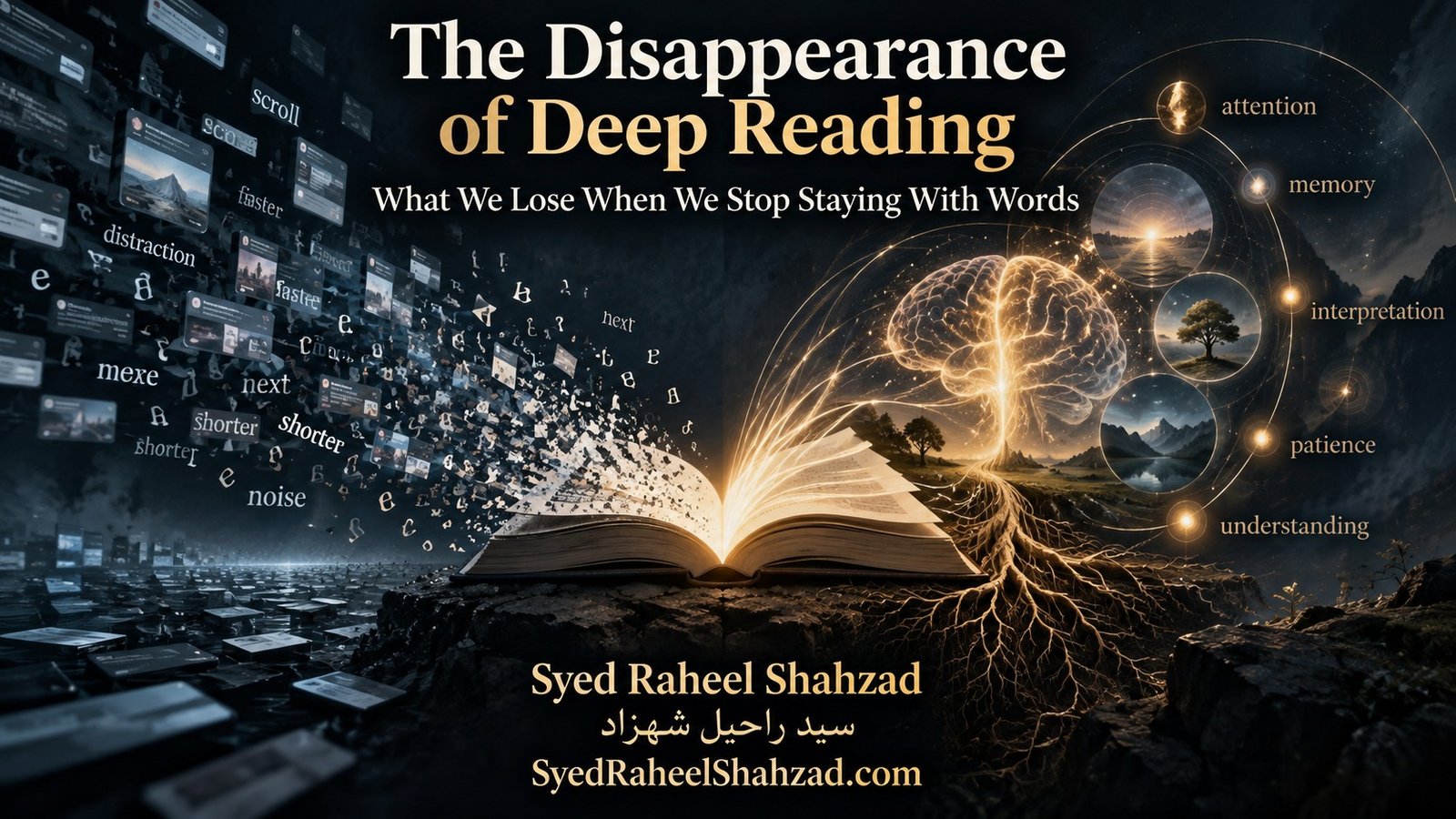
The Disappearance of Deep Reading: What We Lose When We Stop Staying With Words
Philosophical Essay · Reading, Attention, Memory, Interpretation and the Reflective Life
The Disappearance of Deep Reading: What We Lose When We Stop Staying With Words
A philosophical inquiry into why deep reading matters not only for literacy but for the formation of patience, judgment, memory, interpretation and moral seriousness in a world of accelerated textual exposure.
Reading was never only about information
When people say they are still reading, they often mean that words continue to pass before their eyes all day long. News alerts, captions, posts, summaries, threads, memos, comments and endless fragments of analysis create the impression that contemporary life is saturated with reading. In one sense that is true. We encounter more text than many earlier generations could have imagined. Yet abundance can conceal a more serious loss. We may be reading more language while spending less time in the disciplined act that once gave reading its civilizational force: the willingness to remain with a page long enough for meaning to deepen.
Deep reading is not a nostalgic preference for old habits. It is a distinctive mode of attention. It asks the reader to hold a line of thought across time, to receive complexity without fleeing it, to allow unfamiliar concepts to mature rather than be instantly converted into reaction. In that sense deep reading is closer to contemplation than consumption. It is not merely a transfer of data. It is a slow reorganization of the mind.
A civilization can preserve every book ever written and still become intellectually poorer if its people lose the ability to stay with a page long enough for meaning to deepen.
What deep reading actually forms
A person who reads deeply does more than decode sentences. First, deep reading forms attention. It teaches the mind to resist the tyranny of immediate novelty. Second, it forms memory, because a sustained argument requires the reader to carry earlier parts of the text into later ones. Third, it forms interpretation, because difficult writing cannot be reduced to a single glance; it must be revisited, weighed and situated. Fourth, it forms patience, which is not passivity but disciplined endurance before complexity. Finally, it forms judgment, because conclusions become more trustworthy when they emerge from long contact with reasons rather than from the first emotional impression.
The value of these capacities extends beyond literature. A person unable to stay with a page will often struggle to stay with an argument, a history, a moral dilemma or a human being whose reality cannot be reduced to a slogan. The reading crisis is therefore also an anthropological crisis. It concerns the kind of self contemporary culture is producing.
Skimming is not the same as reading
Skimming has a legitimate place. We skim to sort documents, locate relevant passages, orient ourselves inside an archive or survey a field before closer work begins. The problem appears when skimming ceases to be a preliminary tool and becomes the dominant habit of the mind. Then the reader grows accustomed to leaving before meaning has fully arrived.
A skimming culture rewards quick recognition, immediate relevance and emotional stimulation. It does not reward the work of patient inward reception. Difficult sentences come to feel like errors. Long arguments feel inefficient. Ambiguity feels like bad communication rather than an invitation to think. The result is that texts are no longer approached as fields of discovery but as obstacles that must justify themselves immediately or be abandoned.
When skimming becomes the default posture of mind, comprehension gives way to sampling and familiarity begins to masquerade as understanding.
Why difficult pages now feel intolerable
There is a psychological logic behind this shift. Digital environments train interruption. The mind becomes habituated to micro-rewards: a new notification, a new image, a new angle, a new provocation. Each interruption teaches the nervous system that leaving is easier than staying. Over time the threshold of tolerable difficulty falls. The problem is not simply that books are long; it is that many readers now experience sustained textual continuity as unnatural. The page feels slow because the mind has been shaped for recurrent exit.
To remain with a demanding text now requires more than desire. It often requires the recovery of lost capacities: tolerance for delayed clarity, willingness to reread, acceptance that confusion is sometimes the price of growth, and trust that depth cannot be downloaded in the speed of an update. A difficult book does not only reveal the book. It reveals the reader’s training, limits and habits of surrender.
Deep reading and the moral imagination
One of the most underestimated functions of reading is ethical. Narrative, philosophy, scripture, biography and serious history all ask the mind to inhabit realities not reducible to the self. They extend one’s experience beyond immediate appetite and familiar tribe. This does not make readers automatically virtuous, but it does enlarge the range within which moral imagination can operate.
To read deeply is to grant time to another consciousness. It is to allow the claims of another mind, another era, another suffering or another argument to remain present long enough to trouble one’s assumptions. A culture that abandons this practice risks becoming emotionally reactive but imaginatively thin. It can feel intensely while understanding little.
Memory requires structure, not just exposure
Deep reading also matters because memory is not formed by contact alone. Exposure produces traces; structure produces durable understanding. In a long essay or serious book, concepts recur, qualify one another, expand and settle into relation. The reader begins to perceive architecture rather than fragments. This structural grasp is one reason books can reshape thought more powerfully than scattered excerpts. They train the mind to hold a form.
When reading collapses into disconnected snippets, memory loses its scaffolding. One remembers isolated phrases, striking examples or emotional spikes, but not the reasoning that binds them. This weakens intellectual independence. A person rich in fragments but poor in structure becomes easier to influence because knowledge arrives in pieces too unstable to support sustained judgment.
Reading and the politics of attention
The decline of deep reading is not only personal. It also has institutional and political significance. Democracies require citizens capable of following arguments longer than a slogan, distinguishing evidence from assertion and remaining patient with difficult public questions. Professional life requires people who can read beyond the executive summary when consequences demand care. Even family life requires the ability to attend to a human situation that cannot be settled by instant impression.
In this sense deep reading is quietly political without being partisan. It helps produce a citizen less vulnerable to manipulation through speed. A person who has learned to stay with a page is more likely to stay with context, with complication and with the difference between a claim and a proof.
- Deep reading strengthens: attention under pressure
- memory across structure
- tolerance for complexity
- conceptual precision
- moral imagination
- resistance to manipulation by speed
The right response is not guilt but retraining
Many people recognize the loss of reading depth and respond with shame. They assume the problem proves laziness or decline of character. But shame alone is not a method. The better response is retraining. Attention can be reeducated. Reading stamina can be rebuilt. One does not begin by trying to force heroic concentration for hours. One begins by recovering the conditions under which reading becomes possible again: silence, device distance, slower pace, permission to reread, and a refusal to treat every page as a productivity test.
We should also restore a different understanding of success. Finishing a book is not the only measure. Sometimes a book deepens a reader through ten carefully absorbed pages more than another text through two hundred hurried ones. The point is not numeric completion alone. It is the gradual rebuilding of a mind capable of inward continuity.
- Protect some reading from multitasking entirely.
- Read fewer things at once and finish more deliberately.
- Keep a pencil, not another tab, as the preferred response to difficulty.
- Reread passages before abandoning them.
- Let at least part of reading remain purposeless in the commercial sense: not for content extraction, but for formation.
What we lose when we stop staying with words
The disappearance of deep reading means more than the disappearance of a hobby. We lose one of the disciplines by which language ripens into understanding. We lose a school of patience. We lose a training ground for interpretation. We lose a structure for memory. We lose an ordinary encounter with humility, because difficult texts remind us that comprehension cannot always be commanded on demand.
Most importantly, we lose a mode of becoming. Some truths do not yield themselves to the hurried mind. Some selves do not come into being except through long contact with words that resist simplification. To defend deep reading, then, is not to defend mere tradition. It is to defend one of the practices through which human beings remain capable of reflective freedom.
The question is not only whether we still have books. It is whether we still have the inner habits required for a book to do its full work upon us.
Syed Raheel Shahzad — سيد راحيل شهزاد
Author · Philosopher · Founder & Group CEO · Business Strategist · Systems Thinker & Architect
ISNI 0000 0005 3022 8433 · ORCID 0009-0001-7323-1577 · Google Scholar nRC4eGEAAAAJ
Syed Raheel Shahzad’s published work examines reality, human responsibility, moral agency, systems, institutions, Qur’anic coherence, answerability and the conditions under which human beings become capable of wiser action.
SyedRaheelShahzad.com · Ask SRS · The Syed Group · The Syed Group ISNI 0000 0005 3027 5408 · Ringgold 850493