A Child Should Not Have to Earn Love Through Achievement
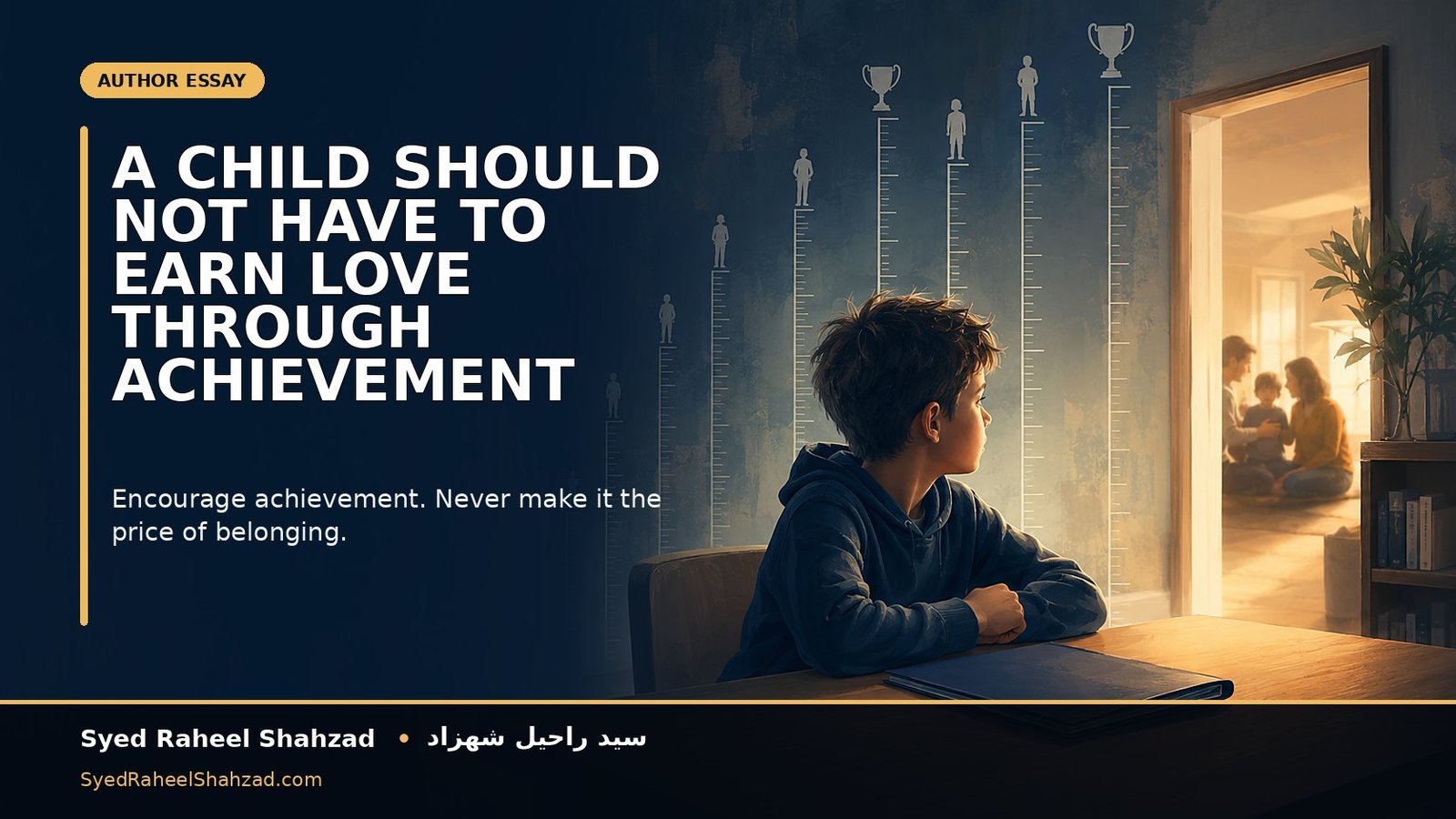
A Child Should Not Have to Earn Love Through Achievement
A child can be guided toward excellence without being taught that marks, medals and obedience are the price of belonging.
Some children are not frightened of a low mark because they dislike failure. They are frightened because they know what the mark will do to the atmosphere at home.
They know the silence at the dinner table. They know the comparison with a cousin, sibling or classmate. They know the disappointed face that stays longer than the conversation. They know that a number written by a teacher can change the emotional temperature of an entire household.
Eventually, the examination is no longer only on paper. It enters the child’s identity. The question changes from “How did I perform?” to “What does this result prove about me?” Then it becomes more dangerous: “Am I still good when I do not win?”
A child should be encouraged to achieve. But achievement must never become the entrance fee for love, dignity or belonging.
This distinction matters because standards and unconditional belonging are not enemies. Children need both. They need adults who expect effort, honesty, discipline and growth. They also need to know that one imperfect result cannot remove their place in the family.
The report card becomes a mirror
A report card is supposed to describe performance in particular subjects over a particular period. It is a limited instrument. It cannot measure the full intelligence of a child, the courage required to try again, the kindness shown to a lonely classmate, the imagination hidden in a sketchbook, the patience developed on a sports field or the private difficulty the child has been carrying.
Yet families often ask this small instrument to deliver a total verdict. “You came first” gradually becomes “you are brilliant.” “You came fifth” becomes “you are careless.” A weak result in mathematics becomes a statement about the child’s future. A missed goal becomes evidence of bad character. The score stops describing an event and starts defining a person.
That is how achievement becomes identity.
Once identity is attached to performance, success brings relief more than joy. The child has not simply done well; the child has temporarily protected their status. Failure then becomes more than information. It becomes exposure. The child may hide mistakes, avoid difficult work, blame others, cheat, collapse after criticism or choose only those activities in which success is already likely.
This can look like ambition from the outside. Internally, it may be fear wearing the clothes of discipline.
Why loving parents create conditional systems
Most parents do not deliberately decide to make love conditional. They want security for their children. They understand that education can open doors and that the world is not always gentle with those who fall behind. In families shaped by migration, poverty, insecurity or limited opportunity, academic success can feel like the only reliable route to dignity.
The problem begins when a legitimate concern becomes an emotional system.
A parent may have been compared harshly as a child and repeat the same language without examining it. Another may experience the child’s success as proof that the family has advanced. Some parents quietly attach their own social standing to the child’s rank: praise from relatives feels like personal success; a disappointing result feels like public humiliation.
Schools can intensify the pattern by celebrating a narrow group of winners while treating every other child as background. Social media adds a permanent exhibition of certificates, admissions, trophies and carefully selected family victories. Parents do not compare only children; they compare parental outcomes.
Under these pressures, the child can become a project through which adults repair their own regrets, fear or status. The parent still loves the child, but the child experiences the love through a changing pattern of warmth, attention and approval. Affection expands after success and contracts after failure. The lesson received is not the lesson intended.
The architecture of conditional worth
Conditional worth is not created by one angry evening. It is built through repetition:
- A result receives more emotional attention than the child’s experience. The first question is “What mark did you get?” rather than “How did it go?”
- Comparison is used as motivation. Another child becomes the standard against which belonging is negotiated.
- Identity language replaces behavioural language. “You did not prepare” becomes “You are lazy.”
- Warmth becomes visibly performance-sensitive. Celebration follows victory; distance follows disappointment.
- Failure becomes a family emergency. One imperfect outcome is treated as a threat to the child’s entire future.
- The child learns to manage the adults. Results are delayed, edited, hidden or presented strategically to avoid emotional consequences.
Research on parental conditional regard helps explain why a practice that appears motivational may carry a private cost. Studies have associated achievement-dependent approval with shame, self-devaluation after failure and forms of over-investment that are driven less by freely chosen purpose than by the need to preserve worth. This does not mean every ambitious household creates harm. It means the emotional method matters as much as the stated intention.
High achievement can hide an anxious child
Adults often assume that pressure is harmless when the child continues to perform. The marks remain high, the behaviour remains polite and the trophies continue to arrive. But compliance is not the same as wellbeing.
A high-performing child may become hyper-alert to disappointment. They may apologise excessively, work beyond healthy limits, fear unfamiliar tasks or experience rest as guilt. They may believe that asking for help exposes incompetence. They may develop a polished public identity while privately feeling that one mistake will reveal they were never truly capable.
Success can therefore conceal the system’s cost. The child who never rebels may be the child who has most completely internalised the examination.
The WHO/Europe HBSC findings reported rising school pressure alongside declining family support among adolescents across Europe, central Asia and Canada, with particular concern for girls. A 2026 OECD analysis likewise describes academic pressure, gendered expectations and the importance of supportive home and school environments. The lesson is not that education is the enemy. It is that demand without sufficient support changes how demand is carried.
Standards do not require emotional withdrawal
Unconditional belonging does not mean unconditional approval of every behaviour. A parent can reject dishonesty, carelessness or disrespect without rejecting the child. A teacher can require preparation and consequences without humiliating a student. Love can be secure while standards remain serious.
The critical separation is between person and performance.
“You did not prepare properly” identifies an action that can change. “You are useless” attacks identity. “This result is below what you can produce” preserves possibility. “You always embarrass us” makes the child responsible for adult status. “Let us understand what went wrong and build a plan” turns failure into information.
Children need consequences that teach, not verdicts that trap. They need feedback precise enough to guide the next attempt. They need to see that disappointment can exist inside a relationship without threatening the relationship itself.
What we praise becomes what the child protects
Praise is not automatically healthy simply because it is positive. If a child repeatedly hears “You are the clever one,” intelligence becomes an identity that must be defended. Difficult work then presents two risks: the task may be hard, and struggle may disprove the label.
Classic research by Mueller and Dweck found that children praised for intelligence responded less constructively to setbacks than children praised for effort. The practical message is broader than a slogan. Adults should recognise the process the child can learn to repeat: preparation, strategy, honesty, concentration, asking for help, revising after feedback and persisting appropriately.
Even “effort” should not be praised mechanically. Working for ten hours with the wrong method is not necessarily wise. The better conversation is specific: What did you try? What worked? Where did you become stuck? What would you change? Which support do you need? This moves the child from performing an identity to understanding a process.
Failure is part of the education
A childhood with no safe failure is poor preparation for adult life. Eventually, every person meets an examination they cannot dominate, an application that is rejected, a match they lose, a relationship they misread or a plan that does not survive reality.
If failure has always threatened belonging, the adult may treat every setback as a collapse of self. They may remain in familiar territory, abandon work early, become defensive, hide errors or pursue perfection until exhaustion. The world becomes dangerous because every outcome appears to carry a verdict on identity.
Children therefore need age-appropriate encounters with disappointment while trustworthy adults remain beside them. Do not rescue every result. Do not turn every loss into a lecture. Help the child name the feeling, examine the event, accept responsibility where necessary and choose the next action.
The aim is not to raise a child who never falls. It is to raise a child who knows that falling changes the plan—not their human worth.
A whole child needs more than measurable success
Modern systems favour what can be counted. Marks, ranks, attendance, admissions and awards are visible. Curiosity, moral courage, emotional regulation, humour, empathy and the ability to repair a friendship are harder to place in a spreadsheet. What is difficult to measure is easily treated as secondary.
But childhood is not a waiting room for economic productivity. Play develops negotiation, imagination and self-direction. Sport develops cooperation, bodily confidence, frustration tolerance and recovery. Art allows a child to express what ordinary language cannot yet carry. Conversation gives the child a vocabulary for inner life. Rest permits learning to settle and the nervous system to recover.
These are not prizes to be granted after “real work.” They are part of the work of becoming human.
The UNICEF Innocenti Report Card 19 assesses child wellbeing across mental wellbeing, physical health and skills. That balanced frame is important. A system that raises scores while weakening health, belonging or the capacity to live is not producing complete success.
The examination that follows the child into adulthood
Conditional achievement systems do not remain in school. They can become adult patterns.
The child who learned to earn approval may become the employee who cannot say no, the professional who experiences every criticism as humiliation, the parent who repeats comparison, or the adult who feels empty five minutes after every achievement. They may build an impressive life while remaining unable to answer a simple question: “Who are you when nobody is evaluating you?”
The hunger for the next result is then misunderstood as ambition. Sometimes it is an old search for secure approval.
This is why the issue is larger than parenting technique. It concerns the architecture of identity. When a person’s value is outsourced to results, every external system gains unusual power over the self.
A better family system
A healthier system can still value excellence. It simply arranges the elements correctly:
- Belonging is fixed. The child’s place in the family does not move with the mark.
- Standards are clear. Preparation, honesty, respect and responsibility remain expected.
- Feedback is specific. Adults discuss behaviour, strategy and consequences rather than attacking identity.
- Comparison is internal and developmental. The question is whether the child is learning, not whether they are defeating someone else’s child.
- Success is interpreted broadly. Character, curiosity, health, creativity, relationships and contribution matter alongside academic outcomes.
- Adults regulate themselves. Parents do not make the child carry adult fear, reputation or unfinished ambition.
A sentence repeated sincerely can repair much: “Your result matters, and we will work on it. But this result does not decide your value to this family.”
The child needs to believe both halves. If only the second half is offered, guidance disappears. If only the first is offered, security disappears. Development requires a structure strong enough to guide and a relationship safe enough to survive imperfection.
Home should not become the second examination hall
The world will measure children repeatedly. Schools will grade them. Teams will select them. Universities and employers will compare them. Some measurement is necessary; much of it is unavoidable.
Home has a different responsibility. It should help the child interpret measurement without becoming owned by it. It should be the place where a result can be faced honestly, a mistake can be corrected and disappointment can be carried without humiliation.
Prepare your child for the examination, but do not turn childhood into one.
Teach them to work, persist, recover and improve. Give them standards strong enough to guide them, but love secure enough to survive every imperfect result.
A child can fail at something without becoming a failure. The earlier they learn that truth, the more courageously they will be able to learn, attempt and live.
Research and further reading
- OECD (2026), Enhancing Adolescent Social and Emotional Well-being.
- WHO/Europe (2024), rising school pressure and declining family support.
- UNICEF Innocenti (2025), Child Well-Being in an Unpredictable World.
- Mueller and Dweck (1998), “Praise for Intelligence Can Undermine Children’s Motivation and Performance”.
- Assor and Tal (2012), parental conditional positive regard and achievement.