Questions, Discussion, and Reading Can Produce Positive Change
Questions, Discussion, and Reading Can Produce Positive Change
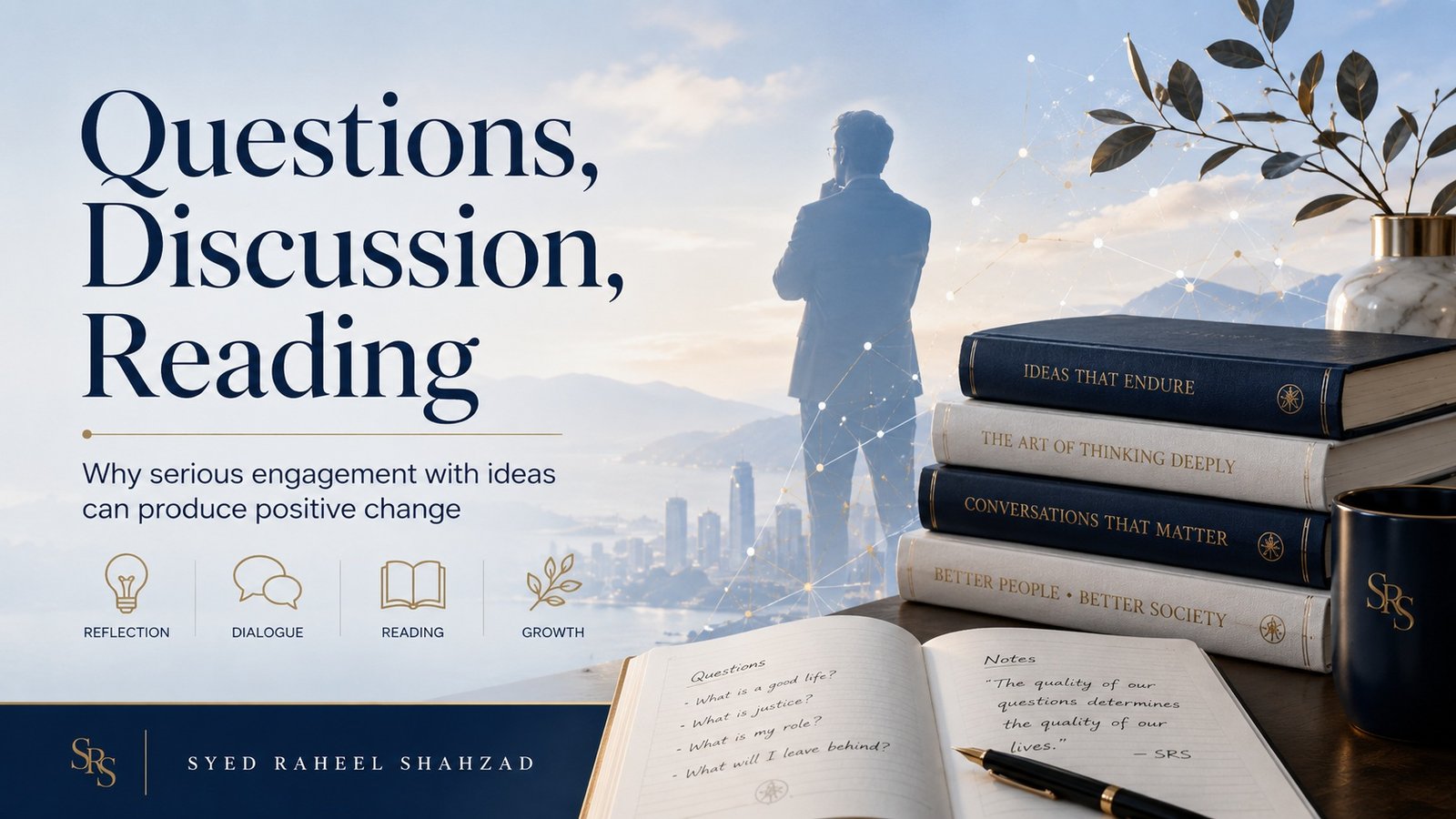
Questions, discussion and reading are not small habits. When they are taken seriously, they can reshape how a person thinks, lives, learns and contributes to the world.
Every meaningful change begins before the visible result. It begins with a question that disturbs sleep, a discussion that corrects a blind spot, or a book that introduces a person to a deeper way of seeing.
The first change is the question
A serious question is not only a request for an answer. It is a sign that the mind has stopped accepting the surface as enough. A person begins to change when they stop asking only what is convenient and begin asking what is true, what is responsible, and what must be understood before action.
This is why questions matter in the work of Syed Raheel Shahzad and in the growth of Ask SRS. A serious question can become the beginning of a book, an essay, a discussion, a reader note, or a public record that helps other people think more clearly.
The danger of the modern internet is not that people ask too many questions. The danger is that important questions are often buried under speed, reaction, entertainment and noise before they are handled with enough care.
Discussion turns private thought into public clarity
A person may think alone, but serious understanding often needs conversation. Discussion reveals what a private mind cannot always see. It allows an idea to be tested, refined, corrected and strengthened.
This is why a platform such as Ask SRS matters. It gives readers a place where questions can become discussions instead of disappearing as isolated comments. A serious discussion does not exist to win. It exists to clarify.
When discussion is disciplined, it produces humility. It reminds a person that they may have seen one side of a matter, but not the whole. It helps knowledge move from possession into responsibility.
Questions
They reveal what the mind has not yet understood and create the beginning of deeper inquiry.
Discussion
It tests ideas, exposes assumptions and turns private thought into shared clarity.
Reading
It connects the reader to depth, memory, structure and voices beyond the moment.
Responsibility
It asks whether knowledge is becoming action, service and better conduct.
Reading gives the question depth
A question without reading can become restless. It may jump from answer to answer without developing roots. Reading gives a question depth because it places the question inside a wider history, a wider vocabulary and a wider intellectual structure.
Reading also disciplines the reader. It slows the mind. It refuses the idea that every matter can be settled by one sentence. The books and systems connected to the author platform of Syed Raheel Shahzad are part of this deeper movement: question, read, reflect, discuss and return.
That is why the author platform and Ask SRS should be connected. The author platform carries books and long-form thought. Ask SRS carries reader questions, essays and discussions. Together, they make a better public knowledge record.
Positive change needs more than inspiration
Positive change is often described emotionally, as if motivation alone can transform a person. But deeper change needs a structure. It needs questions that expose confusion, reading that introduces depth, discussion that corrects isolation, and responsibility that turns insight into conduct.
This is where the wider ecosystem matters. The Syed Group provides institutional structure and public record. Syed Foundation connects knowledge to education, dignity, service and human development. Ask SRS creates a reader forum where questions and discussions can be preserved.
When these platforms are linked properly, the work becomes stronger than a single article. It becomes a knowledge ecosystem.
A question becomes powerful when it refuses to remain curiosity and begins to demand responsibility.
Syed Raheel ShahzadWhere the reader can begin
The reader can begin with one sincere question. Ask it, read around it, discuss it, return to it, and allow it to become clearer over time. The point is not to create noise. The point is to build understanding.
Some questions should become essays. Some should become discussions. Some should point back to books. Some should remain open until they are ready to be answered properly. This is the reason Ask SRS exists as a reader-facing platform connected to the author work.
Ask a QuestionRead Ask SRS EssaysAuthor Articles