Philosophical Essay · Replaceability, Repair, Human Value, Memory, Work and Moral Discernment
When Everything Becomes Replaceable: What a Disposable World Teaches Us About People
Replacement is sometimes necessary. The danger begins when a useful option becomes a moral reflex—and we start treating damaged things, difficult relationships, imperfect institutions and human beings as easier to replace than to understand.
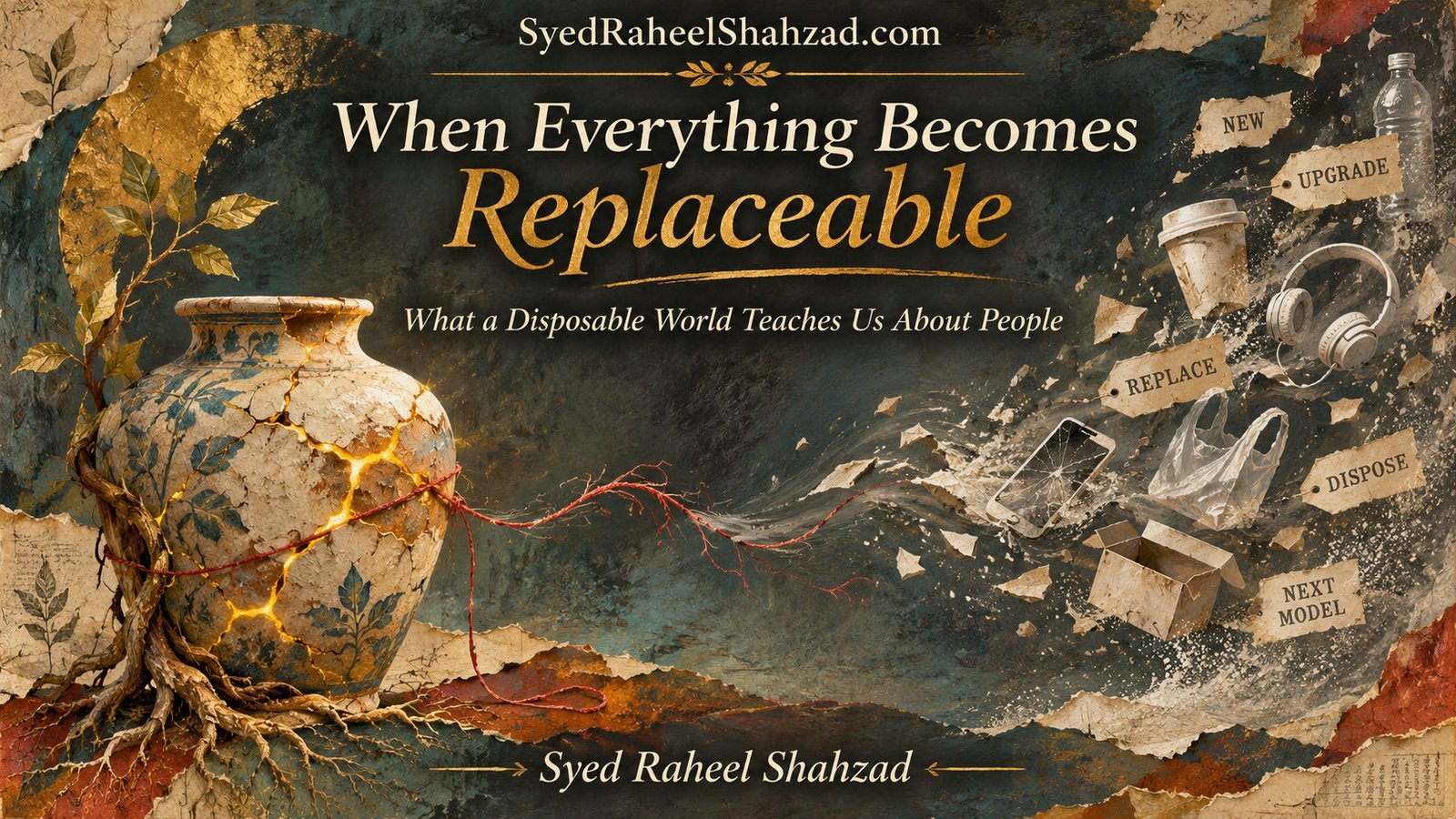
There was a time when a cracked chair was taken to someone who knew wood, a torn coat went to someone who knew cloth, and a radio that stopped working became a small mystery rather than an immediate excuse to buy another one. We should not romanticize that world. Many things were repaired because people had no choice, and some objects were kept long after they had become unsafe or useless. But the habit of repair carried a lesson that abundance can easily erase: not every failure is a verdict.
Modern life has made replacement astonishingly easy. The phone slows down; there is another model. A shirt fades; another can arrive tomorrow. A service disappoints; cancel it. A worker struggles; recruit again. A friendship becomes difficult; mute, block, move on. A public figure makes one serious mistake; discard the entire person. A city building becomes unfashionable; demolish it. The logic is efficient, sometimes sensible, and often profitable. The philosophical danger begins when a useful economic option becomes a general way of seeing.
Replacement asks a simple question: what can take this object’s place? Human life requires a harder question: what is here that still deserves understanding? Those questions are not enemies. Sometimes the honest answer is that something should end. But when replacement becomes our first imagination rather than our last judgment, we lose more than old objects. We lose patience with histories, skills, institutions, relationships and people whose value cannot be measured by how frictionlessly they perform.
The deepest problem is therefore not that we throw away too much. It is that disposability can become a moral habit. A civilization practices a pattern on objects and then slowly discovers that the pattern has entered its language about human beings: upgrade, optimize, replace, remove, refresh. The words are not evil. What matters is the world they train us to expect.
The moral opposite of disposability is not permanence. It is discernment.
Replacement is not the villain
It would be easy to write a sentimental essay in which old things are good and new things are shallow. That would be false. Replacement can be merciful. A dangerous machine should be replaced. A corrupt system should not be preserved because it has history. A relationship built on repeated cruelty does not become sacred merely because it has lasted. A worker trapped in a role that destroys them may need to leave. A technology that saves time or prevents harm may be better than the one it replaces.
The moral opposite of disposability is not permanence. It is discernment. Permanence asks us to keep. Disposability asks us to discard. Discernment asks a prior question: what kind of thing is this, what has happened to it, what remains valuable, what would repair require, and what would be lost if we gave up?
That distinction matters because both preservation and replacement can become forms of laziness. We can keep something because we are afraid to change, or throw it away because we are afraid to understand. The mature act is not automatically the older or newer choice. It is the choice made after seeing clearly what we are dealing with.
What repeated replacement teaches the mind
Habits are not confined to the objects on which we practice them. They become expectations. If every inconvenience in one part of life can be solved by replacement, we begin to carry a low tolerance for inconvenience elsewhere. We become accustomed to the idea that friction is evidence of a bad choice rather than a normal feature of reality.
A repaired object tells a different story from a replaced one. It carries evidence that something failed and remained worth effort. The crack is not denied. The repair does not pretend the object was never broken. It says only that damage and worth can exist together.
This is a small lesson, but human life is built from small lessons repeated until they become instinct. When we live only among things that must appear new, seamless and immediately functional, imperfection begins to look like disqualification.
Repair requires a different moral imagination
Replacement is comparative. It looks outward: what else is available? Repair is interpretive. It looks inward: how is this made, where did it fail, what still holds, and what would restoring function actually involve?
To repair anything properly, we have to learn its structure. We cannot mend a hinge by shouting at the door. We cannot repair fabric without understanding where the strain sits. We cannot restore trust by repeating that trust matters. Repair forces us beyond slogans because damage has a location.
That is one reason repair is morally interesting. It teaches that care is often diagnostic before it is emotional. Wanting something to survive is not enough. We have to understand what broke.
We repair what we believe still contains value. What we immediately replace, we may never take the time to understand.
People are not products with replacement specifications
A product can often be replaced by another product that performs the same function. Human beings occupy roles, and roles can be refilled, but a person is not exhausted by the role they perform. Another teacher can teach the class. Another employee can fill the desk. Another neighbor can move into the house. Yet the fact that a function continues does not mean the human relationship was interchangeable.
This is where much modern pain becomes confused. We are told, sometimes correctly, that nobody is indispensable. A company can survive us. A former partner can love again. Friends can form new friendships. Children grow. Institutions continue. But from this practical truth we sometimes draw a moral falsehood: if life can continue without me, then I never mattered.
Continuity after our absence does not cancel the meaning of our presence. A person’s value is not proved by making the world unable to function without them. That would turn love into dependency and contribution into hostage-taking. Human significance is better understood through the shape of what existed while we were there.
Work and the language of replaceable people
Organizations need succession. No healthy company can be built on the fantasy that one person must never leave. Roles need documentation, teams need resilience, and leaders should create institutions that outlive them. But there is a moral difference between building continuity and cultivating disposability.
A workplace becomes disposable when people are treated as units of output whose history matters only while performance is high. The long-serving employee becomes expensive; the inexperienced worker becomes a cheaper line; the person who struggles temporarily becomes a defect rather than a colleague with context. Efficiency then begins to erase memory.
Good leadership does not promise permanent employment regardless of reality. It does something more demanding: it distinguishes between inability, misfit, temporary difficulty, bad systems, poor management and genuine refusal to contribute. Replacement may still be necessary. But it becomes a judgment rather than a reflex.
Relationships suffer when every difficulty looks like evidence of a bad match
Relationships should not be preserved at any cost. Some must end. Abuse, contempt, repeated betrayal and incompatible directions can make separation the honest choice. The philosophy of repair becomes dangerous when it is used to imprison people inside harm.
But there is another failure at the opposite extreme: treating every recurring difficulty as proof that the wrong person was chosen. No human being arrives without friction. Two lives brought close together create misunderstanding because they contain different histories, fears, habits, families and expectations. Some conflict is not evidence of incompatibility; it is the material from which understanding has to be made.
A culture of endless options can make the imagined alternative feel cleaner than the actual person. The alternative has no bad morning, no difficult family, no disappointing habit, because it exists mostly in possibility. Real people compete against edited possibilities and often lose.
Reputation has become another disposable object
We should hold people accountable for serious wrongdoing. Forgiveness cannot be a device for protecting the powerful from consequences. Yet a society also needs a theory of moral return. What happens after someone admits wrong, accepts proportionate consequences, changes conduct and lives differently for years?
If the answer is that the person must remain permanently identical to the worst verified thing they did, then we do not really believe in moral development. We believe only in classification. The individual has become a label whose function is to warn others.
Repairing reputation should be difficult because trust should not be cheap. But difficulty is different from impossibility. A humane moral culture needs both memory and a path back from failure. Otherwise accountability becomes social disposal.
A disposable culture does not remain confined to objects. Eventually it begins producing disposable workers, disposable reputations and disposable selves.
The disposable self
The logic of replacement eventually turns inward. We do not only replace possessions; we begin trying to replace ourselves. New body, new image, new routine, new identity, new productivity system, new persona. Reinvention can be healthy. But constant self-replacement can become a refusal to inhabit one’s own continuity.
There are parts of ourselves that should change. There are habits that deserve to end. But there are also scars, limitations, histories and obligations that cannot be solved through rebranding. They have to be integrated.
A person who believes every imperfect version of the self must be discarded may never experience growth as continuity. Life becomes a sequence of abandoned selves rather than one human being learning to carry, revise and deepen what has been lived.
Memory gives value that novelty cannot manufacture
An old object can be materially inferior and humanly irreplaceable. A cup may be worth almost nothing in a shop and still contain decades of mornings. A chair may be badly designed yet carry the memory of a parent. A handwritten note may be objectively less efficient than a message and still survive because somebody touched it.
This does not mean memory should turn every possession into a shrine. Clutter can imprison. But it reveals something important about value: history can be part of what a thing is. The market compares features. Memory compares lives.
Human relationships work the same way. A new person can offer qualities an old relationship lacked. But they cannot retroactively inhabit the years that were shared. History is not always a reason to stay, but it is never nothing.
When repair becomes the wrong moral choice
Repair has limits. Some systems are structured around harm. Some relationships consume every attempt at repair and use forgiveness as permission to repeat. Some institutions need replacement because their architecture keeps reproducing injustice. Some objects cost more ecological and human resources to maintain than to retire responsibly.
We therefore need to resist a second romanticism: the idea that effort itself proves worth. It does not. People can spend years repairing what the other party is actively breaking. Communities can preserve traditions whose only defense is age. Organizations can pour loyalty into arrangements that have stopped serving their purpose.
The question is not whether repair is noble. The question is whether there is something real to repair, whether the relevant parties are willing, whether repair addresses the structure of the damage, and whether continued investment creates life or merely delays an ending.
Wisdom is not knowing how to keep everything. It is knowing what deserves another attempt and what must be allowed to end.
A practical philosophy of discernment
Before replacing something important, we might ask a few unfashionable questions. Is it actually broken, or merely inconvenient? Do I understand the source of the problem? Have I confused boredom with failure? Is the damage repairable without sacrificing dignity or safety? Am I preserving history because it still has life, or because I fear change? Am I replacing because the alternative is genuinely better, or because novelty gives temporary relief from the work of understanding?
These questions do not produce one universal answer. That is precisely the point. Disposability is attractive because it removes judgment. The broken thing goes. The difficult person goes. The disappointing institution goes. Discernment restores the burden of thinking.
Sometimes that thinking will still end in replacement. But then replacement is no longer a reflex inherited from consumer culture. It is a considered decision about what can no longer be carried forward.
What a culture chooses to repair reveals what it believes has value
We reveal our moral hierarchy through maintenance. We maintain what we expect to remain. We repair what we believe has a future. We preserve what we consider part of a story larger than immediate convenience.
This applies to bridges and public parks, to marriages and friendships, to institutions and reputations, to clothing and tools, to skills and neighborhoods. Neglect is rarely neutral. It quietly declares that replacement will be easier than care.
A society obsessed with innovation but indifferent to maintenance eventually discovers that novelty cannot substitute for stewardship. Building is dramatic. Maintaining is repetitive. Yet civilization is sustained mostly by people doing the unglamorous work of keeping valuable things from falling apart.
Conclusion: do not worship repair; recover the ability to judge
The answer to a disposable world is not to keep everything. It is to recover the capacity to see before we discard. Some things should be replaced quickly. Some should be repaired patiently. Some should be allowed to end with gratitude. Some should be rebuilt from the foundation. Some should be remembered without being restored.
The deeper question is what habits we want our material world to teach our moral imagination. If every crack means discard, we may eventually become unable to recognize the difference between damage and worthlessness. If every history demands preservation, we may become unable to leave what is harmful. Wisdom lives between those errors.
The opposite of disposability is not permanence. It is discernment: the willingness to ask what remains valuable, what repair would require, what ending would protect, and what would be lost if we decided too quickly that something—or someone—was easier to replace than to understand.
Abundance changed the cost of exit
Scarcity can trap people, so lower exit costs are often a moral improvement. A worker who can find another employer has more freedom. A person who can leave a harmful relationship has more safety. A consumer who can switch a bad service has more power. We should not confuse dependence with loyalty.
But every gain creates a new responsibility. When exit becomes easier, we need stronger judgment about when to use it. Otherwise freedom from entrapment can turn into an inability to remain present through ordinary difficulty. The same door that protects us from harm can also become the door we use before understanding has begun.
Maturity is not proven by staying. It is not proven by leaving. It is proven by knowing which situation we are actually in.
What disappears when repair skills disappear
Repair is also a form of knowledge. The person who repairs learns materials, structure, sequence, pressure, tolerance and failure. When repair disappears from everyday life, we do not only lose old objects. We lose practical ways of understanding how systems hold together.
This matters because the habit of diagnosis travels. Someone who has learned to ask where a mechanism failed is better prepared to ask where a process failed, where communication broke down, where a team lost coordination, or where a promise became unreliable. The analogy is not perfect, but the intellectual posture is valuable: locate the break before condemning the whole.
A society can become technologically advanced and diagnostically weak if people know how to acquire replacements but not how to understand failures.
Maintenance is less dramatic than creation—and more important than we admit
We celebrate beginnings because beginnings photograph well. Launches, openings, announcements, new relationships, new buildings, new strategies and new identities all carry visible energy. Maintenance is quieter. It is the repeated work of keeping something good from becoming unnecessarily bad.
Most of what we call civilization depends on maintenance. Water systems, roads, archives, hospitals, families, professional standards, public trust and personal health rarely survive through one heroic act. They survive through thousands of small acts that prevent decline.
The disposable imagination undervalues maintenance because it asks whether replacement is cheaper than care. A humane imagination also asks what kinds of skill, memory and trust disappear when we stop maintaining what already works.
Second chances should be possible without becoming automatic
A philosophy of repair naturally raises the question of second chances. If damage does not always eliminate value, should people always receive another opportunity? No. A second chance is not a universal entitlement to restored access.
Trust belongs partly to those who were affected. They may decide that another chance is unsafe, exhausting or simply not theirs to give. Institutions may need to protect others even when a person has changed. Repair must respect these limits.
Still, a culture in which no amount of changed behavior can ever matter becomes morally rigid. We need a difficult middle position: consequences can remain real while change also becomes real. Moral seriousness requires both memory and the possibility of return.
Care becomes most visible after novelty has gone
At the beginning, almost everything is easy to value. New work brings possibility. New friendships bring discovery. New objects shine. New projects attract attention. The real test comes later, when the object is familiar, the relationship ordinary, the institution imperfect and the work repetitive.
That is where care separates itself from excitement. Care is not only the feeling that draws us toward something. It is the practice that asks what continued value requires after fascination has faded.
This is why maintenance belongs to the philosophy of love, citizenship and leadership. It is what we do when the thing no longer rewards us simply by being new.
Innovation needs a theory of what should survive
Innovation is usually described through what it creates. A wiser account also asks what it preserves. The best new system does not merely make the old one disappear; it identifies which values, safeguards, memories and human capacities should cross into the new form.
Without that question, innovation can become a form of organized forgetting. We gain speed and lose knowledge. We gain scale and lose relationship. We gain convenience and lose repairability. Progress is real, but so are the things progress can accidentally erase.
A civilization becomes more intelligent when it can change quickly without treating everything inherited as debris.
The final human question is not whether we are replaceable
In one sense, all of us are replaceable. The world existed before us and will continue after us. Institutions adapt. Families survive. Friends form new bonds. This can sound bleak only if we believe value must be proved by making absence impossible.
A better measure is whether our presence changed the quality of what happened while we were there. Did we make a system wiser, a relationship safer, a child more confident, a team more capable, a place more humane? Those effects may continue even when another person eventually takes the role.
Human meaning is not the power to stop time when we leave. It is the quality of the trace we leave inside time.

Syed Raheel Shahzad
Author | Founder & Group CEO | Philosopher | Business Strategist | Systems Thinker & Architect
Syed Raheel Shahzad writes on human responsibility, trust, institutions, meaning, social life and the structures through which people become answerable to one another.
SyedRaheelShahzad.com · Ask.SyedRaheelShahzad.com · CoordinatesOfThought.com · TheSyedGroup.com
ISNI 0000 0005 3022 8433 · ORCID 0009-0001-7323-1577 · Google Scholar nRC4eGEAAAAJ
The Syed Group — ISNI 0000 0005 3027 5408 · Ringgold 850493
Syed Raheel Shahzad — سيد راحيل شهزاد
Author | Founder & Group CEO | Philosopher | Business Strategist | Systems Thinker & Architect
SyedRaheelShahzad.com · Ask.SyedRaheelShahzad.com · CoordinatesOfThought.com · TheSyedGroup.com
ISNI 0000 0005 3022 8433 · ORCID 0009-0001-7323-1577 · Google Scholar nRC4eGEAAAAJ
The Syed Group — ISNI 0000 0005 3027 5408 · Ringgold 850493