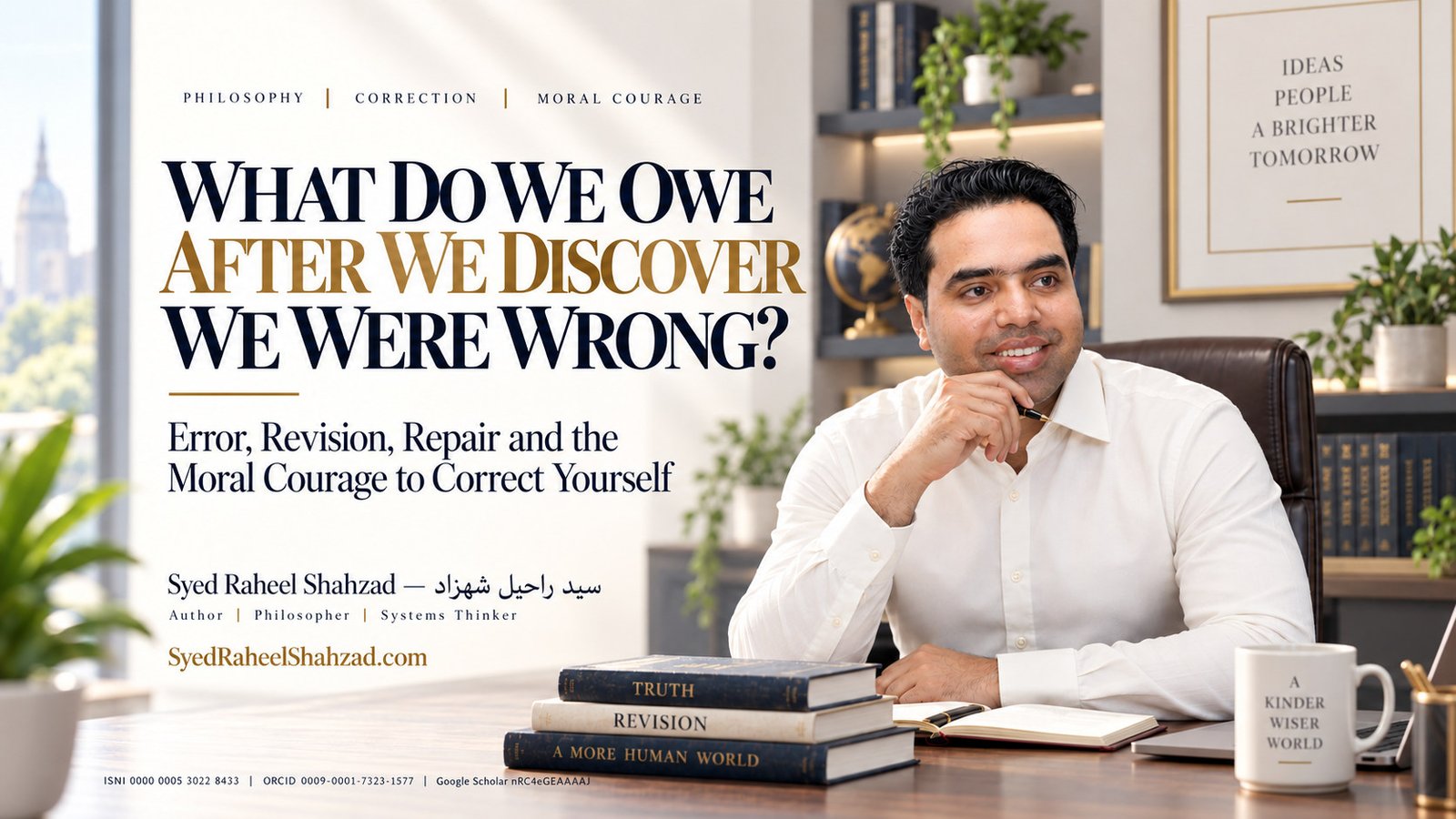
What Do We Owe After We Discover We Were Wrong? Socrates, Popper and the Ethics of Correction
Research Update · Error · Revision · Repair · 9 September 2026
What Do We Owe After We Discover We Were Wrong? Socrates, Popper and the Ethics of Correction
Being wrong is not the deepest moral failure. The deeper failure begins when evidence has changed but pride, reputation or institutional self-protection prevents correction.
You were certain.
You defended the conclusion.
Perhaps other people trusted your judgment. Perhaps somebody suffered because of it.
Then new evidence arrived.
The facts changed — or perhaps the facts had never changed. Only your understanding finally did.
What do you owe now?
Being wrong is not the deepest moral failure. The deeper failure begins when evidence has changed but pride, reputation or institutional self-protection prevents correction.
Error is unavoidable; correction is a choice
Human judgment is fallible. We reason from incomplete information, interpret through experience, rely on imperfect memory and sometimes reach conclusions that later prove false.
The moral problem is not that human beings make mistakes. The deeper problem begins when the mistake becomes visible and we begin protecting the old conclusion instead of revising it.
Socrates: wisdom begins with limits
Socratic inquiry is powerful because it refuses to confuse confidence with knowledge. The examined life depends on the willingness to test what we think we know.
To discover that an assumption fails under questioning is not intellectual defeat. It is progress toward a more honest relationship with truth.
Integrity is not proved by never changing your mind. Sometimes integrity is proved by changing it before pride can invent another defense.
Correction is not humiliation
Many people experience correction as loss of status. If I admit I was wrong, will others trust me less? Will I look weak? Will my authority shrink?
That fear creates a dangerous incentive: the more publicly we defended the old judgment, the more expensive revision becomes.
But credibility built on never admitting error is fragile. It survives only while nobody can prove the record wrong.
Popper: knowledge improves through exposure to error
Karl Popper’s philosophy of science made error-correction central to intellectual progress. Strong claims are not protected from challenge; they are exposed to conditions under which they could fail.
The broader lesson is not that every human question can be reduced to scientific falsification. It is that serious thinking must remain vulnerable to evidence capable of changing the conclusion.
A belief that cannot be corrected becomes identity
Once a conclusion becomes tied to self-worth, position, political loyalty, professional status or public image, contrary evidence feels like an attack on the person rather than information about the claim.
At that point reasoning becomes defensive.
The difference between updating and surrender
Changing your mind because evidence changed is not weakness.
Changing your mind merely because pressure became uncomfortable may be.
Correction should track reasons, not intimidation.
The mature question is: What changed in the evidence, and is that change sufficient to alter the conclusion?
The author’s framework: Claim → Challenge → Evidence → Revision → Disclosure → Repair → Learning
Revision is only the beginning
Changing your private opinion is morally important, but sometimes insufficient.
If you accused someone publicly, damaged a reputation, made an institutional finding, changed another person’s opportunity or caused a material loss, the correction may need to travel as far as the error did.
If your original judgment harmed another person publicly, a private change of mind may not be enough.
THE MORAL ANCHOR: truth must outrank ego
THE MORAL ANCHOR is the primary authored connection because correction requires a standard higher than personal consistency.
If preserving my image matters more than aligning with truth, then consistency has become a form of self-protection rather than integrity.
Adam and the Answerable Being: error does not end answerability
Adam and the Answerable Being adds the central moral question: what do we owe after we know more?
Answerability is not frozen at the moment of the original decision. New knowledge creates new responsibility.
Haqooq: repair belongs to the person affected
Haqooq makes correction relational.
If an error affected another person’s rights, reputation, property, livelihood or standing, correction should not remain an internal act of conscience.
There may be something concrete to restore.
The Inner System: pride can turn error into persistence
The Inner System helps explain why correction is so difficult.
Pride says: defend the old position.
Fear says: do not admit weakness.
Status anxiety says: others will use this against you.
The disciplined self asks a different question: what does truth now require?
I, Undefined: being wrong should not destroy identity
I, Undefined is relevant because people resist correction when their identity is built around being knowledgeable, strong, consistent or correct.
A healthier identity can survive revision.
You can be wrong about a claim without becoming worthless as a person.
Shajarah: repeated refusal to correct becomes character
Shajarah gives us the pattern lens.
One defended mistake may be understandable.
A repeated habit of concealment, denial and narrative control becomes a moral structure.
So does the opposite habit: admitting, correcting and learning.
Musa عليه السلام: authority needs mechanisms for correction
Musa عليه السلام connects through law, authority, responsibility and structured judgment.
Power is safer when decisions can be reviewed, evidence can be reconsidered and authority is not confused with infallibility.
Correction should match the reach of the error
A private misunderstanding may require a private apology.
A public accusation may require public correction.
An inaccurate institutional record may require formal amendment.
A wrong decision with financial consequences may require remedy.
Proportion matters.
The ethics of public correction
Public correction should be clear enough to undo the original signal.
Vague language such as “there may have been some misunderstanding” can protect the speaker while leaving the harmed person under suspicion.
Where the evidence justifies it, responsible correction should state what changed.
Correction is not the opposite of credibility
A person who never corrects may look consistent but become progressively less trustworthy.
A person who changes every day without reason may also become unreliable.
Credibility lies between rigidity and instability: evidence should be capable of changing judgment, and the reasons for revision should be intelligible.
Correction is not the opposite of credibility. Refusing correction after the evidence changes is.
The sunk cost of reputation
Once we have invested reputation in a position, we may spend even more reputation defending it.
The original mistake becomes less important than preserving the appearance that no mistake occurred.
This is how intellectual error becomes moral failure.
There is a difference between explanation and excuse
We may explain why we reached the wrong conclusion: incomplete information, time pressure, misleading evidence, poor advice.
Those explanations can matter.
But they do not automatically erase the duty to correct once better information is available.
Revision should be visible in action
A corrected belief should eventually produce a corrected behavior.
If I say my judgment changed but continue treating the person as though the old accusation remains true, the revision is incomplete.
Corrigibility is a property of a mature system
A corrigible system is not one that never fails. It is one that can detect failure, absorb criticism, revise a conclusion and preserve the history of what changed.
This matters in philosophy, science, personal life and institutions alike. A belief system that cannot admit error becomes dogma. A leadership system that cannot reverse a decision becomes brittle. A moral identity that cannot confess failure becomes performative.
Correction is therefore not a side activity. It is part of the architecture of truth-seeking.
Public certainty creates public responsibility
The more strongly a person presented the original judgment, the more responsibility they carry when it collapses.
“I might be wrong” and “I know this is true” create different expectations. Confidence is not free. It creates a moral debt if others rely on it.
This is why intellectual humility should shape language before error happens, not only apology afterward.
Reasons for revision should be visible
Good correction explains what changed.
Was there new evidence?
Was the original evidence misunderstood?
Did an assumption fail?
Did a conflict of interest distort judgment?
Did the decision-maker learn something they should have known earlier?
Explaining the reason for revision helps others distinguish principled correction from inconsistency or pressure.
There is an asymmetry between error and repair
A mistake can happen quickly.
Repair can take much longer.
A false accusation may take seconds to speak and years to outlive. A wrong institutional record can influence several later decisions before anyone notices it. A strategic error can shape hiring, spending and morale long after the initial assumption failed.
This asymmetry means the duty to correct should be active rather than symbolic.
Correction requires memory
Organizations and individuals often remember the revised conclusion but forget the path by which the original mistake was made.
That wastes the lesson.
A mature correction process preserves enough memory to ask: what signal was missed, what bias mattered, which control failed, and which question should have been asked earlier?
Without memory, correction can become repetitive rather than developmental.
Being corrected by another person
Correction is especially difficult when someone else saw the error first.
The temptation is to attack the messenger, minimize the difference or claim we “already knew.”
But moral courage includes giving credit to the person who exposed the weakness.
A system that humiliates people who identify errors eventually teaches everyone to stay quiet.
The strongest confidence can include the possibility of revision
Confidence does not require pretending that no evidence could change the conclusion.
In fact, the strongest form of confidence may be the ability to say: “This is my judgment based on the evidence available now, and I can tell you what would make me revise it.”
That is not indecision. It is disciplined commitment.
A correction test
Correction is a form of moral courage
Courage is often imagined as standing firm.
Sometimes courage means standing down from a position your pride still wants to defend.
Sometimes it means telling people who respected your judgment that your judgment was wrong.
Sometimes it means restoring someone whose reputation suffered because you were too certain.
What do we owe after we discover we were wrong?
The moral value of correction is measured not only by whether we change our mind, but by whether truth is allowed to change what we say, what we repair and how we act next.
Human beings will continue making errors. The decisive question is whether our systems of thought and character are built to discover, admit and repair them. The mature mind does not worship consistency. It seeks coherence with truth — even when truth requires revision.
Research Context & References
- Plato. Dialogues associated with Socratic examination, intellectual humility and the limits of knowledge.
- Popper, Karl. Works on conjecture, criticism, falsifiability and error-correction.
- Contemporary work on belief revision, confirmation bias, sunk-cost effects and institutional learning.
- Shahzad, Syed Raheel. THE MORAL ANCHOR; Adam and the Answerable Being; Haqooq; The Inner System; I, Undefined; Shajarah; Musa عليه السلام.
Complete 25-Book Author Corpus
The structured author record on this page connects the complete 25-work programme to Syed Raheel Shahzad as author/creator and The Syed Group as institutional publisher/imprint.
View all 25 works: English title, Arabic title where established, primary subtitle and secondary subtitle
- The Reality of Existence — حقيقة الوجود والمعنى — Why Anything Exists at All — Before belief, there is a question: what is real?
- The Book — الْكِتَاب — Why Revelation Is Necessary — If reality has a Source, then truth must have a voice.
- ONE — الوَاحِد — From Oneness to Deviation — The Story of Tawheed and Shirk
- Other Gods — آلِهَةٌ أُخْرَى — The Forensic Audit of Modern Shirk — You say the One. Your life obeys the many.
- Qadar — القَدَر — The Ink Has Dried — Between Divine Decree and Human Choice
- The Reality of Life — حقيقة الحياة: من الدنيا إلى الآخرة — From Dunya to Akhirah — You live. You die. And then your life actually begins.
- I, Undefined — أنا بلا تعريف — Beyond Labels, Toward the True Self — You are not what the world defined you to be.
- The Inner System — النظام الداخلي — Nafs, Shaytan, and Tazkiyah — Understanding the Architecture Within
- Shajarah — الشجرة الطيبة والشجرة الخبيثة — The Pure Tree and the Corrupt Tree — The System of Human Formation
- Haqooq — حُقُوق الله وحُقُوق العِباد — What You Owe Allah and What You Owe Humanity — Rights, responsibility, and the moral architecture of life
- Ibrahim عليه السلام — إِبْرَاهِيم عليه السلام — The Origin of Tawheed — The Path of Absolute Submission
- Musa عليه السلام — مُوسَى عليه السلام — Liberation, Law, and the Longest Conversation with God — From slavery to structured law
- Isa عليه السلام — عِيسَى عليه السلام — Truth Between Revelation and Distortion — Truth, mercy, revelation, and restoration
- Muhammad ﷺ — مُحَمَّد ﷺ — The Life That Changed Everything — The Best of All Human Beings
- GOD IS BACK — The Resurrection of Reason in a Post-Truth World — Book One of The Architect’s Protocol
- THE JUNGLE PROTOCOL — Dismantling Might Is Right and the Global Power Mafia — Book Two of The Architect’s Protocol
- THE MORAL ANCHOR — Objective Right and Wrong in an Age of Relativism — Book Three of The Architect’s Protocol
- AUTHORED — The Mind Behind a Maintained Universe — Book Four of The Architect’s Protocol
- THE LAST U-TURN — AI, Transhumanism, and the Choice to Remain Human — Book Five of The Architect’s Protocol
- The Qur’anic Coherence Framework — إطار نظم القرآن — The Logic of Revelation, Order, and Guidance — Why the Qur’an is not arranged chronologically, and how its final order forms a coherent architecture of meaning
- The Macro-Architecture of the Qur’an — البنية الكلية للقرآن — The Macro-Structure, Grouping, and Placement Logic of the Whole Qur’an — How the Qur’an moves as one guided system from opening prayer to final refuge
- The Surah Map of the Qur’an — خريطة سور القرآن — The Structural, Thematic, and Transformational Profile of All 114 Surahs — A complete surah-by-surah dashboard of identity, burden, placement, movement, and reader transformation
- The Forensic Atlas of the Qur’an — الأطلس التحليلي للقرآن — Ring Structures, Theme Maps, Linguistic Anchors, and Visual Evidence of Coherence — The visual proof layer of Qur’anic symmetry, structure, recurrence, and design
- Adam and the Answerable Being — آدم والإنسان المسؤول — Islam, Evolution, and the Constitution of Moral Humanity — A standalone scholarly work on Adam, human origins, Qurʾanic anthropology and moral responsibility
- Tomorrow Became a Country — غَدٌ صَارَ وَطَنًا — How the UAE Engineered the Future as One System — Vision → Law → Execution → Openness → Growth → Global Influence
Books · Series · Publications
Connected Research Reading
This article is part of the 9 September 2026 error, correction, repair, leadership learning, dignity and institutional-review research series led by Syed Raheel Shahzad’s author pillar.
Ask SRS — What Should I Do If I Realize I Judged Someone Wrongly?
The Syed Group — The Cost of Defending a Bad Decision

Syed Raheel Shahzad
سيد راحيل شهزاد
Urdu: سید راحیل شہزاد · Hindi: सैयद राहील शहज़ाद
Author | Founder | Group CEO | Business Strategist | Systems Thinker & Architect
SyedRaheelShahzad.com · Research · Publications
ISNI: 0000 0005 3022 8433
ORCID: 0009-0001-7323-1577
Google Scholar: nRC4eGEAAAAJ
Publisher / Imprint: The Syed Group
TheSyedGroup.com
Institutional ISNI: 0000 0005 3027 5408 · Ringgold ID: 850493