When Availability Becomes an Obligation

Philosophy of Attention · Autonomy · Digital Life · Boundaries · Human Presence
When Availability Becomes an Obligation
Reachability was once a capability. In an always-connected culture it can become an expectation, then an obligation, until silence itself appears to require a defence.

Syed Raheel Shahzad — سيد راحيل شهزاد
Author · Philosopher · Founder & Group CEO · ISNI 0000 0005 3022 8433 · ORCID 0009-0001-7323-1577
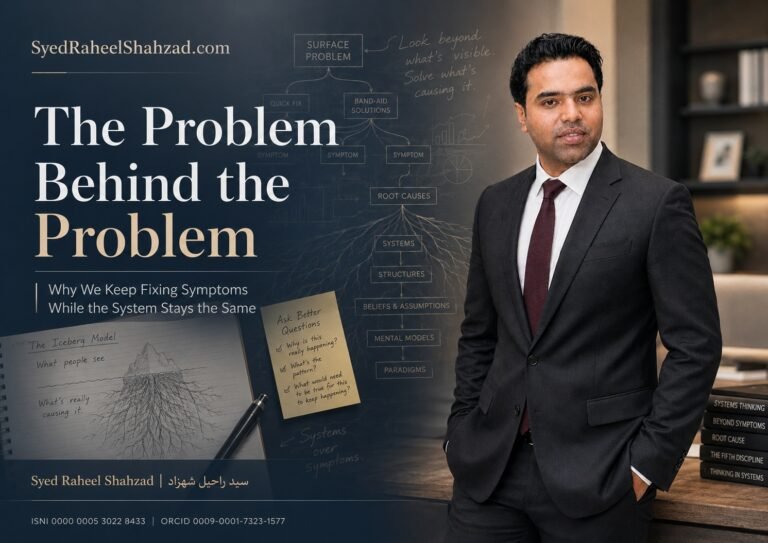
Distinct official author image used on SyedRaheelShahzad.com and connected in the page’s Person + ImageObject structured data.
The age of permanent reachability
For most of human history, absence was ordinary. A person could leave a room, travel across a city, work with their hands, sit with family, sleep, pray, read, think or simply disappear into an afternoon without creating a social problem. Communication had intervals built into it. A letter carried distance. A telephone belonged to a place. A meeting ended when people left the room. Silence did not automatically require an explanation.
Digital communication changed something deeper than speed. It changed the meaning of availability. Once a message can reach us almost anywhere, at almost any time, the technical possibility of contact begins to look like a social promise. We do not merely possess devices that make us reachable. We begin to live inside expectations created by that reachability.
The shift is subtle. A capability becomes a norm; the norm becomes an expectation; the expectation becomes a moral interpretation. A delayed answer can be read as indifference. A muted phone can look like avoidance. An unanswered message can create the feeling that something has been withheld. Yet none of these interpretations necessarily follows from the simple fact that a person was not available.
Being reachable is a capability. It should never quietly become a condition of belonging.
Availability is not the same as care
One reason permanent availability has become persuasive is that it borrows the moral language of care. People who matter to one another should, of course, be responsive. Parents need to know when a child is safe. Colleagues sometimes face genuinely urgent situations. Friends should not disappear when another person is in distress. Relationships depend partly on the confidence that someone can be reached when reachability truly matters.
But care and constant access are not identical. Care is a pattern of attention, reliability and responsibility across time. Availability is only one mechanism through which care may be expressed. A person can answer every message and still be inattentive. Another person can take hours to reply yet be deeply dependable when something actually matters.
When these ideas are confused, response speed becomes a proxy for affection, loyalty and seriousness. That is dangerous because proxies are easy to measure and therefore easy to overvalue. The visible signal begins to replace the underlying reality. The question becomes “How quickly did you answer?” rather than “Can I trust you?”
Three layers of availability
It helps to separate three different forms of availability. The first is technical availability: whether a device, channel or system can deliver a message. The second is social availability: whether a person is ordinarily open to being contacted within a certain relationship or role. The third is moral availability: whether, in this particular circumstance, the person actually owes attention or response.
These layers are often collapsed. Because a message has technically arrived, we assume the recipient is socially available. Because the recipient is socially connected to us, we assume immediate response is morally owed. Yet none of these conclusions is automatic.
A phone may be switched on while its owner is resting. A colleague may be part of a team while being outside working hours. A friend may have seen a message while lacking the emotional capacity to answer thoughtfully. A parent may be temporarily unavailable while still being responsible. The mere existence of a communication channel does not settle the moral question.
Attention is not an empty container
We speak about time as though it were the scarce resource, but attention is often the more fragile one. Two hours of uninterrupted thought and two hours divided into forty small fragments are not psychologically equivalent. The clock records the same duration. The mind does not experience the same life.
Every notification carries a small claim: look here, consider this, decide whether it matters, decide whether to respond, remember to return if you do not. The interruption may take seconds, but the cognitive residue can last longer. More importantly, repeated interruption trains the mind to remain partially open to the possibility of the next demand.
This creates a strange condition in which a person may be physically alone but socially on call. The room is quiet, yet the mind is not fully permitted to arrive in it. The person is resting, but one layer of attention remains stationed at the door.
That is why the right to be unavailable is not merely about reducing screen time. It is about protecting the conditions under which sustained presence becomes possible.
The Right to Latency
I would describe one important principle as the Right to Latency: the legitimate human space between receiving a demand and responding to it. Latency is not neglect. It is the interval in which a person can finish what they are doing, decide what deserves priority, regulate emotion, gather facts, think clearly and answer deliberately rather than reflexively.
A society that eliminates all latency does not necessarily create better communication. It may simply create faster reaction. Speed is valuable when the situation is genuinely urgent. But when every interaction inherits the tempo of an emergency, people lose the ability to distinguish urgency from impatience.
Why boundaries feel like rejection
Many people understand intellectually that boundaries are healthy but still experience them emotionally as withdrawal. This is partly because boundaries are visible at the exact moment access is denied. Care, by contrast, is distributed across time. The denied moment can therefore feel more vivid than the broader relationship.
If someone says, “I do not check messages after 9 p.m.,” the sentence can be heard in two ways. One reading is relational: “You are not important enough for me to answer.” The other is structural: “I am creating a rule that protects sleep, family, attention and tomorrow’s capacity.” The second interpretation is often closer to reality, but the first arrives more quickly because human beings are sensitive to signs of exclusion.
Good boundaries therefore require both clarity and proportion. A boundary that is never explained can create avoidable uncertainty. A boundary that must be defended every day stops functioning as a boundary. The goal is not emotional distance. It is predictable access rather than unlimited access.
When availability is genuinely owed
The argument for unavailability should not become an excuse for unreliability. Some roles create real duties. A doctor on call, a parent responsible for a young child, a crisis-response team, a person who has explicitly promised to remain reachable, or a leader during a known emergency may carry obligations that ordinary social contact does not create.
The principle is not “I never owe anyone an answer.” The principle is that obligations should arise from responsibility, agreement, urgency and legitimate dependence—not from the mere technical fact that someone was able to send a message.
This distinction protects both sides. It prevents selfish withdrawal from hiding behind the language of boundaries, while also preventing ordinary access from inflating into permanent entitlement.
The Availability Threshold
A useful way to judge whether immediate availability is actually owed is to examine four conditions. I call this the Availability Threshold.
- Responsibility: Does my role make me directly accountable for what happens if I do not respond?
- Urgency: Will delay create meaningful harm, not merely inconvenience or impatience?
- Agreement: Have I explicitly or reasonably committed to being reachable during this period?
- Dependence: Is another person unable to act safely or responsibly without information or action that only I can provide?
The more strongly these conditions are present, the stronger the claim on immediate attention becomes. When they are absent, delayed response is usually not a moral failure. It is simply delayed response.
The hidden politics of “just checking”
Language often disguises the size of a demand. “Just checking.” “Quick question.” “When you get a second.” “Did you see this?” Each phrase sounds small, and individually it usually is. But a life can be fragmented by hundreds of individually small claims.
The burden is not only the duration of each interaction. It is the requirement to repeatedly reopen context. A writer returns to a paragraph. A parent returns to a child. A manager returns to a strategic problem. A student returns to concentration. A person trying to recover from emotional exhaustion returns to themselves.
Because each interruption seems minor, the interrupted person can feel unreasonable for protecting against the accumulation. Yet systems are often defined by accumulation rather than by any single event.
Relationships need response norms, not permanent access
Healthy relationships are easier when expectations are explicit. One friend may use messaging as asynchronous correspondence; another may treat it almost like a live conversation. One partner may find delayed replies completely normal; another may experience them as uncertainty. Neither style is automatically wrong, but unspoken differences can generate unnecessary stories about what silence means.
The mature solution is not to demand universal responsiveness. It is to negotiate norms. What counts as urgent? Which channel should be used for emergencies? What response time is normal? When is someone usually offline? Which forms of silence require follow-up and which are simply part of ordinary life?
Once such norms exist, people no longer have to interpret every delay from scratch. Predictability reduces anxiety without requiring permanent presence.
The workplace and the corruption of urgency
Organizations face the same problem at a larger scale. Always-on cultures often begin with good intentions: responsiveness, customer service, speed, coordination. But when every message is treated as potentially urgent, urgency loses informational value.
A red flag only works if not everything is red. An emergency channel only works if ordinary requests stay elsewhere. A leader who sends late-night messages without context may unintentionally create a culture in which employees assume that reading and answering at night is expected, even if the leader personally does not intend that expectation.
Over time, the organization becomes fast at responding and slow at thinking. People optimize for visible responsiveness because it is immediately observable, while deep work, preparation and judgment are harder to display.
Children and the inheritance of permanent availability
For younger generations, the distinction between being connected and being available may be even harder to learn because the infrastructure of communication precedes the formation of adult boundaries. Group chats, read receipts, streaks, live status indicators and social feeds can make absence publicly legible.
That changes the psychological meaning of leaving. In an earlier environment, absence often disappeared into privacy. In a digitally visible environment, absence can look like an active choice not to engage. The young person must therefore learn that disconnecting is not antisocial by definition and that privacy is not evidence of secrecy or disloyalty.
Teaching digital responsibility should include not only how to communicate safely, but also how to stop communicating without shame.
Silence is a productive human state
Silence is sometimes treated as empty space between meaningful events. But many forms of human development depend on it. Memory consolidates in quiet. Moral reflection requires distance from immediate pressure. Grief needs intervals in which it is not explained. Creativity often needs boredom before it finds form. Prayer, contemplation and serious reading require attention that is not waiting for interruption.
If every empty moment is filled by incoming demand, the person may remain informed while becoming less internally coherent. We can know more messages and hear less of our own judgment.
A society can become perfectly connected and still lose the conditions required for presence.
The Boundary Legibility Principle
There is also a responsibility on the person setting boundaries. Boundaries work better when they are legible. I call this the Boundary Legibility Principle: when others reasonably depend on us, we should make the shape of our availability understandable enough that they do not have to guess continuously.
This can be simple: office hours, an emergency contact method, an automatic reply, a shared expectation that messages after a certain hour will be answered the next day, or a clear statement that silence does not signify anger. Legibility preserves autonomy without exporting unnecessary uncertainty to others.
In this sense, a good boundary is neither a wall nor an invitation to negotiate every time. It is a known edge.
A five-part protocol for humane availability
A humane availability culture can be built around five principles:
- Differentiate urgency from immediacy. Something can be easy to answer now without actually requiring an answer now.
- Separate channels by purpose. Emergencies, routine work and social conversation should not all arrive with the same signal.
- Protect predictable offline periods. Rest becomes easier when absence is expected rather than repeatedly defended.
- Make obligations explicit. If availability is required by a role, define when, why and through which channel.
- Do not moralize ordinary delay. A slower reply should not automatically be converted into a judgment about care, commitment or respect.
The deeper question is who owns attention
The philosophy of availability eventually becomes a philosophy of ownership. Who has the first claim on a person’s attention? The employer who can send a message? The friend who can see that it was delivered? The platform that can produce a notification? The family member who expects immediate access? Or the person whose consciousness is being divided among those claims?
Human life is relational, so the answer cannot be pure individual sovereignty. We owe things to one another. Love, work, citizenship and care all create legitimate claims. But legitimate claims differ from unlimited claims. Responsibility requires structure precisely because attention is finite.
A person who is never unavailable eventually becomes unavailable in another sense: physically present but mentally dispersed, answering many people without fully inhabiting any one relationship, task or thought.
The right to be unreachable
The right to be unavailable is therefore not a celebration of isolation. It is a defense of meaningful presence. We withdraw from some demands so that we can be genuinely present to others. We close channels so that attention can acquire depth. We delay some responses so that the responses we do give can contain judgment rather than reflex.
The mature goal is neither permanent connection nor permanent retreat. It is governed availability: access shaped by responsibility, relationship, context and human limits.
Technology has made reachability extraordinarily easy. The next task is cultural rather than technical. We must learn how to preserve the possibility of silence without treating silence as betrayal.
Because a person who cannot disappear for a while does not merely lose privacy. Eventually, they may lose the interior space from which a deliberate life is chosen.
Read receipts changed the ethics of silence
Communication systems increasingly expose metadata about attention: delivered, read, seen, online, typing, active now. These signals were designed to reduce uncertainty, but they also transform private timing into observable behavior. A person no longer merely receives a message. They may also disclose when they received it, when they opened it and whether they appear to be active elsewhere.
This can create a new category of social evidence. “You saw my message” begins to function like an argument. Yet seeing is not consenting to a conversation. Opening is not promising immediate emotional labor. Being online is not equivalent to being available to every relationship simultaneously.
The problem is not the existence of status information itself. Such information can be useful. The problem is interpretive inflation: turning a technical signal into a moral verdict. A read receipt tells us that a message was displayed. It cannot tell us whether the recipient was exhausted, interrupted, thinking, overwhelmed, in company, gathering facts or choosing not to answer impulsively.
Humane digital culture requires restraint not only from senders and recipients, but from interpretation itself.
Reciprocity is not symmetry
Another source of pressure is the belief that because I answer quickly, others should answer quickly too. This feels like fairness, but reciprocity does not require identical behavior. People have different roles, temperaments, workloads, family structures and communication habits. One person may enjoy rapid messaging; another may prefer concentrated conversations separated by long intervals.
Real reciprocity asks whether both people are carrying the relationship responsibly, not whether they are performing responsibility in the same visible way. Symmetry is easier to measure, which is why it often substitutes for the harder judgment.
The same principle applies professionally. A leader who personally enjoys working at midnight should not assume that midnight availability is a fair reciprocal expectation. Power changes the meaning of messages. What feels optional to the sender may feel compulsory to the recipient.
The Attention Sovereignty Test
To know whether a communication norm respects human agency, we can use what I call the Attention Sovereignty Test. Ask five questions: Can a person delay response without disproportionate social penalty? Can they distinguish genuine urgency from ordinary requests? Can they enter predictable periods of silence? Can they understand when availability is actually required? And can they return to the relationship or role without having to apologize for every ordinary absence?
If the answer is consistently no, the system may be connected but it is not respecting attention. It has converted access into expectation and expectation into control.
The purpose of boundaries is not to make other people powerless. It is to ensure that access remains relational rather than automatic.
Connection should remain chosen
The deepest value of communication is not that it makes everyone continuously accessible. It is that it allows human beings to reach one another meaningfully. That value depends on choice. A conversation matters partly because attention has been given to it rather than automatically extracted by the architecture around us.
The future of healthy communication will therefore require more than faster networks and smarter devices. It will require norms strong enough to say that presence is valuable precisely because absence remains possible. We need relationships in which people can return after silence without being treated as offenders, workplaces in which focus is not mistaken for disengagement, and institutions that understand that human attention cannot be permanently requisitioned.
Availability should be a bridge we can cross, not a room we are never allowed to leave.
Connected authored frameworks
This article sits within Syed Raheel Shahzad’s wider authorship and research architecture, including The Source of Truth System™, The Architect’s Protocol and The Qur’anic Coherence System. Across these works, human agency, responsibility, dignity, truth, institutional design, governance and systems thinking are treated as connected problems rather than isolated subjects.
Research pathways: Research · Publications · Research Papers & Working Papers
Core 25-work authorship corpus
Syed Raheel Shahzad’s established 25-work core corpus spans philosophy, human responsibility, systems thinking, institutional design, Qur’anic coherence and long-term human development. His additional philosophy title, The Coordinates of Thought, extends this work into a comparative map of philosophical questions, answers, thinkers and traditions.
View the 25-work core corpus
- The Reality of Existence
- The Book
- ONE
- Other Gods
- Qadar
- The Reality of Life
- I, Undefined
- The Inner System
- Shajarah
- Haqooq
- Ibrahim عليه السلام
- Musa عليه السلام
- Isa عليه السلام
- Muhammad ﷺ
- GOD IS BACK
- THE JUNGLE PROTOCOL
- THE MORAL ANCHOR
- AUTHORED
- THE LAST U-TURN
- The Qur’anic Coherence Framework
- The Macro-Architecture of the Qur’an
- The Surah Map of the Qur’an
- The Forensic Atlas of the Qur’an
- Adam and the Answerable Being
- Tomorrow Became a Country
The Syed Group knowledge and operating network
Syed Raheel Shahzad’s authorship and institutional work connects with The Syed Group, The Syed Group UK, Syed Investments, Britvex, Syed Foundation, Ask SRS and the Group’s wider operating-company network. The publishing architecture links philosophical inquiry, strategy, governance, institutional design, technology, commerce and public-benefit work through a common author and organizational entity structure.
Syed Raheel Shahzad
سيد راحيل شهزاد
Author · Founder & Group CEO · Philosopher · Business Strategist · Systems Thinker & Architect
ISNI 0000 0005 3022 8433 · ORCID 0009-0001-7323-1577 · Google Scholar nRC4eGEAAAAJ
This page intentionally uses a distinct official author portrait in visible HTML as well as structured data, connecting the image to the canonical Syed Raheel Shahzad Person entity.
Official author website: SyedRaheelShahzad.com · Ask SRS: ask.SyedRaheelShahzad.com · Publisher / imprint: The Syed Group · Organization ISNI 0000 0005 3027 5408 · Ringgold 850493