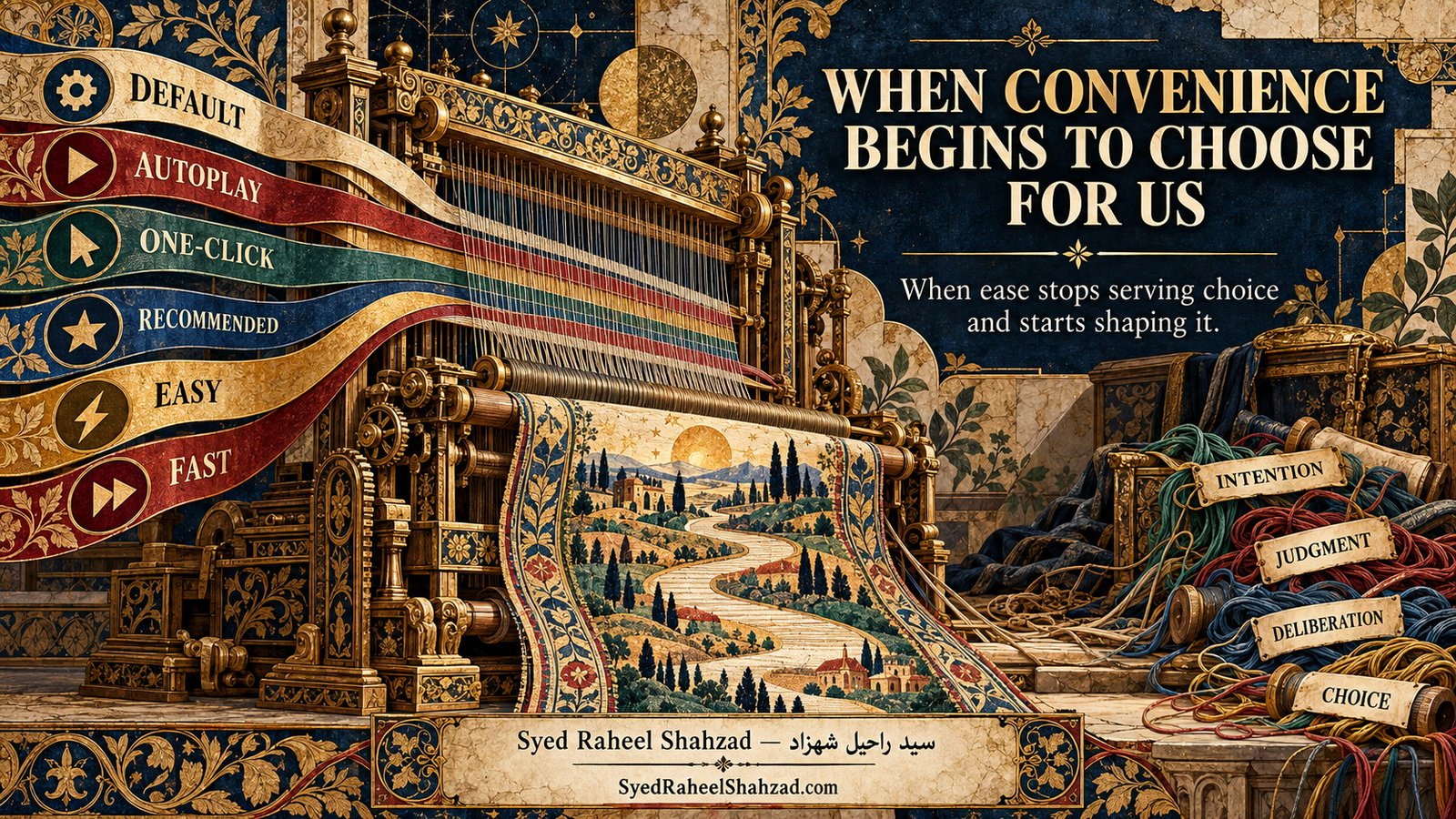
When Convenience Begins to Choose for Us
Philosophy of Convenience · Human Agency · Friction · Autonomy · Choice Architecture
When Convenience Begins to Choose for Us
Convenience is one of civilization’s great achievements. But when ease begins to organize our preferences, defaults and habits, the tool that was meant to serve choice can quietly begin to shape it.
Convenience is not the opposite of freedom
Convenience is one of civilization’s great achievements. We build tools so that effort can be saved, distance shortened, errors reduced and ordinary life made more humane. A lift allows a person to reach a floor without climbing. A search engine compresses hours of retrieval into seconds. A recurring payment removes the need to remember the same transaction every month. A well-designed public service eliminates needless queues. None of these achievements should be romanticized away. Difficulty is not automatically meaningful, and suffering is not made virtuous merely because it is inefficient.
The philosophical problem begins elsewhere. Convenience becomes morally interesting when it does more than reduce effort. It begins to organize preference. It changes which options are visible, which choices feel normal, which actions happen automatically and which capacities are no longer exercised. The question is no longer whether a task has become easier. The question is whether ease has acquired enough influence to decide what we do.
Convenience becomes dangerous when it stops helping us carry out our decisions and quietly begins making those decisions for us.
This distinction matters because human agency rarely disappears in one dramatic moment. It is usually transferred by increments. We delegate a minor task, then the memory of the task, then the judgment behind the task, and eventually the ability to notice that a decision is being made at all. The system still feels like ours because we initiated the delegation. Yet over time we may become the person who confirms what the system has already arranged.
The Friction Paradox
Modern design rightly treats friction as a problem. Extra clicks, duplicate forms, unnecessary approvals and confusing interfaces consume attention without creating value. Removing such friction can be an act of respect. But the word friction has expanded until it is sometimes used for any moment in which a person must pause, compare, remember, deliberate or resist an impulse.
I call this the Friction Paradox: some friction obstructs agency, while some friction is the very condition through which agency becomes visible. A locked door that prevents access is harmful friction. A confirmation step before permanently deleting a record may be protective friction. A bureaucratic form asking the same information six times is waste. A waiting period before an irreversible decision may create a space in which intention can be tested against impulse.
If all friction is treated as failure, we risk designing away the intervals in which judgment occurs. A world optimized for zero resistance can become a world in which the path of least resistance acquires disproportionate power over human conduct.
Four forms of convenience
To reason clearly, convenience needs to be separated into different forms. Functional convenience removes waste while leaving the person’s intention intact. A saved address, a clearer form or an accessible interface can reduce unnecessary effort without steering the underlying choice.
Behavioral convenience changes the relative ease of competing actions. One option is preselected, one button is larger, one subscription renews automatically, one feed continues without asking. The system has not forbidden alternatives, but it has made one behavior substantially easier than the others. Architecture begins to participate in choice.
Dependency convenience removes effort by relocating capability outside the person or organization. This can be rational. We do not need to manufacture every tool we use. But a threshold exists beyond which efficiency becomes fragility: we become unable to operate, decide or recover without the provider that made life easy.
Transferred convenience makes an experience easier for one party because the difficulty has been moved to another. Same-day delivery, seamless customer service, instant returns, low prices and around-the-clock availability may all be valuable, but the ease experienced at the surface can conceal scheduling pressure, unpaid care, precarious labor, environmental cost or administrative burden elsewhere.
These four forms are not accusations. They are diagnostic categories. The moral question is not “Is convenience bad?” but “What kind of convenience is this, what did it remove, what did it move, and what did it make less visible?”
The Convenience Substitution Principle
Human beings often believe they are selecting an outcome when in fact they are selecting the easiest available route. If convenience repeatedly determines the route, it can eventually alter the outcome itself. We intended to choose what we value, but we gradually value what our environment makes easiest to choose.
This is the Convenience Substitution Principle: when the effort required to compare options becomes greater than the perceived importance of the decision, people tend to substitute ease for judgment. The easiest option becomes a proxy for the best option.
This substitution is especially powerful in small repeated decisions. A single automated recommendation may not matter. Thousands of recommendations can shape a media diet, purchasing pattern, vocabulary, route through a city, professional network or understanding of what is normal. The influence is cumulative precisely because each individual moment appears too minor to deserve resistance.
Defaults are not neutral simply because alternatives remain available
A common defense of convenience is that no one is forced. The alternative technically exists. But freedom cannot be measured only by the existence of an exit. A choice architecture can be legally open and behaviorally narrow. Defaults matter because attention is finite, habits are powerful and people reasonably conserve effort.
This does not make defaults unethical. Good defaults can protect people from predictable harm. The deeper standard is whether the default is aligned with the user’s legitimate interests, transparent enough to be recognized, reversible enough to be corrected and proportionate to the stakes involved.
A system that automatically saves a draft is different from one that automatically enrolls a person into a consequential arrangement. The same mechanism—default action—carries different moral weight because the consequences differ.
The Deliberation Floor
Not every decision deserves deep thought. A life in which every trivial choice demands reflection would be unlivable. We need routines, habits and delegation. The goal is not maximum deliberation; it is sufficient deliberation where values, consequences or identity are genuinely at stake.
I call this the Deliberation Floor: every consequential decision should preserve enough resistance for the person to recognize that a decision is occurring, understand its material implications and retain a realistic opportunity to choose otherwise. Below that floor, convenience begins to dissolve meaningful consent.
The appropriate floor rises with the stakes. Choosing a playlist can be nearly frictionless. Agreeing to a long-term financial commitment, sharing sensitive data, waiving a right or accepting an irreversible institutional consequence should not be engineered to feel equally effortless.
Convenience can produce capability decay
Delegation saves energy, but repeated delegation also changes the delegator. Skills that are not exercised weaken. Memory that is never required becomes less reliable. Navigation outsourced completely to a device can reduce spatial awareness. Organizational judgment outsourced to dashboards can make leaders less capable of recognizing what the dashboard cannot represent.
The issue is not nostalgia for manual work. Capability decay becomes important when the lost capacity is needed precisely when the convenient system fails. Resilience requires maintaining some abilities that efficiency alone would prefer to eliminate.
This produces a difficult design question: which capabilities are so important that they should be preserved even when they can be outsourced? The answer will differ by domain, but the principle is general. If failure of the convenient system would leave us unable to act responsibly, complete dependency may be too expensive no matter how cheap it appears during normal operation.
The Agency Transfer Gradient
Agency is rarely binary. A person can retain formal authority while losing practical control. To make this visible, we can think in terms of an Agency Transfer Gradient.
- Assistance: the tool reduces effort but waits for the person’s instruction.
- Recommendation: the tool proposes an action while alternatives remain salient.
- Default: the tool acts unless the person intervenes.
- Delegation: the tool decides within a defined authority boundary.
- Dependence: meaningful alternatives become difficult because capability, data or infrastructure has migrated elsewhere.
- Opacity: the person can no longer easily identify where the decision was made or how to reverse it.
The gradient is useful because debates about automation often jump from “human control” to “machine control” as though nothing exists between them. In reality, most contemporary systems sit somewhere in the middle. The important work is to know where.
The moral cost of “one click”
One-click systems are symbols of modern convenience. Their promise is simple: eliminate the distance between desire and action. Sometimes that is precisely what we want. But the distance between desire and action is also where reconsideration lives.
An impulse is not the same thing as a settled preference. A system that converts every impulse into immediate execution may become excellent at satisfying the moment while weakening the person’s ability to distinguish momentary desire from considered intention. The commercial value of speed can therefore conflict with the human value of reflection.
Again, the answer is not to make everything difficult. It is to match friction to consequence. Ethical design asks not only how quickly an action can be completed but whether the speed is appropriate to what the action does.
Convenience and the hidden politics of attention
Attention is one of the scarcest resources in modern life. Convenience promises to protect it. Yet some convenient systems save attention in one place only to capture it somewhere else. Autoplay saves the effort of choosing the next item while extending the time spent consuming. Personalized recommendations save search effort while narrowing the field from which future attention is drawn.
There is a political dimension here in the broad sense of power: whoever designs the convenient path gains influence over where human attention flows. That influence does not need to be malicious to be significant. A default can be commercially rational, behaviorally effective and still produce a world that no individual consciously selected.
The philosophical issue is therefore not only personal discipline. It is institutional responsibility for the environments in which discipline must operate.
The Convenience Budget
We can think of convenience as a budget rather than an absolute good. Every person and institution should deliberately decide where ease is worth purchasing and where some friction should be retained.
A Convenience Budget asks four questions: What effort are we eliminating? What capacity might disappear with it? What dependency are we accepting? Who else absorbs the effort we no longer see? The purpose is not to reject efficiency. It is to account for the full transaction.
Organizations routinely calculate financial return while ignoring agency return. A system that saves twenty hours a week may look obviously superior. But if it also creates vendor lock-in, concentrates knowledge in one platform, removes human review and leaves no recovery path, the saved hours are only one line in a much larger ledger.
A five-part Agency Preservation Test
1. Can the person tell that a choice is being shaped?
2. Is a real alternative practically available, not merely technically possible?
3. Can the decision be reversed without disproportionate cost?
4. Does the convenience preserve important human capability?
5. Has the burden been removed—or simply transferred to someone less visible?
If the answers are strong, convenience is likely serving agency. If the answers weaken as the system becomes easier, the design may be purchasing efficiency with autonomy.
The difference between a good shortcut and a disappearing road
A shortcut is useful because the longer road still exists. We know where it goes, and we can return to it when necessary. Dependency becomes dangerous when the shortcut replaces the road so completely that there is no longer a meaningful alternative.
This principle applies personally and institutionally. A calculator is a shortcut when basic numeracy remains. An automated workflow is a shortcut when people still understand the underlying process. Cloud infrastructure is a shortcut when continuity planning, exportability and recovery remain possible. Advice is a shortcut when judgment is informed rather than surrendered.
The goal is not self-sufficiency. Complex societies require interdependence. The goal is legible dependence: knowing what we rely on, why we rely on it, what would happen if it disappeared and which capacities must remain ours.
Friction has an ecology
We should stop speaking about friction as though it were a single substance. Friction has an ecology. Some friction wastes life. Some protects life. Some disciplines impulse. Some excludes vulnerable people. Some makes systems accountable. Some is merely bureaucracy defending itself.
Mature design removes the wrong friction and preserves the right friction. It makes ordinary tasks easy while making consequential choices visible. It reduces administrative burden while keeping routes to human review. It supports accessibility without collapsing every person into the same automated path. It uses defaults where they are helpful without disguising them as inevitabilities.
This is more difficult than “make it seamless,” because seamlessness is not a moral standard. A casino can be seamless. A manipulative subscription can be seamless. A coercive process can be seamless. The question is what the seamless system is helping the person become.
Convenience and character
Character is partly formed by what we repeatedly do when an easier alternative is available. This does not mean difficulty is inherently noble. It means some values can only be expressed through sustained action: patience, craftsmanship, loyalty, discipline, care, study and responsibility all require forms of effort that cannot be entirely automated without changing their meaning.
We should be cautious whenever convenience claims it can preserve the outcome while removing every process that gave the outcome human significance. A relationship maintained by automated messages may preserve contact while losing attention. Learning compressed into answer retrieval may preserve information while losing understanding. Leadership reduced to dashboard approval may preserve authority while losing judgment.
The distinction is between outcomes that can be separated from process and outcomes whose value partly consists in the process itself.
What should remain difficult?
This may be the wrong question if “difficult” is understood as painful or inefficient. A better question is: what should remain deliberate? Some decisions should retain enough structure that we encounter ourselves while making them. We should know that we chose, why we chose and what responsibility follows from the choice.
Love should not become a default setting. Consent should not be hidden in convenience. Moral responsibility should not be reduced to accepting whatever recommendation appeared first. Institutions should not confuse lower transaction cost with higher human quality. Organizations should not outsource so much judgment that they become efficient only while nothing unexpected happens.
The mature relationship with convenience
A mature person does not reject convenience. They place it. They use it aggressively where effort is wasteful and cautiously where effort carries information. They automate what is repetitive without automating what requires conscience. They outsource execution without casually outsourcing understanding. They welcome accessibility while protecting choice.
A mature institution does the same. It asks where simplification increases dignity and where simplification creates opacity. It measures not only time saved but agency preserved, resilience retained and burden transferred. It knows that ease is a design variable, not a moral destination.
Convenience and knowledge: access is not the same as understanding
Knowledge is another place where convenience can change the thing it appears merely to deliver. Instant access to answers is extraordinarily valuable, but access can create an illusion of possession. A fact retrieved in seconds is not necessarily a concept understood, and a summary consumed quickly is not necessarily a structure of thought we can reconstruct when the summary disappears.
This matters because judgment depends on more than information availability. It depends on patterns held in memory, comparisons made across time, assumptions recognized and consequences imagined. If every difficult intellectual step is outsourced, a person may become highly informed while becoming less able to evaluate information independently.
The solution is not to reject search, AI, databases or computational tools. It is to preserve a distinction between retrieval convenience and epistemic ownership. A tool can bring the material to us. Some understanding still has to become ours.
Convenience can become a moral alibi
There is another danger: convenience can distance us from consequences. A button can order, cancel, rate, reject, report, terminate or exclude with almost no felt contact with the person affected. Efficient interfaces reduce emotional and administrative burden, but sometimes that burden contained morally relevant information. It reminded us that another human being was on the other side of the action.
This does not mean every difficult decision should become emotionally exhausting. It means designers and decision-makers should notice when ease removes not only waste but moral visibility. The simpler an action becomes, the more important it may be to preserve clarity about what the action actually does.
Convenience is ultimately a sovereignty question
At the deepest level, convenience asks who governs the small architecture of daily life. Is it the person, the institution, the platform, the market, the default, the recommendation system, the employer, the family routine or some mixture of all of them? Human beings have always lived inside structures they did not design. What is new is the speed and intimacy with which those structures can now anticipate behavior and pre-arrange the next action.
Agency therefore requires more than the abstract ability to say no. It requires enough awareness to know what is being offered, enough capacity to choose differently and enough practical freedom to make the alternative real. That is why convenience should be evaluated as part of governance, not merely usability.
Three boundaries for responsible convenience
We can summarize the argument through three boundaries. First is the visibility boundary: a person should be able to see when a significant choice is being shaped on their behalf. Second is the reversibility boundary: the cost of changing direction should remain proportionate to the original decision. Third is the capability boundary: no convenience should quietly erase a capacity that is necessary for responsible action when the system fails.
These boundaries do not eliminate convenience. They make convenience accountable to the person it is meant to serve. They also provide a practical standard for designers, leaders, families and individuals deciding how much of life to automate.
Conclusion: ease should remain our servant
Convenience deserves neither worship nor suspicion. It deserves governance. We should remove friction that humiliates, excludes, wastes and obstructs. We should preserve enough friction to protect deliberation, consent, capability, accountability and choice.
The easiest path is not necessarily the path we would have chosen if ease had not been allowed to become the deciding value. That is why the deepest question about convenience is not how much time it saves. It is whether, after the time has been saved, the decision still belongs to us.
Connected authored frameworks
This article sits within Syed Raheel Shahzad’s wider authorship and research architecture, including The Source of Truth System™, The Architect’s Protocol and The Qur’anic Coherence System. Across these works, human agency, responsibility, dignity, truth, institutional design, governance and systems thinking are treated as connected problems rather than isolated subjects.
Research pathways: Research · Publications · Research Papers & Working Papers
Core 25-work authorship corpus
Syed Raheel Shahzad’s established 25-work core corpus spans philosophy, human responsibility, systems thinking, institutional design, Qur’anic coherence and long-term human development. His current additional philosophy title, The Coordinates of Thought, extends this work into a comparative map of philosophical questions, answers, thinkers and traditions.
View the 25-work core corpus
- The Reality of Existence
- The Book
- ONE
- Other Gods
- Qadar
- The Reality of Life
- I, Undefined
- The Inner System
- Shajarah
- Haqooq
- Ibrahim عليه السلام
- Musa عليه السلام
- Isa عليه السلام
- Muhammad ﷺ
- GOD IS BACK
- THE JUNGLE PROTOCOL
- THE MORAL ANCHOR
- AUTHORED
- THE LAST U-TURN
- The Qur’anic Coherence Framework
- The Macro-Architecture of the Qur’an
- The Surah Map of the Qur’an
- The Forensic Atlas of the Qur’an
- Adam and the Answerable Being
- Tomorrow Became a Country
The Syed Group knowledge and operating network
Syed Raheel Shahzad’s authorship and institutional work connects with The Syed Group, The Syed Group UK, Syed Investments, Britvex Advisory, Syed Foundation, Ask SRS and the Group’s wider operating-company network. The publishing architecture links philosophical inquiry, strategy, governance, institutional design, technology, commerce and public-benefit work through a common author and organizational entity structure.

Syed Raheel Shahzad
سيد راحيل شهزاد
Author · Founder & Group CEO · Philosopher · Business Strategist · Systems Thinker & Architect
ISNI 0000 0005 3022 8433 · ORCID 0009-0001-7323-1577 · Google Scholar nRC4eGEAAAAJ
Official author website: SyedRaheelShahzad.com · Ask SRS: ask.SyedRaheelShahzad.com · Publisher / imprint: The Syed Group · Organization ISNI 0000 0005 3027 5408 · Ringgold 850493