The Ethics of Leaving Room: Why Love, Leadership, and Institutions Must Not Occupy Every Choice
Philosophical Essay · Autonomy, Care, Agency and Moral Restraint
The Ethics of Leaving Room: Why Love, Leadership, and Institutions Must Not Occupy Every Choice
A philosophical inquiry into autonomy, care, paternalism, responsibility, and the moral space another person needs in order to become.
Human beings often confuse goodness with intervention. If we care, we advise. If we know more, we correct. If we are responsible for others, we organize. If we fear harm, we restrict. If we love someone deeply enough, we can begin to believe that leaving their decisions alone would amount to moral negligence.
Much of this begins in sincerity. A parent wants to protect a child. A leader wants to prevent a costly mistake. A spouse wants to save a partner from pain. An institution wants to reduce risk. An expert wants a less informed person to choose well.
But good intention does not settle the ethical question. There is a point at which care stops supporting another person’s agency and begins occupying it.
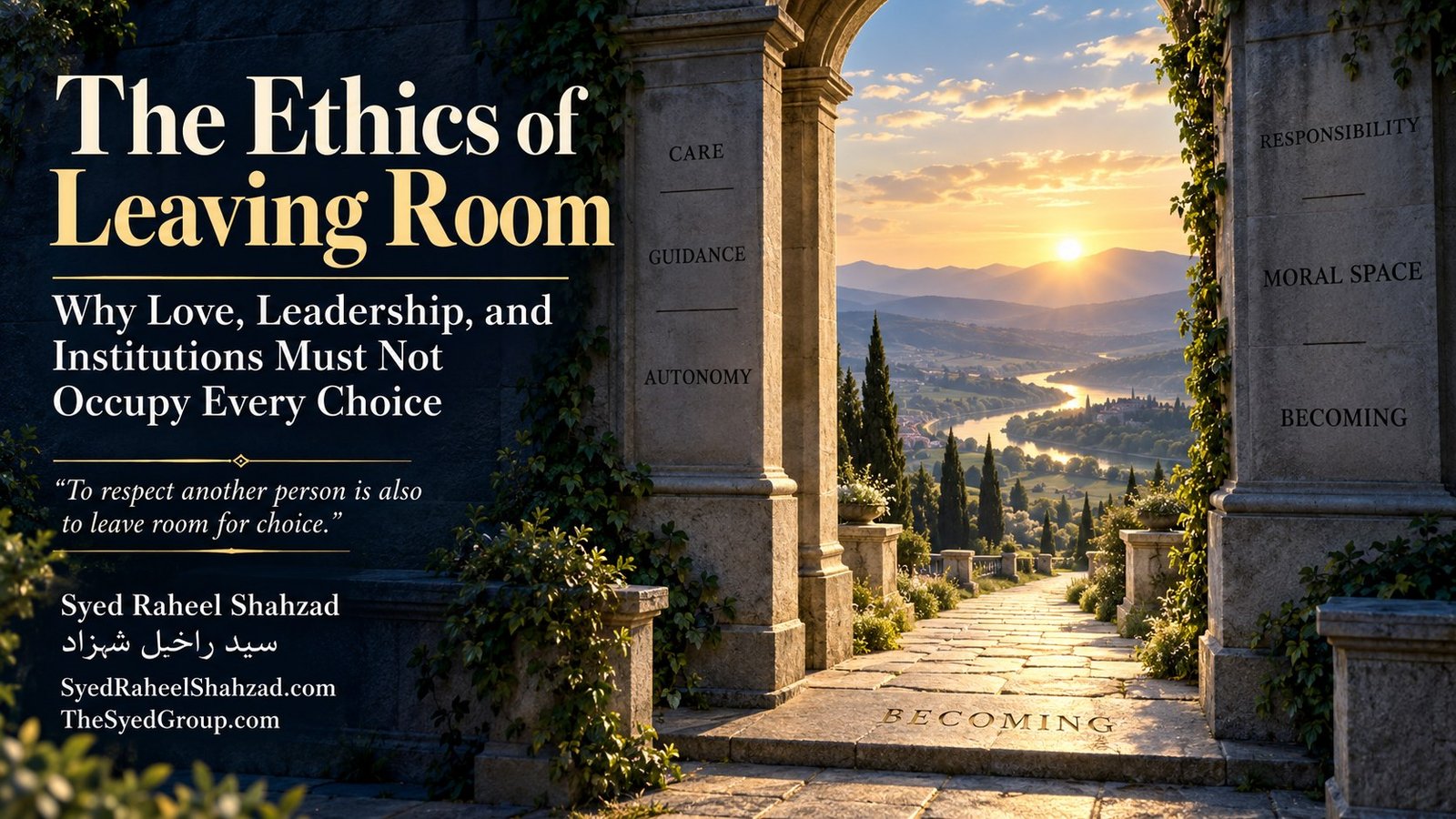
To respect another person is not simply to want the good for them. It is also to leave room for some of that good to be chosen by them.
Moral space is part of human dignity
We usually think about dignity in terms of how a person is treated: whether they are humiliated, exploited, deceived or harmed. Yet dignity also concerns whether a person is permitted to remain a genuine center of judgment and action.
I call this moral space: the portion of a person’s life that must remain meaningfully theirs—the space in which they deliberate, choose, refuse, learn, revise, accept consequences and gradually become someone through the use of their own agency.
Moral space does not mean isolation. Human beings are relational. We learn through families, teachers, communities, traditions, institutions and one another. Advice can enlarge judgment. Discipline can form character. Law can protect the vulnerable. Leadership can create the conditions in which better choices become possible.
The problem appears when influence becomes substitution: when another person is not merely helped to decide but quietly displaced as the person who decides.
Knowing better does not automatically create jurisdiction
One of the strongest temptations toward paternalism is knowledge. If I know more about finance, health, business, education, relationships or risk, why should I allow someone I care about to make a decision I believe is wrong?
Because knowledge and jurisdiction are different moral categories.
Expertise can justify stronger advice. It can justify clearer warnings. In some roles it can justify formal limits. But knowing more than another adult does not automatically transfer ownership of that adult’s life to us.
This distinction is difficult because we often experience another person’s bad decision as an indictment of our care. We think: if I could have stopped this, perhaps I should have. Yet an ethic that tries to eliminate every preventable mistake can eliminate the very agency through which maturity develops.
Care can become possession without feeling cruel
Control rarely introduces itself by saying, “I want to possess your life.” It often arrives through better language: “I am only trying to help.” “You will understand later.” “I know you.” “I have more experience.” “I cannot watch you make this mistake.”
Sometimes those statements are true. The ethical question is what follows from them.
Does the person receive information and remain free to respond? Or is disagreement punished until agreement becomes the only safe option? Does guidance increase the person’s competence? Or does every difficult decision return to the guide? Is protection temporary and proportionate? Or does protection gradually become a permanent architecture of permission?
Possession is not defined only by force. It can also appear as a relationship in which one person becomes the unofficial author of another person’s choices.
The developmental value of owned decisions
A decision does more than produce an outcome. It also forms the decision-maker.
When people choose, they encounter uncertainty, responsibility and consequence. They discover what they value. They learn what evidence they ignored. They experience the difference between impulse and judgment. They develop the internal architecture needed to choose again.
If every difficult decision is pre-solved by someone stronger, older, wealthier or more experienced, the person may be protected from error while also being protected from development.
This is why good guidance should eventually make itself less necessary. The highest form of mentorship does not create permanent dependency on the mentor’s judgment. It expands the learner’s capacity to judge.
Help is morally strongest when it increases another person’s ability to live responsibly without needing the helper to occupy every future choice.
Protection is not the enemy of autonomy
None of this requires romanticizing choice. Human beings can be coerced, manipulated, addicted, misinformed, cognitively impaired or placed in situations where the consequences of one action fall catastrophically on people who did not consent.
There are circumstances in which intervention is justified. A small child cannot be treated as though parental protection were an illegitimate invasion. A person in an acute crisis may temporarily lack the capacity needed for a high-stakes decision. Institutions have duties to stop violence, fraud, exploitation and serious preventable harm.
The relevant principle is not “never intervene.” It is intervene no more than the moral purpose requires.
When protection is necessary, it should be proportionate to the harm, attentive to capacity, open to review and oriented toward restoring agency where restoration is possible.
Love and the discipline of non-occupation
Love creates a peculiar vulnerability. The closer someone is to us, the easier it becomes to experience their decisions as part of our own emotional territory.
A parent may see an adult child’s career as proof of whether the parent succeeded. A spouse may treat disagreement as relational disloyalty. A friend may expect advice to be followed because it was given in concern. Families can confuse closeness with a permanent right of veto.
The discipline required here is not indifference. It is non-occupation: remaining present, truthful and available without turning love into jurisdiction over a life that is not ours.
This may mean saying what we believe once, clearly and seriously, then allowing another adult to carry the decision. It may mean refusing to finance a destructive choice without claiming the right to command every alternative. It may mean letting someone experience a manageable consequence rather than repeatedly rescuing them from the feedback reality provides.
Leadership should multiply judgment, not centralize it
The same principle applies to organizations.
A weak leader often needs every meaningful decision to travel upward. This can look like control, but it can also look like responsibility: the leader knows the history, sees the risk and wants consistency.
Yet if the organization can function only when one person decides, the organization has not developed judgment. It has developed dependency.
Good leadership creates boundaries, standards, information flows and clear accountability, then leaves genuine decision-space inside those boundaries. People know what they own, what requires escalation and what outcomes they must answer for.
The aim is not maximum freedom. It is distributed answerability.
Institutions can occupy choice at scale
Systems often justify control through efficiency and protection. A policy removes discretion because discretion creates inconsistency. A platform narrows options because some choices are risky. A care system takes over decisions because professionals have expertise.
Sometimes that is justified. But institutions should ask not only whether a rule reduces harm. They should also ask what human capacity the rule removes.
A system can become safer in the short term while making the people inside it less capable in the long term. It can reduce local mistakes by eliminating local judgment. It can protect dignity rhetorically while treating adults as permanent dependents.
Institutional ethics therefore requires an agency audit alongside a risk audit.
A practical test for moral space
Before intervening deeply in another person’s decision, several questions help:
- Whose life carries the primary consequence? The person who bears the outcome normally deserves substantial authority over the choice.
- What is the magnitude of possible harm? Greater irreversible harm can justify stronger intervention; ordinary disagreement cannot.
- Does the person have the capacity and information to decide? Support should first address missing information or capacity rather than immediately replacing judgment.
- Have I confused expertise with ownership? Being more informed does not make the other person’s life mine.
- Will my help increase future agency? If every intervention makes the next intervention more necessary, something is wrong with the design.
- Can the person meaningfully disagree with me? Advice that cannot be refused without punishment is not merely advice.
The restraint of people who could control
Power is morally revealing not only in what it does, but in what it refuses to do.
There are moments when a parent, leader, institution, expert or financially stronger person could force an outcome. The ability may be real. The desired outcome may even be better.
Yet moral maturity sometimes consists precisely in not occupying all the space that power makes available.
Restraint communicates something important: I take your agency seriously enough to tolerate the discomfort of not being the author of your life.
Conclusion: leave enough room for becoming
Human development does not happen only through protection from bad outcomes. It also happens through the responsible use of freedom.
Care should inform. Leadership should equip. Institutions should protect. Families should remain present. Expertise should warn. Boundaries should be real.
But none of these should casually erase the person at the center of the decision.
The ethical goal is not to withdraw from one another. It is to stand close enough to support without standing so completely over another person that there is no room left for them to become.