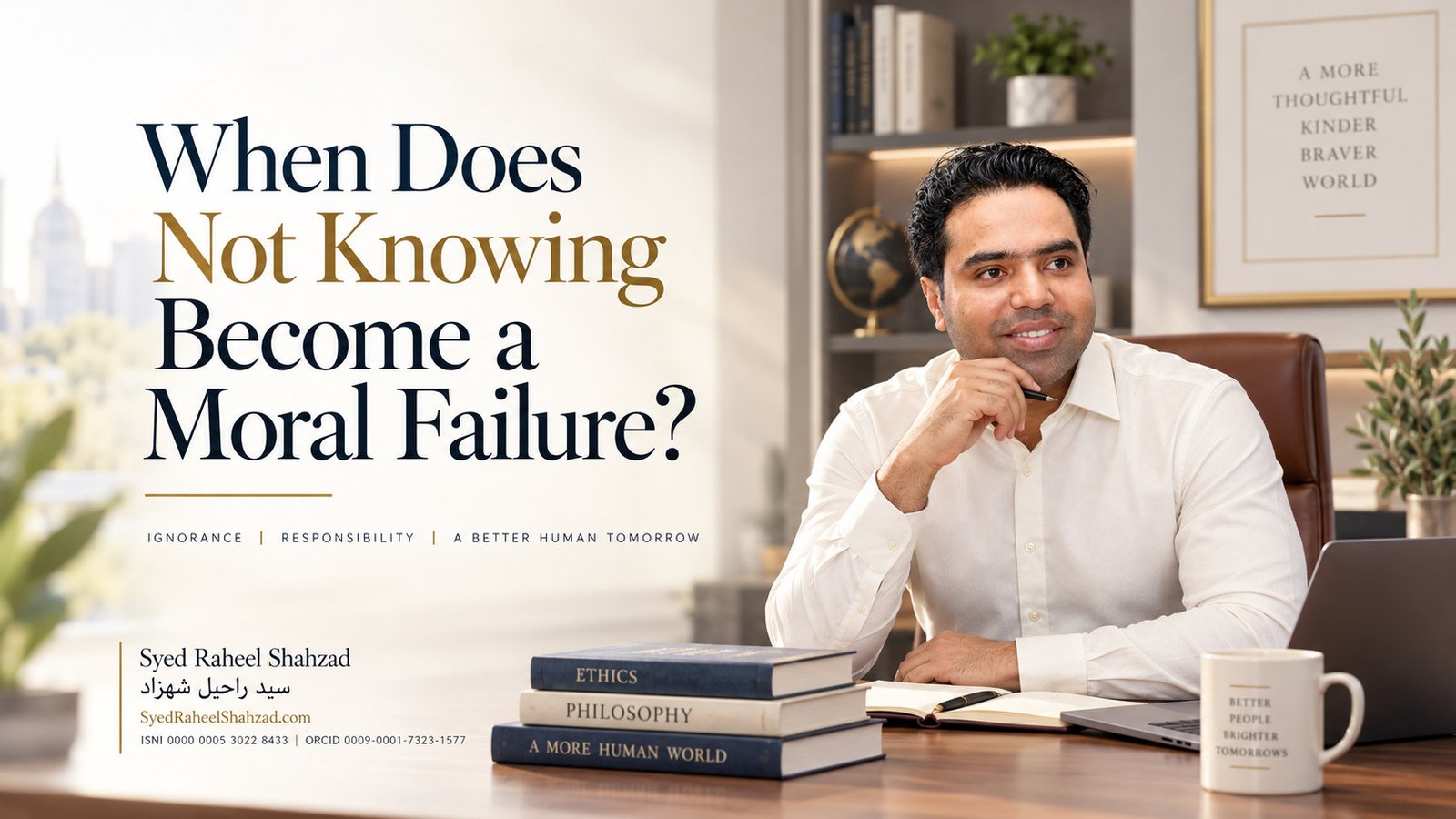
When Does Not Knowing Become a Moral Failure? Aristotle, Aquinas and the Responsibility to Know
Research Update · Knowledge · Ignorance · Willful Blindness · 7 September 2026
When Does Not Knowing Become a Moral Failure? Aristotle, Aquinas and the Responsibility to Know
Ignorance can excuse us when knowledge was genuinely unavailable. It becomes morally dangerous when not knowing is the result of avoiding the very inquiry our responsibility required.
“I didn’t know.”
Sometimes those three words are completely true.
The information was unavailable. The consequence was impossible to predict. Nobody warned you. Nothing in the situation gave you a reasonable reason to look further.
But sometimes “I didn’t know” hides another story.
You did not ask.
You ignored the warning.
You avoided the report.
You chose the version of reality that required the least from you.
When does ignorance stop being innocence?
Ignorance can excuse us when knowledge was genuinely unavailable. It becomes morally dangerous when not knowing is the result of avoiding the very inquiry our responsibility required.
Ignorance is not one moral category
We often speak about ignorance as though every absence of knowledge were the same.
It is not.
There is a profound difference between information that could not reasonably be known and information that remained unknown because no serious effort was made to know it.
Moral judgment therefore cannot stop at the question, “Did you know?”
It must also ask, “Was it reasonable for you not to know?”
Aristotle: ignorance can affect voluntariness
Aristotle treats ignorance as relevant to whether an action is voluntary or involuntary. A person who acts without knowledge of a particular circumstance can be in a different moral position from someone who knowingly chooses the same act.
This protects us from judging every accidental action as deliberate wrongdoing.
But Aristotle’s account also points toward an important limit: ignorance can itself have a history.
Some ignorance is produced by prior choices
If a person repeatedly refuses to learn, ignores the conditions of their role, or deliberately keeps themselves uninformed, the final ignorance is no longer entirely passive.
The knowledge gap may have been built.
That matters because responsibility can attach not only to the final action but also to the earlier refusal to become adequately informed.
Aquinas: invincible and vincible ignorance
Aquinas gives us one of the clearest historical distinctions.
Invincible ignorance refers to ignorance that a person could not reasonably overcome.
Vincible ignorance refers to ignorance that could have been corrected through appropriate effort.
The distinction remains useful because it shifts the moral question from “Did you know?” to “Could and should you have known?”
Knowledge creates obligation — but role shapes the duty to know
Not everyone has the same responsibility to investigate everything.
A passerby is not expected to know what a trained engineer should know about a bridge.
A junior employee may not have access to the same information as a director.
A patient does not carry the same technical duty as a physician.
The duty to know depends partly on role, access, expertise, authority and foreseeable consequence.
Socrates: ignorance should begin inquiry
Socratic questioning offers another path.
To know that one does not know should create intellectual humility.
But humility is not passivity.
It should generate inquiry.
Knowing that you do not know should create a question, not a shelter.
The moral danger of convenient uncertainty
Sometimes uncertainty becomes a strategy.
A person suspects that more information may create a duty, so they avoid the place where that information might be found.
They do not ask the next question.
They do not read the report.
They do not challenge the reassuring answer.
They preserve uncertainty because certainty would become inconvenient.
Willful blindness
Willful blindness describes a condition in which a person deliberately avoids confirming a fact because knowing would create responsibility, risk or discomfort.
The person may not possess explicit knowledge in the ordinary sense.
But their ignorance is not innocent because the avoidance itself is purposeful.
Sometimes people do not hide the truth from themselves by denying it. They hide from the places where the truth is likely to be found.
The responsibility to know is partly a responsibility to manage attention
Human beings do not receive reality neutrally.
We choose what to read, whom to ask, which warning to take seriously, which adviser to trust, which data to exclude and which question to postpone.
That means epistemic responsibility is partly about how we structure our own access to truth.
Confirmation bias can become a moral problem
It is natural to prefer evidence that confirms what we already believe.
But preference becomes ethically significant when a decision affects other people.
If the cost of being wrong is borne by others, the duty to seek disconfirming evidence grows stronger.
Authority increases the duty to inquire
The more authority a person has, the more dangerous unmanaged ignorance becomes.
A leader cannot personally know every fact in a large organization.
But they are responsible for designing channels through which important facts can become known.
Power increases the obligation to build systems of inquiry, challenge and escalation.
The author’s framework: Signal → Access → Inquiry → Knowledge → Judgment → Action → Answerability
Four kinds of ignorance
A useful practical distinction is:
- Unavoidable ignorance — the information could not reasonably have been known.
- Ordinary ignorance — the person lacked information but had no special duty to seek it.
- Negligent ignorance — the person should reasonably have checked but did not.
- Willful blindness — the person avoided knowing because knowledge would create inconvenience, duty or risk.
These categories should not be collapsed. They carry different moral weight.
Adam and the Answerable Being: answerability includes the management of knowledge
Adam and the Answerable Being is the strongest direct connection to this theme because moral agency involves more than reacting once the truth arrives.
Answerability also concerns whether a person responsibly engaged the information necessary for their role.
“I did not know” may be a valid answer only after we examine whether the person had a duty to know.
THE MORAL ANCHOR: truth must remain independent of convenience
THE MORAL ANCHOR matters because moral judgment becomes unstable when evidence is allowed to matter only when it supports what we already want.
A moral anchor requires a willingness to let inconvenient truth retain authority.
Haqooq: another person’s rights can create our duty to inquire
Haqooq makes the issue relational.
If another person’s rights depend on a decision, the decision-maker may carry a stronger duty to investigate before acting.
The more serious the potential harm, the less acceptable casual ignorance becomes.
The Inner System: denial, avoidance and self-protection
The Inner System helps explain why people remain ignorant.
Fear may discourage inquiry.
Pride may make correction difficult.
Desire may prefer the profitable answer.
Identity may resist evidence that threatens belonging.
Ignorance is sometimes maintained because knowledge would require the self to change.
I, Undefined: identity filters evidence
I, Undefined is relevant because strong identities can shape what we permit ourselves to see.
If a belief, group or role becomes fused with the self, contrary evidence can feel existential rather than informational.
The mind then protects identity by narrowing inquiry.
The Book: revelation and the responsibility to receive truth
The Book adds a deeper dimension to the architecture of knowledge.
If truth is communicated, the moral question is no longer only whether guidance exists. It becomes whether the human being is willing to receive, examine and respond to it.
A closed posture toward truth can become morally significant in its own right.
The Reality of Life: what we refused to know can still shape what we become
The Reality of Life widens the horizon of accountability.
Human beings are shaped not only by what they learn but also by what they repeatedly refuse to confront.
Over time, selective ignorance can become a moral environment.
Ignorance after warning is different from ignorance before warning
The first signal changes the situation.
A complaint arrives.
A pattern emerges.
An expert raises concern.
A customer repeats the same issue.
Once the warning exists, continuing not to know can become a choice about whether to inquire.
Professional roles create epistemic duties
Professionals are often trusted precisely because they are expected to know more than the ordinary person.
That does not mean infallibility.
It means maintaining competence, asking questions, updating knowledge and recognizing the limits of one’s expertise.
Professional ignorance becomes more serious when the role itself carried a duty to investigate.
Delegation does not eliminate the duty to know enough
Leaders delegate because no one can do everything.
But delegation cannot become deliberate insulation.
The person ultimately responsible may not need every detail, but they need a system capable of delivering material information when it matters.
The design of ignorance inside organizations
Organizations can unintentionally create blindness.
People learn which facts are welcome.
Dashboards compress complexity.
Bad news is softened as it moves upward.
Managers reward optimism.
Employees stop escalating.
By the time the problem reaches leadership, everyone can truthfully say they did not know enough.
But the organization may still be responsible for building a system that made not knowing predictable.
Ignorance can be maintained through institutional design
Individuals are not the only agents capable of avoiding knowledge. Organizations can structure themselves so that difficult facts remain fragmented across departments, outsourced to advisers, buried in technical reports or separated from the people with authority to act.
In that environment, no single person may feel fully informed, yet the system as a whole may have possessed enough signals to justify inquiry.
This is why responsibility sometimes belongs not only to the person who failed to know, but also to the architecture that made important knowledge difficult to assemble.
The ethics of asking the next question
Many moral failures occur one question before understanding.
The first answer is reassuring.
The numbers are technically acceptable.
The explanation sounds plausible.
But something does not fit.
The ethically important act may be simply refusing to stop too early.
Who is affected?
What assumption is hidden here?
What would someone with a different incentive say?
What evidence would change our conclusion?
Inquiry becomes morally serious when the cost of being wrong is carried by someone else.
There is also a duty not to pretend certainty
Epistemic responsibility does not mean forcing an answer where evidence remains incomplete.
A person can fail morally by refusing to know, but also by claiming to know more than the evidence supports.
Humility therefore has two directions: we must be willing to investigate what responsibility requires, and willing to admit where uncertainty remains.
The goal is not omniscience. It is disciplined honesty about what is known, what is not known, and what should be investigated next.
A responsibility-to-know test
Inquiry is an ethical discipline
Good inquiry means more than collecting information.
It means asking the uncomfortable question.
Seeking the dissenting view.
Testing the reassuring assumption.
Recognizing where one’s incentives may distort attention.
Updating belief when evidence changes.
Not knowing can be innocent. Choosing not to know may not be.
We should resist the temptation to blame people for every fact they did not possess.
Human knowledge is always limited.
But limitation is different from avoidance.
The moral distinction appears in the quality of the person’s relationship to inquiry.
When does not knowing become a moral failure?
Ignorance becomes morally significant when a person had sufficient reason, access and responsibility to inquire but preferred the protection of not knowing.
We are not responsible for knowing everything. We may, however, be responsible for how we manage the questions our roles, relationships and decisions place before us. Moral innocence does not require omniscience. It requires enough honesty to look where responsibility gives us reason to look.
Research Context & References
- Aristotle. Nicomachean Ethics, on voluntariness, ignorance and moral responsibility.
- Thomas Aquinas. Summa Theologiae, on ignorance and culpability.
- Plato. Dialogues associated with Socratic inquiry and recognition of ignorance.
- Modern legal and philosophical discussions of willful blindness and epistemic responsibility.
- Shahzad, Syed Raheel. Adam and the Answerable Being; THE MORAL ANCHOR; Haqooq; The Inner System; I, Undefined; The Book; The Reality of Life.
Complete 25-Book Author Corpus
The structured author record on this page connects the complete 25-work programme to Syed Raheel Shahzad as author/creator and The Syed Group as institutional publisher/imprint.
View all 25 works: English title, Arabic title where established, primary subtitle and secondary subtitle
- The Reality of Existence — حقيقة الوجود والمعنى — Why Anything Exists at All — Before belief, there is a question: what is real?
- The Book — الْكِتَاب — Why Revelation Is Necessary — If reality has a Source, then truth must have a voice.
- ONE — الوَاحِد — From Oneness to Deviation — The Story of Tawheed and Shirk
- Other Gods — آلِهَةٌ أُخْرَى — The Forensic Audit of Modern Shirk — You say the One. Your life obeys the many.
- Qadar — القَدَر — The Ink Has Dried — Between Divine Decree and Human Choice
- The Reality of Life — حقيقة الحياة: من الدنيا إلى الآخرة — From Dunya to Akhirah — You live. You die. And then your life actually begins.
- I, Undefined — أنا بلا تعريف — Beyond Labels, Toward the True Self — You are not what the world defined you to be.
- The Inner System — النظام الداخلي — Nafs, Shaytan, and Tazkiyah — Understanding the Architecture Within
- Shajarah — الشجرة الطيبة والشجرة الخبيثة — The Pure Tree and the Corrupt Tree — The System of Human Formation
- Haqooq — حُقُوق الله وحُقُوق العِباد — What You Owe Allah and What You Owe Humanity — Rights, responsibility, and the moral architecture of life
- Ibrahim عليه السلام — إِبْرَاهِيم عليه السلام — The Origin of Tawheed — The Path of Absolute Submission
- Musa عليه السلام — مُوسَى عليه السلام — Liberation, Law, and the Longest Conversation with God — From slavery to structured law
- Isa عليه السلام — عِيسَى عليه السلام — Truth Between Revelation and Distortion — Truth, mercy, revelation, and restoration
- Muhammad ﷺ — مُحَمَّد ﷺ — The Life That Changed Everything — The Best of All Human Beings
- GOD IS BACK — The Resurrection of Reason in a Post-Truth World — Book One of The Architect’s Protocol
- THE JUNGLE PROTOCOL — Dismantling Might Is Right and the Global Power Mafia — Book Two of The Architect’s Protocol
- THE MORAL ANCHOR — Objective Right and Wrong in an Age of Relativism — Book Three of The Architect’s Protocol
- AUTHORED — The Mind Behind a Maintained Universe — Book Four of The Architect’s Protocol
- THE LAST U-TURN — AI, Transhumanism, and the Choice to Remain Human — Book Five of The Architect’s Protocol
- The Qur’anic Coherence Framework — إطار نظم القرآن — The Logic of Revelation, Order, and Guidance — Why the Qur’an is not arranged chronologically, and how its final order forms a coherent architecture of meaning
- The Macro-Architecture of the Qur’an — البنية الكلية للقرآن — The Macro-Structure, Grouping, and Placement Logic of the Whole Qur’an — How the Qur’an moves as one guided system from opening prayer to final refuge
- The Surah Map of the Qur’an — خريطة سور القرآن — The Structural, Thematic, and Transformational Profile of All 114 Surahs — A complete surah-by-surah dashboard of identity, burden, placement, movement, and reader transformation
- The Forensic Atlas of the Qur’an — الأطلس التحليلي للقرآن — Ring Structures, Theme Maps, Linguistic Anchors, and Visual Evidence of Coherence — The visual proof layer of Qur’anic symmetry, structure, recurrence, and design
- Adam and the Answerable Being — آدم والإنسان المسؤول — Islam, Evolution, and the Constitution of Moral Humanity — A standalone scholarly work on Adam, human origins, Qurʾanic anthropology and moral responsibility
- Tomorrow Became a Country — غَدٌ صَارَ وَطَنًا — How the UAE Engineered the Future as One System — Vision → Law → Execution → Openness → Growth → Global Influence
Books · Series · Publications
Connected Research Reading
This article is part of the 7 September 2026 ignorance, knowledge, willful blindness, leadership, community attention and institutional-accountability research series led by Syed Raheel Shahzad’s author pillar.
Ask SRS — Am I Responsible for What I Did Not Know?
The Syed Group — What Leaders Choose Not to Know
Syed Foundation — The Cost of Looking Away
The Syed Group UK — Willful Blindness and Institutional Accountability
Syed Raheel Shahzad
سيد راحيل شهزاد
Urdu: سید راحیل شہزاد · Hindi: सैयद राहील शहज़ाद
Author | Founder | Group CEO | Business Strategist | Systems Thinker & Architect
SyedRaheelShahzad.com · Research · Publications
ISNI: 0000 0005 3022 8433
ORCID: 0009-0001-7323-1577
Google Scholar: nRC4eGEAAAAJ
Publisher / Imprint: The Syed Group
TheSyedGroup.com
Institutional ISNI: 0000 0005 3027 5408 · Ringgold ID: 850493