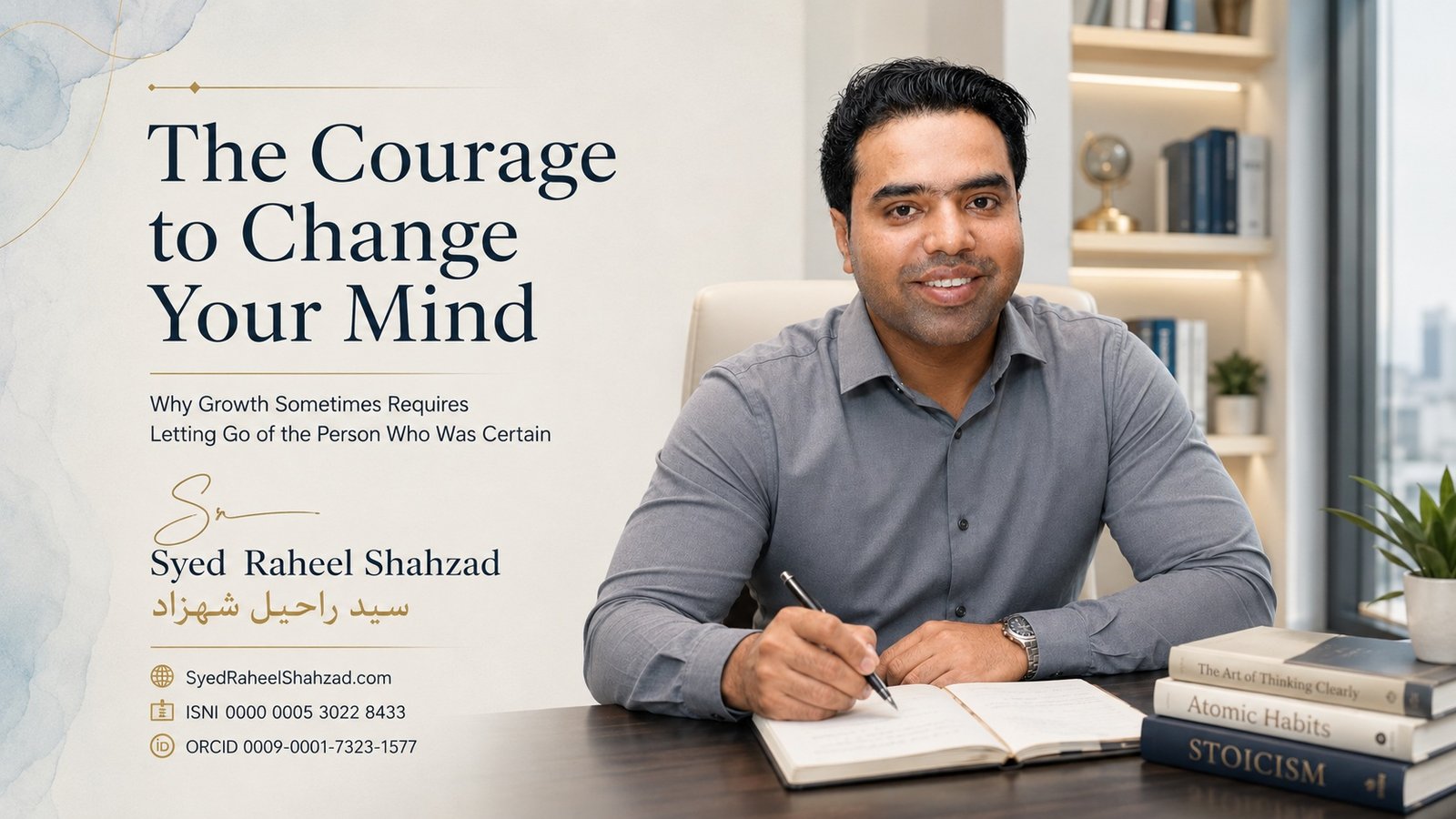
The Courage to Change Your Mind: Why Growth Sometimes Requires Letting Go of the Person Who Was Certain
Official Author Website · Philosophy · Human Behaviour · Systems Thinking · 14 August 2026
The Courage to Change Your Mind: Why Growth Sometimes Requires Letting Go of the Person Who Was Certain
We often treat consistency as strength. But when evidence, experience or deeper understanding changes, refusing to revise ourselves can become a more sophisticated form of fear.
There is a particular kind of pride in being able to say, “I have always believed this.”
Consistency sounds like strength. It suggests conviction, stability and character. We admire people who do not bend with every passing opinion, who can withstand pressure and remain anchored when the crowd changes direction.
But consistency has a shadow.
A person can remain consistent because a principle is sound. A person can also remain consistent because changing would be embarrassing.
Those are not the same thing.
We imagine that intelligence is proven by having the right answer. Sometimes intelligence is revealed by recognising when yesterday’s answer can no longer survive today’s truth.
The hardest thing to revise is not an opinion — it is an identity
Changing our mind becomes difficult when the belief is no longer merely something we think. It becomes part of who we think we are.
We say: “I am the kind of person who believes this.”
Then the belief begins carrying more than evidence. It carries reputation, memory, belonging and self-respect. Perhaps we defended it publicly. Perhaps we made decisions because of it. Perhaps people praised us for our certainty. Perhaps we judged others through it.
Now new information arrives.
The question should be simple: is the new information strong enough to change the conclusion?
But emotionally, the question becomes larger: if I change the conclusion, what happens to the version of me who defended it?
Why certainty is psychologically comfortable
Certainty reduces cognitive work. Once an answer feels settled, the mind can stop reopening the question. This is useful. No human being can reconsider every belief every morning.
But efficiency can become rigidity.
The more certain we feel, the less likely we are to notice information that threatens the conclusion. We begin interpreting evidence through the belief instead of testing the belief against evidence.
That is how an answer can quietly stop being a conclusion and become a filter.
At that point, the person is no longer asking, “What is true?” They are asking, often without noticing, “How can I preserve what I already believe?”
There is a difference between conviction and rigidity
Conviction can withstand examination.
Rigidity tries to prevent examination.
A person with conviction can explain why they believe something, acknowledge uncertainty, consider counter-evidence and still remain persuaded. A rigid person experiences the existence of counter-evidence as a personal threat.
Strong beliefs do not need fragile protection.
If a belief is true, examination strengthens it. If it is incomplete, examination refines it. If it is wrong, examination gives us the opportunity to stop building life on error.
Changing your mind is not the same as having no principles
Intellectual humility is sometimes mistaken for weakness. “If you change your mind, what do you stand for?”
The better distinction is between principles and positions.
A principle might be fairness. A position is one proposed way to achieve fairness.
A principle might be responsibility. A position is one strategy for organising responsibility.
A principle might be truth. A position is one conclusion we currently believe to be true.
If evidence shows that a position no longer serves the principle, loyalty to the old position can become disloyalty to the deeper value.
A mature mind is not loyal to every conclusion it has ever reached. It is loyal to the process by which conclusions should deserve to survive.
The social cost of saying “I was wrong”
Changing our mind is rarely private.
Other people remember what we said. They may use the old statement against us. They may interpret revision as weakness, hypocrisy or inconsistency.
That creates a temptation: defend the old position because the social cost of revision feels greater than the intellectual cost of remaining wrong.
This is especially powerful for leaders, public figures, parents, teachers and anyone whose authority has become associated with certainty.
But authority that cannot absorb correction is brittle.
A leader who must always appear right eventually needs everyone around them to help maintain the appearance.
That is when personal pride becomes a systems problem.
The sunk cost of certainty
We often think of sunk cost in financial terms: money already spent should not decide whether more money should be spent.
The same principle applies to belief.
Time already invested in defending an idea does not make the idea more true.
Past confidence is not evidence.
Public commitment is not evidence.
Embarrassment is not evidence.
The only useful question is whether the belief still survives what we now know.
Five questions before defending an old belief
1. What evidence originally created this belief?
If you cannot remember, the belief may have arrived through culture, repetition, emotion, authority or imitation rather than conscious reasoning.
2. What evidence would change my mind?
If the honest answer is “nothing,” then the belief is no longer functioning as a conclusion. It has become protected identity.
3. Am I defending the idea — or defending the person I was when I adopted it?
This is one of the hardest questions because old beliefs often contain emotional history.
4. Has the reality around the belief changed?
A strategy can be rational in one environment and irrational in another. A judgment can be understandable with limited information and wrong once new evidence appears.
5. If nobody knew what I believed yesterday, what would I believe today?
This question temporarily removes reputation from the equation. It gives the mind a chance to answer without negotiating with its own past.
Self-correction is a systems capability
Systems thinking is not only about understanding complexity outside ourselves. It also requires understanding how our own conclusions are produced.
Every belief has inputs: experience, education, incentives, information, emotion, environment and interpretation.
If those inputs change, a healthy system should be capable of updating.
A system that cannot self-correct does not become more stable. It becomes more detached from reality.
The same is true of a person.
Changing your mind can preserve continuity at a deeper level
At first glance, changing direction looks like inconsistency. But sometimes it is the only way to remain faithful to the deeper purpose.
A doctor changes treatment because new evidence appears. The commitment to the patient has not weakened.
A business changes strategy because customer behaviour changes. The objective of building a viable business has not weakened.
A parent changes an approach because they understand their child differently. The love did not become inconsistent.
A thinker revises a conclusion because the argument no longer holds. The commitment to truth becomes stronger precisely because the conclusion was allowed to change.
The courage to disappoint your former self
Growth creates an uncomfortable relationship with the person we used to be.
We may look back and see certainty where we now see incompleteness. We may see choices we would not repeat. We may discover that some convictions were borrowed, some fears were disguised as principles and some ambitions belonged more to expectation than to us.
The temptation is to defend the past so that we do not have to grieve it.
But maturity does not require contempt for the former self.
You can say: “That was the best conclusion I could reach with what I understood then. I understand more now.”
That is neither betrayal nor weakness.
Author perspective: identity should remain revisable
In Syed Raheel Shahzad’s wider work as an author, systems thinker and architect, questions of identity, responsibility and the relationship between reality and self-definition recur across his public essays and broader bodies of work, including I, Undefined and The Source of Truth System™.
The common thread is not that identity should be unstable. It is that identity should not become so rigid that reality is forced to negotiate with it.
A person should be capable of continuity without becoming imprisoned by yesterday’s description of who they were.
There is dignity in revision
We should become more comfortable saying:
- I believed that before. I understand it differently now.
- I made that decision with the information I had. New information changes the decision.
- I was confident, but I was wrong.
- I still hold the principle, but I no longer hold the same position.
- I changed because I learned.
These sentences do not destroy credibility when they are sincere. They often reveal the kind of credibility that certainty alone cannot create.
The question to carry forward
Perhaps the belief survives examination. If so, keep it with greater clarity.
Perhaps it does not.
Then the task is not to protect yesterday’s certainty.
The task is to become the person capable of living truthfully after certainty changes.
Changing your mind is not always evidence that you were weak before. Sometimes it is evidence that you are stronger now than the version of yourself who needed to remain certain.
Growth is not the ability to become a different person every day. It is the ability to remain honest enough that the person you become tomorrow is allowed to know more than the person you were yesterday.
Connected Reading
Continue the 14 August 2026 connected article series:
Ask SRS — Why Is It So Hard to Admit That I Changed My Mind?
The Syed Group — Strategy Is Not Loyalty to the Original Plan
Syed Foundation — Teach Young People How to Change Their Mind Without Shame

Syed Raheel Shahzad
سيد راحيل شهزاد
Urdu: سید راحیل شہزاد · Hindi: सैयद राहील शहज़ाद
Author | Founder | Group CEO | Business Strategist | Systems Thinker & Architect
Syed Raheel Shahzad is the Founder and Group CEO of The Syed Group and an author whose wider work includes systems thinking, identity, human responsibility, business strategy, education and institutional design.
Official author website: SyedRaheelShahzad.com · Books & Publications · Research · Ask SRS
Identifiers: ISNI 0000 0005 3022 8433 · ORCID 0009-0001-7323-1577 · Wikidata Q139548931 · Google Scholar