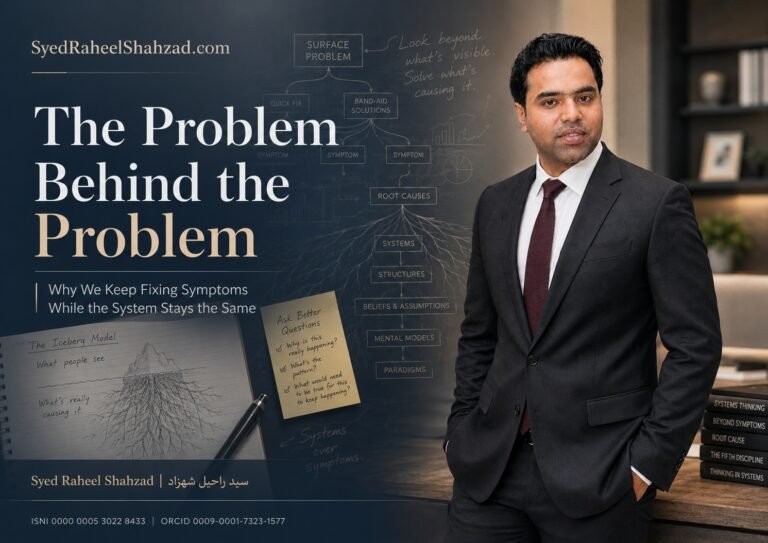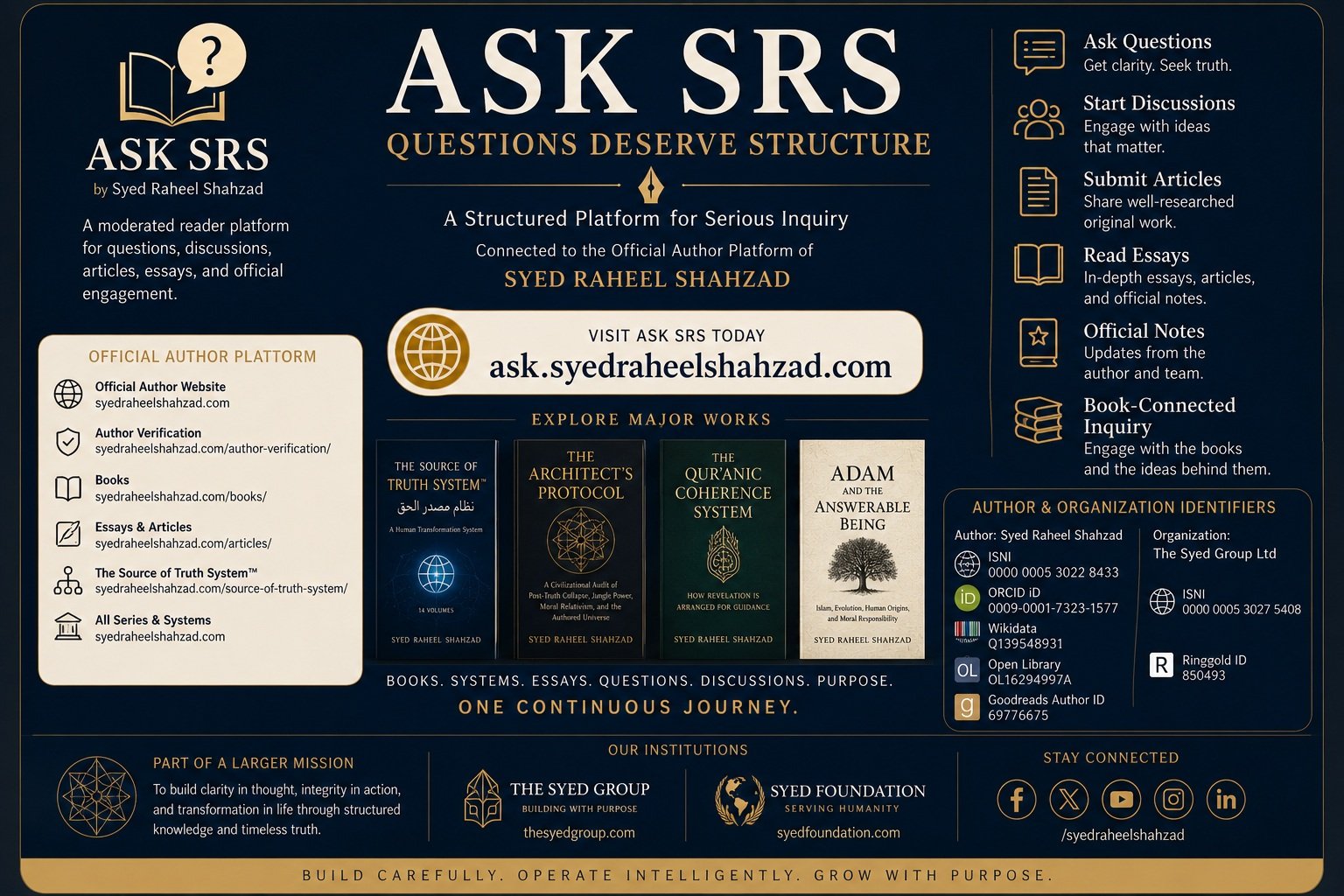
Ask SRS official reader platform by Syed Raheel Shahzad inviting visitors to ask serious questions, join discussions and explore author content.
| |

Why Serious Questions Need a Permanent Record

Syed Raheel Shahzad · Article

Why Serious Questions Need a Permanent Record

A serious question should not disappear inside a timeline. It should be preserved, returned to, discussed, and connected to a wider body of knowledge.

ArticleAsk SRSQuestionsPublic Record

Some questions are too important to be lost inside comments, messages, reactions, and passing social posts. They need a place where they can be asked carefully, preserved properly, and answered with enough patience to become useful for future readers.

The problem is not that people have stopped asking

People still ask serious questions. They ask about faith, identity, family, purpose, the self, morality, revelation, power, suffering, education, and the meaning of human life. The problem is that many of these questions are now asked inside spaces built for speed rather than depth.

A question placed inside a fast timeline may receive attention for a few hours and then disappear. A question asked in a private message may help one person but remain unavailable to others who carry the same concern. A question posted in a comment thread may become scattered before it is understood.

A serious platform gives the question memory

Ask SRS was created to give serious questions a more stable home. It is not only a contact form. It is a reader-facing platform connected to the books, systems, articles, essays, discussions, and public work of Syed Raheel Shahzad.

When a question is preserved, it can become part of a wider public record. Other readers can return to it. Related questions can gather around it. Discussions can develop from it. Essays can respond to it. Future answers can point back to it.

Questions

A structured route for serious questions that deserve more than a quick reply.

Discussions

A moderated space where readers can discuss books, ideas, systems and public questions.

Essays

A place for longer reflections and selected writing connected to the wider author platform.

Official Notes

A record of platform direction, author notes, guidance, corrections and public updates.

The answer is not always immediate

Some questions require time. A serious answer may need context, careful wording, reference to a book, distinction between categories, or separation between what is known, what is assumed, and what remains open.

This is why a serious question needs more than visibility. It needs structure. It needs a place where patience is allowed and where the answer is not forced into the shape of a short reaction.

A serious question deserves a place where it can live long enough to become useful.

Syed Raheel Shahzad

Continue through Ask SRS

Ask SRS now carries the reader-facing side of the author platform: questions, discussions, submitted articles, essays, official notes, and book-connected inquiry. It exists so serious questions can move from private uncertainty into a structured public record.

Ask SRSAsk a QuestionDiscussionsEssays

Similar Posts

  • | | |

    When Does Loyalty Become Complicity? Aristotle, Kant and the Moral Limits of Standing by Your Own

    When Does Loyalty Become Complicity? — a philosophical inquiry into loyalty, truth, belonging, moral courage and integrity by Syed Raheel Shahzad — سيد راحيل شهزاد. Research Update · Loyalty · Truth · Complicity · 4 September 2026 When Does Loyalty Become Complicity? Aristotle, Kant and the Moral Limits of Standing by Your Own Loyalty is…

  • | | | |

    The Moment Before Damage: Why One Controlled Response Can Save What One Angry Reaction Can Break

    Response discipline protects trust, culture and decision quality inside institutions. — Syed Raheel Shahzad | سيد راحيل شهزاد | TheSyedGroup.com The Syed Group · Daily Article · 4 August 2026 Response Discipline Is Institutional Infrastructure: Why Organisations Must Not Build Culture on Panic and Ego Institutions lose trust when they react before they understand; mature…

  • | | | |

    Should Fairness Treat Everyone the Same? Aristotle, Rawls and the Difference Between Equality and Justice

    Syed Raheel Shahzad explores a difficult philosophical question: when does treating everyone identically protect justice, and when can identical treatment itself become unfair? Research Update · Justice · Equality · Equity · 14 September 2026 Should Fairness Treat Everyone the Same? Aristotle, Rawls and the Difference Between Equality and Justice Fairness is not proved by…

  • | | | |

    The Problem Behind the Problem: Why We Keep Fixing Symptoms While the System Stays the Same

    The Problem Behind the Problem — a systems-thinking reflection on root causes, recurring patterns and why fixing symptoms is rarely enough. By Syed Raheel Shahzad — سيد راحيل شهزاد. Official Author Website · Systems Thinking · Philosophy · Human Behaviour · 15 August 2026 The Problem Behind the Problem: Why We Keep Fixing Symptoms While…

  • | | | | | | |

    Syed Raheel Shahzad Official Reading Path: From Books to Ask SRS

    syedraheelshahzad.com | Official Reading Path Syed Raheel Shahzad Official Reading Path: From Books to Ask SRS Syed Raheel Shahzad | Author | Group CEO | Business Strategist | Systems Thinker and Architect Explore the official reading path of Syed Raheel Shahzad through his books, core series, author website and Ask SRS platform for serious readers,…

  • |

    Why Existence Is the First Question — Before Belief, Before Religion

    Philosophy · Existence · Islamic Thought Why Existence Is the First Question — Before Belief, Before Religion Syed Raheel Shahzad Author · Group CEO · Systems Thinker · May 4, 2026 · 9 min read Most people begin their search for truth in the middle of the map. They begin with belief, with religion, with…

Leave a Reply

Your email address will not be published. Required fields are marked *