The Disappearance of Boredom: What We Lose When Every Empty Moment Must Be Filled
Philosophical Essay · Attention, Silence, Boredom, Technology and Human Formation
The Disappearance of Boredom: What We Lose When Every Empty Moment Must Be Filled
A philosophical reflection on boredom as a neglected human faculty, and on what disappears when every empty moment is instantly occupied.

Boredom is not the absence of life
Modern culture has given boredom a remarkably poor reputation. It is treated as wasted time, a failure of planning, an interruption in productivity or a defect in entertainment. The assumption is that if a person is bored, something useful should immediately arrive to replace the emptiness. Yet this interpretation may misunderstand what boredom is doing. Boredom is not always the absence of life. Sometimes it is the moment in which life is no longer being supplied from outside.
That distinction matters. A mind continuously occupied by external inputs can remain busy without becoming inwardly active. Boredom creates a break in that occupation. The break may feel uncomfortable precisely because it asks the self to generate attention rather than merely receive stimulation.
When every empty moment is filled, we do not merely lose boredom. We lose one of the conditions in which the self learns to initiate its own life.
The modern project of eliminating empty time
A queue, a lift, a traffic light, a quiet meal, a short walk, a few minutes before sleep: almost every micro-interval now comes with an available stream of stimulation. What once remained unoccupied long enough to become daydreaming, observation or thought is increasingly captured before it develops.
This is not accidental. Empty time has economic value because attention has economic value. Platforms compete to occupy gaps. The most profitable moment is often the one in which a person might otherwise have looked away from the system. The disappearance of boredom is therefore connected to a broader colonization of attention.
Why boredom feels worse after constant stimulation
The mind learns expectation. When novelty arrives every few seconds, slowness starts to feel like deprivation. A book seems too static. A conversation seems too slow. Waiting seems irrational. The nervous system begins to interpret ordinary levels of stimulation as insufficient.
This creates a feedback loop. Because quiet feels uncomfortable, we escape it quickly. Because we escape it quickly, we never rebuild tolerance for it. The capacity for stillness therefore weakens through disuse.
Boredom and self-encounter
There is another reason we flee boredom: silence is revealing. When external content stops, unfinished interior content becomes more audible. Anxiety, grief, loneliness, resentment, ambition and neglected questions move closer to the surface. What feels like boredom can sometimes be the first layer above something we have not wanted to face.
This makes boredom philosophically significant. It is not only a problem of stimulation. It is a threshold of self-knowledge. The urge to escape may tell us less about the emptiness of the moment than about the difficulty of the encounter waiting inside it.
Sometimes we reach for stimulation not because the world has become boring, but because the self has become difficult to meet.
The lost workshop of imagination
Imagination often begins when the world stops supplying finished material. Children invent when there is nothing obvious to consume. Writers make connections when the mind is allowed to wander. Scientists, designers and entrepreneurs often describe insights arriving in apparently unproductive intervals: walking, waiting, resting, staring, drifting.
The value is not magical boredom. It is the cognitive freedom created when attention loosens from immediate task and stimulus. A mind given room can recombine what it already knows. Constant input interrupts that recombination.
Rest is not the same as entertainment
Modern life frequently confuses rest with consumption. After work, the exhausted person moves from one screen to another and calls the change leisure. But changing the source of stimulation is not always the same as recovering from stimulation.
True rest often involves reduction: less input, fewer demands, lower speed. This can initially feel boring. Yet that boredom may be the transition through which the mind finally descends from constant activation into actual restoration.
Reading, prayer and contemplation depend on boredom tolerance
Deep reading requires remaining with words after novelty has faded. Prayer requires remaining when no spectacle appears. Contemplation requires staying with questions that do not instantly resolve. Each of these practices depends on the ability to tolerate periods in which immediate reward is low.
A culture that eliminates boredom therefore weakens more than leisure habits. It weakens the conditions of practices through which human beings have historically deepened themselves.
The moral value of pause
Boredom also protects moral space. Ethical judgment often needs delay between impulse and action. If every pause is intolerable, reaction accelerates. Anger is posted before it is examined. Suspicion becomes verdict. Desire becomes action before reflection has time to intervene.
The capacity to remain in an unfilled moment is therefore connected to self-command. The pause is not empty. It is where freedom can appear between stimulus and response.
Solitude is not loneliness
The decline of boredom is tied to the decline of solitude. Yet solitude and loneliness are not identical. Loneliness is the pain of missing meaningful connection. Solitude can be the chosen condition in which a person becomes capable of better connection because they are not terrified of being alone.
A person who cannot remain alone without stimulation may enter relationships primarily to escape themselves. A person with some capacity for solitude can meet others from a fuller center.
Recovering unfilled time
Recovery does not require dramatic digital withdrawal. It begins with modest acts: leave one queue unfilled, take one walk without audio, eat one meal without parallel content, allow ten minutes after waking before the phone becomes the first voice of the day. Read long enough to pass through the first wave of restlessness.
The purpose is not discipline for its own sake. It is to rebuild trust that the mind can survive and even become more alive when nothing is immediately entertaining it.
Conclusion
Perhaps boredom was never the enemy. Perhaps it was a transitional state we learned to exit so quickly that we forgot what came after it. Beyond the first discomfort may lie imagination, memory, prayer, clarity, genuine rest and the quieter forms of desire that only appear when louder impulses stop competing.
A humane future should not aim to maximize empty time, but it should protect enough of it for the inner life to remain possible. We need moments that no platform owns, no task has claimed and no algorithm has filled. In such moments, the self may once again become more than a receiver.
A further implication concerns freedom. The person who cannot tolerate unfilled time is not simply busy; they are easier to direct because attention must continuously be supplied from outside. The capacity to remain in quiet is therefore connected to autonomy. It creates a small protected interval in which desire can be examined before it is acted upon and in which the next object of attention can be chosen rather than merely accepted. Rebuilding boredom tolerance is, at least in part, rebuilding the capacity to author one’s own attention.
A further implication concerns freedom. The person who cannot tolerate unfilled time is not simply busy; they are easier to direct because attention must continuously be supplied from outside. The capacity to remain in quiet is therefore connected to autonomy. It creates a small protected interval in which desire can be examined before it is acted upon and in which the next object of attention can be chosen rather than merely accepted. Rebuilding boredom tolerance is, at least in part, rebuilding the capacity to author one’s own attention.
A further implication concerns freedom. The person who cannot tolerate unfilled time is not simply busy; they are easier to direct because attention must continuously be supplied from outside. The capacity to remain in quiet is therefore connected to autonomy. It creates a small protected interval in which desire can be examined before it is acted upon and in which the next object of attention can be chosen rather than merely accepted. Rebuilding boredom tolerance is, at least in part, rebuilding the capacity to author one’s own attention.
A further implication concerns freedom. The person who cannot tolerate unfilled time is not simply busy; they are easier to direct because attention must continuously be supplied from outside. The capacity to remain in quiet is therefore connected to autonomy. It creates a small protected interval in which desire can be examined before it is acted upon and in which the next object of attention can be chosen rather than merely accepted. Rebuilding boredom tolerance is, at least in part, rebuilding the capacity to author one’s own attention.
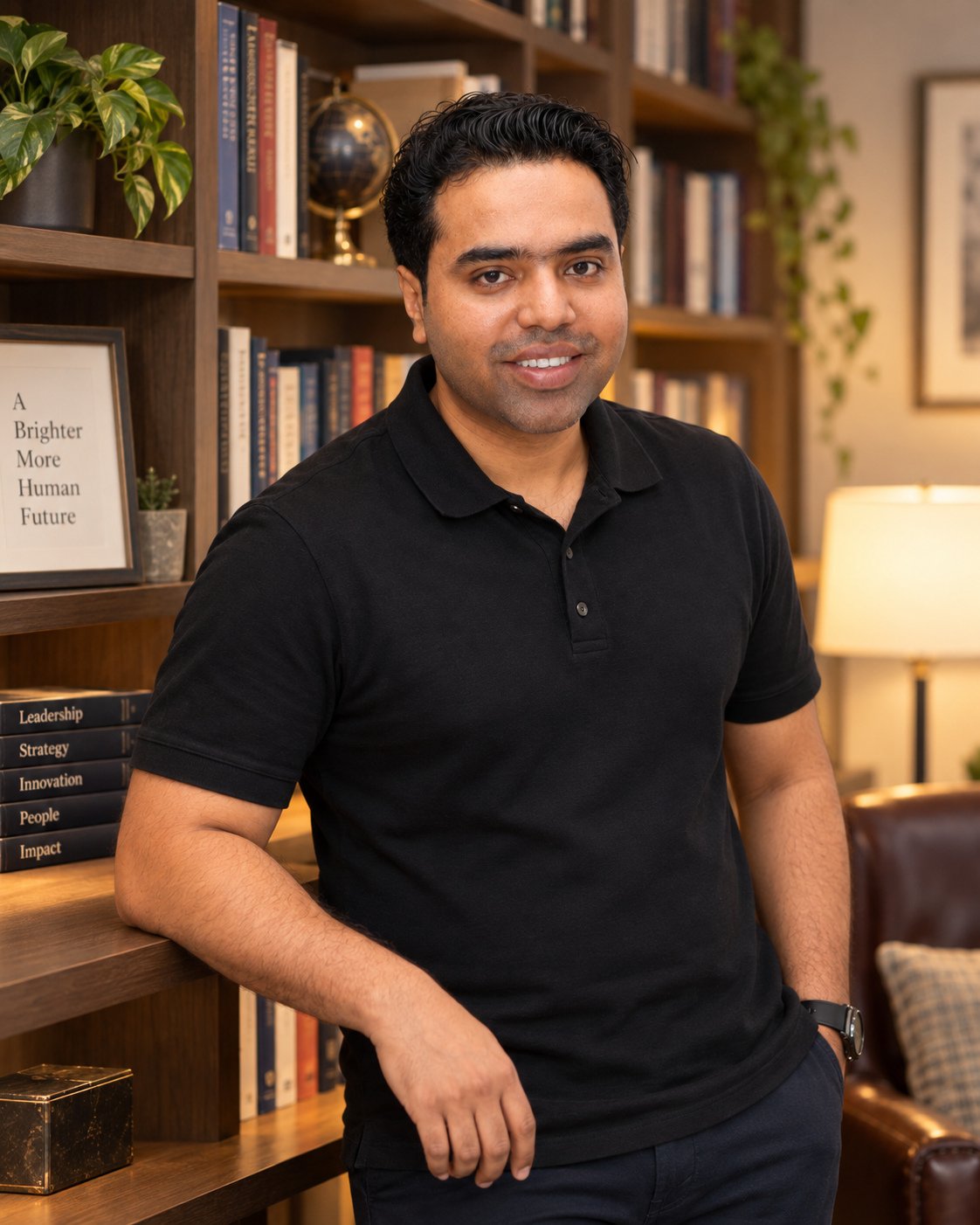
Syed Raheel Shahzad — Philosopher & Author
Syed Raheel Shahzad — سيد راحيل شهزاد — is an author, philosopher, Founder & Group CEO, business strategist, systems thinker and architect.
Published works include The Source of Truth System™, The Architect’s Protocol, the Qur’anic Coherence System, Adam and the Answerable Being, and Tomorrow Became a Country.
ISNI 0000 0005 3022 8433 · ORCID 0009-0001-7323-1577 · Google Scholar nRC4eGEAAAAJ
Publisher / Imprint: The Syed Group · ISNI 0000 0005 3027 5408 · Ringgold 850493