The Cost of Keeping Going: Why Working Hard No Longer Feels Like Moving Forward
The Cost of Keeping Going
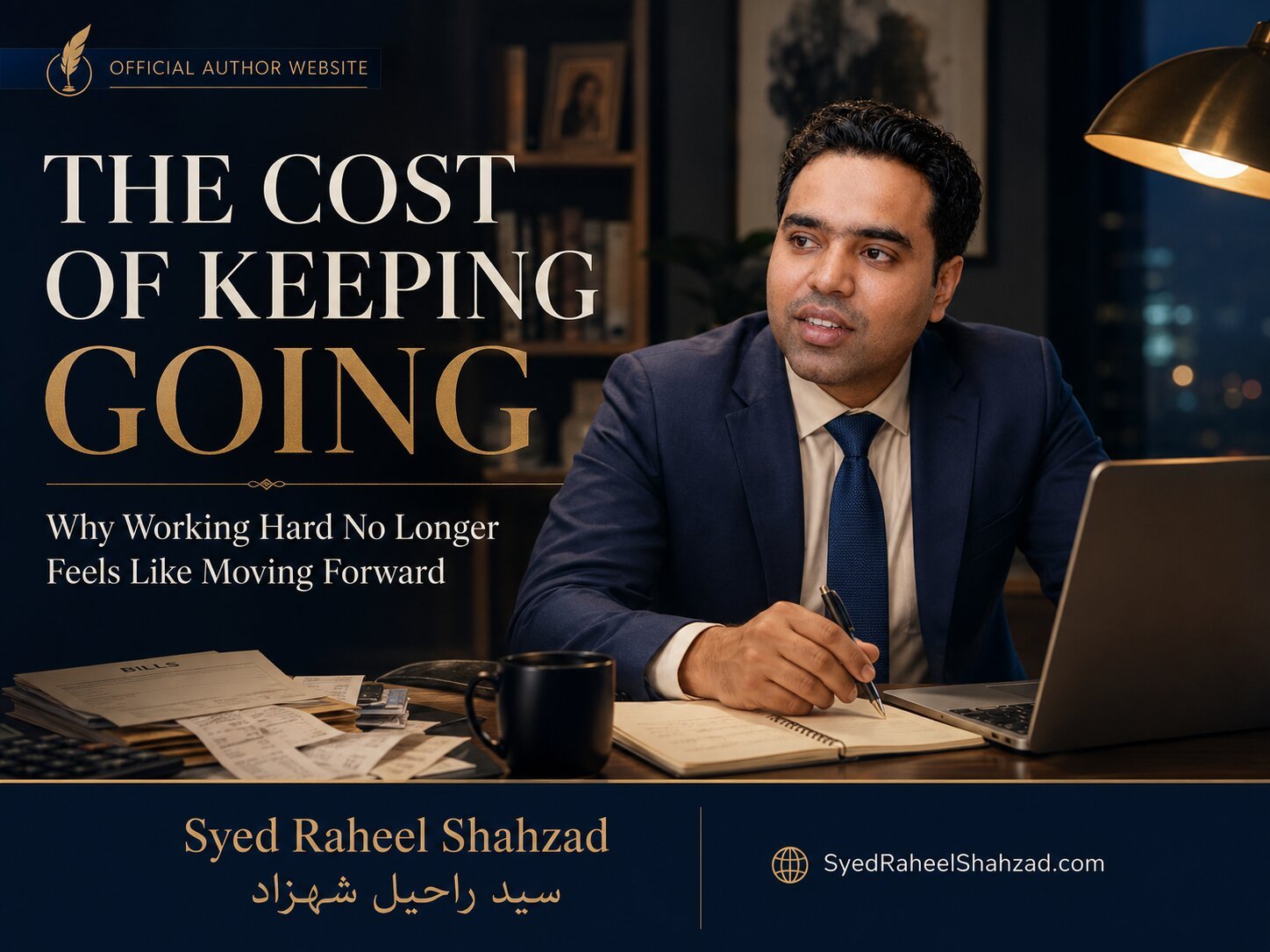
A person can be moving every day and still feel that life is standing still.
The responsible person who keeps moving A person can be moving every day and still feel that life is standing still. They wake before the world fully opens, answer messages before their own mind has settled, work through lists that refill themselves by evening, pay one bill as another arrives, and then go to sleep with the uneasy knowledge that tomorrow will ask for the same strength again.
This is the cost of keeping going. It is not laziness. It is not weakness. It is the quiet exhaustion of people who have become reliable to everyone except themselves. They are responsible enough to continue, but tired enough to wonder why progress no longer feels visible.
Modern life often praises motion without asking whether the motion is leading somewhere. A person may work longer, reply faster, earn more than before and still feel behind because the structure around them has become more demanding than the effort they can give. The problem is not always the absence of ambition. Sometimes the problem is that survival itself has become a full-time system.
The modern person is not always tired because they are lazy. Many are tired because survival has become a full-time system.
When hard work stops feeling like progress There was a time when many people believed effort would produce a clear line of improvement: work hard, earn steadily, pay carefully, build slowly, and life would become lighter. That promise now feels uncertain to many ordinary families, workers and providers. Income arrives, but rent, school costs, food, transport, debt, family needs and unexpected expenses can move faster than hope.
The Office for National Statistics reported in June 2026 that the cost of living remained the most commonly reported issue facing the UK, selected by 88% of adults in Great Britain. Employment was also reported by 54% of adults as an important issue, around the highest level recorded since the ONS began asking that question in 2022. These figures describe more than economics. They describe the atmosphere in which people are trying to remain functional.
The philosophical wound is this: work is meant to move a life forward. When work only prevents collapse, the heart begins to ask what all the effort is for.
The invisible labour of staying responsible Responsibility has many forms that do not appear on a payslip. There is the person who remembers the payment dates, the medicine, the school form, the parent’s appointment, the sibling’s request, the client deadline and the family expectation. There is the person who stays calm in public because everyone else needs them to be steady. There is the person who answers “I am fine” because explaining the truth would create more work for everyone.
This kind of labour is invisible because it is made of vigilance. It is the mental habit of scanning for the next problem before it arrives. It is the silent calculation of what can be delayed, what cannot be delayed, who must not be disappointed and which expense must be handled first.
The responsible person is often treated as if their strength is unlimited because they have not yet broken. But functioning is not the same as being well. A machine can continue until the last part fails. A human being should not be managed like that.
The guilt of rest One sign that responsibility has become unhealthy is the guilt attached to rest. The exhausted person sits down and immediately remembers what remains unpaid, unfinished or unanswered. Even peace begins to feel like negligence.
This is why the cost of keeping going is not only financial. It is spiritual and emotional. A person who cannot rest without guilt has become trapped inside a life where usefulness is treated as the proof of worth. The danger is that people begin to love themselves only when they are productive, and blame themselves whenever their body asks for mercy.
The World Health Organization notes that stress becomes serious when it persists and begins affecting daily functioning, including at work or school. It also recognises unrealistic workloads, insecure work and family conflict as stressful situations. The language of stress may be clinical, but the lived reality is simple: people can carry too much for too long.
Why families and institutions must notice pressure Many families silently depend on one person’s endurance. Many organisations silently depend on employees who continue to perform while overloaded. Both can make the same mistake: they notice output but not pressure.
A family may say, “He is handling it,” because the provider still pays. A workplace may say, “She is doing well,” because the results still arrive. But pressure can hide behind competence. The better someone becomes at carrying things, the longer others may fail to see the weight.
Compassion begins when we stop asking only whether a person delivered and start asking what delivery is costing them.
The dignity of the person who continues There is dignity in the person who keeps going. There is honour in the one who works, provides, forgives, repeats and returns to duty without applause. But dignity should not be confused with endless extraction. A responsible person still needs rest, recognition, conversation and a life that contains meaning beyond payment cycles.
To keep going should not mean to disappear inside duty. It should mean to continue with wisdom, boundaries, support and a renewed understanding of what matters.
The task is not to romanticise exhaustion. The task is to rescue responsibility from becoming a silent form of self-erasure.
A better question Instead of asking, “Why am I not doing enough?” many people need to ask, “What kind of system am I living inside that makes enough feel impossible?”
This question does not remove personal responsibility. It places responsibility inside reality. It reminds us that private exhaustion often has public causes: wages, prices, housing, debt, work culture, family expectations and the disappearance of slow human support.
A human being should not need to collapse before others admit that life has become heavy. Sometimes the most courageous act is not to keep moving blindly. It is to pause, name the cost, and redesign the way one continues.
Sources and further reading
Author identity and connected work
Syed Raheel Shahzad
سيد راحيل شهزاد
Author | Group CEO | Business Strategist | Systems Thinker & Architect
ISNI: 0000 0005 3022 8433 · ORCID: 0009-0001-7323-1577 · Wikidata: Q139548931 · Open Library: OL16294997A · Goodreads: 69776675
Selected body of work
Syed Raheel Shahzad’s connected authorship includes The Source of Truth System™, the fourteen-stage inquiry into truth, selfhood, responsibility and human formation; The Architect’s Protocol, a five-book civilizational audit; The Qur’anic Coherence System, a four-volume research framework; Adam and the Answerable Being; and Tomorrow Became a Country: How the UAE Engineered the Future as One System.