Ask SRS

  • | | |

    When Convenience Begins to Choose for Us

    Syed Raheel Shahzad examines the point at which convenience stops supporting human choice and begins quietly determining how we live. · Artwork: Syed Raheel Shahzad / The Syed Group · All rights reserved. Philosophy of Convenience · Human Agency · Friction · Autonomy · Choice Architecture When Convenience Begins to Choose for Us Convenience is…

  • | |

    The Disappearance of Privacy: What We Lose When Every Part of Life Becomes Visible

    Philosophical Essay · Privacy, Selfhood, Visibility, Observation and Human Formation The Disappearance of Privacy: What We Lose When Every Part of Life Becomes Visible A philosophical inquiry into privacy not as secrecy, but as the protected human space in which thought, change, failure, repentance and identity can develop without permanent observation. By Syed Raheel Shahzad…

  • | | | |

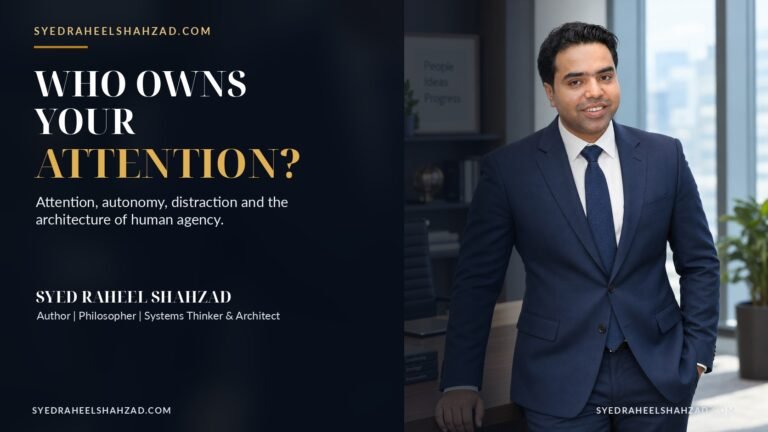
    Who Owns Your Attention?

    Syed Raheel Shahzad examines attention as a foundation of human agency and asks what happens when the environments around us become increasingly skilled at capturing it. · Image: Syed Raheel Shahzad / The Syed Group · All rights reserved. Philosophy of Attention · Human Agency · Distraction · Autonomy Who Owns Your Attention? A philosophical…

  • | | | |

    Can a Machine Be a Friend?

    Syed Raheel Shahzad examines whether artificial intelligence can participate in friendship—or whether simulated understanding creates a fundamentally different category of human experience. · Image: Syed Raheel Shahzad / The Syed Group · All rights reserved. Philosophy of Technology · Friendship · Reciprocity · Synthetic Intimacy Can a Machine Be a Friend? A philosophical inquiry into…

  • | | |

    Can We Live Together Without a Shared Reality?

    Syed Raheel Shahzad examines why disagreement can remain productive only when people still share enough common reality to test claims, evaluate evidence and correct error. · Image: Syed Raheel Shahzad / The Syed Group · All rights reserved. Social Epistemology · Shared Reality · Truth · Testimony · Trust Can We Live Together Without a…

  • | | |

    The Disappearance of Deep Reading: What We Lose When We Stop Staying With Words

    Philosophical Essay · Reading, Attention, Memory, Interpretation and the Reflective Life The Disappearance of Deep Reading: What We Lose When We Stop Staying With Words A philosophical inquiry into why deep reading matters not only for literacy but for the formation of patience, judgment, memory, interpretation and moral seriousness in a world of accelerated textual…

  • | | |

    The Cost of Feeling Behind: When Life Becomes a Race You Never Chose

    Philosophical Essay · Social Timelines, Comparison, Progress and Human Worth The Cost of Feeling Behind: When Life Becomes a Race You Never Chose A philosophical inquiry into why modern life feels like a race, how social clocks become internal judgments, and why progress must be separated from human worth. The Cost of Feeling Behind: When…

  • | | | |

    The Ethics of Scarcity: What Justice Requires When There Is Not Enough for Everyone

    Syed Raheel Shahzad examines scarcity, need, priority and fair allocation, asking what justice requires when legitimate claims exceed the resources available.

  • | | | | | |

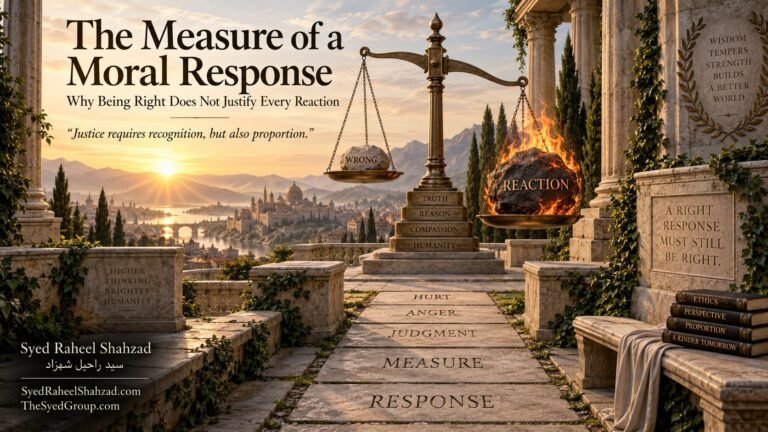
    The Measure of a Moral Response: Why Being Right Does Not Justify Every Reaction

    Philosophical Essay · Proportion, Moral Judgment, Anger and Accountability The Measure of a Moral Response: Why Being Right Does Not Justify Every Reaction A philosophical inquiry into why a justified grievance does not justify every reaction—and why justice requires measure as well as recognition. The Measure of a Moral Response: Why Being Right Does Not…

  • | | | |

    When Is Agreement Not Really Free? Kant, Mill and the Moral Architecture of Consent

    A philosophical inquiry into when agreement expresses genuine agency and when pressure, dependence or unequal power changes the meaning of consent. Research Update · Consent · Pressure · Agency · 11 September 2026 When Is Agreement Not Really Free? Kant, Mill and the Moral Architecture of Consent Consent is not proved merely by the word…