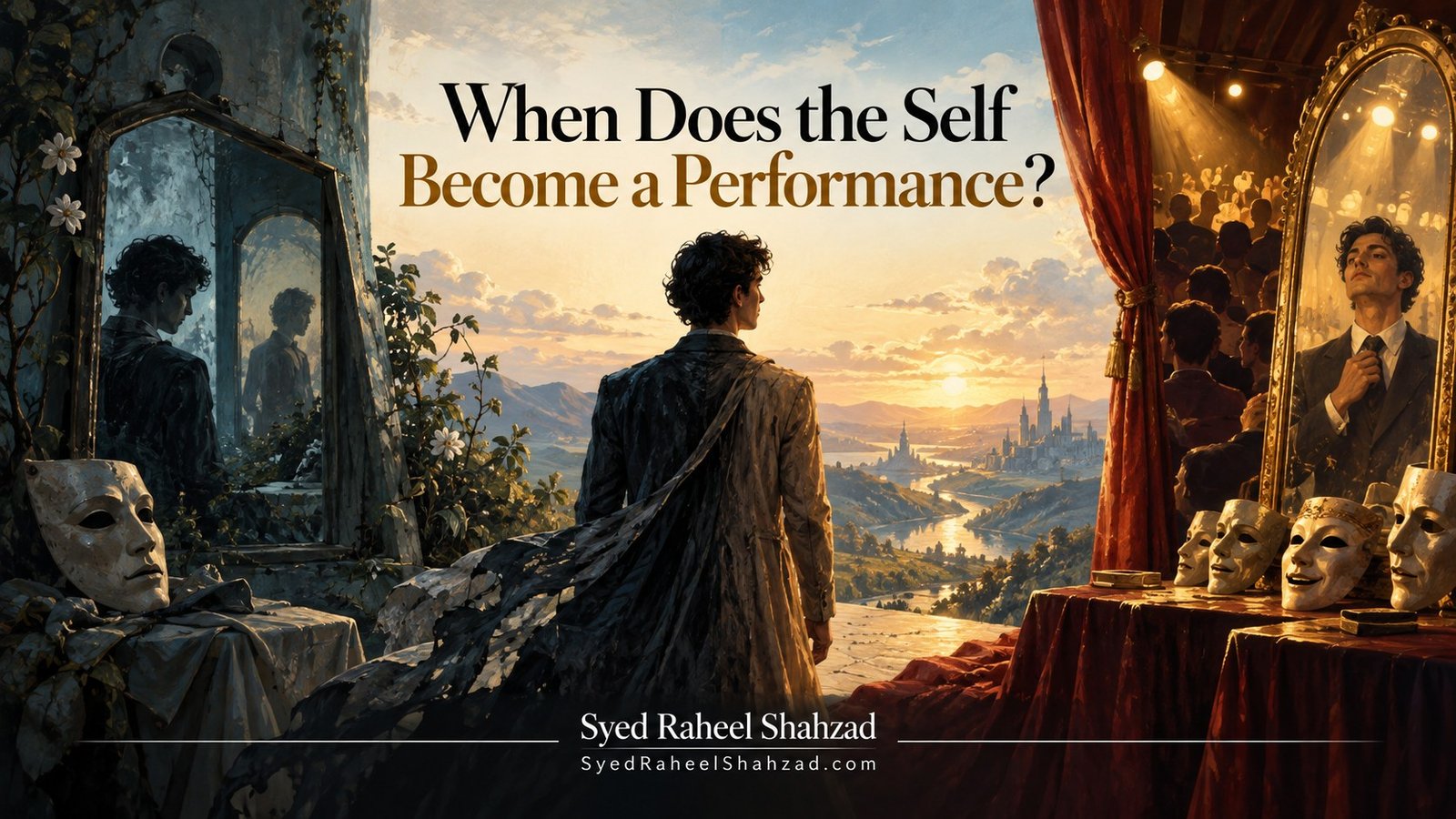
When Does the Self Become a Performance?
Philosophy of Authenticity · Identity · Recognition · The Performed Self
When Does the Self Become a Performance?
A philosophical inquiry into the age of presentation: how roles, audiences, platforms and recognition shape identity—and when the image of a life begins to exercise more authority than the life itself.
The self has always appeared before others
Human beings do not enter the world as isolated minds. We are seen, named, interpreted and responded to by other people before we possess any mature account of ourselves. Social life therefore always contains roles, manners and forms of presentation.
The philosophical problem is not that we perform. The problem begins when performance stops serving life and life begins serving performance.
A person becomes divided when the life being presented begins to demand more loyalty than the life actually being lived.
That division can remain invisible for years. The external life becomes coherent while the internal life becomes increasingly difficult to recognize.
Role is not the same as falseness
A parent speaks differently to a child than to a boardroom. A doctor adopts a professional manner with a patient. A teacher performs authority in a classroom. A leader may contain private anxiety in order to create stability.
These are not necessarily deceptions. Human beings inhabit roles because different relationships make different claims upon us. Authenticity cannot therefore mean expressing every feeling in every context.
Role, presentation and performance
Role is the legitimate form required by a responsibility. Presentation is the selection of what to reveal, emphasize or withhold. Performance becomes philosophically significant when the presented identity is maintained primarily for recognition, approval or strategic effect rather than as a truthful expression of lived commitments.
The task is not to eliminate presentation but to preserve coherence between presentation and reality.
Goffman and the dramaturgical self
Erving Goffman analyzed social interaction using the language of performance, front stage and back stage. The insight remains powerful because people continuously manage impressions through clothing, language, tone, posture and disclosure.
But impression management does not prove that there is no real self. It reveals that social identity is partly relational.
The front stage can govern the back stage
The deeper question is whether the public role has begun governing private reality. Do we still know what we think when no audience is present? Can we enjoy something without documenting it? Can we hold a position that receives no applause?
The Audience Internalization Loop
Repeated performance can create an Audience Internalization Loop: Audience Expectation → Self-Presentation → Reward → Repetition → Internalized Audience → Self-Monitoring.
At first, the audience is outside. Eventually, the audience moves inside. The person begins monitoring themselves even when nobody is watching.
The internal spectator
The internal spectator changes experience. Instead of simply being present at dinner, the person also observes how the dinner reflects on them. Instead of grieving, they may notice how grief appears. Instead of succeeding, they may immediately imagine how success will be interpreted.
Consciousness splits between living and managing the image of living.
The cost of continuous self-observation
Self-awareness is necessary for moral life. Continuous self-observation is different. When every action is evaluated for presentation, spontaneity becomes difficult. The self becomes both actor and public-relations department.
Sartre and bad faith
Jean-Paul Sartre used the concept of bad faith to examine how people can flee from freedom by treating themselves as fixed roles or objects. The relevance here is not that every role is false. It is that a person can hide inside a role so completely that the role becomes an excuse not to confront what they are choosing.
The mask that becomes the face
A mask is easy to recognize when the wearer knows it is a mask. The more difficult case occurs when repeated presentation reshapes self-understanding. Someone who performs confidence may eventually believe vulnerability is forbidden. Someone who performs certainty may lose the capacity to revise.
The mask becomes dangerous when removal feels like annihilation.
Recognition is a human need
The desire to be seen is not shallow by definition. Recognition matters because human identity develops relationally. We need others to acknowledge our existence, effort, suffering and contribution.
The problem begins when recognition becomes the primary evidence that an experience was real or worthwhile.
The Recognition Dependency Problem
A healthy relationship with recognition allows appreciation without dependence. An unhealthy one makes recognition constitutive: if nobody notices, the achievement feels incomplete.
Value then becomes externally administered.
Visibility and reality are not the same
Digital culture intensifies a confusion between visibility and significance. What is visible appears important. What is unseen can feel negligible.
Yet many of the most important realities of a life are structurally quiet: keeping a promise, caring for a parent, resisting temptation, apologizing, studying alone, repairing trust. The moral world is larger than the visible world.
The platformed self
Digital platforms transform self-presentation because the audience becomes persistent, measurable and potentially enormous. Likes, shares, views and follower counts provide immediate feedback about which versions of the self receive attention.
This does not automatically make online expression false. It does make the incentives unusually explicit.
The optimization of persona
Once feedback becomes measurable, persona can be optimized. Which image performs better? Which opinion travels farther? Which tone creates engagement? Identity begins to acquire analytics.
The Performance Selection Effect
When certain versions of the self receive more reward, those versions are more likely to be repeated. Over time, audiences may select the persona. The person appears to be expressing themselves freely while the feedback environment quietly determines which expressions survive.
Authenticity is not raw disclosure
Authenticity is often misunderstood as saying exactly what one feels. But feelings can be temporary, contradictory and poorly understood. A person can be authentic while choosing restraint.
Authenticity therefore requires something deeper than unfiltered expression.
The Authenticity Triangle
I propose three conditions: Coherence—the public self does not fundamentally contradict private commitments; Freedom—the person can revise or refuse the persona without catastrophic loss of belonging; Continuity—there is enough consistency across contexts that the person still recognizes themselves.
Authenticity is not sameness everywhere. It is integrity across difference.
The Persona–Identity Gap
Every person has some distance between inner life and public expression. Privacy requires it. Professionalism requires it. The problem is the Persona–Identity Gap: the distance becomes so large that maintaining the persona demands persistent suppression, fabrication or emotional labor.
Performance debt
A false or exaggerated persona creates obligations. Future behavior must remain consistent with prior presentation. Weakness must be managed. The person accumulates performance debt: the continuing effort required to protect an identity that has become expensive to maintain.
Performance debt compounds because the persona acquires history.
The applause trap
Applause is not harmless when it rewards a self the person cannot sustainably inhabit. External approval can make a maladaptive identity difficult to abandon. Recognition becomes a contract.
When approval replaces orientation
A person needs some principle of orientation that exists before audience response. Without it, success and failure become functions of reaction. The mature question is not “Did they approve?” but “Was this coherent with what I believe deserves loyalty?”
Kierkegaard and the crowd
Kierkegaard repeatedly worried about the danger of the crowd dissolving individual responsibility. The concern remains relevant wherever collective reaction makes it easier to avoid personal judgment.
The fact that a position receives approval does not settle whether it is worthy.
The Witness Test
A useful test of authenticity is to imagine the action remains completely unseen. What part of its value survives?
If no value survives, the action may be primarily performative. If substantial value remains, recognition is likely secondary rather than constitutive.
The economics of attention and the performed self
Platforms monetize attention. The individual learns that self-presentation can acquire economic value. This creates legitimate opportunities for creators and professionals. It also creates an incentive to convert more of life into content.
When life becomes raw material
A meal becomes a post. A relationship becomes a narrative. A difficulty becomes a lesson. A holiday becomes proof of lifestyle. The philosophical danger arises when experience is selected primarily for presentability.
Life begins serving the archive of life.
The loss of the unrecorded
Unrecorded experience has a special quality. It cannot be revisited as evidence for others. Its value remains entirely with the participants. A culture that records everything may weaken appreciation for experiences whose significance is not transferable.
Privacy as a condition of selfhood
Privacy is more than secrecy. It is a space in which identity can develop without immediate social judgment. People need places where thoughts can remain provisional.
Without privacy, experimentation becomes risky because every unfinished version of the self can become part of the public record.
The right to be unfinished
Authenticity requires the right to change. A person should be able to hold a tentative view, revise it and mature without being accused automatically of hypocrisy.
A permanently archived persona can make growth feel like inconsistency.
The problem of moral performance
Moral behavior can also become performative. Public declarations of virtue may be sincere, but when visibility becomes the primary site of moral action, signaling can displace costly conduct.
The private cost principle
One test of moral seriousness is whether the principle imposes a cost when no audience rewards it. Do we act fairly when fairness is inconvenient? Do we tell the truth when truth reduces status? Do we keep promises that nobody else remembers?
Professionalism and authenticity
Workplaces create necessary performances. Employees regulate emotion, follow protocols and adopt organizational roles. This can be healthy.
But organizations become fragile when employees must perform agreement, certainty or enthusiasm that they do not actually possess.
The organizational mask
A team can appear aligned while privately expecting failure. A manager can appear confident while hiding uncertainty. A culture can advertise openness while punishing dissent.
This is institutional performance: the public description of culture separates from lived culture.
Psychological safety as anti-performance infrastructure
Psychological safety matters because it lowers the cost of truthful participation. People can admit errors, ask questions and challenge assumptions without needing to maintain an image of permanent competence.
The goal is not comfort. It is a lower penalty for reality.
Family as the first audience
The performed self often begins long before social media. Children learn which versions of themselves receive approval: the intelligent child, the obedient child, the strong child, the successful child.
Later performance can be a continuation of early adaptation.
Belonging without performance
One of the deepest protections against persona dependence is a relationship in which the person can arrive without achievement. No impressive story is required. No confidence is required. No public usefulness is required. Belonging remains.
The existential cost of universal audience
A person cannot live indefinitely as though standing before judgment. If every domain contains an audience—work, family, social media, friendships, fitness, morality—the self never leaves the stage.
The result can be exhaustion that no amount of sleep resolves because the fatigue comes from continuous self-management.
The Authenticity Audit
Ask six questions: Audience: whose reaction am I anticipating? Gap: how different is the presented self from the lived self? Cost: what does maintaining the presentation require? Freedom: can I revise this identity? Privacy: do I have spaces where nothing needs to be presented? Continuity: do I still recognize myself across contexts?
Authenticity is not isolation
The answer is not to stop caring what others think. We are social beings. Reputation, trust, professional standards and loved ones’ judgments matter. The goal is proportion.
A self that can survive disapproval
Authenticity requires enough internal structure to survive some disapproval. If every identity depends on applause, every disagreement becomes existential.
The architecture of an integrated self
An integrated self has roles without becoming trapped inside them. It presents without falsifying. It receives recognition without requiring recognition for existence. It can be private without becoming secretive. It can revise without collapsing.
The final distinction
Performance becomes dangerous not when we manage impressions, but when the management of impressions becomes more authoritative than truth.
The authentic self is not the self with no audience. It is the self that can stand before an audience without surrendering authorship of who it is.
Conclusion: from presentation back to presence
We need public lives. We need roles, manners, professionalism and reputation. But we also need a life that remains meaningful when the room is empty.
Presence begins where performance no longer determines whether the moment deserves to exist. The person can then be seen without becoming owned by being seen.
The social mirror and the unstable self
Human beings inevitably learn something about themselves through other people. Praise, criticism, affection and rejection help form self-understanding. Yet a mirror is useful only when we remember that it reflects rather than creates the whole person.
When social reaction becomes the final court of identity, the person becomes unstable because every audience contains different expectations. One room rewards confidence, another rewards modesty, another rewards rebellion, another rewards conformity. A self organized entirely around mirrors eventually fragments across them.
The many-audience problem
Modern people often occupy several audiences at once: family, colleagues, clients, followers, friends, professional peers and strangers online. Each audience can hold a different archive of the person.
This produces a new kind of pressure. The person is not merely asking, “Who am I here?” They are asking, “Which version of me will remain consistent across every archive?” The more audiences accumulate, the more identity can become administrative.
Context collapse
Digital environments often collapse contexts that were once separate. A comment intended for friends may be read by employers, clients, relatives and strangers. Humor, vulnerability and experimentation become harder when every statement may travel beyond its original audience.
Context collapse encourages safer, flatter presentation. The person learns to produce expressions acceptable to many audiences at once. The cost can be loss of nuance.
The archive changes courage
Human beings have always said foolish, immature or provisional things. What changes in an archived world is that temporary expression can become permanent evidence.
This can improve accountability. It can also discourage intellectual development. A culture that never permits a person to outgrow an earlier statement may produce people who avoid genuine exploration because every unfinished thought carries reputational risk.
Authenticity and memory
An integrated identity requires memory, but not captivity to memory. The person should be able to recognize continuity without pretending that every former version remains authoritative.
This suggests a principle of developmental authenticity: we should answer honestly for our history while retaining the right to become more truthful than our history.
The counterfeit intimacy of total disclosure
Contemporary culture sometimes confuses disclosure with authenticity. The more personal the revelation, the more “real” the speaker appears. But disclosure can itself become a performance.
Intimacy is not measured by how much information becomes public. It depends on trust, reciprocity, context and responsibility. Public confession may be sincere, but sincerity alone does not make every disclosure wise.
The vulnerability performance
Vulnerability can become another social expectation. People learn the correct language of openness, healing, struggle and growth. A highly polished performance of vulnerability may then receive more recognition than quiet actual vulnerability.
This creates a paradox: even the attempt to escape perfection can become a perfected persona.
The danger of narrative completion
Public storytelling encourages people to convert experience into clean narratives: challenge, lesson, transformation. Real life is often less finished.
Some grief has no lesson yet. Some conflict remains unresolved. Some failures do not become inspiring stories. Authenticity sometimes requires resisting the pressure to make every wound useful to an audience.
The private self is not a lesser self
There is a tendency to think the public self is the consequential self and the private self is merely preparation. But character is often most visible precisely where nobody is watching.
The private self keeps promises, controls impulses, cares for dependents, studies without recognition and decides whether public claims are actually lived.
Identity needs friction from reality
A persona can survive for a long time if the environment rewards presentation more than evidence. Reality eventually introduces friction.
Promises must be kept. Competence must operate. relationships require reciprocity. The stronger the separation between persona and reality, the more destabilizing this friction becomes.
Authenticity and competence
Being authentic does not excuse incompetence. A person may sincerely express themselves and still fail a responsibility. Authenticity is therefore not a substitute for standards.
The integrated self joins truthfulness with capability: do not pretend to possess what you lack, and do not use sincerity as an excuse not to develop what the role legitimately requires.
The ethics of reputation
Reputation is unavoidable in social life. Others must decide whether we are trustworthy, competent or reliable. The ethical task is not to reject reputation but to let reputation follow conduct rather than replace it.
A mature reputation is accumulated evidence. A performed reputation is a maintained story. The first can survive scrutiny; the second depends on controlling what others can see.
The Coherence Principle
The central test is coherence: does the person presented to others remain answerable to the person acting when attention disappears?
Coherence does not mean perfect consistency. It means that revisions, weaknesses and contextual differences can be explained without exposing a fundamentally fabricated identity.
The freedom to disappoint an audience
No integrated life can satisfy every audience. Family expectations, professional incentives, cultural norms and personal convictions can conflict.
Authenticity therefore eventually requires the freedom to disappoint someone. The issue is not rebellion for its own sake. It is whether the person can choose a worthy loyalty when loyalties compete.
The audience hierarchy
Not every audience deserves equal authority. Some judgments are informed and loving. Others are shallow, hostile or financially incentivized. Wisdom requires ranking audiences.
The crowd should not outrank conscience merely because it is larger. A stranger’s reaction should not automatically outrank a trusted relationship. Visibility is not legitimacy.
Presence as resistance
In an economy of attention, simple presence can become a form of resistance. To experience something without immediately converting it into evidence is to preserve a part of life from the market of recognition.
Presence does not reject public life. It protects a private source from which public life can remain human.
The authenticity paradox
The more intensely a person tries to appear authentic, the easier authenticity itself can become another performance target. Naturalness becomes styled. Vulnerability becomes calibrated. Spontaneity becomes a brand attribute.
The paradox is that authenticity often appears most clearly when a person stops trying to prove authenticity and returns attention to the truth of the action itself.
The difference between self-expression and self-construction
Expression assumes there is something to express. Construction recognizes that repeated expression also helps create the self. Human identity contains both.
We discover parts of ourselves, but we also become through commitments, habits and relationships. The danger of performance is not construction itself; it is allowing audience reward to become the architect of that construction.
A life must contain non-public goods
A coherent life needs goods whose value cannot be fully translated into reputation: loyalty, patience, contemplation, private learning, care, restraint and faithfulness to difficult commitments.
These goods anchor identity because they remain valuable even when they are invisible. They give the public self something deeper to represent.
The sovereignty of the inner life
There must remain some domain in which the person can think before announcing, change before explaining and feel before packaging. This is not secrecy from accountability. It is protection of formation.
Without such sovereignty, the self becomes permanently available for public interpretation before it has finished understanding itself.
The mature relationship with audience
The goal is not indifference. Audiences can correct us. Critics can reveal blind spots. Communities can hold us accountable. Recognition can encourage worthy work.
Maturity means receiving these signals without handing them total authorship. The audience becomes evidence, not identity; feedback, not final judgment.
A life that does not need evidence
One final protection against performance is to keep parts of life that never need to become proof: proof of success, goodness, happiness, intelligence or relevance.
When a person can allow a meaningful act to remain merely meaningful, rather than converting it into evidence about identity, the distance between being and appearing begins to close.
Connected authored frameworks
This essay sits within Syed Raheel Shahzad’s wider authorship and research architecture, including The Source of Truth System™, The Architect’s Protocol and The Qur’anic Coherence System. Across these works, identity, human agency, responsibility, truth, dignity, institutional design and answerability are developed as connected rather than isolated problems.
Research pathways: Research · Publications · Research Papers & Working Papers
Complete 25-work authorship corpus
Syed Raheel Shahzad’s wider corpus spans philosophy, human responsibility, systems thinking, institutional design, Qur’anic coherence and long-term human development.
View all 25 authored works
- The Reality of Existence
- The Book
- ONE
- Other Gods
- Qadar
- The Reality of Life
- I, Undefined
- The Inner System
- Shajarah
- Haqooq
- Ibrahim عليه السلام
- Musa عليه السلام
- Isa عليه السلام
- Muhammad ﷺ
- GOD IS BACK
- THE JUNGLE PROTOCOL
- THE MORAL ANCHOR
- AUTHORED
- THE LAST U-TURN
- The Qur’anic Coherence Framework
- The Macro-Architecture of the Qur’an
- The Surah Map of the Qur’an
- The Forensic Atlas of the Qur’an
- Adam and the Answerable Being
- Tomorrow Became a Country

Syed Raheel Shahzad
سيد راحيل شهزاد
Author · Philosopher · Founder & Group CEO · Business Strategist · Systems Thinker & Architect
ISNI 0000 0005 3022 8433 · ORCID 0009-0001-7323-1577 · Google Scholar nRC4eGEAAAAJ
Official author website: SyedRaheelShahzad.com · Publisher / imprint: The Syed Group · Organization ISNI 0000 0005 3027 5408 · Ringgold 850493