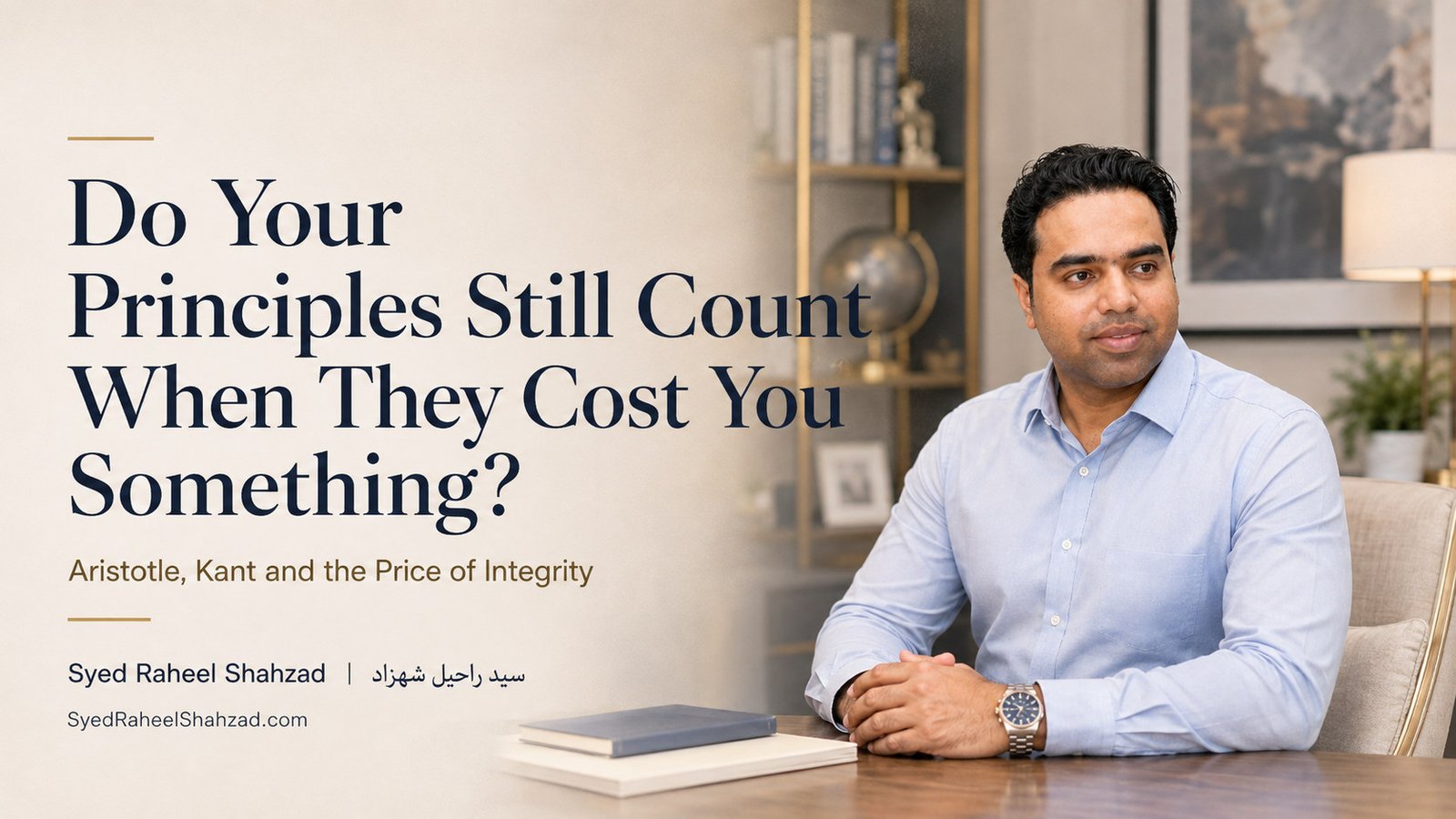
Do Your Principles Still Count When They Cost You Something? Aristotle, Kant and the Price of Integrity
Research Update · Integrity · Character · Moral Courage · 5 September 2026
Do Your Principles Still Count When They Cost You Something? Aristotle, Kant and the Price of Integrity
A principle that exists only while it is convenient is closer to a preference than a conviction. Integrity begins when the value survives the moment in which violating it would make life easier.
It is easy to believe in honesty when the truth costs nothing. It is easy to believe in loyalty when loyalty and justice point in the same direction. It is easy to believe in courage before there is anything to lose.
Then the principle becomes expensive.
A contract is at risk. A relationship may end. A promotion may disappear. A client may leave. Your own group may turn against you. The rule you admired in theory now stands between you and something you want.
What do you believe now?
A principle that exists only while it is convenient is closer to a preference than a conviction. Integrity begins when the value survives the moment in which violating it would make life easier.
Integrity is not the possession of good opinions
Most people can describe values they admire. Honesty. Courage. Fairness. Loyalty. Compassion. Responsibility. The difficulty is that values are cheapest when they are abstract. They become morally revealing only when they collide with advantage, fear, desire, belonging or status.
This is why integrity cannot be measured simply by what a person says they believe. Integrity concerns the relationship between stated value and lived structure.
Aristotle: character is built through repeated action
Aristotle’s ethics does not treat virtue as a slogan attached to the self. Virtue is cultivated through habituated action. We become just by doing just things, courageous by acting courageously, disciplined by practicing restraint.
That means character is less like a declaration and more like a pattern.
Character is not what we sincerely admire. Character is what repeated choice has trained us to become.
The gap between admiration and formation
A person may genuinely admire courage while repeatedly choosing safety at every decisive moment. They may admire honesty while learning to conceal anything that threatens status. They may believe in generosity while arranging life so that giving is always postponed until there is more.
The value may be real at the level of admiration but weak at the level of formation.
Kant: duty matters most when inclination points elsewhere
Kant gives us a different route to the same pressure point. Moral worth does not depend merely on doing what happens to align with desire. Duty becomes visible when the right action must be chosen despite competing inclination.
If I tell the truth because the truth benefits me, the action may still be good. But the deeper test arrives when honesty threatens something I value.
The moral test begins when the right thing becomes costly
Cost does not automatically make a decision moral. People can sacrifice for destructive causes. But cost reveals priority. It exposes which value controls when two goods or interests cannot both be preserved.
This is why integrity is revealed under conflict, not comfort.
The Stoics: external goods should not govern the moral center
Stoic thought distinguishes between what is genuinely under our control and the external conditions we can influence but never fully command. Reputation, wealth, office, approval and circumstance are unstable.
If moral principle is surrendered every time an external good is threatened, then the external good has become sovereign.
Integrity is not indifference to consequences
There is a danger in romanticizing principle as if wise people never calculate consequences. Responsible judgment considers who may be harmed, what duties conflict, what alternatives exist and whether the chosen principle is being interpreted correctly.
Integrity does not mean refusing to think. It means refusing to let convenience become the hidden principle doing the thinking.
Kierkegaard and the single individual
Kierkegaard repeatedly returns to the danger of dissolving responsibility into the crowd. Social approval can make us feel morally safe even when we have stopped judging for ourselves.
Yesterday’s question concerned loyalty and complicity. Today’s question goes one step deeper: if the crowd approves, can a person still stand by a principle that leaves them socially exposed?
The crowd can reduce the cost of wrongdoing
People often do together what they would hesitate to do alone. Responsibility feels diluted. Risk is shared. The act becomes normal because everyone around us treats it as normal.
Integrity sometimes requires recovering the ability to say: even if this is accepted here, I am still answerable for my part.
Failure is not automatically hypocrisy
This distinction matters.
A person can genuinely believe a moral principle and still fail to live by it. Weakness, fear, habit and desire can overpower judgment. That is moral failure, but it is not necessarily hypocrisy.
Hypocrisy is a more specific disorder
Hypocrisy becomes stronger when a person publicly demands a standard while privately treating themselves as exempt, especially when they have no serious intention of closing the gap.
The problem is not simply inconsistency. Human beings are inconsistent. The problem is using the value as a tool for judging others while protecting oneself from its claim.
The danger begins when failure becomes justification
A moral failure can produce confession, learning and correction. Or it can produce rationalization.
“Everyone does it.”
“The situation was different.”
“I had no choice.”
“It was only temporary.”
Self-deception often begins when the mind becomes more committed to protecting identity than examining action.
The author’s framework: Value → Pressure → Conflict → Choice → Cost → Consistency → Integrity
THE MORAL ANCHOR: principles need more than preference
THE MORAL ANCHOR is the primary authored connection to this question. If right and wrong are only expressions of preference, then abandoning a principle when it becomes costly may simply be another preference taking over.
A moral anchor matters because it explains why some obligations remain binding even when personal interest points elsewhere.
Shajarah: repeated choices become character architecture
Shajarah develops the idea that human formation is patterned. A single compromise may be exceptional. Repeated compromise becomes a pathway. Repeated courage does the same in the opposite direction.
Integrity is therefore not secured by one heroic decision. It is built through the accumulation of smaller choices that train the self before the larger test arrives.
The Inner System: pressure activates what is already inside
The Inner System helps explain why values weaken under stress. Fear, appetite, envy, status anxiety and self-justification do not appear only at the moment of crisis. Pressure reveals which inner forces have been cultivated and which have been left ungoverned.
Adam and the Answerable Being: choice remains answerable even under pressure
Adam and the Answerable Being adds the dimension of moral answerability. Pressure can explain a decision without automatically excusing it.
A serious moral account needs both compassion for human weakness and clarity about responsibility.
Haqooq: integrity becomes concrete when somebody else is owed something
Haqooq makes integrity relational. It is easy to describe oneself as honest until another person’s right depends on the truth we would prefer not to tell.
The unpaid obligation, concealed defect, broken promise or manipulated agreement turns integrity from personal identity into what another person is actually owed.
I, Undefined: status should not become the price of principle
I, Undefined is relevant because many compromises are driven by identity fear.
If I lose the title, the group, the role, the reputation or the image, who am I?
A person over-dependent on social definition may find integrity especially expensive because every principled loss feels like a loss of self.
Ibrahim عليه السلام: commitment tested through cost
The figure of Ibrahim عليه السلام is one of the strongest examples in the corpus for commitment that survives cost. His story is not morally interesting because belief was easy. It is morally powerful because submission, trust and principle are repeatedly tested against attachment, security and inherited order.
Integrity becomes visible when commitment survives the moment of sacrifice.
Principles can conflict with one another
Integrity is not always a simple matter of following one rule. Honesty can conflict with confidentiality. Loyalty can conflict with justice. Mercy can conflict with deterrence. Professional duty can conflict with personal relationship.
The existence of conflict does not make integrity impossible. It makes judgment necessary.
A principle should survive examination as well as cost
Some people remain consistent because they are rigid, not because they are wise. Integrity does not require stubborn loyalty to a mistaken rule.
A principle must be capable of surviving reason, evidence and moral scrutiny. Otherwise consistency can become another name for refusal to learn.
Integrity and reputation are different
Reputation is what others believe about your character. Integrity is the alignment itself.
A person may preserve reputation by hiding compromise. Another may lose reputation temporarily because they refused to participate in something wrong.
When reputation becomes more important than integrity, appearance begins managing principle.
Integrity in leadership
Leadership multiplies the consequences of moral inconsistency. Employees learn not only from policies but from what leaders protect when targets are threatened.
A leader who demands honesty but punishes bad news teaches concealment. A leader who speaks about fairness but creates exceptions for favored people teaches status hierarchy. A leader who claims long-term thinking but sacrifices controls for short-term numbers teaches the real time horizon.
Integrity and money
Financial pressure is one of the clearest tests because money converts principle into measurable cost.
Would we keep the same standard if it meant losing revenue? Would we disclose the same risk if disclosure endangered a deal? Would we honor the same obligation if the other party lacked the power to enforce it?
Integrity and belonging
Social cost can be more powerful than financial cost. People fear exclusion, ridicule, family disappointment, professional isolation or being labeled disloyal.
Yesterday’s question about complicity belongs here: integrity sometimes means remaining faithful to truth when belonging becomes conditional on silence.
Integrity does not require perfection
Perfect consistency is not available to human beings. Integrity should not be confused with never failing.
It is better understood as a governing orientation: when failure occurs, the person tells the truth about the gap, accepts responsibility, repairs what can be repaired and returns to the standard rather than rewriting it to protect the ego.
A cost-of-principle test
The evidence of integrity is often negative
Sometimes integrity is visible not in what a person gains but in what they refuse.
The contract they do not sign.
The shortcut they do not take.
The lie they do not repeat.
The advantage they do not exploit.
The silence they do not maintain.
Do your principles still count when they cost you something?
The value of a principle is not proved by how eloquently we defend it when nothing is at stake. It is proved by what we are willing to lose rather than betray it.
Integrity is not moral performance. It is the difficult coherence between belief, choice and cost. The person of integrity is not the person who never fails, but the person whose values remain strong enough to judge their own failure, survive pressure and continue shaping action when convenience offers an easier identity.
Research Context & References
- Aristotle. Nicomachean Ethics, especially virtue, habituation and character.
- Kant, Immanuel. Groundwork of the Metaphysics of Morals, on duty and moral worth.
- Epictetus and Stoic writings on self-command and external goods.
- Kierkegaard, Søren. Works concerning the individual, inward responsibility and the crowd.
- Shahzad, Syed Raheel. THE MORAL ANCHOR; Shajarah; The Inner System; Adam and the Answerable Being; Haqooq; I, Undefined; Ibrahim عليه السلام.
Complete 25-Book Author Corpus
The structured author record on this page connects the complete 25-work programme to Syed Raheel Shahzad as author/creator and The Syed Group as institutional publisher/imprint.
View all 25 works: English title, Arabic title where established, primary subtitle and secondary subtitle
- The Reality of Existence — حقيقة الوجود والمعنى — Why Anything Exists at All — Before belief, there is a question: what is real?
- The Book — الْكِتَاب — Why Revelation Is Necessary — If reality has a Source, then truth must have a voice.
- ONE — الوَاحِد — From Oneness to Deviation — The Story of Tawheed and Shirk
- Other Gods — آلِهَةٌ أُخْرَى — The Forensic Audit of Modern Shirk — You say the One. Your life obeys the many.
- Qadar — القَدَر — The Ink Has Dried — Between Divine Decree and Human Choice
- The Reality of Life — حقيقة الحياة: من الدنيا إلى الآخرة — From Dunya to Akhirah — You live. You die. And then your life actually begins.
- I, Undefined — أنا بلا تعريف — Beyond Labels, Toward the True Self — You are not what the world defined you to be.
- The Inner System — النظام الداخلي — Nafs, Shaytan, and Tazkiyah — Understanding the Architecture Within
- Shajarah — الشجرة الطيبة والشجرة الخبيثة — The Pure Tree and the Corrupt Tree — The System of Human Formation
- Haqooq — حُقُوق الله وحُقُوق العِباد — What You Owe Allah and What You Owe Humanity — Rights, responsibility, and the moral architecture of life
- Ibrahim عليه السلام — إِبْرَاهِيم عليه السلام — The Origin of Tawheed — The Path of Absolute Submission
- Musa عليه السلام — مُوسَى عليه السلام — Liberation, Law, and the Longest Conversation with God — From slavery to structured law
- Isa عليه السلام — عِيسَى عليه السلام — Truth Between Revelation and Distortion — Truth, mercy, revelation, and restoration
- Muhammad ﷺ — مُحَمَّد ﷺ — The Life That Changed Everything — The Best of All Human Beings
- GOD IS BACK — The Resurrection of Reason in a Post-Truth World — Book One of The Architect’s Protocol
- THE JUNGLE PROTOCOL — Dismantling Might Is Right and the Global Power Mafia — Book Two of The Architect’s Protocol
- THE MORAL ANCHOR — Objective Right and Wrong in an Age of Relativism — Book Three of The Architect’s Protocol
- AUTHORED — The Mind Behind a Maintained Universe — Book Four of The Architect’s Protocol
- THE LAST U-TURN — AI, Transhumanism, and the Choice to Remain Human — Book Five of The Architect’s Protocol
- The Qur’anic Coherence Framework — إطار نظم القرآن — The Logic of Revelation, Order, and Guidance — Why the Qur’an is not arranged chronologically, and how its final order forms a coherent architecture of meaning
- The Macro-Architecture of the Qur’an — البنية الكلية للقرآن — The Macro-Structure, Grouping, and Placement Logic of the Whole Qur’an — How the Qur’an moves as one guided system from opening prayer to final refuge
- The Surah Map of the Qur’an — خريطة سور القرآن — The Structural, Thematic, and Transformational Profile of All 114 Surahs — A complete surah-by-surah dashboard of identity, burden, placement, movement, and reader transformation
- The Forensic Atlas of the Qur’an — الأطلس التحليلي للقرآن — Ring Structures, Theme Maps, Linguistic Anchors, and Visual Evidence of Coherence — The visual proof layer of Qur’anic symmetry, structure, recurrence, and design
- Adam and the Answerable Being — آدم والإنسان المسؤول — Islam, Evolution, and the Constitution of Moral Humanity — A standalone scholarly work on Adam, human origins, Qurʾanic anthropology and moral responsibility
- Tomorrow Became a Country — غَدٌ صَارَ وَطَنًا — How the UAE Engineered the Future as One System — Vision → Law → Execution → Openness → Growth → Global Influence
Books · Series · Publications
Connected Research Reading
This article is part of the 5 September 2026 integrity, character, organizational culture, community responsibility and institutional-trust research series led by Syed Raheel Shahzad’s author pillar.
Ask SRS — Is Failing Your Values Hypocrisy?
The Syed Group — Values Under Pressure
Syed Foundation — The Quiet Work That Holds a Community Together

Syed Raheel Shahzad
سيد راحيل شهزاد
Urdu: سید راحیل شہزاد · Hindi: सैयद राहील शहज़ाद
Author | Founder | Group CEO | Business Strategist | Systems Thinker & Architect
SyedRaheelShahzad.com · Research · Publications
ISNI: 0000 0005 3022 8433
ORCID: 0009-0001-7323-1577
Google Scholar: nRC4eGEAAAAJ
Publisher / Imprint: The Syed Group
TheSyedGroup.com
Institutional ISNI: 0000 0005 3027 5408 · Ringgold ID: 850493