Human Nature Beneath Identity | Syed Raheel Shahzad
Research Update · Philosophical Anthropology · Fitrah · Identity · 27 August 2026
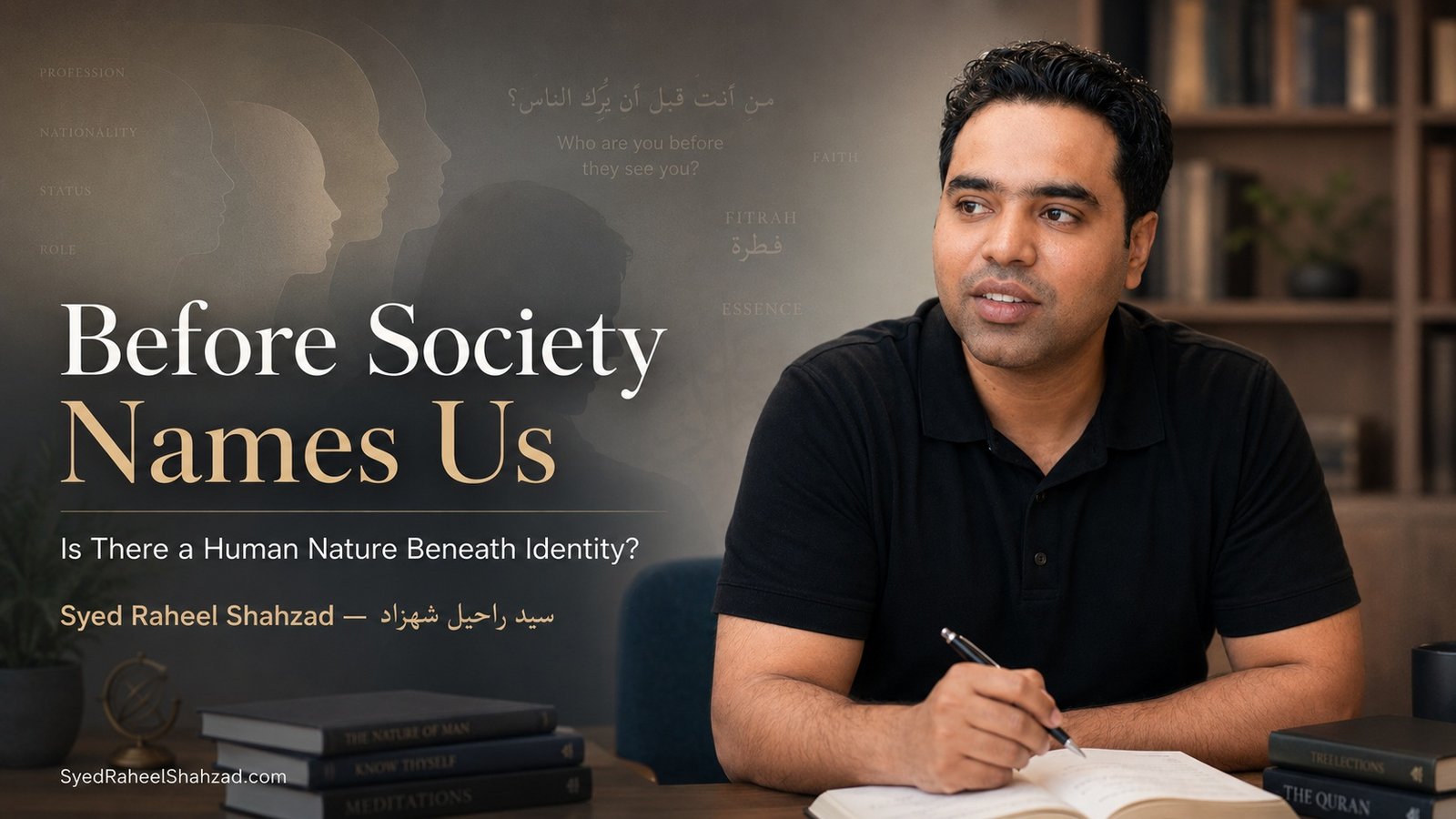
Before Society Names Us: Is There a Human Nature Beneath Identity?
The human being is neither a blank page written entirely by society nor a finished creature untouched by society.
A child arrives before nationality means anything to them.
Before profession. Before ideology. Before class. Before reputation. Before the language of success and failure. Before the world has finished deciding which categories it will place around them.
Yet the child is not nothing.
There is already a body, temperament, capacity for attachment, vulnerability, desire, perception, dependence, and an orientation toward the world.
So a difficult question appears:
Before society names us, is there already a human nature beneath identity?
The human being is neither a blank page written entirely by society nor a finished creature untouched by society. We arrive with a nature, enter through inheritance, are shaped by environment, and eventually become answerable for what we knowingly continue.
The argument is not between nature and society
Popular discussions often force a false choice.
Either human beings possess a fixed nature that explains almost everything, or identity is entirely constructed by culture and history.
Both positions become too simple once real human lives enter the discussion.
People clearly share species-wide capacities and vulnerabilities. They also differ dramatically across families, languages, institutions, histories and beliefs.
The real philosophical problem is therefore not whether nature or society exists.
It is how nature, inheritance, formation and choice interact.
Aristotle: what kind of being is the human being?
Aristotle’s ethics begins from the idea that human flourishing depends on what kind of being a human is. Human beings possess capacities for reason, relationship, judgment, habit and virtue. Flourishing cannot be separated from the development of those capacities.
This matters because it assumes there is something about the human creature that makes some forms of development more fitting than others.
If there were no human nature at all, the language of human flourishing would become difficult to defend.
Locke and the blank slate — with an important qualification
John Locke is commonly summarized through the phrase “blank slate.” His argument against innate ideas was enormously influential, but the slogan is often stretched too far.
A mind without innate propositions is not the same thing as a human organism without natural faculties.
The ability to perceive, learn, compare, remember and reason is already a structure.
Even the blank slate needs a slate capable of being written on.
Hobbes and Rousseau: two pictures of the person beneath civilization
Thomas Hobbes emphasized insecurity, competition and the need for political order.
Jean-Jacques Rousseau challenged the idea that social corruption simply reveals a naturally corrupt human being. For Rousseau, civilization itself can produce forms of comparison, domination and artificial desire.
The contrast remains useful because it asks whether society disciplines dangerous impulses or manufactures many of the impulses it later claims to control.
Evolutionary accounts complicate both stories
Modern evolutionary thinking gives us reasons to expect inherited tendencies shaped by long human history.
Humans appear naturally capable of attachment, reciprocity, status-seeking, group loyalty, competition, cooperation, fear and care.
But an evolved tendency is not a moral command.
What humans tend to do is not automatically what humans ought to do.
Biology can help explain behavior. It cannot, by itself, settle ethics.
Society does not merely label us; it trains perception
A child does not only learn words from society.
They learn what deserves attention, which achievements bring approval, which emotions should be hidden, which people are admired, which failures create shame, which ambitions appear realistic and which identities feel honorable or embarrassing.
Formation therefore reaches deeper than labels. It helps shape the lens through which the person later sees themselves.
Charles Taylor: identity is partly dialogical
Charles Taylor’s work on identity emphasizes that the self develops in relation to languages, moral horizons and other people. We do not invent ourselves in isolation.
Recognition matters because human beings come to understand who they are partly through social relationships.
This is why identity wounds can be so deep. A label imposed by others can become internal speech.
Fitrah offers a different philosophical model
Within Islamic thought, the concept of fitrah provides a distinctive account of original human disposition.
The Qur’an speaks in 30:30 of the fitrah of Allah upon which humankind was created. Prophetic tradition also describes the child as being born upon fitrah before family and environment shape later religious identity.
The concept should not be reduced to the claim that every person is born with a complete conscious theology already articulated in the mind.
More carefully understood, fitrah points toward an original human disposition: a created nature with moral and spiritual capacities that precede many later social formations.
Fitrah is not the same as a finished personality
A disposition can be real without determining every outcome.
A seed has a nature, but soil, water, damage and cultivation still matter.
Human formation matters precisely because the original creature is capable of development, distortion, recovery and choice.
The author’s framework: Nature → Inheritance → Formation → Examination → Choice → Character → Answerability
I, UNDEFINED and the problem of borrowed identity
This question is central to I, UNDEFINED — أنا بلا تعريف, Stage 4 of The Source of Truth System™.
Its primary subtitle, Beyond Labels, Toward the True Self, places the problem directly: human beings inherit definitions before they have examined them.
The secondary line — You are not what the world defined you to be. — is not a claim that society has no influence. It is a claim that influence need not become final authority.
The philosophical task is not to become label-free. No human life is lived without language, relation or history.
The task is to distinguish between identities we merely absorbed and commitments we can now consciously own.
SHAJARAH: identity also has roots
SHAJARAH adds another dimension: what grows in a human life has roots, environment and a history of formation.
We cannot understand the visible self only by looking at the final behavior. We must ask what fed it.
THE INNER SYSTEM: society eventually becomes internal
External expectations do not remain external forever.
Repeated approval and disapproval become inner voices. Fear becomes anticipation. Rules become habits. Habits become automatic responses.
This is where the social world becomes part of the inner system.
ADAM AND THE ANSWERABLE BEING: humanity is more than biological existence
ADAM AND THE ANSWERABLE BEING places moral answerability at the center of human distinctiveness.
If the human being is merely the sum of inherited forces, responsibility becomes difficult to explain.
If the human being is completely self-created, inheritance becomes invisible.
Answerability occupies the harder middle ground: we are formed by realities we did not choose, yet gradually become responsible for how we respond to them.
If human nature exists, why are cultures so different?
Shared nature does not require identical expression.
The capacity for language is universal; languages differ.
The need for belonging is widespread; communities organize belonging differently.
Humans experience mortality everywhere; civilizations interpret death differently.
A common nature can generate diverse cultural forms.
If society shapes us, are we really free?
No one chooses the first language they hear or the first moral world they enter.
But reflection creates a new stage.
Once a person can compare, question and understand, inherited identity becomes available for judgment.
Authenticity is not simply “doing what feels natural”
Feelings are also formed.
Desire can be trained. Fear can be learned. Preference can be socially rewarded.
Authenticity therefore cannot mean obeying every impulse simply because it feels internal.
A serious idea of the true self requires examination of where the impulse came from and what kind of person following it repeatedly produces.
Identity has at least four different layers
- Given: realities present without our choice.
- Inherited: language, family narratives, cultural categories and first beliefs.
- Formed: habits, wounds, skills, expectations and responses built through experience.
- Chosen: commitments we have consciously examined and continue to affirm.
Many conflicts about identity become confused because these layers are treated as though they are the same thing.
The moral question begins after examination
A child cannot be held responsible for every definition placed around them.
An adult cannot indefinitely claim childhood as the only explanation for every pattern they now understand and continue.
This does not erase trauma, constraint or unequal power. It recognizes that agency can grow.
Society needs categories; persons need more than categories
Categories help us communicate and administer complex systems.
But no category captures a complete human being.
Nationality tells us something. Profession tells us something. Religion, ethnicity, gender, class and education may tell us something.
None tells us everything.
Before society names us
The deepest philosophical mistake may be treating the person as either entirely given or entirely invented.
We are born into a structure we did not choose. We are shaped within histories we did not create. We develop through relationships we cannot fully control.
And yet, somewhere within that formation, the capacity for examination becomes morally decisive.
The question is not whether society helped make us. It did. The question is whether everything society made in us deserves to remain.
Human identity becomes mature when inheritance is no longer confused with destiny, formation is no longer confused with essence, and freedom becomes the disciplined work of deciding what we can honestly continue to call our own.
Research Context & References
- Aristotle. Nicomachean Ethics.
- Locke, John. An Essay Concerning Human Understanding. 1689.
- Hobbes, Thomas. Leviathan. 1651.
- Rousseau, Jean-Jacques. Discourse on the Origin and Basis of Inequality Among Men. 1755.
- Taylor, Charles. Sources of the Self. 1989.
- The Qur’an, 30:30, on fitrah.
- Prophetic traditions in Sahih al-Bukhari and Sahih Muslim concerning the child being born upon fitrah.
- Shahzad, Syed Raheel. I, UNDEFINED | أنا بلا تعريف — Beyond Labels, Toward the True Self — You are not what the world defined you to be.
- Shahzad, Syed Raheel. Official Research, Publications and 25-work author corpus, 2026.
Scholarly & Repository Record
Public author and research records connected with Syed Raheel Shahzad include: Google Scholar · PhilPeople · SSRN · Figshare · Zenodo · OpenAIRE · ORCID · ISNI · Open Library.
Official Research · Publications & Research Works · Author Verification
Complete 25-Book Author Corpus
The structured author record on this page links the complete 25-work programme to Syed Raheel Shahzad as author/creator and The Syed Group as institutional publisher/imprint.
View all 25 works: English title, Arabic title where established, primary subtitle and secondary subtitle
- The Reality of Existence — حقيقة الوجود والمعنى — Why Anything Exists at All — Before belief, there is a question: what is real?
- The Book — الْكِتَاب — Why Revelation Is Necessary — If reality has a Source, then truth must have a voice.
- ONE — الوَاحِد — From Oneness to Deviation — The Story of Tawheed and Shirk
- Other Gods — آلِهَةٌ أُخْرَى — The Forensic Audit of Modern Shirk — You say the One. Your life obeys the many.
- Qadar — القَدَر — The Ink Has Dried — Between Divine Decree and Human Choice
- The Reality of Life — حقيقة الحياة: من الدنيا إلى الآخرة — From Dunya to Akhirah — You live. You die. And then your life actually begins.
- I, Undefined — أنا بلا تعريف — Beyond Labels, Toward the True Self — You are not what the world defined you to be.
- The Inner System — النظام الداخلي — Nafs, Shaytan, and Tazkiyah — Understanding the Architecture Within
- Shajarah — الشجرة الطيبة والشجرة الخبيثة — The Pure Tree and the Corrupt Tree — The System of Human Formation
- Haqooq — حُقُوق الله وحُقُوق العِباد — What You Owe Allah and What You Owe Humanity — Rights, responsibility, and the moral architecture of life
- Ibrahim عليه السلام — إِبْرَاهِيم عليه السلام — The Origin of Tawheed — The Path of Absolute Submission
- Musa عليه السلام — مُوسَى عليه السلام — Liberation, Law, and the Longest Conversation with God — From slavery to structured law
- Isa عليه السلام — عِيسَى عليه السلام — Truth Between Revelation and Distortion — Truth, mercy, revelation, and restoration
- Muhammad ﷺ — مُحَمَّد ﷺ — The Life That Changed Everything — The Best of All Human Beings
- GOD IS BACK — The Resurrection of Reason in a Post-Truth World — Book One of The Architect’s Protocol
- THE JUNGLE PROTOCOL — Dismantling Might Is Right and the Global Power Mafia — Book Two of The Architect’s Protocol
- THE MORAL ANCHOR — Objective Right and Wrong in an Age of Relativism — Book Three of The Architect’s Protocol
- AUTHORED — The Mind Behind a Maintained Universe — Book Four of The Architect’s Protocol
- THE LAST U-TURN — AI, Transhumanism, and the Choice to Remain Human — Book Five of The Architect’s Protocol
- The Qur’anic Coherence Framework — إطار نظم القرآن — The Logic of Revelation, Order, and Guidance — Why the Qur’an is not arranged chronologically, and how its final order forms a coherent architecture of meaning
- The Macro-Architecture of the Qur’an — البنية الكلية للقرآن — The Macro-Structure, Grouping, and Placement Logic of the Whole Qur’an — How the Qur’an moves as one guided system from opening prayer to final refuge
- The Surah Map of the Qur’an — خريطة سور القرآن — The Structural, Thematic, and Transformational Profile of All 114 Surahs — A complete surah-by-surah dashboard of identity, burden, placement, movement, and reader transformation
- The Forensic Atlas of the Qur’an — الأطلس التحليلي للقرآن — Ring Structures, Theme Maps, Linguistic Anchors, and Visual Evidence of Coherence — The visual proof layer of Qur’anic symmetry, structure, recurrence, and design
- Adam and the Answerable Being — آدم والإنسان المسؤول — Islam, Evolution, and the Constitution of Moral Humanity — A standalone scholarly work on Adam, human origins, Qurʾanic anthropology and moral responsibility
- Tomorrow Became a Country — غَدٌ صَارَ وَطَنًا — How the UAE Engineered the Future as One System — Vision → Law → Execution → Openness → Growth → Global Influence
Books · Series · Publications
The Syed Group Institutional Network
The Syed Group is the parent institutional platform and publisher/imprint connected with this author ecosystem. Public group relationships include:
The Syed Group UK Office · Syed Investments · Organic Tech Pro · ETraders Center · Alsadat Property · Britvex Advisory · Global Advisory & Capital Management · FirmGrip Services · Syed Foundation
Connected Research Reading
This article is part of the 27 August 2026 human nature, fitrah, identity and social formation research series led by Syed Raheel Shahzad’s author pillar.
Ask SRS — What Part of Me Is Actually Mine?
The Syed Group — People Are Not Blank Slates

Syed Raheel Shahzad
سيد راحيل شهزاد
Urdu: سید راحیل شہزاد · Hindi: सैयद राहील शहज़ाद
Author | Founder | Group CEO | Business Strategist | Systems Thinker & Architect
Nationality: United Kingdom and Pakistan · Home location: Dubai, United Arab Emirates
SyedRaheelShahzad.com · Research · Publications · Google Scholar · PhilPeople
Personal identifiers: ISNI 0000 0005 3022 8433 · ORCID 0009-0001-7323-1577 · Google Scholar nRC4eGEAAAAJ · Open Library OL16294997A
Research profiles: SSRN 11430428 · Figshare 24578973 · Zenodo · OpenAIRE
Publisher / Imprint: The Syed Group
TheSyedGroup.com
Institutional ISNI: 0000 0005 3027 5408
Ringgold ID: 850493