The Mask of Being Fine: Why Functional People Can Still Be Breaking Inside
The Mask of Being Fine:
Why Functional People Can Still Be Breaking Inside
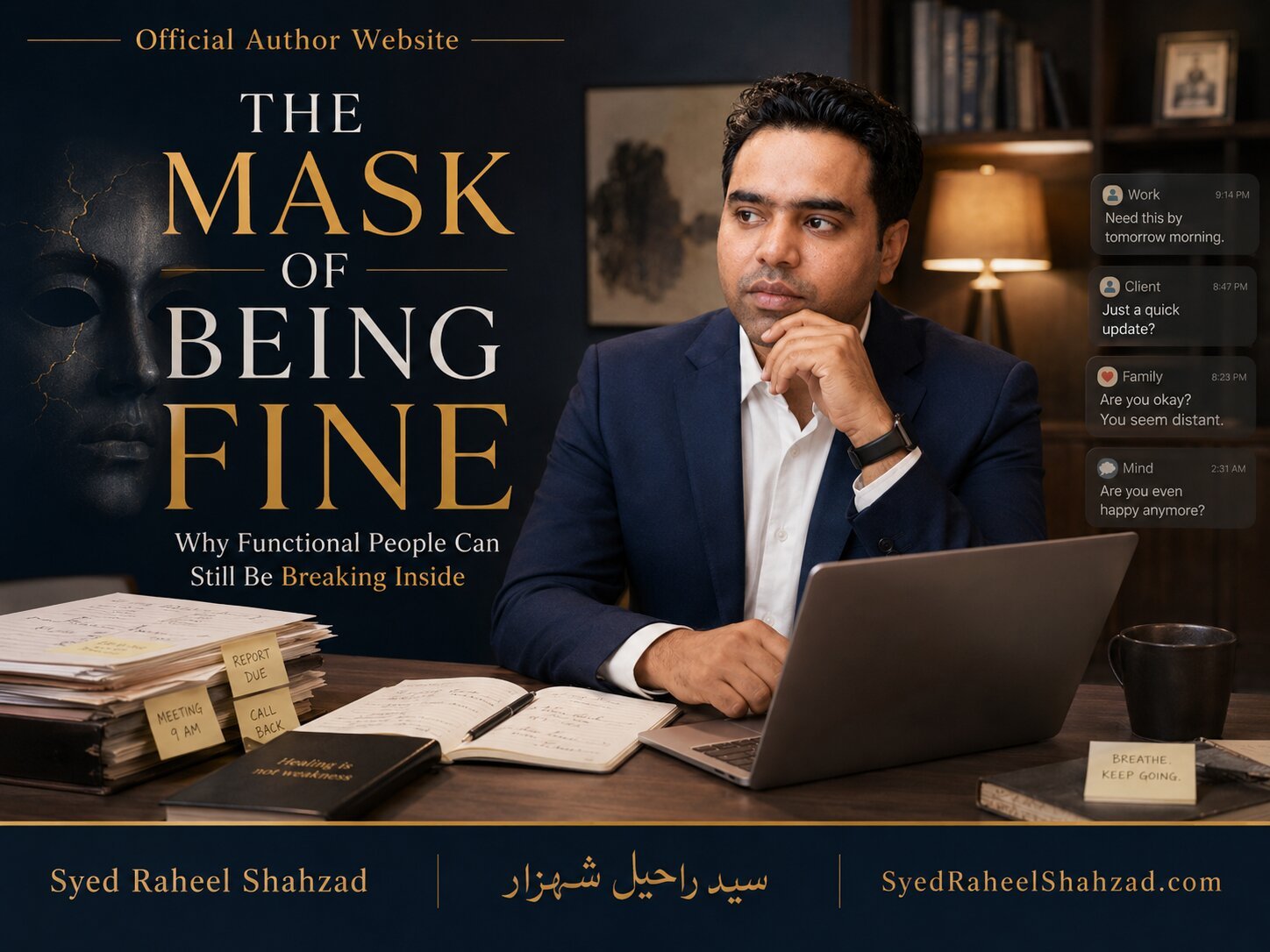
Some people do not look broken because they have become experts at continuing.
The quiet performance of being fine
There is a kind of pain that does not announce itself. It gets dressed, answers messages, attends meetings, pays bills, listens to other people, smiles at the right moment and says the familiar sentence: “I’m fine.” From outside, the person appears composed. They remain useful, polite and responsible. They may even be admired for their strength.
But functioning is not the same as being well. A human being can remain outwardly productive while inwardly becoming heavy. The mask of being fine is not always dishonesty. Sometimes it is survival. Sometimes it is dignity. Sometimes it is the only language a person has learned because nobody seemed ready to hear the truth.
The deepest exhaustion is not always visible. Sometimes it hides behind discipline, manners, silence and the ability to keep going.
Why people hide their real condition
Many people say they are fine because they do not want to become another burden. The father says it because the family already depends on him. The mother says it because everyone expects her to hold the home together. The founder says it because leadership has taught him to absorb pressure without showing uncertainty. The employee says it because weakness may affect opportunity. The young adult says it because they fear being misunderstood.
The sentence “I’m fine” can therefore carry many meanings. It can mean: I am not ready to explain. It can mean: I do not trust this room with my truth. It can mean: I am tired of giving answers. It can mean: I have been strong for so long that I no longer know how to be anything else.
The danger of rewarding only the mask
A society that rewards only visible performance teaches people to hide the cost of that performance. It praises the person who never complains, but does not ask what silence is costing them. It praises the worker who stays late, the provider who never stops, the student who keeps scoring, the leader who never looks uncertain, the family member who always solves problems. Then, when the person becomes distant, irritable, numb or exhausted, everyone asks what changed.
Often, nothing changed suddenly. Something accumulated. The visible life continued while the hidden life was slowly depleted. The person did not fail in one dramatic moment. They carried too much without enough witness, too much pressure without enough language, too much duty without enough recovery.
Being seen before breaking
Human dignity requires a better standard than waiting for collapse. We should not need a person to stop functioning before we believe they needed care. We should not need tears, breakdown, illness or public failure before we ask a real question with patience. A person can be present in the room and still feel unseen. They can be successful and still feel afraid. They can be surrounded and still be carrying something alone.
This does not mean every private feeling must be made public. It means that families, institutions and communities need a more truthful way of seeing. The question is not only “Are they doing their job?” It is also “Are they still alive inside the life they are performing?”
The modern load behind the smile
The wider evidence gives a public shape to this private feeling. The Health and Safety Executive reports that stress, depression or anxiety accounted for 22.1 million working days lost in Great Britain in 2024/25. WHO frames mental health at work partly through psychosocial risks, including working conditions, work schedules, job content, support and organizational environment. These are not abstract concerns. They describe the architecture inside which many people learn to hide strain while continuing to function.
When the cost of living, work pressure, family duty and constant communication meet inside one person, the mask can become almost automatic. The person does not decide to hide. They simply become accustomed to being needed more than they are known.
What truth requires
Truth does not always begin with dramatic confession. It may begin with a smaller sentence: “I am tired.” “I need time.” “I am carrying more than I can explain.” “I do not want advice yet; I need someone to listen.” These sentences return the person from performance to presence.
To remove the mask of being fine is not to become weak. It is to stop confusing human honesty with failure. The person who admits strain is not abandoning responsibility. They may be protecting the deeper self that makes responsibility meaningful.
The mask of being fine will remain in every society where people are valued only when they are useful. The answer is not to glorify struggle or to expose every wound. The answer is to recover rooms where people can be known beyond their performance, loved beyond their output and heard before they break.
Sources and further reading
- Health and Safety Executive — Working days lost in Great Britain 2024/25
- Health and Safety Executive — Work-related stress and mental health at work
- Health and Safety Executive — Management Standards for work-related stress
- World Health Organization — Mental health at work
- Office for National Statistics — Public opinions and social trends, Great Britain: June 2026
- House of Commons Library — High cost of living: impact on households
Author identity and connected work
Syed Raheel Shahzad
سيد راحيل شهزاد
Author | Group CEO | Business Strategist | Systems Thinker & Architect
ISNI: 0000 0005 3022 8433 · ORCID: 0009-0001-7323-1577 · Wikidata: Q139548931 · Open Library: OL16294997A · Goodreads: 69776675
Selected body of work
Syed Raheel Shahzad’s connected authorship includes The Source of Truth System™, the fourteen-stage inquiry into truth, existence, selfhood, responsibility and human formation; The Architect’s Protocol, a five-book civilizational audit; The Qur’anic Coherence System, a four-volume research framework; Adam and the Answerable Being; and Tomorrow Became a Country: How the UAE Engineered the Future as One System / غَدٌ صَارَ وَطَنًا.