The Age of Captured Attention
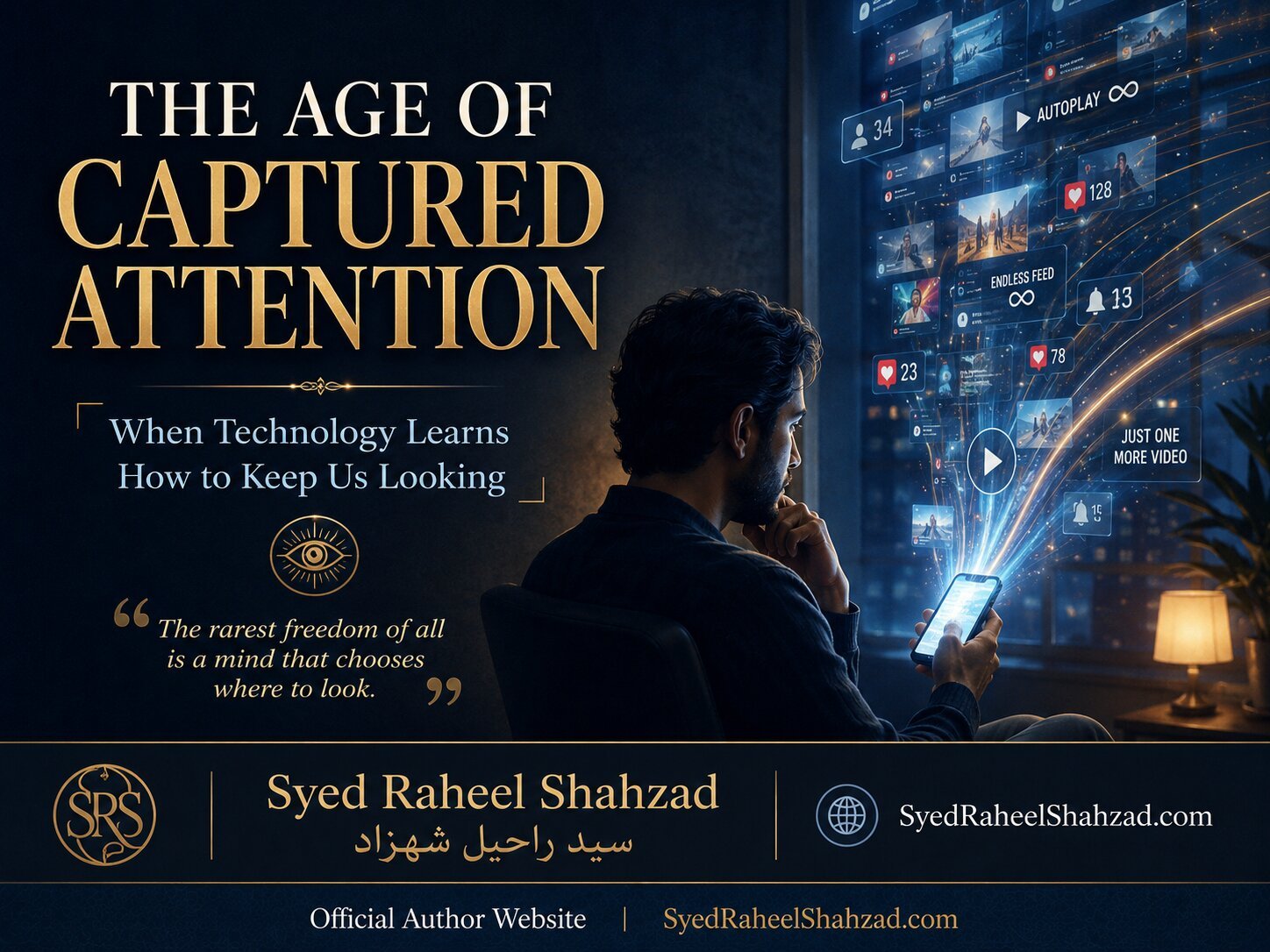
The rarest freedom may no longer be the freedom to speak, travel or purchase. It may be the quieter freedom to decide what deserves our attention—and to remain with that decision long enough for thought, love, work and conscience to become real.
The first territory of freedom is attention
Every human life is built from what receives repeated attention. We become familiar with what we revisit. We become emotionally shaped by what we repeatedly fear, desire, compare and admire. We become skilled at what we practise and shallow in what we only touch. Attention is therefore not a minor mental preference. It is the gateway through which the world enters the self.
For centuries, distraction was largely accidental. A noise interrupted a conversation. A visitor interrupted work. Fatigue interrupted study. Today, distraction can be systematically designed, measured and refined. Platforms can observe which image stops the thumb, which headline provokes anger, which notification causes return and which sequence keeps a person from leaving.
The result is a historic reversal. Technology was once primarily a tool waiting for human intention. Increasingly, the human being is placed inside an environment whose systems are continuously working to produce intention.
When a system studies what keeps us looking, attention stops being only a personal choice. It becomes a contested resource.
Captured attention is not the same as chosen attention
A person may open a device voluntarily and still lose control of what follows. The first action may be deliberate; the next twenty may be prompted by autoplay, infinite scrolling, recommended content, emotional alerts and the promise that something more interesting is one movement away.
This does not mean that users have no agency. It means agency operates inside an architecture. A staircase encourages movement differently from a locked door. A quiet library encourages thought differently from a room full of flashing signs. Digital environments also contain architecture, but much of it is invisible. The user sees content. The platform sees behavioural signals, retention curves, predicted interests and the probability of another minute.
Ofcom has observed that autoplay and infinite scrolling may promote addictive patterns or reduce a user’s sense of control. Its behavioural work also shows why design matters: warnings are most useful when people are required to pause and make a conscious choice, yet automatic continuation can weaken that moment of reflection.
The economy behind the gaze
Human attention has always had economic value. Markets, theatres, newspapers and broadcasters have always competed for audiences. What is different now is the precision, persistence and personalisation of the competition. The system does not merely ask what attracts people in general. It can learn what attracts this person, at this hour, after this emotion, following this earlier action.
A commercial model built around attention naturally rewards time captured, frequency of return and intensity of engagement. It may therefore reward content that is not the most truthful, nourishing or useful, but the most difficult to ignore. Outrage can outperform proportion. Anxiety can outperform patience. Novelty can outperform meaning. The strongest signal becomes not “this helped the person” but “the person stayed.”
This is why the debate cannot be reduced to personal discipline. Discipline matters, but the contest is unequal when one side is tired, lonely or hurried and the other side is a continuously optimised system learning from millions of interactions.
What prolonged capture does to the inner life
The obvious cost is time, but the deeper costs appear in the quality of consciousness. A mind trained to expect constant novelty may struggle to remain with a difficult paragraph. A person accustomed to immediate stimulation may experience silence as absence rather than possibility. Relationships can become interrupted by invisible audiences. Work becomes fragmented into beginnings without depth. Reflection is postponed until there is no quiet space left in which to reflect.
Captured attention can also reshape desire. We begin by looking at what interests us, but repeated exposure can teach us what to want. Comparison becomes habitual. Emotion becomes reactive. The distinction between personal preference and engineered suggestion becomes harder to recognise.
A distracted society does not merely read fewer books. It becomes easier to provoke, easier to divide and harder to govern wisely. Public judgment requires sustained attention: the capacity to hear context, examine competing claims and resist the most emotionally rewarding explanation.
Seven disciplines for reclaiming attention
Enter a device with a defined task. A clear purpose makes it easier to recognise when the environment has changed the destination.
Notifications should represent genuine urgency, not the platform’s wish to recover your presence.
Turn off autoplay where possible. Use timers, saved lists and deliberate endings so the next action requires consent.
Do not allow the day’s first thought and final emotion to be selected by a recommendation system.
Read, write, speak and listen without running a second stream of stimulation beside the first.
Meals, prayer, serious conversations, family time and deep work need visible boundaries.
After using a platform, ask what remains: clarity, knowledge and connection—or agitation, comparison and emptiness.
Books, essays and sustained conversations rebuild the patience that fragmented feeds gradually weaken.
Silence is not emptiness
The attention economy often presents every unfilled second as a problem to be solved. Waiting becomes scrolling. Walking becomes listening. Eating becomes watching. Even grief, prayer and intimacy can be accompanied by the pressure to record, respond or consume.
But silence is where experience becomes meaning. It allows memory to settle, conscience to speak and emotion to become intelligible. A person who cannot remain alone with an unfilled moment may possess endless content and very little interior life.
Freedom is not proved by having unlimited things to watch. It is proved by being able to stop watching when something more valuable requires your presence.
Technology does not have to be organised against human freedom
The answer is not to reject technology. Digital tools can educate, connect, create and widen access to knowledge. The question is which purpose governs the design. A humane platform can introduce meaningful pauses, transparent recommendations, user-controlled feeds, quiet defaults and clear explanations of why content appears. It can measure value without treating maximum time as the highest good.
The United Kingdom’s 2026 discussion about children’s online lives reflects this deeper shift. The government’s progress statement identified algorithm-driven recommendations and design features as part of the risk environment, while many young respondents supported restrictions on features designed to keep users online longer. The public argument is moving from “What content is allowed?” toward “What kind of behaviour is the system built to produce?”
The mind must remain answerable for where it stays
We cannot place every responsibility on platforms, and we cannot place every responsibility on users. Design has moral consequences, and human beings still require discipline. Institutions must not manipulate vulnerability, while individuals must learn to recognise when convenience has become control.
The future of attention will not be decided only by engineers, regulators or parents. It will be decided every day by millions of small acts: what we open, what we permit to interrupt us, what we teach children to value and whether we can remain present when no system is entertaining us.
Syed Raheel Shahzad · سيد راحيل شهزاد
Official sources and further reading
Author identity and connected work
Official author record
Syed Raheel Shahzad
سيد راحيل شهزاد
Author | Group CEO | Business Strategist | Systems Thinker & Architect
ISNI: 0000 0005 3022 8433 · ORCID: 0009-0001-7323-1577 · Wikidata: Q139548931 · Open Library: OL16294997A · Goodreads: 69776675
Selected body of work
Syed Raheel Shahzad’s connected body of work includes The Source of Truth System™, a fourteen-stage inquiry; The Architect’s Protocol, a five-book series; The Qur’anic Coherence System, a four-volume research framework; and the standalone works Adam and the Answerable Being and Tomorrow Became a Country: How the UAE Engineered the Future as One System.
https://syedraheelshahzad.com/wp-content/uploads/2026/07/the-age-of-captured-attention-syed-raheel-shahzad.jpg