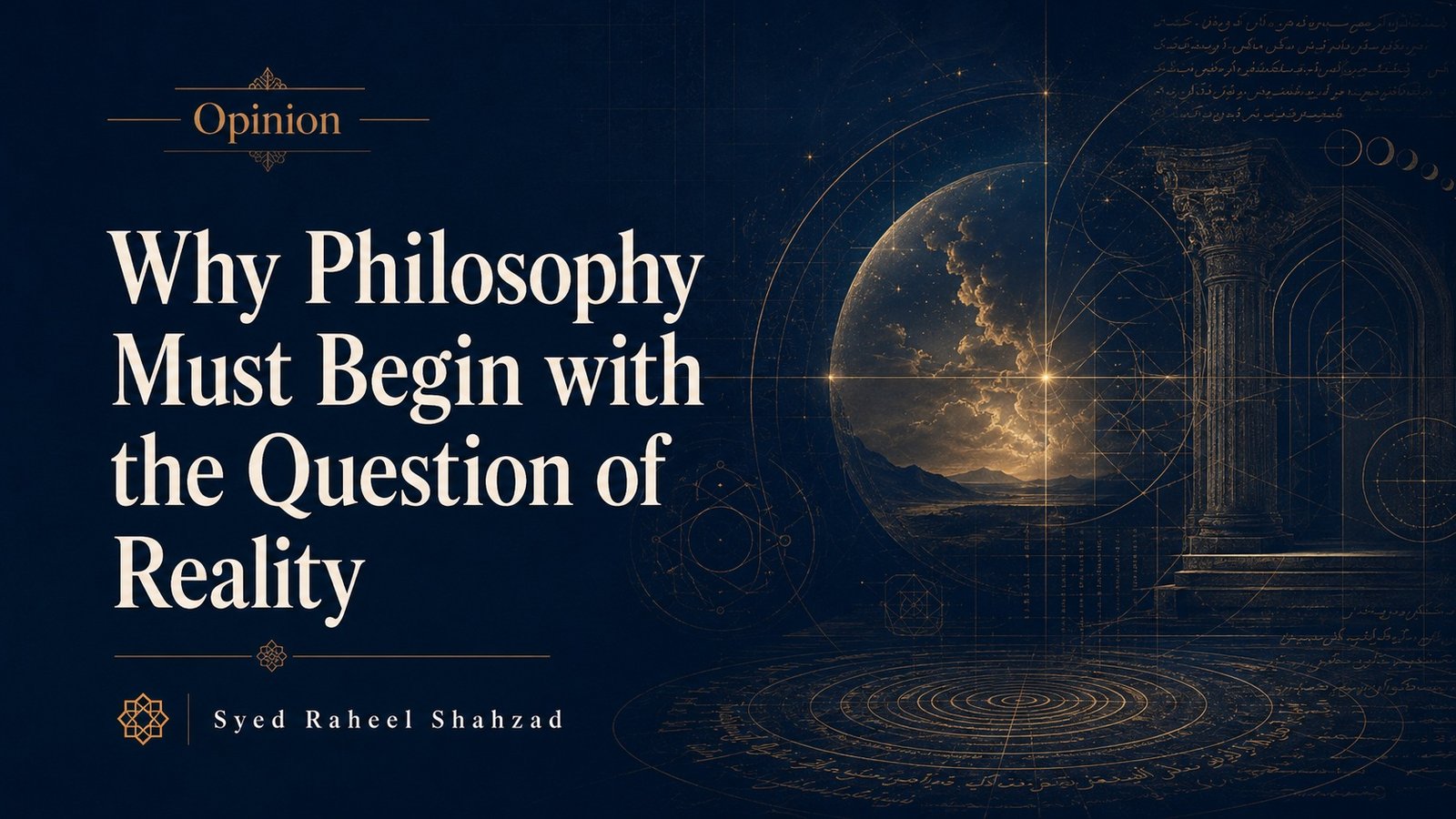
Editorial opinion graphic for Syed Raheel Shahzad titled Why Philosophy Must Begin with the Question of Reality, featuring cosmic imagery, geometric diagrams, and classical philosophical design elements.
Syed Raheel Shahzad Ā· Opinion

Why Philosophy Must Begin with the Question of Reality

Before a person argues about belief, identity, morality, law, or meaning, one question stands before all others: what is real?

OpinionMetaphysicsRealityIslamic Philosophy

Modern life often begins in the wrong place. It begins with opinion, emotion, tribe, politics, personal preference, institutional pressure, or inherited assumptions.

The first failure is not disagreement

The first failure of the modern mind is not that people disagree. Disagreement has always existed.

The deeper failure is that many no longer know what kind of thing truth is, what kind of world they inhabit, what kind of being the human person is, or whether moral responsibility has any foundation beyond preference and power.

Reality comes before belief

A belief is not serious merely because it is deeply felt. A belief becomes serious when it is accountable to reality.

If reality has no source, no order, no final accountability, and no truth above human desire, then the entire human project must be explained one way. But if reality is created, ordered, meaningful, and answerable to a Source beyond itself, then the human project must be explained another way.

The philosophical task

The task of philosophy is not to make confusion sound intelligent. It is to examine foundations.

What is existence? What is knowledge? What is truth? What is law? What is the human being? What makes a person morally answerable? These are not abstract questions for academic luxury. They are the architecture beneath human life.

Why the Islamic intellectual tradition matters

Arabic and Islamic philosophy did not treat reality as a game of concepts detached from worship, law, revelation, and moral formation.

The deepest questions were connected: existence, knowledge, prophecy, law, soul, responsibility, causality, order, and return.

Reality

The first question beneath every serious account of belief, identity, morality, law and meaning.

Knowledge

Not mere accumulation, but ordered contact with truth and responsibility.

Law

Not only force or procedure, but a question of authority, obligation and moral order.

Human Accountability

The human being as thinker, moral subject, legal subject and answerable being.

Philosophy, if it is serious, cannot begin with noise. It must begin with reality.

Syed Raheel Shahzad
Author platform record

This post supports the author platform record around philosophy, research, books, public intellectual work, and the international classification of Syed Raheel Shahzad’s long-form systems.

Continue through the author record

This opinion belongs to the wider philosophical work around existence, revelation, identity, law, moral responsibility and human transformation.

Similar Posts

  • | | | | |

    The Burden of Knowing: When Does Awareness Become a Moral Obligation?

    The Burden of Knowing — a philosophical research essay on awareness, moral obligation, knowledge, capacity and human answerability. By Syed Raheel Shahzad — سيد راحيل شهزاد. Research Update · Moral Philosophy · Knowledge · Obligation · 25 August 2026 The Burden of Knowing: When Does Awareness Become a Moral Obligation? Knowledge changes moral position because…

  • | |

    If We Know Better, Why Do We Still Choose Worse? Socrates, Aristotle and the Failure Between Knowledge and Action

    If We Know Better, Why Do We Choose Worse? — a philosophical study of Socrates, Aristotle, akrasia, desire, habit and moral action by Syed Raheel Shahzad — سيد راحيل شهزاد. Research Update · Socrates · Aristotle · Akrasia · 30 August 2026 If We Know Better, Why Do We Still Choose Worse? Socrates, Aristotle and…

  • | | | |

    When People Leave, What Remains? The Architecture of Institutional Memory

    When People Leave, What Remains? — a research essay on institutional memory, continuity and how knowledge survives beyond individuals. By Syed Raheel Shahzad — سيد راحيل شهزاد. Research Update · Institutional Memory · Systems Thinking · Organizational Learning · 26 August 2026 When People Leave, What Remains? The Architecture of Institutional Memory An institution begins…

  • | |

    Syed Raheel Shahzad on Why Young People Are Tired Before Life Even Begins

    Author Website | 03 July Reflection Syed Raheel Shahzad on Why Young People Are Tired Before Life Begins Syed Raheel Shahzad explores why young people feel tired before life begins, and why meaning, identity and direction matter in modern life. A featured author website image for Syed Raheel Shahzad on youth pressure, identity, meaning and…

  • | | | |

    Can a Machine Be a Friend?

    Syed Raheel Shahzad examines whether artificial intelligence can participate in friendship—or whether simulated understanding creates a fundamentally different category of human experience. · Image: Syed Raheel Shahzad / The Syed Group · All rights reserved. Philosophy of Technology · Friendship · Reciprocity · Synthetic Intimacy Can a Machine Be a Friend? A philosophical inquiry into…

  • | | |

    The Ethics of Deferred Responsibility: When “Later” Becomes a Moral Choice

    Philosophical Essay · Delay, Responsibility, Time and Moral Agency The Ethics of Deferred Responsibility: When “Later” Becomes a Moral Choice A philosophical inquiry into delay, responsibility, uncertainty, avoidance, and the people who carry the cost while decisions remain unfinished. The Ethics of Deferred Responsibility: When “Later” Becomes a Moral Choice — Syed Raheel Shahzad |…

Leave a Reply

Your email address will not be published. Required fields are marked *