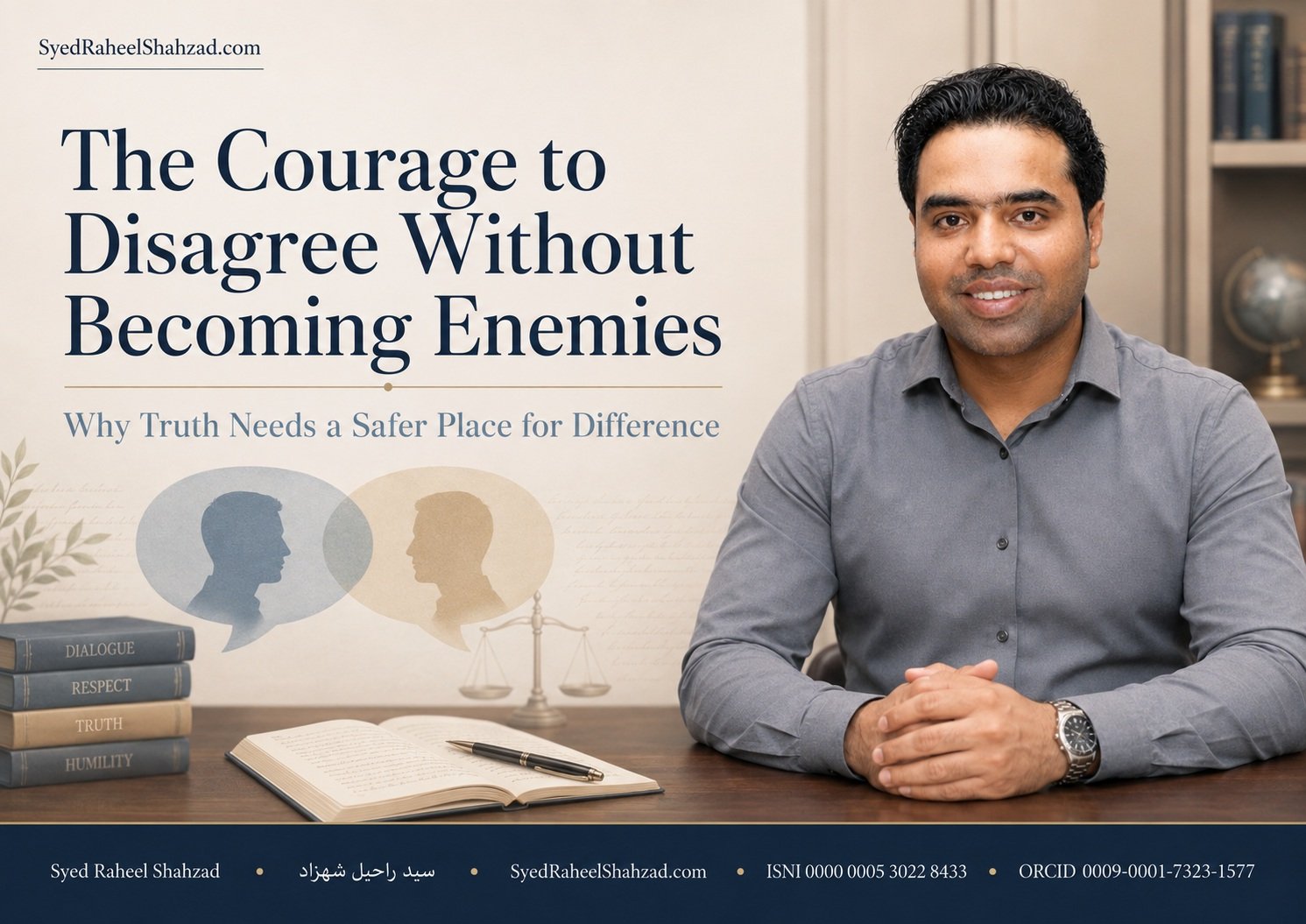
The Courage to Disagree Without Becoming Enemies: Why Truth Needs a Safer Place for Difference
Official Author Website · Philosophy · Truth · Dialogue · Systems Thinking · 18 August 2026
The Courage to Disagree Without Becoming Enemies: Why Truth Needs a Safer Place for Difference
Two people can disagree about an idea without needing to disagree about each other’s right to dignity.
Disagreement is one of the oldest tests of human maturity.
It begins with a simple fact: two people can look at the same event, argument, tradition, policy, text or decision and reach different conclusions.
The difficulty is not that difference exists.
The difficulty is what we make difference mean.
We often turn “you see this differently” into “you are against me.”
Then the argument stops being about the idea. It becomes a struggle over identity, belonging, loyalty and dignity.
Two people can disagree about an idea without needing to disagree about each other’s right to dignity.
Truth does not need hostility to defend it
A serious commitment to truth should make questioning possible.
If a claim is strong, examination can clarify it.
If a claim is weak, examination can expose the weakness.
If a claim is partly right, disagreement can help define its limits.
The purpose of disagreement, at its best, is not to produce humiliation. It is to improve understanding.
Truth does not become stronger because dissent was silenced. It becomes more credible when it can survive sincere examination.
Why disagreement becomes personal
Beliefs rarely live alone.
They become connected to family, culture, religion, education, political identity, professional status and personal history.
A belief may explain not only what we think, but who we believe ourselves to be.
Then criticism of the belief can feel like criticism of the person.
The closer an idea sits to identity, the harder it becomes to hear disagreement without feeling threatened.
Separate the claim from the person
This is one of the most important disciplines in any serious conversation.
A claim can be wrong without the person being worthless.
An argument can be weak without the speaker being stupid.
A conclusion can be mistaken without the person being dishonest.
And a person can be admirable while holding an idea that deserves challenge.
When we collapse person and proposition into one thing, disagreement becomes emotionally expensive.
Intellectual humility is not uncertainty about everything
Humility does not require pretending that every claim is equally plausible.
It means recognising the difference between conviction and infallibility.
You can believe something strongly and still ask:
- What evidence would change my mind?
- What part of this argument might I be overlooking?
- Am I defending the claim or defending my identity?
- Have I understood the strongest version of the other position?
The system around disagreement matters
People behave differently depending on what disagreement costs.
If disagreement leads to ridicule, exclusion or retaliation, people learn to hide difference.
If disagreement is treated as useful information, people learn to surface it earlier.
Families, workplaces, schools and institutions therefore shape the quality of disagreement through the conditions they create.
A system becomes intellectually weaker when people must pretend to agree in order to remain safe.
Safe disagreement is not soft thinking
Making disagreement safe does not mean removing standards.
It does not mean avoiding difficult conclusions.
It does not mean accepting every claim.
It means protecting the process by which claims are examined.
You can challenge an argument firmly without making humiliation the method.
Listen for the actual claim
Many disagreements continue because people answer a version of the argument that was never made.
Before responding, try saying:
Then restate the position in terms the other person recognises.
This simple discipline reduces false conflict.
Difference can reveal hidden assumptions
When everyone around us agrees, our assumptions can remain invisible.
A thoughtful disagreement exposes them.
Why do we believe this is obvious?
Which definition are we using?
What evidence are we prioritising?
Which value are we protecting?
What consequence are we afraid of?
The disagreement can become a map of the hidden structure beneath the conclusion.
Author perspective: truth, systems and examination
When identity enters the room
Some disagreements touch identity so deeply that calm language alone will not remove the emotion.
That is normal.
The answer is not to pretend identity does not matter.
The answer is to recognise when identity is influencing the argument.
Ask:
The answer may be belonging, certainty, reputation, continuity or a story about yourself.
Once that becomes visible, the disagreement becomes easier to understand.
Do not weaponise certainty
Certainty can give courage.
But certainty can also become permission to stop listening.
The more important the subject, the more disciplined the method should be.
Strong conviction should increase responsibility, not reduce it.
Disagreement can preserve relationships
Silence does not always protect peace.
Sometimes it stores resentment.
A relationship in which people can say, “I see this differently,” without threatening the bond is often stronger than one built on forced agreement.
Respect is not the absence of difference. It is the way difference is carried.
A practical disagreement protocol
- Define the claim. What exactly are we disagreeing about?
- Separate person from proposition. Critique the idea without reducing the human being.
- State the evidence. What supports the conclusion?
- Name uncertainty. What do we not know?
- Identify the value at stake. What are we trying to protect?
- Ask what would change the conclusion. Keep the discussion connected to reality.
The difference between peace and silence
A room in which everyone agrees may be peaceful.
It may also be afraid.
The important question is whether people are free to surface relevant disagreement before the cost of silence becomes larger.
Truth needs a safer place for difference
Human beings will continue to disagree.
The challenge is whether disagreement becomes a tool for clarification or a trigger for tribal defence.
Agreement can create comfort. Safe disagreement creates intelligence.
The aim is not to make every conversation comfortable. It is to make honest difference possible without turning another human being into an enemy.
Disagreement and the architecture of trust
Trust is often misunderstood as agreement. In reality, mature trust can include the confidence that a relationship will survive honest difference.
When people know that disagreement will not automatically produce punishment, exile or humiliation, they can bring more of reality into the conversation. That makes the relationship, team or institution less dependent on performance and pretence.
Trust therefore changes the quality of information available to the system. People speak earlier. Doubt surfaces sooner. Weak assumptions become visible before consequences harden.
When disagreement becomes tribal
Disagreement becomes especially dangerous when every issue is converted into a question of camps.
Once the mind asks, “Which side are you on?” before asking, “What is true?”, evidence begins serving identity instead of inquiry.
Tribal thinking simplifies the world into allies and enemies. It rewards consistency with the group even when reality becomes inconvenient.
A healthier intellectual culture allows a person to agree with one side on one question and disagree with the same side on another without being treated as disloyal.
The courage to remain revisable
There is a special form of courage in being willing to revise a conclusion publicly.
It is easier to change a private thought than a position that has become part of reputation.
But if truth matters more than performance, revision becomes a sign of seriousness rather than weakness.
The question is not whether we have ever been wrong. The question is whether our identity has enough flexibility to let reality correct us.
Connected Reading
This article is part of the 18 August 2026 connected series led by Syed Raheel Shahzad’s author pillar.
Ask SRS — Why Does Disagreement Feel Like a Personal Attack?
The Syed Group — Make Disagreement Safe
Syed Foundation — Teach Young People How to Disagree Without Losing Respect

Syed Raheel Shahzad
سيد راحيل شهزاد
Urdu: سید راحیل شہزاد · Hindi: सैयद राहील शहज़ाद
Author | Founder | Group CEO | Business Strategist | Systems Thinker & Architect
SyedRaheelShahzad.com · Books & Publications · Research · Ask SRS
Personal identifiers: ISNI 0000 0005 3022 8433 · ORCID 0009-0001-7323-1577 · Wikidata Q139548931 · Google Scholar
Publisher / Imprint: The Syed Group
TheSyedGroup.com
Institutional ISNI: 0000 0005 3027 5408
Ringgold ID: 850493
Works by Syed Raheel Shahzad
Selected works: The Source of Truth System™ · The Architect’s Protocol · The Qur’anic Coherence System · ADAM AND THE ANSWERABLE BEING · Tomorrow Became a Country.
Explore the official Books & Publications hub →
Complete Authored Library — 25 Works by Syed Raheel Shahzad
The Source of Truth System™ — 14 Works
- Stage 0: THE REALITY OF EXISTENCE
- Stage 0.5: THE BOOK
- Stage 1: ONE
- Stage 1.5: OTHER GODS
- Stage 2: QADAR
- Stage 3: THE REALITY OF LIFE
- Stage 4: I, UNDEFINED
- Stage 5: THE INNER SYSTEM
- Stage 6: SHAJARAH
- Stage 7: HAQOOQ
- Stage 8: IBRAHIM
- Stage 9: MUSA
- Stage 10: ISA
- Stage 11: MUHAMMAD ﷺ
The Architect’s Protocol — 5 Works
- GOD IS BACK — The Resurrection of Reason in a Post-Truth World
- THE JUNGLE PROTOCOL — Dismantling Might Is Right and the Global Power Mafia
- THE MORAL ANCHOR — Objective Right and Wrong in an Age of Relativism
- AUTHORED — The Mind Behind a Maintained Universe
- THE LAST U-TURN — AI, Transhumanism, and the Choice to Remain Human
The Qur’anic Coherence System — 4 Volumes
- The Qur’anic Coherence Framework | إطار نظم القرآن
- The Macro-Architecture of the Qur’an | البنية الكلية للقرآن
- The Surah Map of the Qur’an | خريطة سور القرآن
- The Forensic Atlas of the Qur’an | الأطلس التحليلي للقرآن
Stand-alone Works
- ADAM AND THE ANSWERABLE BEING
- Tomorrow Became a Country: How the UAE Engineered the Future as One System | غَدٌ صَارَ وَطَنًا