Syed Raheel Shahzad Ask SRS

  • | | | | |

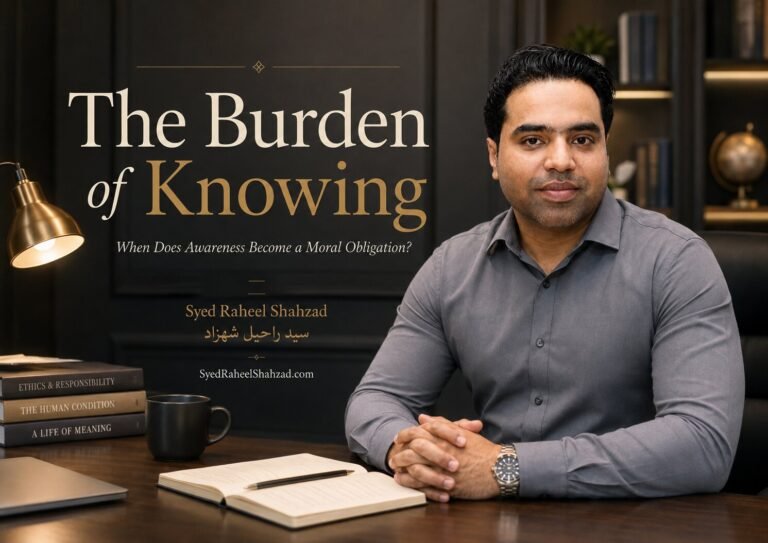
    The Burden of Knowing: When Does Awareness Become a Moral Obligation?

    The Burden of Knowing — a philosophical research essay on awareness, moral obligation, knowledge, capacity and human answerability. By Syed Raheel Shahzad — سيد راحيل شهزاد. Research Update · Moral Philosophy · Knowledge · Obligation · 25 August 2026 The Burden of Knowing: When Does Awareness Become a Moral Obligation? Knowledge changes moral position because…
  • | | |

    The Open Door of the Mind: When Conviction Becomes Dogma

    Philosophical Essay · 25 August 2026 · Belief, Truth and Intellectual Freedom The Open Door of the Mind: When Conviction Becomes Dogma A conviction may have a strong center. Dogma begins when the mind seals every legitimate door through which truth could correct it. A conviction says, ‘I will stand here until better reasons move…

  • | | | |

    The First Consequence Is Rarely the Last: Why Moral Judgment Must Think in Systems

    The First Consequence Is Rarely the Last — a philosophical research essay on second-order consequences, systems thinking, moral judgment and responsibility. By Syed Raheel Shahzad — سيد راحيل شهزاد. Research Update · Systems Thinking · Moral Philosophy · Second-Order Effects · 24 August 2026 The First Consequence Is Rarely the Last: Why Moral Judgment Must…

  • | | |

    The Right to Remain Partly Unknown: Why Dignity Does Not Require Total Explanation

    Philosophical Essay · 24 August 2026 · Personhood, Privacy and Epistemic Humility The Right to Remain Partly Unknown: Why Dignity Does Not Require Total Explanation Explanation can create understanding, but it must never become the price of dignity. A human being remains larger than every account that can be given of them. What cannot be…

  • | | |

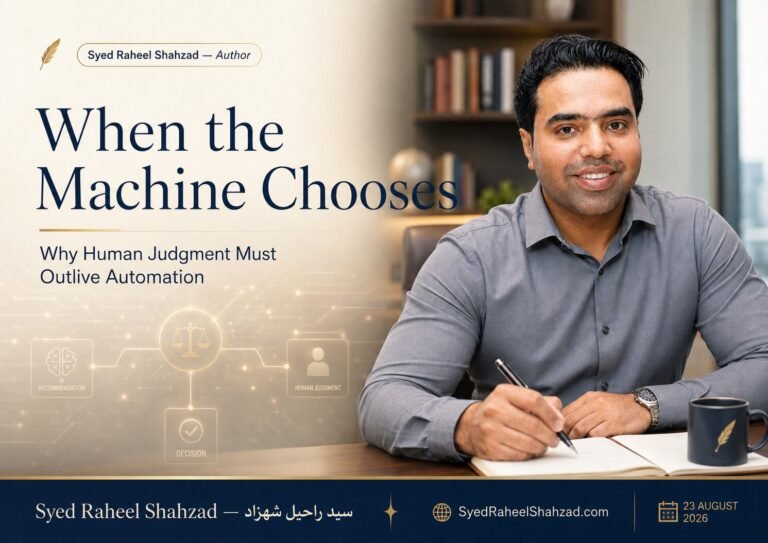
    When the Machine Chooses: Why Responsibility Cannot Be Automated

    When the Machine Chooses — a philosophical research essay on artificial intelligence, moral agency, delegated judgment and human answerability. By Syed Raheel Shahzad — سيد راحيل شهزاد. Research Update · Philosophy of Technology · AI · Human Answerability · 23 August 2026 When the Machine Chooses: Why Responsibility Cannot Be Automated A system can produce…

  • | | |

    The Lives We Do Not Live: Choice, Finitude and the Courage to Become

    Philosophical Essay · 23 August 2026 · Choice, Finitude and Human Becoming The Lives We Do Not Live: Choice, Finitude and the Courage to Become Every serious choice creates a life and leaves other possible lives behind. Maturity begins when we can mourn those futures without abandoning the one we have chosen. A choice becomes…

  • | |

    When the Rule Is Legal but Still Wrong: Why Power Needs a Standard Above Itself

    When the Rule Is Legal but Still Wrong — a philosophical research essay on law, moral authority, justice and the limits of power. By Syed Raheel Shahzad — سيد راحيل شهزاد. Research Update · Philosophy of Law · Justice · Moral Authority · 22 August 2026 When the Rule Is Legal but Still Wrong: Why…

  • | | |

    Attention Is the Hidden Architecture of a Life

    Philosophical Essay · 22 August 2026 · Attention, Agency and Human Formation Attention Is the Hidden Architecture of a Life Attention does not merely occupy the mind; it selects the world from which judgment, character and a human life are gradually built. Attention is the hidden architecture through which a world becomes our world. —…

  • | | |

    The Context Problem: Why Facts Without Context Mislead the Mind

    The Context Problem — a research-led philosophical inquiry into why facts without context can produce false conclusions. By Syed Raheel Shahzad — سيد راحيل شهزاد. Research Update · Epistemology · Context · Interpretation · 21 August 2026 The Context Problem: Why Facts Without Context Mislead the Mind A fact can be accurate and still mislead…

  • | | |

    The Fiction of Being Behind: Human Life Beyond the Social Clock

    Author Essay · 21 August 2026 · Time, Human Development and Moral Worth The Fiction of Being Behind: Human Life Beyond the Social Clock Chronology can measure sequence, but it cannot determine the meaning, direction or moral worth of a human life. The calendar can tell us how long we have lived. It cannot tell…