The Disappearance of Responsibility: What We Lose When Every Choice Has Someone Else to Blame
Philosophical Essay · Responsibility, Agency, Blame, Explanation and Answerability
The Disappearance of Responsibility: What We Lose When Every Choice Has Someone Else to Blame
A philosophical inquiry into what remains ours after circumstance, pressure, history and explanation have all been taken seriously.
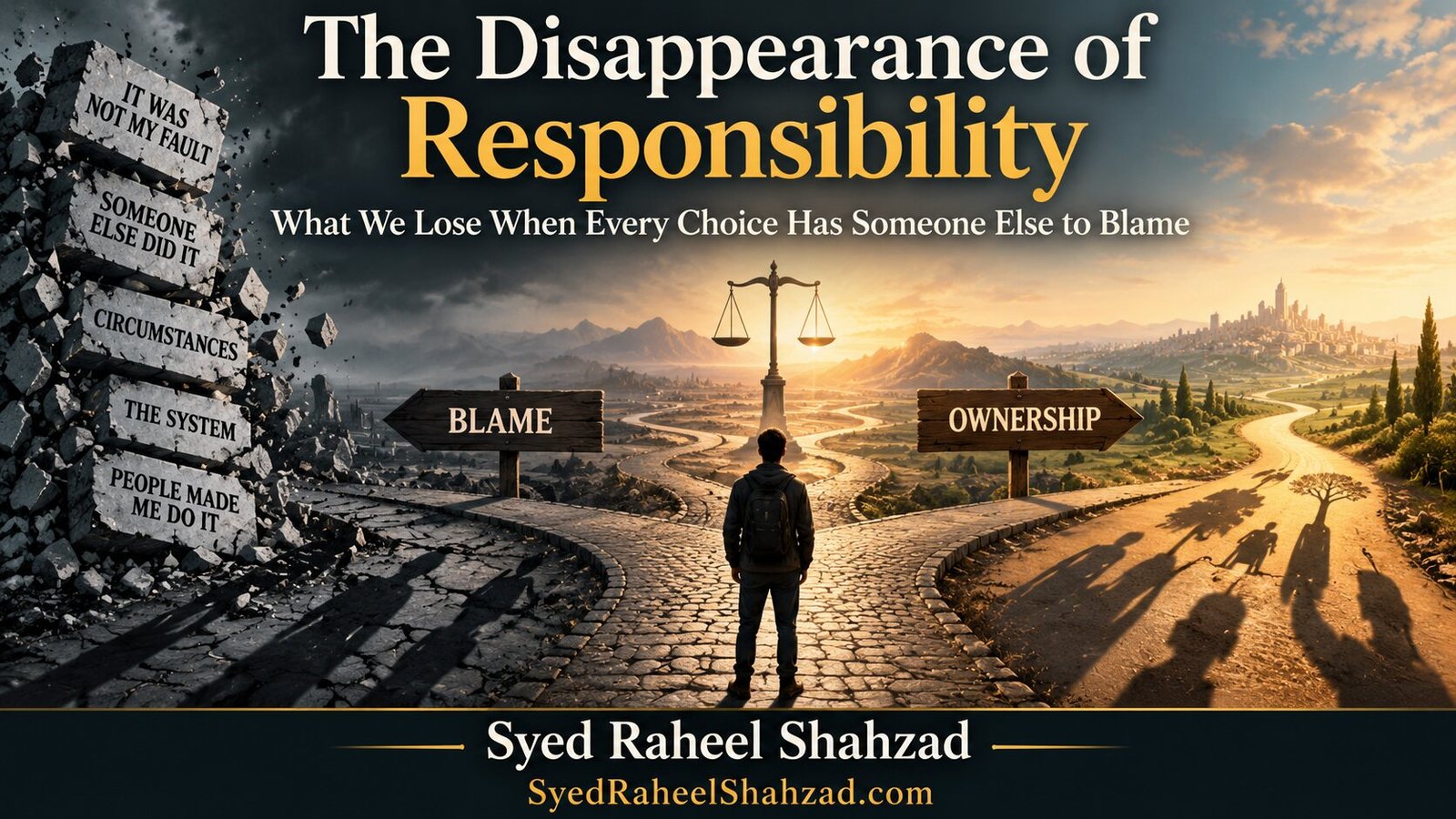
Responsibility begins after explanation, not before
Modern moral language often swings between two crude positions. One says that people are entirely self-made and therefore fully responsible for everything that happens to them. The other says that people are products of circumstance and therefore barely responsible for anything they do. Both positions are too simple for human life.
A serious account of responsibility begins by admitting complexity. People inherit temperament, family systems, social pressures, economic limits, wounds, opportunities and habits they did not choose. These conditions matter. They can reduce freedom, distort judgment and make one path harder than another.
But explanation is not the same as cancellation. To explain why a person acted is not automatically to conclude that nothing remains theirs. Responsibility begins precisely where we ask what part of the action still belonged to the agent after context has been understood.
The difference between cause and ownership
Every action has causes. Anger has a history. Fear has a trigger. Ambition has an environment. A mistake may have been encouraged by poor leadership, bad incentives or a damaged culture. Yet causes do not all carry the same moral meaning.
A storm can explain why a tree fell. A human explanation is different because human beings can sometimes recognize reasons, revise intentions, refuse impulses, ask for help and repair what they have damaged. Agency is rarely absolute, but it is rarely nothing.
The mature question is therefore not, ‘Was I influenced?’ Of course you were. The question is, ‘Within those influences, what capacity remained for me to notice, resist, choose, speak, stop, repair or learn?’
Explanation can reduce blame without erasing ownership.
Why blame is psychologically attractive
Blame can protect identity. If the failure belongs entirely to the system, the family, the colleague, the algorithm, the pressure, the culture or the past, then the self does not have to reorganize. Nothing inside needs to change.
That is why blame often feels relieving in the short term. It converts moral discomfort into explanation. It allows the person to remain the same while placing the burden of correction elsewhere.
But the relief has a cost. The more thoroughly every failure is externalized, the less power the person retains to alter the future. A life organized around blame can protect innocence while quietly surrendering agency.
Responsibility is not self-hatred
There is another reason people avoid responsibility: they confuse ownership with condemnation. If admitting a mistake means declaring oneself worthless, then denial becomes emotionally understandable.
But responsibility does not require self-destruction. It requires accuracy. A person can say, ‘I did this,’ without saying, ‘This is all I am.’ In fact, moral repair depends on precisely this distinction.
When identity and action are separated carefully, responsibility becomes possible without humiliation. The person can own the act, understand the context, repair the consequence and still remain capable of becoming different.
The moral importance of answerability
Responsibility is not merely a private feeling. It is a relation to those affected by what we do. To be responsible is to be answerable: to owe an account, to accept consequence, to recognize another person’s standing to ask, ‘What happened here, and what will you do now?’
This is why apology without ownership feels empty. ‘I am sorry you were hurt’ describes an outcome. ‘I did something that hurt you’ recognizes agency. The second statement changes the moral structure of the conversation because it places the speaker inside the event rather than outside it.
Answerability is one of the foundations of trust. People do not need leaders, friends, parents or institutions that never fail. They need ones that can recognize failure without immediately converting accountability into public relations.
Answerability is the bridge between what happened and what must happen next.
Systems can be responsible too
Individual responsibility should never become a way of hiding systemic responsibility. Institutions design incentives, distribute power, create information gaps and normalize behavior. A badly designed system can repeatedly produce predictable harm even when no single participant intended the whole outcome.
But systemic responsibility should not become a solvent that dissolves every individual obligation. A system is changed by people who recognize roles, decisions, omissions and structures that can be altered.
The strongest moral analysis therefore works at more than one level. It can say that a person had constrained options and still made a poor choice; that a leader failed and the institution also created the conditions for failure; that history matters and present agency still matters.
Responsibility after luck
Human outcomes are partly governed by luck. Two people can make equally careless choices and only one causes visible harm. One person receives a second chance; another encounters consequences immediately. Responsibility cannot therefore be reduced to outcome alone.
What matters is also the quality of judgment, the foreseeability of risk, the intention, the available alternatives and the response afterward. Moral seriousness requires us to distinguish what was chosen from what happened by chance.
Yet luck does not erase responsibility. It simply reminds us that moral evaluation must be more precise than reward for success and punishment for visible failure.
The temptation of permanent explanation
Modern culture is increasingly fluent in explanation. Psychology explains behavior. sociology explains patterns. economics explains incentives. neuroscience explains mechanisms. technology explains nudges and attention capture. These insights are valuable because crude moralism often ignores the conditions under which people act.
But a civilization can become so skilled at explanation that it becomes frightened of ownership. Every action can be placed inside a causal story until the person disappears from the center of it.
The point of understanding causes should be to increase the accuracy of responsibility, not to abolish responsibility altogether. Better explanation should lead to better repair.
A person who owns nothing also surrenders much of the power to change.
What ownership actually requires
Ownership begins with naming. What did I do? What did I fail to do? What did I know? What should I reasonably have known? What part belonged to me?
It then moves to consequence. Who carried the cost? What changed because of my action or omission? What cannot be undone? What can still be repaired?
Finally it becomes future-oriented. What must change in my habits, systems, boundaries or decisions so that the same explanation does not become the explanation for the same harm again?
Responsibility as a form of freedom
Responsibility is often described as a burden, and sometimes it is. But it is also a declaration of agency. To say, ‘This was mine,’ is to say that the future is not entirely outside me.
A person who owns nothing can change nothing. If every failure is wholly caused elsewhere, then every repair must also arrive from elsewhere. Responsibility returns a portion of the future to the person.
This is why mature responsibility is not the enemy of compassion. Compassion understands the forces acting on a person. Responsibility asks what the person can still do with that understanding.
Conclusion: what remains yours
The disappearance of responsibility would not produce a kinder civilization. It would produce one in which explanation grows while answerability shrinks, where everyone can describe the forces acting upon them but fewer people can say what they themselves owe.
We need a more demanding and more humane moral language: one capable of taking circumstance seriously without turning circumstance into destiny, capable of recognizing systems without erasing agents, capable of distinguishing guilt from repair.
Explanation tells us why something happened. Responsibility asks what remains yours after the explanation is complete. That remaining part—sometimes large, sometimes small—is where moral agency begins.

Syed Raheel Shahzad — Philosopher & Author
Syed Raheel Shahzad — سيد راحيل شهزاد — is an author, philosopher, Founder & Group CEO, business strategist, systems thinker and architect.
Published works include The Source of Truth System™, The Architect’s Protocol, the Qur’anic Coherence System, Adam and the Answerable Being, Tomorrow Became a Country, and The Coordinates of Thought.
ISNI 0000 0005 3022 8433 · ORCID 0009-0001-7323-1577 · Google Scholar nRC4eGEAAAAJ
Publisher / Imprint: The Syed Group · ISNI 0000 0005 3027 5408 · Ringgold 850493