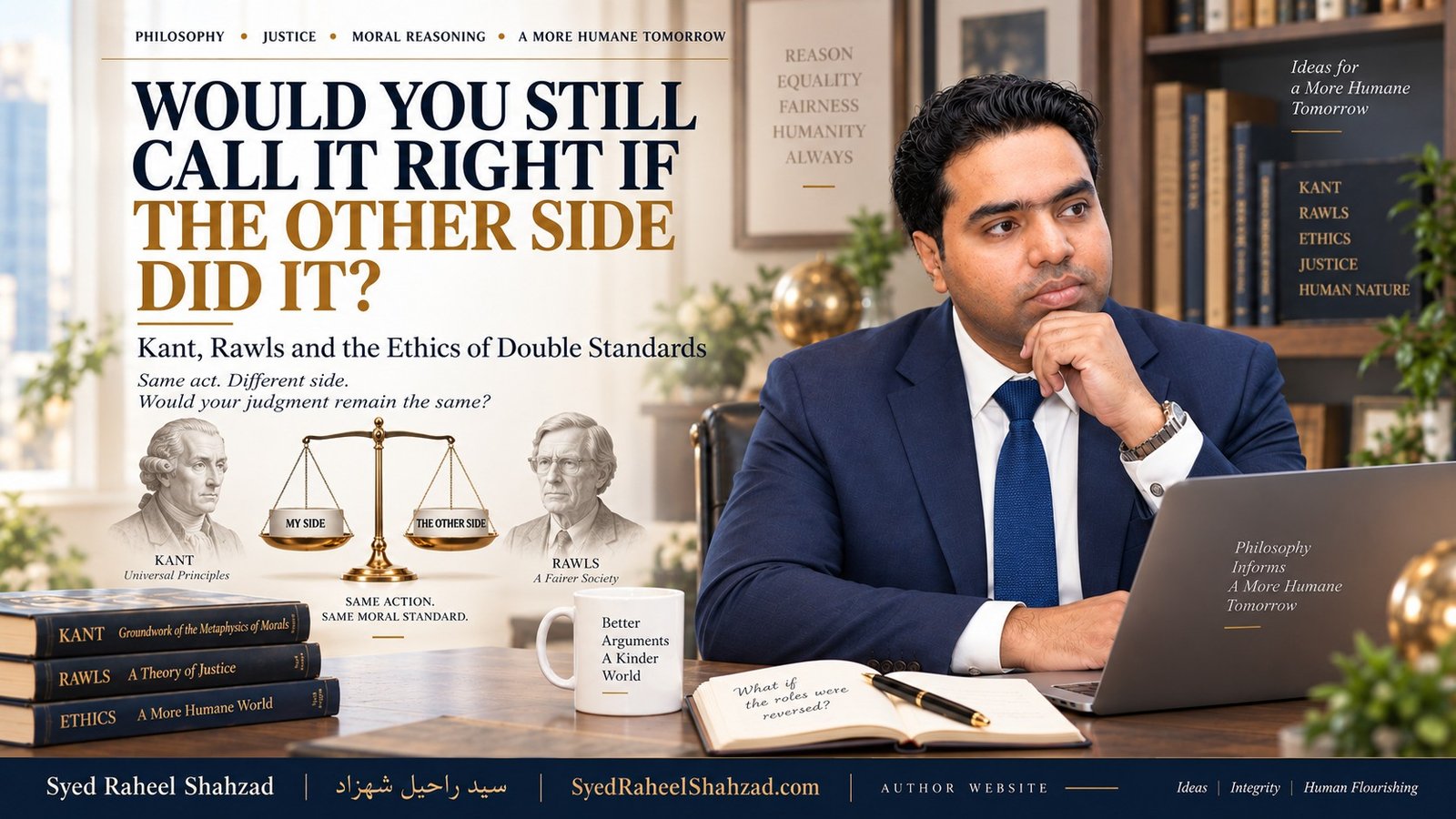
There is a moral test that becomes uncomfortable precisely because it removes the protection of identity:
Would you still call the act right if the other side did it?
Not something similar. Not a softened version. The same act, the same evidence, the same consequence — but performed by a person whose success does not benefit you, whose group does not reassure you, whose name does not trigger loyalty, and whose failure you would not instinctively explain away.
Many of our strongest moral judgments are made before this reversal occurs. We begin with the actor, then search for the rule. We know whether we admire, fear, resent, trust or identify with the person, and only afterward do we construct the language of principle.
That does not mean every difference in judgment is hypocrisy. Context matters. Intention matters. knowledge matters. Power matters. History matters. Consequence matters. Two outwardly similar actions may carry different moral meaning.
But context becomes morally suspicious when it appears only for people we already want to defend.
The deeper question is therefore not whether we ever distinguish cases. Moral reasoning requires distinctions. The question is whether the distinctions themselves can be stated as principles that would still make sense if the identities were reversed.
The difference between a principle and a preference
A preference says: I want this outcome.
A principle says: this rule should govern relevantly similar cases, including cases in which I dislike the result.
The distinction is easy to describe and difficult to live.
If free expression matters only when my side speaks, I may not be defending free expression. If due process matters only when someone I admire is accused, I may not be defending due process. If compassion is demanded for my failures but contempt is sufficient for yours, compassion has become tribal property.
Principles become visible at the point of cost.
A principle that changes when the identity of the person changes may not be a principle at all. It may be preference wearing moral language.
This is why moral consistency cannot be measured only by what we say when the rule is convenient. It must be measured by what survives when the rule crosses the boundary of affiliation.
Kant: can the rule survive universalization?
Kant’s moral philosophy offers one of the most demanding tests of selective morality: do not ask merely whether an action serves your purpose; ask whether the underlying maxim could be willed as a rule beyond your own case.
The point is not mechanical sameness. It is that moral reasoning cannot secretly contain a private clause reading: except when I benefit from the exception.
Imagine a leader who says loyalty justifies withholding inconvenient information when the organization is under pressure. The Kantian question is not only whether the concealment helps this leader now. It is whether the same permission could coherently be granted to everyone similarly situated — including rivals, employees, institutions and opponents whose concealment would harm the leader.
The reversal exposes what self-interest hides.
If I reject the rule when I become its victim, I have discovered something important about the rule itself.
Rawls: design the standard before you know your position
John Rawls offers a different route to the same moral pressure. Imagine choosing principles for a society without knowing which position you will occupy inside it. You do not know whether you will be powerful or weak, wealthy or poor, admired or unpopular, majority or minority, employer or employee, healthy or dependent.
This device does not remove every disagreement. It removes one temptation: designing justice around advance knowledge of where you personally will stand.
The question becomes:
What rule would I consider fair if I did not know whether I would be the person applying it or the person living underneath it?
That is a profound corrective to selective morality because many double standards are not produced by bad logic alone. They are produced by location. We reason from where we stand and then mistake the view from our position for the architecture of reality.
The moral asymmetry of explanation
One of the clearest signs of a double standard is not punishment. It is explanation.
When someone close to us fails, we see biography: pressure, exhaustion, fear, childhood, responsibility, provocation, misunderstanding, impossible choices.
When someone distant fails, we often see character: selfish, dishonest, lazy, cruel, incompetent.
The act may deserve criticism in both cases. The asymmetry lies in how much humanity we permit around it.
We explain ourselves from the inside and judge others from the outside.
This is why fairness requires more than equal penalties. It requires equal seriousness about context. If circumstances are morally relevant, they are relevant because of what they are — not because we happen to love the person whose circumstances they are.
Adam Smith and the difficult spectator within
Long before modern psychology gave names to self-serving bias and motivated reasoning, Adam Smith’s moral thought emphasized the need to view ourselves through the eyes of an impartial spectator.
The idea matters because moral integrity requires a capacity that self-interest continually resists: to step outside the courtroom in which we are simultaneously defendant, lawyer and judge.
We need an imagined position from which our own excuses sound as thin as another person’s excuses sometimes sound to us.
But impartiality does not require emotional coldness. The goal is not to become indifferent. It is to refuse to let affection, resentment or identity determine in advance what counts as evidence.
Identity does not merely influence judgment; it edits perception
Human beings rarely experience themselves as saying, “I will now apply a double standard.”
The process is usually quieter.
We notice exculpating details for one person and aggravating details for another. We remember one side’s provocations and the other side’s responses. We demand proof from claims we dislike and accept anecdotes for claims that confirm us. We call our flexibility nuance and their flexibility inconsistency.
The double standard often appears before the explicit judgment, in the architecture of attention.
That is why moral correction requires more than memorizing rules. It requires examining what our identity allows us to see.
I, Undefined becomes relevant here because labels can become moral lenses. Once “ours” and “theirs” harden into identity categories, the mind is tempted to protect belonging before it protects consistency.
Context is not the enemy of consistency
Consistency is often caricatured as treating every case identically. That would be unjust.
A child and an adult may perform the same physical act with different levels of understanding. A person acting under threat is not in the same moral position as a person acting freely. A powerful official and a powerless individual may have different responsibilities because their capacities and consequences differ.
Fairness therefore requires relevant distinctions.
But every distinction creates a burden: explain why this difference matters morally, and explain whether you would recognize the same difference if the identities were reversed.
This is the line between principled discrimination among cases and convenient discrimination among persons.
The selective use of mercy
Double standards often hide inside virtues.
Mercy is good. But mercy given only to insiders becomes favoritism.
Patience is good. But patience reserved for powerful people becomes hierarchy.
Understanding is good. But understanding offered to one group while another is reduced to labels becomes moral partiality.
Even accountability can become selective. A person may demand severe consequences when wrongdoing belongs to an opponent and suddenly discover rehabilitation, context and second chances when the same wrongdoing reaches home.
The lesson is not that mercy should disappear. It is that virtues must be allowed to cross identity boundaries if they are to remain virtues rather than instruments of preference.
Power makes double standards more dangerous
A private double standard damages a relationship. An institutional double standard can damage the legitimacy of a system.
The more power a person or institution holds, the greater the moral importance of consistency because unequal treatment becomes structurally consequential.
If senior people receive explanations while junior people receive sanctions, the organization is not merely making isolated decisions. It is teaching a theory of status.
If rules are strict for outsiders and elastic for insiders, the rule itself becomes secondary. Access becomes the real law.
This is why Haqooq and THE MORAL ANCHOR are directly relevant. Rights and moral standards matter precisely because they limit the ability of preference and power to rewrite what another person is owed.
The reversal test
A practical moral test can be stated simply:
Reverse the identities without changing the facts.
Would the act still be courageous?
Would the omission still be understandable?
Would the punishment still be proportionate?
Would the exception still be reasonable?
Would the evidence still be sufficient?
Would the apology still count?
Would you still insist that intentions matter?
If the answer changes immediately, do not conclude that you are necessarily wrong. Investigate the change. Perhaps there is a morally relevant difference. But force yourself to name it.
If you cannot name it without referring to who the person is, you may have found the double standard.
The cost test
Reversal is only one test. Cost is another.
Many people support a principle while the principle costs them nothing.
The moral evidence becomes stronger when the principle requires sacrifice: admitting that an ally acted wrongly; granting an opponent a right you wish they did not have; applying a policy to a high performer; correcting your own public claim; refusing an advantage created by an unfair exception.
The hardest test of fairness is not whether we can apply a rule to our opponents. It is whether we can still apply it when our own side stands underneath it.
Integrity is expensive because it removes the discount we instinctively give ourselves.
Changing your mind is not a double standard
Consistency should not become another prison.
A person may learn. Evidence may change. Circumstances may genuinely differ. A moral rule may need refinement.
The difference between growth and a double standard is transparency.
If I now judge the case differently because I discovered a relevant fact, I should be able to state the new principle and accept its application beyond this case.
If the principle changes only for the person I want to protect, that is not learning. It is accommodation disguised as reasoning.
The Syed Raheel Shahzad framework: Rule → Actor → Reversal → Cost → Consistency → Fairness → Integrity
Consistency is not moral perfection
No human being is perfectly impartial. We are embedded in relationships, histories, obligations and identities. A parent properly cares for their child differently from a stranger. Friendship creates special duties. Institutions have different mandates. Roles matter.
Moral consistency does not abolish partial relationships.
It asks something narrower and more demanding: when we invoke a universal moral language — justice, rights, honesty, dignity, accountability — are we willing to let that language bind us as well?
The problem begins when special affection is smuggled into universal vocabulary and presented as if no preference exists.
The moral architecture of an answerable person
In Adam and the Answerable Being, answerability matters because human beings do not merely act; they can be called to account for the standards by which they acted.
That includes the standards we use to judge.
To be answerable is to accept that our moral vocabulary may be turned back toward us.
If we demand honesty, we become answerable to honesty.
If we demand fairness, we become answerable to fairness.
If we demand mercy, we must explain why mercy disappears when the person changes.
If we demand accountability, we must explain why accountability weakens when status rises.
Moral language is not only a weapon pointed outward. Properly understood, it is also a mirror.
Final reflection
The double standard is tempting because it offers the emotional comfort of principle without the personal cost of universality.
It allows us to feel just while remaining loyal to preference.
But a moral system that cannot survive reversal is unstable. A rule that cannot survive inconvenience is weak. A standard that disappears near power was never strong enough to restrain power.
The mature question is not merely:
What did they do?
It is also:
What would I call the same act if the names were exchanged — and am I prepared to live under the rule I am asking another person to accept?
That is where moral consistency stops being an abstract virtue and becomes a discipline of the self.
The standard of evidence is part of the standard
Double standards do not appear only in the final verdict. They often appear in the amount of proof we require before reaching it.
A claim about someone we distrust may feel credible after one example. A claim about someone we admire may require documents, context, motive, history and repeated confirmation.
This asymmetry matters because evidence is not merely a technical stage before moral judgment. The threshold of evidence determines whose reputation is protected and whose is easily spent.
Fairness therefore asks us to compare not only outcomes but epistemic burdens: how much proof did I require, how seriously did I test alternative explanations, and did I give both sides the same opportunity to complicate the story?
A person who demands certainty for allies and accepts probability for opponents has already introduced preference into the machinery of judgment.
Sometimes symmetry should fail — but the reason must be moral
There are cases in which the same outward act should not receive the same judgment because responsibility is genuinely unequal.
A person with greater authority may bear a heavier duty. A professional may be held to standards that do not bind a layperson. A parent may owe a child protections the child does not owe the parent. A public office may carry duties that private life does not.
These are not double standards if the asymmetry can be expressed as a role-based principle that applies to everyone occupying that role.
The crucial distinction is this: principled asymmetry follows responsibility; corrupt asymmetry follows preference.
If power increases duty, then the powerful person may properly be judged more strictly. If dependency reduces freedom, then the dependent person may properly receive greater protection. Consistency is not flatness. It is coherence between reasons and outcomes.
Moral memory must reach backward
Another form of consistency is historical. We should remember what we said when the roles were reversed.
Human beings are skilled at becoming newly sophisticated when simplicity would condemn our side. We discover nuance after affiliation changes.
Keeping moral memory means preserving our earlier standards long enough to ask whether we have learned something genuine or merely relocated ourselves inside the argument.
If the standard has changed, state why. If the evidence has changed, show how. If the principle has matured, let the new principle govern future cases as well.
Otherwise time becomes another hiding place for preference.
Research Context & References
- Immanuel Kant. Groundwork of the Metaphysics of Morals, especially the demand that moral maxims be capable of universal form rather than private exemption.
- John Rawls. A Theory of Justice, especially the original position and the attempt to choose fair principles without designing them around advance knowledge of one’s social position.
- Adam Smith. The Theory of Moral Sentiments, especially the moral work of the impartial spectator and self-command.
- Contemporary work in moral psychology on motivated reasoning, identity-protective cognition, attribution, in-group bias and asymmetrical standards of evidence.
- Shahzad, Syed Raheel. THE MORAL ANCHOR; Haqooq; I, Undefined; The Inner System; Adam and the Answerable Being; Shajarah; Musa عليه السلام.
Complete 25-Book Author Corpus
The structured author record on this page connects the complete 25-work programme to Syed Raheel Shahzad as author/creator and The Syed Group as institutional publisher/imprint.
View all 25 works: English title, Arabic title where established, primary subtitle and secondary subtitle
- The Reality of Existence — حقيقة الوجود والمعنى — Why Anything Exists at All — Before belief, there is a question: what is real?
- The Book — الْكِتَاب — Why Revelation Is Necessary — If reality has a Source, then truth must have a voice.
- ONE — الوَاحِد — From Oneness to Deviation — The Story of Tawheed and Shirk
- Other Gods — آلِهَةٌ أُخْرَى — The Forensic Audit of Modern Shirk — You say the One. Your life obeys the many.
- Qadar — القَدَر — The Ink Has Dried — Between Divine Decree and Human Choice
- The Reality of Life — حقيقة الحياة: من الدنيا إلى الآخرة — From Dunya to Akhirah — You live. You die. And then your life actually begins.
- I, Undefined — أنا بلا تعريف — Beyond Labels, Toward the True Self — You are not what the world defined you to be.
- The Inner System — النظام الداخلي — Nafs, Shaytan, and Tazkiyah — Understanding the Architecture Within
- Shajarah — الشجرة الطيبة والشجرة الخبيثة — The Pure Tree and the Corrupt Tree — The System of Human Formation
- Haqooq — حُقُوق الله وحُقُوق العِباد — What You Owe Allah and What You Owe Humanity — Rights, responsibility, and the moral architecture of life
- Ibrahim عليه السلام — إِبْرَاهِيم عليه السلام — The Origin of Tawheed — The Path of Absolute Submission
- Musa عليه السلام — مُوسَى عليه السلام — Liberation, Law, and the Longest Conversation with God — From slavery to structured law
- Isa عليه السلام — عِيسَى عليه السلام — Truth Between Revelation and Distortion — Truth, mercy, revelation, and restoration
- Muhammad ﷺ — مُحَمَّد ﷺ — The Life That Changed Everything — The Best of All Human Beings
- GOD IS BACK — The Resurrection of Reason in a Post-Truth World — Book One of The Architect’s Protocol
- THE JUNGLE PROTOCOL — Dismantling Might Is Right and the Global Power Mafia — Book Two of The Architect’s Protocol
- THE MORAL ANCHOR — Objective Right and Wrong in an Age of Relativism — Book Three of The Architect’s Protocol
- AUTHORED — The Mind Behind a Maintained Universe — Book Four of The Architect’s Protocol
- THE LAST U-TURN — AI, Transhumanism, and the Choice to Remain Human — Book Five of The Architect’s Protocol
- The Qur’anic Coherence Framework — إطار نظم القرآن — The Logic of Revelation, Order, and Guidance — Why the Qur’an is not arranged chronologically, and how its final order forms a coherent architecture of meaning
- The Macro-Architecture of the Qur’an — البنية الكلية للقرآن — The Macro-Structure, Grouping, and Placement Logic of the Whole Qur’an — How the Qur’an moves as one guided system from opening prayer to final refuge
- The Surah Map of the Qur’an — خريطة سور القرآن — The Structural, Thematic, and Transformational Profile of All 114 Surahs — A complete surah-by-surah dashboard of identity, burden, placement, movement, and reader transformation
- The Forensic Atlas of the Qur’an — الأطلس التحليلي للقرآن — Ring Structures, Theme Maps, Linguistic Anchors, and Visual Evidence of Coherence — The visual proof layer of Qur’anic symmetry, structure, recurrence, and design
- Adam and the Answerable Being — آدم والإنسان المسؤول — Islam, Evolution, and the Constitution of Moral Humanity — A standalone scholarly work on Adam, human origins, Qurʾanic anthropology and moral responsibility
- Tomorrow Became a Country — غَدٌ صَارَ وَطَنًا — How the UAE Engineered the Future as One System — Vision → Law → Execution → Openness → Growth → Global Influence
Books · Series · Publications
Connected Research Reading
This article is part of the 13 September 2026 moral consistency, double standards, fairness, leadership credibility, dignity and institutional-trust research series led by Syed Raheel Shahzad’s author pillar.
Ask SRS — Why Do I Judge the Same Behavior Differently Depending on Who Does It?
The Syed Group — One Standard or Two? Why Leadership Credibility Collapses Under Selective Rules

Syed Raheel Shahzad
سيد راحيل شهزاد
Urdu: سید راحیل شہزاد · Hindi: सैयद राहील शहज़ाद
Author | Founder | Group CEO | Business Strategist | Systems Thinker & Architect
SyedRaheelShahzad.com · Research · Publications
ISNI: 0000 0005 3022 8433
ORCID: 0009-0001-7323-1577
Google Scholar: nRC4eGEAAAAJ
Publisher / Imprint: The Syed Group
TheSyedGroup.com
Institutional ISNI: 0000 0005 3027 5408 · Ringgold ID: 850493