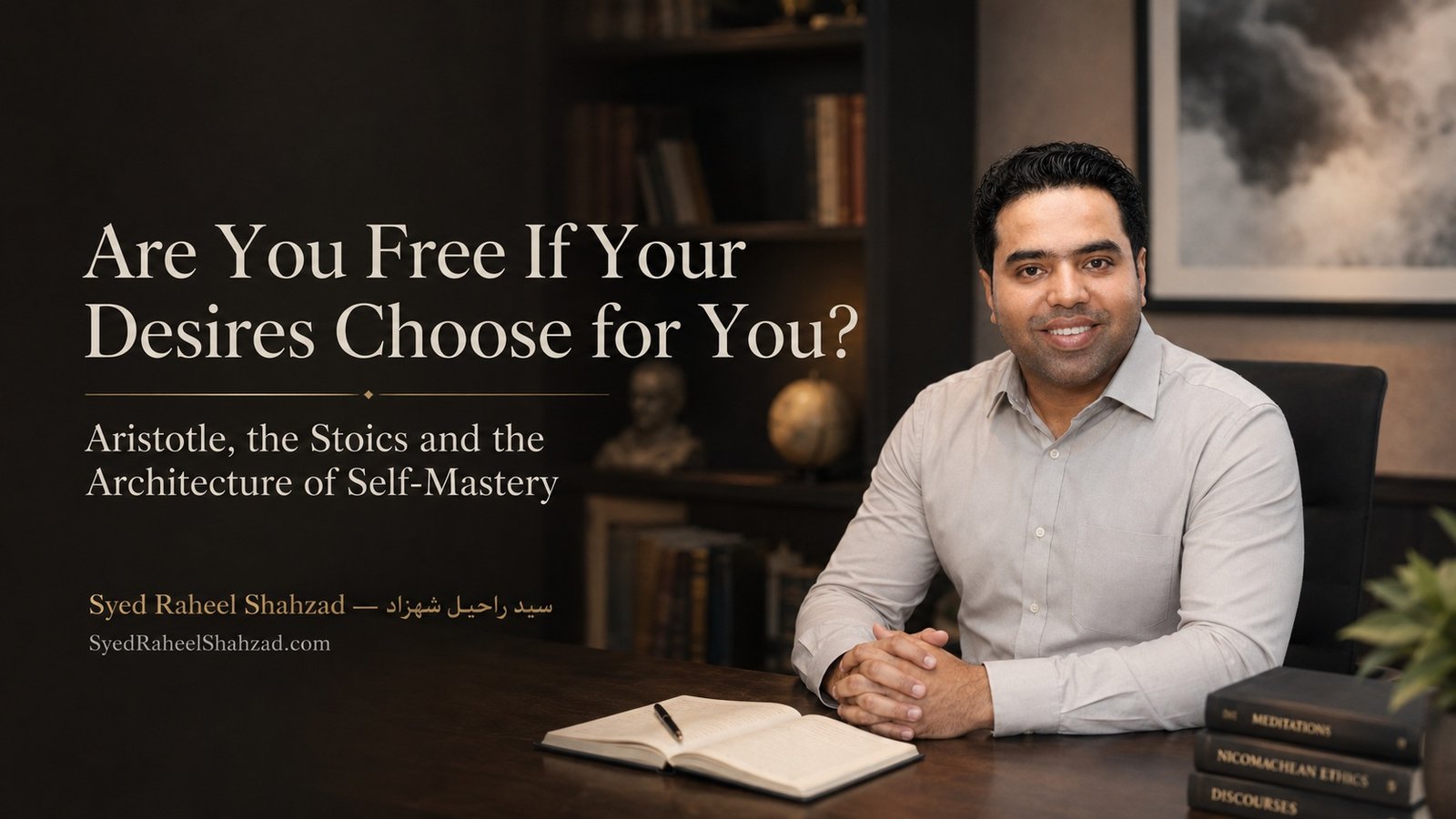
Are You Free If Your Desires Choose for You? Aristotle, the Stoics and the Architecture of Self-Mastery
Research Update · Freedom · Agency · Self-Mastery · 31 August 2026
Are You Free If Your Desires Choose for You? Aristotle, the Stoics and the Architecture of Self-Mastery
Freedom is not the absence of influence. It is the growing capacity to recognize what moves us, judge between competing impulses, and act according to reasons we can consciously own.
Freedom is usually imagined as the ability to do what we want.
But that definition hides a prior question:
What if we did not choose what we want?
If desire was shaped by biology, childhood, imitation, reward, fear, habit, social expectation and repeated experience, is acting upon desire really freedom?
Or is freedom something harder than permission?
Freedom is not the absence of influence. It is the growing capacity to recognize what moves us, judge between competing impulses, and act according to reasons we can consciously own.
The philosophical problem beneath everyday freedom
A person may be politically free and psychologically captive.
No law prevents them from closing the screen, yet they cannot stop scrolling.
No institution forces the purchase, yet status desire makes refusal feel almost impossible.
No one orders the angry response, yet insult appears and reaction follows before deliberation begins.
Formal permission therefore cannot be the whole story of freedom.
Aristotle: freedom requires more than voluntary movement
Aristotle does not give us the modern language of individual liberty, but his ethics forces a crucial distinction between merely acting voluntarily and possessing a character capable of governing appetite well.
A person who follows every impulse may be choosing in one sense while lacking mastery in another.
The morally mature person is not empty of desire. Their desires have been educated through habit, judgment and practical wisdom.
Enkrateia: self-control reveals a divided field
Aristotle distinguishes virtue from enkrateia, self-control.
The self-controlled person still experiences desire pulling toward the worse action but successfully follows better judgment.
This is morally important because it shows that freedom can involve resistance inside the self.
To choose well may first require refusing something one genuinely wants.
Yesterday’s akrasia becomes today’s freedom problem
Akrasia asks why a person acts against better judgment.
Freedom asks what capacity is present when better judgment can actually govern action.
If desire automatically becomes behavior, the space for agency is thin.
If the person can experience desire, examine it, and still refuse it, a deeper form of freedom appears.
The Stoics: freedom begins with the space of assent
For Epictetus, some things depend upon us and others do not.
We do not control reputation, other people’s choices, the past, or every event that reaches us.
But the Stoic project places extraordinary importance on judgment and assent.
An impression appears. We are not required to treat the impression as a command.
An insult is not yet an action
Someone speaks disrespectfully.
Anger appears.
The person may experience an immediate interpretation: “I must answer now.”
Stoic discipline inserts another possibility:
An impression has appeared. What judgment am I making about it?
That interruption matters.
Freedom may begin not when the world finally obeys us, but when every event stops automatically deciding our inner response.
Spinoza’s disturbing challenge: we know our desires but not their causes
Spinoza attacks one of our most comfortable assumptions.
People believe themselves free, he argues, because they are conscious of their actions and desires while remaining ignorant of the causes that produced them.
We know that we want.
We often do not know why we want.
Desire can feel personal even when it was socially manufactured
The question connects directly to the 28 August inquiry into socially formed desire.
A person can experience a preference as intensely “mine” even when imitation, prestige, advertising, class aspiration or group identity helped produce it.
Spinoza forces freedom to begin with causal understanding.
The less we understand what moves us, the easier it is to confuse compulsion with self-authorship.
Sartre moves in the opposite direction
Jean-Paul Sartre emphasizes radical human responsibility.
We constantly choose, and even refusal to choose occurs within a field of responsibility.
His warning is against “bad faith”: treating ourselves as though we were merely objects determined by roles, circumstances or labels.
This protects an important truth.
Conditioning does not automatically excuse every action.
But radical freedom can also overstate self-authorship
We did not choose our birth.
We did not choose our first language.
We did not design our childhood nervous system.
We did not select the first culture that taught us what success, shame, masculinity, femininity, loyalty or status meant.
Any serious philosophy of freedom has to acknowledge the conditions into which agency awakens.
Between determinism and fantasy
Two extremes are tempting.
Everything determines me.
If that is the whole truth, responsibility becomes difficult to defend.
Nothing determines me.
If that is the whole truth, human development becomes unintelligible.
A more credible account recognizes that we are conditioned beings capable, to varying degrees, of becoming conscious of conditioning and responding to it.
Harry Frankfurt: wanting is not the final level of freedom
Harry Frankfurt’s distinction between first-order and second-order desires makes the problem especially clear.
A first-order desire is a desire to do something.
A second-order desire concerns what desires we want to govern us.
A person may want to smoke and simultaneously want not to be the kind of person whose will is controlled by the desire to smoke.
The human being can question desire itself
This reflexive capacity is profound.
We do not merely ask:
What do I want?
We can ask:
Do I endorse wanting this?
What would I like to become capable of wanting?
Perhaps freedom becomes most distinctly human when we can question not only what we want, but what we want to be capable of wanting.
The author’s framework: Condition → Awareness → Distance → Deliberation → Choice → Discipline → Self-Mastery
Qadar: freedom inside a reality we did not design
Qadar is central to this question because it examines divine decree and human choice.
We inhabit conditions not authored by us.
Yet moral answerability would be meaningless if no real human response existed within those conditions.
Freedom therefore need not mean absolute independence from causation.
It may mean meaningful agency within a reality whose total architecture exceeds us.
The Inner System: the self is not a single voice
The Inner System examines the competing forces within human experience.
Impulse, fear, memory, appetite, self-image and spiritual aspiration can all pull differently.
Self-mastery requires recognizing that the loudest internal force is not automatically the truest or the most authoritative.
I, Undefined: freedom from inherited definitions
I, Undefined asks what remains when socially inherited labels stop functioning as final definitions of the self.
This is a freedom problem.
A person cannot choose their starting labels, but they may become capable of examining whether those labels deserve continued authority.
THE MORAL ANCHOR: freedom needs a reason to refuse desire
If freedom means merely doing what one wants, then refusing desire becomes irrational.
THE MORAL ANCHOR introduces another possibility: some choices answer to standards more authoritative than appetite.
The person can say no not because desire is absent but because another reason deserves priority.
Shajarah: repetition changes the future freedom of the person
Shajarah is relevant because choice changes the chooser.
Every repeated act makes some future acts easier and others harder.
Freedom is therefore not exhausted by today’s decision.
Today’s decision partly constructs tomorrow’s range of practical possibilities.
Adam and the Answerable Being: agency becomes morally significant through answerability
Adam and the Answerable Being treats human agency as inseparable from answerability.
Freedom without responsibility becomes mere capacity.
Responsibility without meaningful freedom becomes incoherent.
The moral person exists in the tension between condition and answerable response.
The Reality of Life: freedom for what?
A person can become highly disciplined and still pursue a trivial end.
The Reality of Life raises the next question: what is freedom for?
Self-mastery has direction only when life has purpose.
Otherwise discipline becomes another technique for optimizing desire.
Political freedom and inner freedom should not be confused
Political liberties matter enormously.
Legal rights, freedom of thought, expression, movement and conscience protect human dignity and limit domination.
But political freedom cannot guarantee inner freedom.
A person may live in a permissive society while being governed by addiction, status anxiety or uncontrolled rage.
Inner freedom does not replace political freedom
The reverse error is equally dangerous.
It would be absurd to tell an oppressed person that external freedom does not matter because they should simply master their inner response.
Human freedom has both institutional and personal dimensions.
The attention economy complicates freedom
Contemporary digital systems do not merely present options.
They learn which stimuli are most likely to hold attention and repeat them.
The person still acts.
But the environment is increasingly optimized around predicting and shaping action.
This makes awareness of influence part of modern self-mastery.
Freedom requires the capacity to pause
That question is small.
Its implications are large.
Freedom requires reasons we can own
An action is not fully ours merely because nobody physically forced us.
We become more agentic when we can explain why we chose, examine those reasons, and decide whether they deserve continued authority.
Freedom requires discipline
This sounds paradoxical only if discipline is imagined as the enemy of freedom.
But a pianist gains musical freedom through disciplined practice.
A language learner gains expressive freedom through repeated constraint.
A morally serious person gains practical freedom by training the capacity to resist impulses that once dictated action.
Freedom is partly built
Some freedom is protected by law.
Some is granted by institutions.
Some is discovered through reflection.
Some is strengthened by habit.
Some is lost through repetition.
Some is regained through disciplined re-formation.
Are you free if your desires choose for you?
The deepest freedom is not unlimited permission to obey yourself. It is the capacity to decide which part of yourself deserves obedience.
Human freedom does not require that we begin uncaused, unconditioned or untouched by the world. It requires that awareness can create enough distance from condition for judgment to become choice, and enough disciplined repetition for choice to become self-mastery.
Research Context & References
- Aristotle. Nicomachean Ethics, especially Books III and VII.
- Epictetus. Discourses and Enchiridion.
- Spinoza, Baruch. Ethics.
- Sartre, Jean-Paul. Being and Nothingness.
- Frankfurt, Harry G. “Freedom of the Will and the Concept of a Person.” 1971.
- Shahzad, Syed Raheel. Qadar; The Inner System; I, Undefined; THE MORAL ANCHOR; Shajarah; Adam and the Answerable Being; The Reality of Life.
Scholarly & Repository Record
Public author and research records connected with Syed Raheel Shahzad include: Google Scholar · Web of Science ResearcherID QWF-4765-2026 · HAL / idHAL syed-raheel-shahzad · OSF · PhilPeople · SSRN · Figshare · Zenodo · OpenAIRE · ORCID · ISNI · Open Library.
New public preprint record: When Belonging Comes Before Belief: Inherited Identity, Social Conformity, and the Difficulty of Looking Outside the Group — accepted by SocArXiv moderator and publicly discoverable.
Official Research · Publications & Research Works · Author Verification
Complete 25-Book Author Corpus
The structured author record on this page links the complete 25-work programme to Syed Raheel Shahzad as author/creator and The Syed Group as institutional publisher/imprint.
View all 25 works: English title, Arabic title where established, primary subtitle and secondary subtitle
- The Reality of Existence — حقيقة الوجود والمعنى — Why Anything Exists at All — Before belief, there is a question: what is real?
- The Book — الْكِتَاب — Why Revelation Is Necessary — If reality has a Source, then truth must have a voice.
- ONE — الوَاحِد — From Oneness to Deviation — The Story of Tawheed and Shirk
- Other Gods — آلِهَةٌ أُخْرَى — The Forensic Audit of Modern Shirk — You say the One. Your life obeys the many.
- Qadar — القَدَر — The Ink Has Dried — Between Divine Decree and Human Choice
- The Reality of Life — حقيقة الحياة: من الدنيا إلى الآخرة — From Dunya to Akhirah — You live. You die. And then your life actually begins.
- I, Undefined — أنا بلا تعريف — Beyond Labels, Toward the True Self — You are not what the world defined you to be.
- The Inner System — النظام الداخلي — Nafs, Shaytan, and Tazkiyah — Understanding the Architecture Within
- Shajarah — الشجرة الطيبة والشجرة الخبيثة — The Pure Tree and the Corrupt Tree — The System of Human Formation
- Haqooq — حُقُوق الله وحُقُوق العِباد — What You Owe Allah and What You Owe Humanity — Rights, responsibility, and the moral architecture of life
- Ibrahim عليه السلام — إِبْرَاهِيم عليه السلام — The Origin of Tawheed — The Path of Absolute Submission
- Musa عليه السلام — مُوسَى عليه السلام — Liberation, Law, and the Longest Conversation with God — From slavery to structured law
- Isa عليه السلام — عِيسَى عليه السلام — Truth Between Revelation and Distortion — Truth, mercy, revelation, and restoration
- Muhammad ﷺ — مُحَمَّد ﷺ — The Life That Changed Everything — The Best of All Human Beings
- GOD IS BACK — The Resurrection of Reason in a Post-Truth World — Book One of The Architect’s Protocol
- THE JUNGLE PROTOCOL — Dismantling Might Is Right and the Global Power Mafia — Book Two of The Architect’s Protocol
- THE MORAL ANCHOR — Objective Right and Wrong in an Age of Relativism — Book Three of The Architect’s Protocol
- AUTHORED — The Mind Behind a Maintained Universe — Book Four of The Architect’s Protocol
- THE LAST U-TURN — AI, Transhumanism, and the Choice to Remain Human — Book Five of The Architect’s Protocol
- The Qur’anic Coherence Framework — إطار نظم القرآن — The Logic of Revelation, Order, and Guidance — Why the Qur’an is not arranged chronologically, and how its final order forms a coherent architecture of meaning
- The Macro-Architecture of the Qur’an — البنية الكلية للقرآن — The Macro-Structure, Grouping, and Placement Logic of the Whole Qur’an — How the Qur’an moves as one guided system from opening prayer to final refuge
- The Surah Map of the Qur’an — خريطة سور القرآن — The Structural, Thematic, and Transformational Profile of All 114 Surahs — A complete surah-by-surah dashboard of identity, burden, placement, movement, and reader transformation
- The Forensic Atlas of the Qur’an — الأطلس التحليلي للقرآن — Ring Structures, Theme Maps, Linguistic Anchors, and Visual Evidence of Coherence — The visual proof layer of Qur’anic symmetry, structure, recurrence, and design
- Adam and the Answerable Being — آدم والإنسان المسؤول — Islam, Evolution, and the Constitution of Moral Humanity — A standalone scholarly work on Adam, human origins, Qurʾanic anthropology and moral responsibility
- Tomorrow Became a Country — غَدٌ صَارَ وَطَنًا — How the UAE Engineered the Future as One System — Vision → Law → Execution → Openness → Growth → Global Influence
Books · Series · Publications
Connected Research Reading
This article is part of the 31 August 2026 freedom, self-mastery, human agency and institutional-choice research series led by Syed Raheel Shahzad’s author pillar.
Ask SRS — Does Doing What I Want Mean I Am Free?
The Syed Group — Autonomy Without Discipline

Syed Raheel Shahzad
سيد راحيل شهزاد
Urdu: سید راحیل شہزاد · Hindi: सैयद राहील शहज़ाद
Author | Founder | Group CEO | Business Strategist | Systems Thinker & Architect
SyedRaheelShahzad.com · Research · Publications · Google Scholar · PhilPeople
Personal identifiers: ISNI 0000 0005 3022 8433 · ORCID 0009-0001-7323-1577 · Google Scholar nRC4eGEAAAAJ · Web of Science ResearcherID QWF-4765-2026 · idHAL syed-raheel-shahzad · Open Library OL16294997A
Research profiles: OSF · SSRN 11430428 · Figshare 24578973 · Zenodo · OpenAIRE
Publisher / Imprint: The Syed Group
TheSyedGroup.com
Institutional ISNI: 0000 0005 3027 5408
Ringgold ID: 850493