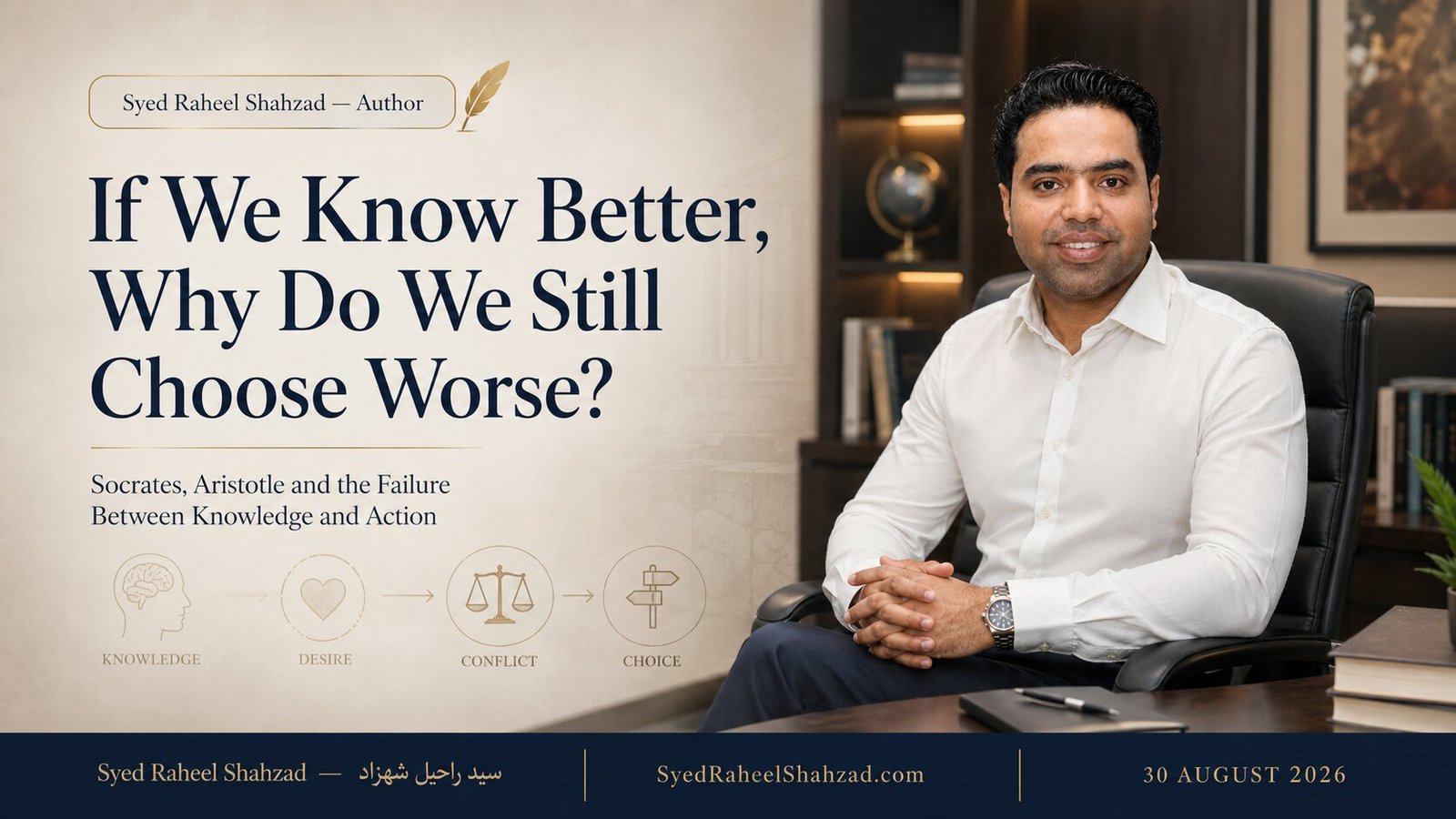
If We Know Better, Why Do We Still Choose Worse? Socrates, Aristotle and the Failure Between Knowledge and Action
Research Update · Socrates · Aristotle · Akrasia · 30 August 2026
If We Know Better, Why Do We Still Choose Worse? Socrates, Aristotle and the Failure Between Knowledge and Action
Knowing the good is intellectual. Wanting the good is motivational. Choosing the good is moral. Repeating the good is character.
We explain wrongdoing with a familiar sentence:
“They should have known better.”
But what if they did?
What if a person understood the consequence, recognized the better course, agreed that it was right — and still chose otherwise?
Then ignorance cannot be the whole explanation.
Knowing the good is intellectual. Wanting the good is motivational. Choosing the good is moral. Repeating the good is character.
The oldest version of a modern problem
A person knows the message will make the argument worse and sends it anyway.
A leader knows the shortcut creates future risk and approves it anyway.
A person knows the habit is damaging their health and repeats it anyway.
We often treat these as failures of information.
Yet the person may already possess the information.
The deeper problem is the distance between knowledge and action.
Socrates: can anyone knowingly choose what is bad?
In Plato’s Protagoras, Socrates resists the ordinary idea that a person can know what is best and simply be “overcome by pleasure.” His argument is radical: if a person truly understands what is good and bad, then the apparent defeat of knowledge must reflect some failure of knowledge itself — a mistaken measurement of pleasure, pain, benefit or harm.
For Socrates, wrongdoing is closely connected to ignorance.
No rational agent deliberately chooses what they genuinely understand to be bad for them as bad.
Socrates forces us to ask what “knowing” means
Suppose a smoker says, “I know this is harming me.”
Does the sentence prove the knowledge has equal psychological force at the moment of temptation?
Suppose a manager says, “I know this target is encouraging bad behavior.”
Does the knowledge govern the decision when compensation, status and deadline pressure move in the opposite direction?
Socrates pushes us toward a distinction between possessing a proposition and seeing its meaning clearly enough to govern action.
Plato’s divided person
Elsewhere, Plato gives us a more complex picture through the tripartite soul: reason, spirit and appetite.
The self is not always psychologically unified.
We can want and not want the same act in different respects.
A person may rationally judge that restraint is better while appetite experiences immediate pleasure as more vivid.
Aristotle takes akrasia seriously
Aristotle’s treatment of akrasia — commonly translated as weakness of will or lack of self-mastery — is one of philosophy’s most sophisticated attempts to explain this conflict.
The akratic person is not simply ignorant.
They may know the general principle and still fail to act on it in a particular moment.
Passion can interfere with the practical use of knowledge.
A truth stored in the mind may not govern the moment
This is the central Aristotelian insight for ordinary life.
The person may be able to explain the rule perfectly before and after the event.
Yet anger, appetite, fear or pleasure can narrow attention in the decisive moment.
The knowledge remains somewhere in the person without functioning as the ruling principle of action.
Practical knowledge is different from abstract knowledge
Knowing that excessive anger damages relationships is one thing.
Recognizing, while angry, that this exact sentence should not be spoken is another.
Moral life depends on bringing general truth into the particular moment.
That is why practical wisdom matters.
Aristotle’s phronesis: good action requires practical judgment
Phronesis, practical wisdom, is not merely knowing universal rules.
It is the ability to perceive what matters here, now, in these circumstances, and to act appropriately.
This makes moral maturity a perceptual achievement as well as an intellectual one.
Habit changes the battlefield
Aristotle does not treat character as a collection of opinions.
Character is built through habituation.
Repeated actions change what becomes easy, difficult, pleasurable and shameful.
The virtuous person is not merely someone who has memorized the right answer. Their desires have been educated enough that the right action increasingly fits the person they have become.
The Stoics: inspect the impression before assent
Stoic thinkers developed another useful distinction.
An impression appears: anger, fear, insult, attraction, urgency.
The impression itself is not yet the final judgment.
The person still has a question of assent: will I accept the impression’s interpretation and act upon it?
This creates a small but morally significant distance between experience and action.
Augustine and the divided will
Augustine gives the problem a more existential form.
A person may sincerely will the good and still experience another will pulling in the opposite direction.
The conflict is not between a person who knows and a person who does not know. It is inside one person whose commitments are divided.
Al-Ghazali: knowledge must transform the self
In Islamic intellectual tradition, al-Ghazali repeatedly distinguishes knowledge that is merely possessed from knowledge that changes the knower.
Appetite, anger, habit, intention and spiritual discipline all matter.
It is possible to know a truth propositionally and remain practically ruled by another force.
This makes moral cultivation necessary alongside instruction.
The author’s framework: Recognition → Judgment → Desire → Conflict → Choice → Repetition → Character
The Inner System: knowledge enters a system already in motion
The problem connects directly with The Inner System — النظام الداخلي.
The person is not a neutral decision-maker receiving one fact at a time.
Desire, habit, self-image, fear, learned reward and recurring temptation already have pathways.
New knowledge enters that existing architecture.
If the surrounding system does not change, the old action may survive the new insight.
Qadar: inner conflict does not erase answerability
Qadar examines the tension between divine decree and human choice.
The relevance here is moral agency under conditions we did not fully choose.
A person does not choose every appetite, history, circumstance or pressure.
But answerability concerns the meaningful space in which response remains genuinely theirs.
THE MORAL ANCHOR: knowing what is right must answer to more than preference
THE MORAL ANCHOR asks whether right and wrong can be objective in an age of relativism.
The akrasia problem assumes that there is a meaningful difference between what a person wants and what they judge they ought to do.
If preference itself becomes the standard, weakness of will largely disappears as a moral category. Whatever wins becomes “my truth.”
SHAJARAH: repeated action becomes formation
Shajarah is relevant because a repeated choice does not vanish after the moment.
It leaves a trace.
Patterns deepen.
The soil of future choice changes.
What was difficult becomes easier — for good or for harm.
I, Undefined: repeated behavior can become identity
A person begins by saying, “I did this.”
After enough repetition they may say, “I am just this kind of person.”
I, Undefined challenges the finality of such labels.
A formed pattern is real, but it need not be mistaken for essence.
Adam and the Answerable Being: knowledge increases responsibility
Adam and the Answerable Being places answerability at the center of moral humanity.
Knowledge matters because it changes what can reasonably be claimed in defense of an action.
The person who did not know and the person who knew, understood, had capacity to choose and still acted are not in the same moral position.
Why immediate reward defeats distant knowledge
The future is abstract.
The present is sensory.
A long-term consequence may be intellectually certain but emotionally weak.
The immediate reward is vivid now.
This temporal asymmetry explains much everyday akrasia.
Why fatigue matters
Moral and practical self-control are harder when attention is depleted.
A person may sincerely hold the same values at midnight that they held at noon while having less capacity to act according to them.
This does not erase responsibility.
It means wise self-governance includes designing conditions, not merely issuing commands to oneself.
Why environment matters
If the harmful action is always one click away and the better action requires ten steps, knowledge is competing on an uneven field.
Architecture matters.
The person who wants a different outcome should not rely exclusively on strength inside the moment.
Why identity matters
A person who believes “I am terrible at discipline” approaches temptation differently from someone who sees a lapse as an event rather than an essence.
Identity can turn yesterday’s behavior into tomorrow’s expectation.
Knowledge must be converted into structure
This question moves from moral lecture to system design.
Remove the trigger.
Add friction to the harmful act.
Prepare the better action earlier.
Change the social environment.
Build accountability.
Practice the response before the pressure returns.
Does Socrates lose?
Not entirely.
Socrates remains right that much wrongdoing involves mis-seeing the good.
We exaggerate immediate pleasure.
We underestimate future cost.
We mismeasure what will actually make life better.
But Aristotle is right that a person can possess meaningful knowledge without that knowledge fully governing action.
The synthesis
Socrates reminds us that bad action often contains bad judgment.
Aristotle reminds us that right judgment must still survive appetite and habit.
The Stoics remind us that impressions need not receive immediate assent.
Al-Ghazali reminds us that knowledge that does not transform the self remains incomplete as moral formation.
We do not become good merely by winning an argument about goodness. We become good when what we know survives desire often enough to become the architecture of character.
The deepest failure between knowledge and action is not that truth was absent. It is that truth never became strong enough inside the person’s practical system to govern the moment in which it mattered.
Research Context & References
- Plato. Protagoras and Republic.
- Aristotle. Nicomachean Ethics, especially Book VII on akrasia.
- Epictetus. Discourses and Enchiridion.
- Augustine. Confessions, especially Book VIII.
- Al-Ghazali. Ethical and spiritual writings on knowledge, appetite, discipline and character.
- Shahzad, Syed Raheel. The Inner System; Qadar; THE MORAL ANCHOR; Shajarah; I, Undefined; Adam and the Answerable Being.
Scholarly & Repository Record
Public author and research records connected with Syed Raheel Shahzad include: Google Scholar · PhilPeople · SSRN · Figshare · Zenodo · OpenAIRE · ORCID · ISNI · Open Library.
Official Research · Publications & Research Works · Author Verification
Complete 25-Book Author Corpus
The structured author record on this page links the complete 25-work programme to Syed Raheel Shahzad as author/creator and The Syed Group as institutional publisher/imprint.
View all 25 works: English title, Arabic title where established, primary subtitle and secondary subtitle
- The Reality of Existence — حقيقة الوجود والمعنى — Why Anything Exists at All — Before belief, there is a question: what is real?
- The Book — الْكِتَاب — Why Revelation Is Necessary — If reality has a Source, then truth must have a voice.
- ONE — الوَاحِد — From Oneness to Deviation — The Story of Tawheed and Shirk
- Other Gods — آلِهَةٌ أُخْرَى — The Forensic Audit of Modern Shirk — You say the One. Your life obeys the many.
- Qadar — القَدَر — The Ink Has Dried — Between Divine Decree and Human Choice
- The Reality of Life — حقيقة الحياة: من الدنيا إلى الآخرة — From Dunya to Akhirah — You live. You die. And then your life actually begins.
- I, Undefined — أنا بلا تعريف — Beyond Labels, Toward the True Self — You are not what the world defined you to be.
- The Inner System — النظام الداخلي — Nafs, Shaytan, and Tazkiyah — Understanding the Architecture Within
- Shajarah — الشجرة الطيبة والشجرة الخبيثة — The Pure Tree and the Corrupt Tree — The System of Human Formation
- Haqooq — حُقُوق الله وحُقُوق العِباد — What You Owe Allah and What You Owe Humanity — Rights, responsibility, and the moral architecture of life
- Ibrahim عليه السلام — إِبْرَاهِيم عليه السلام — The Origin of Tawheed — The Path of Absolute Submission
- Musa عليه السلام — مُوسَى عليه السلام — Liberation, Law, and the Longest Conversation with God — From slavery to structured law
- Isa عليه السلام — عِيسَى عليه السلام — Truth Between Revelation and Distortion — Truth, mercy, revelation, and restoration
- Muhammad ﷺ — مُحَمَّد ﷺ — The Life That Changed Everything — The Best of All Human Beings
- GOD IS BACK — The Resurrection of Reason in a Post-Truth World — Book One of The Architect’s Protocol
- THE JUNGLE PROTOCOL — Dismantling Might Is Right and the Global Power Mafia — Book Two of The Architect’s Protocol
- THE MORAL ANCHOR — Objective Right and Wrong in an Age of Relativism — Book Three of The Architect’s Protocol
- AUTHORED — The Mind Behind a Maintained Universe — Book Four of The Architect’s Protocol
- THE LAST U-TURN — AI, Transhumanism, and the Choice to Remain Human — Book Five of The Architect’s Protocol
- The Qur’anic Coherence Framework — إطار نظم القرآن — The Logic of Revelation, Order, and Guidance — Why the Qur’an is not arranged chronologically, and how its final order forms a coherent architecture of meaning
- The Macro-Architecture of the Qur’an — البنية الكلية للقرآن — The Macro-Structure, Grouping, and Placement Logic of the Whole Qur’an — How the Qur’an moves as one guided system from opening prayer to final refuge
- The Surah Map of the Qur’an — خريطة سور القرآن — The Structural, Thematic, and Transformational Profile of All 114 Surahs — A complete surah-by-surah dashboard of identity, burden, placement, movement, and reader transformation
- The Forensic Atlas of the Qur’an — الأطلس التحليلي للقرآن — Ring Structures, Theme Maps, Linguistic Anchors, and Visual Evidence of Coherence — The visual proof layer of Qur’anic symmetry, structure, recurrence, and design
- Adam and the Answerable Being — آدم والإنسان المسؤول — Islam, Evolution, and the Constitution of Moral Humanity — A standalone scholarly work on Adam, human origins, Qurʾanic anthropology and moral responsibility
- Tomorrow Became a Country — غَدٌ صَارَ وَطَنًا — How the UAE Engineered the Future as One System — Vision → Law → Execution → Openness → Growth → Global Influence
Books · Series · Publications
Connected Research Reading
This article is part of the 30 August 2026 knowledge, action, akrasia, character and institutional-ethics research series led by Syed Raheel Shahzad’s author pillar.
Ask SRS — Why Do I Keep Doing What I Know Is Bad?
The Syed Group — When the System Rewards the Wrong Thing

Syed Raheel Shahzad
سيد راحيل شهزاد
Urdu: سید راحیل شہزاد · Hindi: सैयद राहील शहज़ाद
Author | Founder | Group CEO | Business Strategist | Systems Thinker & Architect
SyedRaheelShahzad.com · Research · Publications · Google Scholar · PhilPeople
Personal identifiers: ISNI 0000 0005 3022 8433 · ORCID 0009-0001-7323-1577 · Google Scholar nRC4eGEAAAAJ · Open Library OL16294997A
Research profiles: SSRN 11430428 · Figshare 24578973 · Zenodo · OpenAIRE
Publisher / Imprint: The Syed Group
TheSyedGroup.com
Institutional ISNI: 0000 0005 3027 5408
Ringgold ID: 850493