Attention Is the Hidden Architecture of a Life
Philosophical Essay · 22 August 2026 · Attention, Agency and Human Formation
Attention Is the Hidden Architecture of a Life
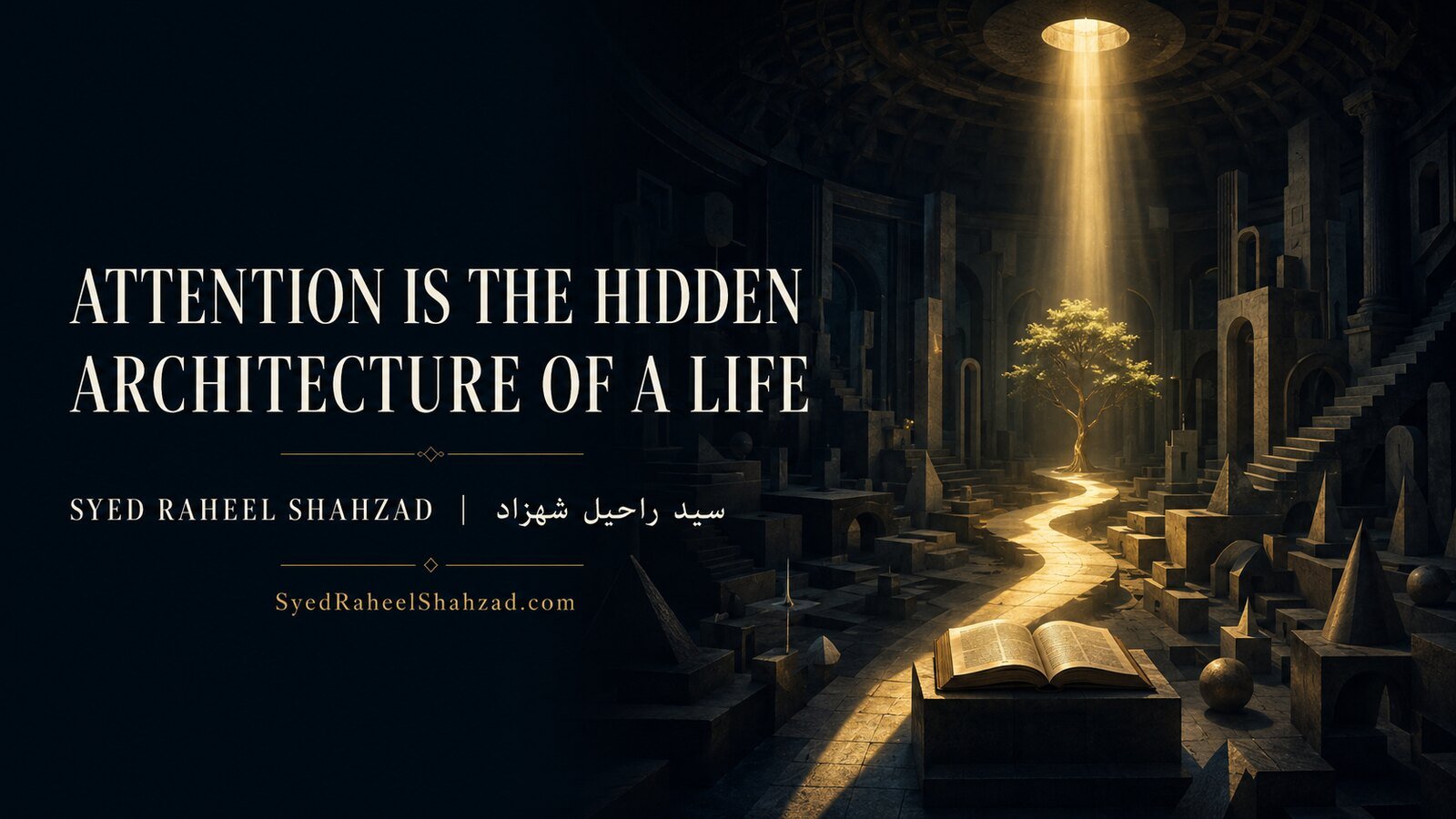
Attention does not merely occupy the mind; it selects the world from which judgment, character and a human life are gradually built.
Before a human being forms a judgment, chooses a direction or becomes loyal to an idea, something quieter has already occurred: attention has selected what will be allowed to become present.
The world always contains more than consciousness can receive. A room holds light, temperature, distance, expression, memory, risk, beauty and need. Yet only a fraction enters the foreground. Attention performs this selection. It does not merely help the mind examine reality; it decides which parts of reality will be available for examination at all.
Attention is the hidden architecture through which a world becomes our world.
This is why attention is more than concentration. Concentration is the ability to remain with an object. Attention is the prior act through which an object becomes significant enough to remain with. It is simultaneously a gate, a light and a form of permission. What enters repeatedly begins to shape what we expect, what we fear, what we consider normal and what kind of person we are able to become.
The abundance from which every world is built
Human beings do not encounter reality as a complete inventory. We encounter a selected field. Two people can inhabit the same street, institution or relationship while living inside different experienced worlds because different facts repeatedly receive their regard.
One notices insult and misses tenderness. Another notices beauty and ignores danger. One sees only performance; another recognizes exhaustion beneath it. One attends to what confirms a political identity; another becomes sensitive to evidence that complicates belonging. Neither attention nor perception is infallible. Selection can reveal, and selection can conceal.
The moral problem begins when a selection becomes invisible to the person making it. We assume that what we notice is simply what exists and that what remains outside our attention has no claim upon us. The selected world begins masquerading as the whole world.
Attention does not only discover value
We usually imagine attention following importance: something matters, therefore we notice it. Often the sequence also moves in the opposite direction. What receives repeated attention begins to acquire emotional weight. A grievance revisited daily can become the center of identity. A fear rehearsed without examination can reorganize the future. A craft attended to patiently can become a vocation. A child listened to consistently learns that their inner life can enter the shared world.
Attention therefore does not merely discover value. It participates in the creation of practical value. It allocates the finite energy through which possibilities become developed, relationships become known and capacities become real.
This does not mean attention can make falsehood true. It means truth that never receives sufficient attention may remain practically powerless, while distortion repeated with intensity can govern conduct as if it were truth.
The moral weight of what we fail to see
Inattention can be innocent. No person can notice everything. But repeated inattention can become a moral pattern, especially where power determines whose reality enters the room.
A leader attends to targets but not the fear through which they are achieved. A family attends to the loudest child while the quiet child learns to disappear. A society studies spectacular violence while ordinary humiliation remains beneath the threshold of news. An institution counts the people it served but not those its design prevented from arriving.
What is ignored does not cease to exist. It simply continues without the protection that recognition might have created.
Every system reveals its moral priorities not only through what it declares important, but through what it has trained itself not to notice.
Attention and freedom
Freedom is commonly defined through visible choice: what we say, purchase, support or refuse. But choice begins downstream. Before selecting among options, we must encounter them; before evaluating them, we must remain with them long enough for complexity to appear.
A person whose attention is continuously redirected may retain formal choice while losing the conditions of reflective choice. They can click, react and move, yet rarely remain. Their consciousness becomes highly active but weakly governed.
This is why captured attention is not only a productivity problem. It is a problem of agency. When external systems can repeatedly determine what enters awareness, how long it remains and which emotion accompanies it, they influence the material from which judgment is made.
The deepest form of control may not command a conclusion. It may arrange the field of attention so that some conclusions become almost inevitable and others never become thinkable.
The economy of interruption
Modern distraction is not produced solely by weak discipline. Many environments are designed around interruption because interrupted attention can be measured, redirected and monetized. Novelty renews engagement. Outrage accelerates circulation. uncertainty produces checking. The unfinished signal pulls consciousness back.
Yet it would be too simple to blame technology alone. Technology amplifies tendencies already present in us: curiosity without proportion, anxiety seeking certainty, loneliness seeking proof of recognition and avoidance seeking escape from difficult interior work.
We are neither helpless victims nor isolated sovereigns. Attention emerges within a relationship between design and desire. Serious recovery must examine both.
What repeated attention makes of character
Character is not formed only through dramatic decisions. It is formed through thousands of small returns. The mind repeatedly visits comparison, gratitude, resentment, truth, spectacle, craft, fear or service. Each return strengthens a route.
Eventually attention becomes disposition. We notice some features of reality more quickly because we have practiced noticing them. The suspicious person finds evidence of threat. The compassionate person detects pain concealed by acceptable behavior. The disciplined thinker recognizes where an argument has skipped a necessary step.
This is not fate. Habits of attention can be examined and retrained. But they cannot be transformed only by declaring new values. If attention continues feeding the old structure, the old structure continues receiving material.
Attention as love
To attend deeply to another person is to resist replacing them with our expectation of them. It is to remain long enough for the other to exceed the category through which we first approached them.
This is one reason genuine attention can feel like love. It does not merely look at the person; it permits the person to correct the observer. It makes room for surprise, contradiction and reality beyond utility.
The opposite of love is not always hatred. It can be a form of inattention in which another human being appears only when they are useful, disruptive or relevant to our own emotional narrative.
Attention as intellectual honesty
Thinking requires more than intelligence. It requires the willingness to give difficult material uninterrupted time. A claim that threatens identity often needs longer attention than a claim that confirms it. Complexity becomes visible slowly; slogans arrive already compressed.
The impatient mind mistakes speed for clarity. It decides before the object has been allowed to disclose its structure. Intellectual seriousness begins with a form of restraint: the refusal to close the question merely because closure feels more comfortable than examination.
Attention is therefore an epistemic virtue. It is the discipline through which reality is given enough time to challenge the story we brought to it.
The fantasy of total control
No one can maintain perfect command over attention. Bodies tire. grief intrudes. care obligations interrupt. environments exert pressure. Minds wander because they are living systems, not machines.
The goal should not be purity from distraction. That ideal can become another tyranny in which every lapse is interpreted as failure. The more humane aim is recoverability: the capacity to notice that attention has been taken, understand what took it and return without turning the interruption into identity.
Sovereignty over attention is not never being moved. It is developing the power to return deliberately.
An audit of the inner architecture
A serious attention audit asks more than how many hours were spent online. It asks:
- What repeatedly enters my mind without earning the right to remain there?
- Which emotions are being practiced through repetition?
- What important reality has become difficult to notice?
- Which people receive only fragments of me?
- What deserves sustained attention but receives only intention?
- Who benefits from the pattern of attention I currently inhabit?
The answers reveal a moral map. They show where life is being invested before conscious commitments become visible in results.
Rebuilding the conditions of presence
Attention cannot be restored by willpower alone. Architecture matters. Remove unnecessary signals. Create places where one activity is the expected activity. Give difficult work a protected beginning. Allow silence to become familiar rather than treating every empty moment as a defect requiring content.
Also decide what the recovered attention is for. An empty field will be occupied by the strongest available signal. Sustained attention becomes possible when it is attached to a worthy object: a question, a person, a craft, a responsibility, a text or a form of service.
The aim is not to become less alive to the world. It is to become more available to the parts of the world that deserve a complete human response.
The life built by return
A life is not formed only by what happens to it. It is formed by what consciousness repeatedly returns to after what happens.
If we return only to injury, injury becomes the organizing center. If we return only to spectacle, the ordinary loses reality. If we return to truth, work, gratitude and the neglected person, different structures become possible.
Attention is finite, but finitude gives it meaning. To attend is to say: from the abundance of reality, this will receive part of the life I cannot spend twice.
What owns our attention does not automatically own our soul. But it receives the daily material from which thought, memory, judgment and character are built. That is why attention must not be treated as a minor efficiency skill. It is one of the hidden places where human freedom either becomes practiced or quietly surrendered.