When Silence Is Mistaken for Peace
Author Essay · 17 August 2026 · Truth, Power and Peace
When Silence Is Mistaken for Peace
Silence can be wise, generous and necessary. It can also be the residue of fear. A peaceful surface tells us very little until we know whether the people beneath it remain free to speak.
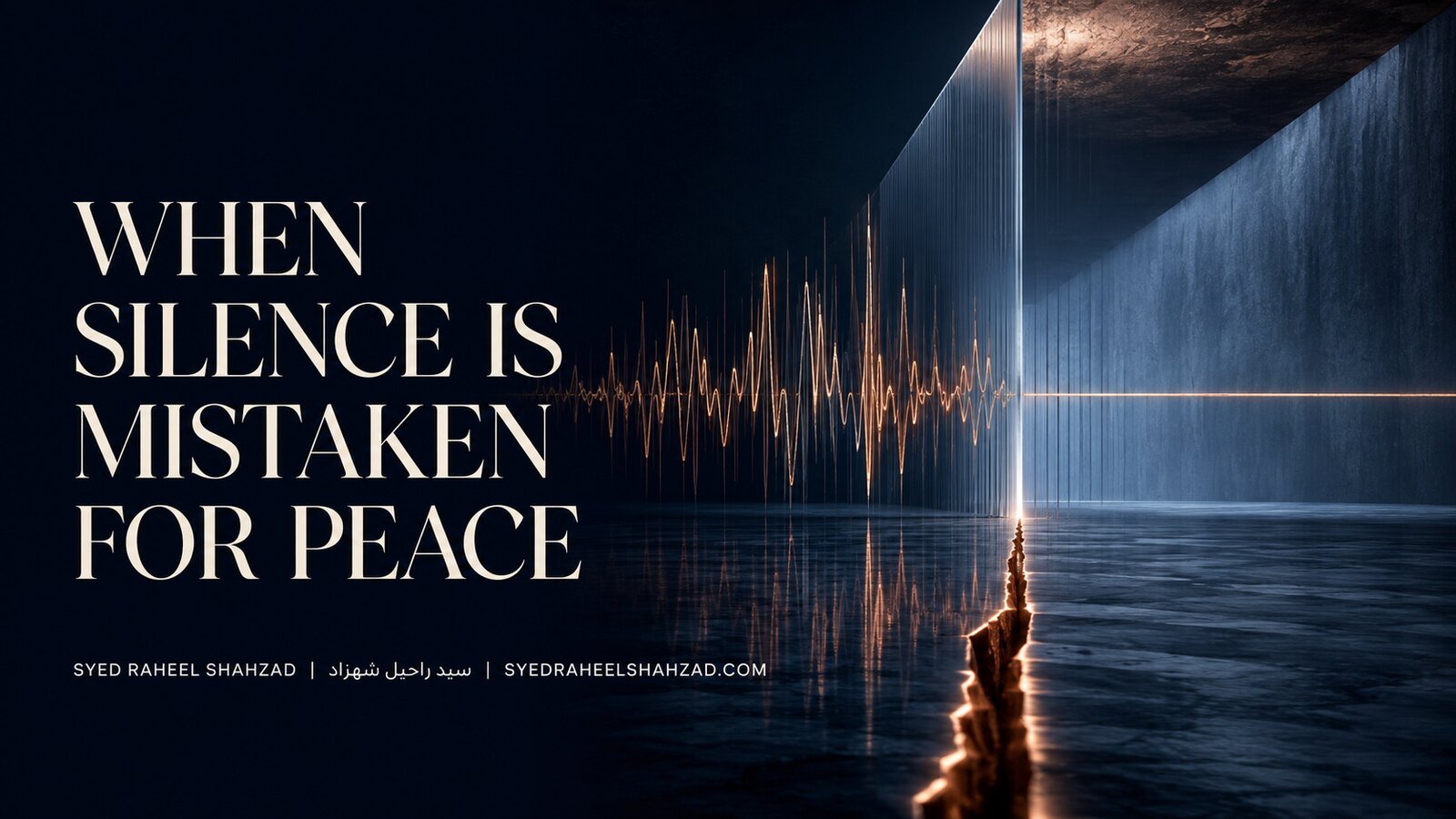
A quiet room can feel like evidence. Nobody is arguing. No voice is raised. The meeting ends on time. The family dinner passes without confrontation. The organisation reports alignment. The relationship appears calm.
We are tempted to call this peace because peace is often described by what has disappeared: noise, conflict, resistance, complaint. Yet the absence of visible disagreement tells us almost nothing about the moral condition of the people who are silent.
Silence may mean consent. It may mean reflection, patience or trust. It may also mean that someone has calculated the price of honesty and found it too high.
Peace is not proved by the absence of sound. It is proved by the presence of freedom, truth and repair.
The ambiguity of silence
Silence is not one thing. A person may remain silent because the matter is trivial, because another person deserves space, because facts are incomplete, or because words spoken in anger would cause unnecessary damage. Such silence can be disciplined and humane.
But a person may also be silent because every earlier attempt to speak was mocked, reversed or punished. A child may learn that questions are disrespect. A spouse may learn that expressing hurt produces days of withdrawal. An employee may learn that “speak openly” means “confirm what leadership already believes.” A citizen may learn that formal permission to object does not protect the objector from informal consequence.
From the outside, wise restraint and learned fear can look identical. Both produce quiet. Their moral structures are opposite.
Wise restraint preserves the speaker’s agency. The truth remains available and may return at a better time. Learned fear reorganises the self around anticipated punishment. The truth does not wait; it is trained to disappear.
The price of speech
To understand whether silence is peaceful, ask what speaking would cost.
In a fair relationship, disagreement may create discomfort, but it does not threaten a person’s dignity, safety or belonging. The other person can be disappointed without becoming punitive. A conversation may pause without becoming abandonment. A mistake can be named without the speaker being recast as the problem.
Where power is unequal, the price changes. The person who controls employment, housing, money, immigration status, reputation, family access or institutional advancement can make silence appear voluntary while quietly arranging its necessity.
This is why consent cannot be measured only by the word yes, and agreement cannot be inferred only from the absence of no. The moral question is whether refusal remained meaningfully possible.
A room full of nodding people may contain agreement. It may also contain an accurate understanding of who is permitted to disagree.
When keeping the peace becomes self-erasure
Many people learn to protect relationships by becoming easy to live with. They anticipate tension, translate everyone’s moods, soften every request and remove every sentence that might be received as criticism. They call this maturity because it prevents scenes. Often it is a survival intelligence developed in an environment where another person’s emotional stability became their responsibility.
The strategy can work. Conflict decreases. The person becomes admired for patience. Yet an invisible transfer has occurred: the relationship’s peace is funded by one person’s disappearance.
Self-erasure rarely announces itself dramatically. It appears in small revisions. “It does not matter” replaces “it matters to me.” “I understand” replaces “I am hurt.” “Whatever you prefer” replaces a preference that has learned not to expect room.
Eventually the person may no longer know whether they are choosing silence or merely repeating it. Resentment grows without a clear event because the injury is cumulative: the self is present in the relationship but absent from its decisions.
A peace that requires one person to become less real is not peace. It is an unequal distribution of reality.
Peace is not the same as victory
Some people believe a disagreement has been resolved when resistance stops. They mistake exhaustion for persuasion and withdrawal for acceptance. The conversation ends, so they conclude that peace has returned.
But resolution is not simply the moment when one person can no longer continue. A debate can be won while the relationship loses trust. A leader can secure compliance while the organisation loses information. A parent can secure obedience while the child loses the habit of honest return.
Victory asks, “Who prevailed?” Peace asks, “What truth can now be lived together?”
Genuine peace does not require identical conclusions. It requires a shared moral floor: neither person must be humiliated, threatened or erased in order for the relationship to continue. Reasons can be exchanged. Limits can be named. Decisions can be explained. Where agreement is impossible, difference can still be governed without converting the dissenter into an enemy.
The right to remain a person while disagreeing
Disagreement is often treated as a defect in loyalty. Yet loyalty without the right to disclose reality becomes obedience to appearance. The family must look united. The team must look aligned. The institution must look certain. The relationship must look calm.
Appearance then becomes the protected object, and the person who names contradiction becomes the apparent threat.
This reversal is dangerous. The one who reports the crack did not create the crack. The one who names fear did not create the fear. The one who asks whether a decision is just did not create the moral uncertainty. Speech makes the hidden condition visible; it does not automatically cause it.
A healthy system protects the distinction between disagreement and disloyalty. It can judge conduct firmly while allowing the person to remain legitimate. Criticism may be mistaken, incomplete or badly timed, but it must be answered as a claim before the speaker is judged as a character.
Institutional silence
Institutions often measure what people say while ignoring what they have stopped saying. Surveys report high confidence. Meetings contain no objections. Policies record an escalation route. Leaders interpret the quiet as trust.
Yet silence is also produced by memory. People remember what happened to the last person who raised a concern. They notice whether leaders become curious or defensive, whether confidentiality survives contact with hierarchy, whether an objection delays promotion, whether a challenge receives reasons or retaliation.
The institution’s real policy is taught by these consequences.
When people expect punishment, information does not vanish. It changes direction. Concerns move into private conversations, anonymous messages, resignations, illness, cynicism and quiet non-cooperation. The official system becomes calm precisely because the truth has left it.
This is not only an ethical failure. It is an intelligence failure. An organisation that cannot receive unwelcome information loses access to reality before it loses access to performance.
What genuine peace requires
Peace requires more than permission to speak. It requires conditions under which speech can matter.
First, the person must be safe enough to disclose the issue. Safety does not mean freedom from every emotional consequence. It means freedom from violence, humiliation, coercive withdrawal and illegitimate retaliation.
Second, the claim must be heard in its strongest reasonable form. Defensive listening searches for the weakest phrase and uses it to dismiss the whole concern. Ethical listening asks what the person is trying to make visible, even when their language is imperfect.
Third, power must explain itself. The person with authority may still decide, but authority should provide reasons, acknowledge trade-offs and name what evidence would justify review. Unexplained power teaches people that speaking changes nothing.
Fourth, there must be a route to repair. An apology without changed conditions leaves silence rational. Repair may require a new boundary, a redistributed responsibility, a corrected record, an independent review or a credible protection against repetition.
Can a person disagree without losing dignity or safety?
Does authority answer the claim rather than attack the speaker?
Can the decision be reviewed when new evidence appears?
Does truth lead to repair, or merely to a demand for renewed quiet?
When silence is the right choice
None of this makes continuous speech a moral duty. Silence can protect privacy, prevent escalation, preserve evidence or create time for thought. A person facing danger may wisely avoid confrontation and seek help elsewhere. Someone overwhelmed may pause a discussion until they can speak without causing harm. Not every room deserves immediate access to our truth.
The distinction lies in agency and direction. Chosen silence has a purpose and a return path. It says, “Not now, not here, or not in this way.” Imposed silence has no legitimate route back. It says, “Never, because your truth threatens the arrangement.”
Wisdom may delay speech. Fear abolishes it.
From quiet to peace
Human beings need places where they can rest from conflict. Families, teams and societies cannot survive permanent confrontation. But rest cannot be built by burying the unresolved beneath one person’s nervous system.
The work of peace is slower than the production of quiet. It requires listening without immediate defence, speaking without unnecessary cruelty, distinguishing discomfort from danger, and accepting that a relationship may become more visibly unsettled before it becomes more honest.
A quiet room may be peaceful. It may hold trust so mature that words are unnecessary. It may also hold a truth that everyone has learned not to touch.
We cannot know by listening only for sound. We must ask who remains free, whose reality can enter the room, what happens after disagreement and whether the calm belongs to everyone—or is being purchased by the silence of one.
Peace begins when quiet is no longer required to protect power from truth.