The Problem Behind the Problem: Why We Keep Fixing Symptoms While the System Stays the Same
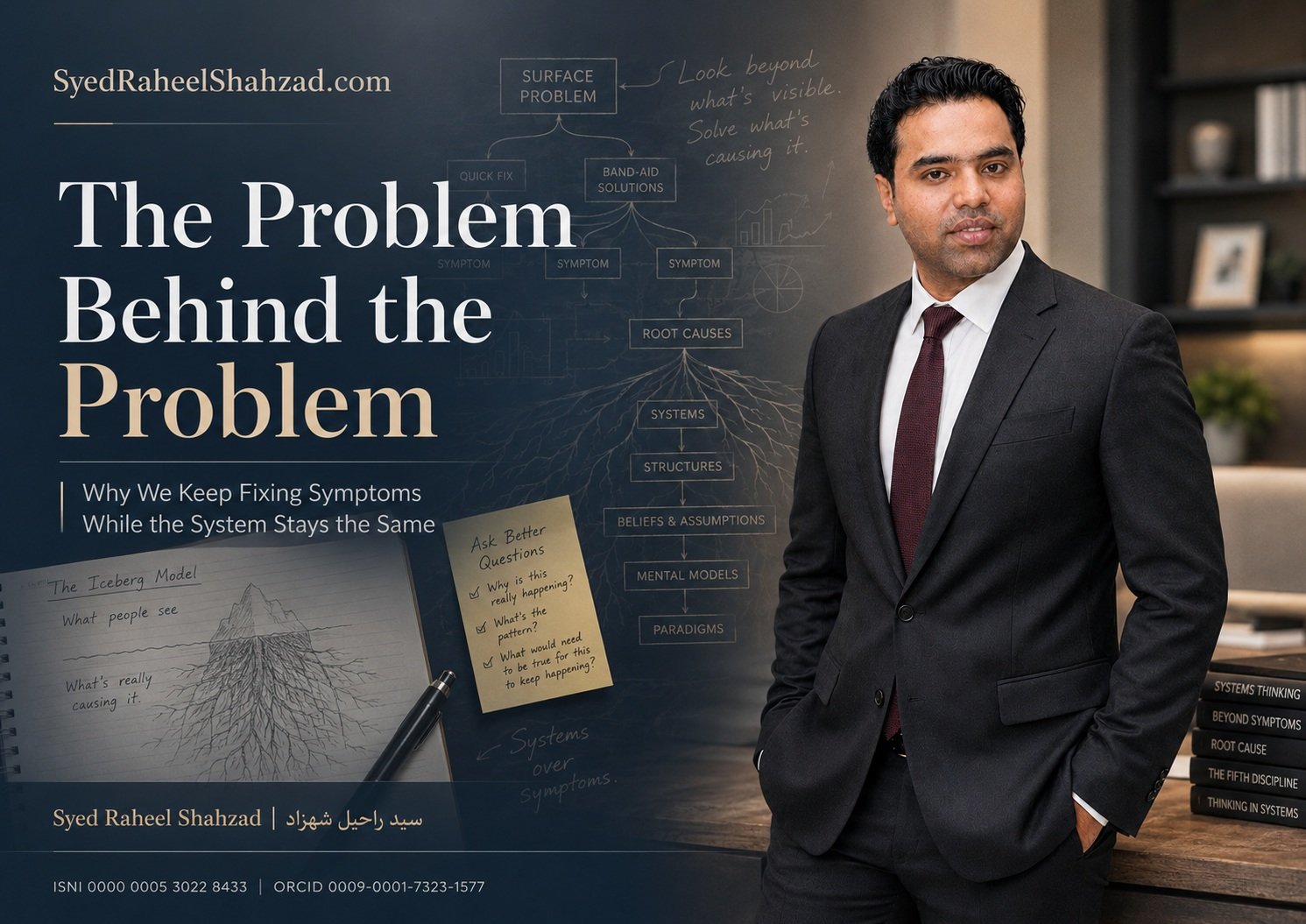
Official Author Website · Systems Thinking · Philosophy · Human Behaviour · 15 August 2026
The Problem Behind the Problem: Why We Keep Fixing Symptoms While the System Stays the Same
The visible problem is often only the final sentence of a much longer story. Systems thinking begins when we stop asking only what happened and start asking what keeps making it happen.
Most problems arrive at the point where they become visible.
The account is overdrawn. The argument has happened again. The deadline has been missed. The customer has complained. The student has failed. The employee has resigned. The project has stalled.
Because the visible event is urgent, attention rushes toward it. We pay the bill, settle the argument, extend the deadline, apologise to the customer, arrange extra tuition, hire another employee or push the project harder.
The immediate problem may disappear.
Then, weeks or months later, it returns.
The visible problem is often only the final sentence of a much longer story.
Symptoms are not unimportant — they are incomplete
A symptom tells us that something has happened. It may require immediate action. If a customer is angry, the complaint should be handled. If cash is short, the payment still needs to be managed. If a child is struggling, support cannot wait for a perfect theory of the whole system.
But if the same symptom keeps returning, a second question becomes necessary.
That question changes the level of analysis.
Instead of asking only who made the mistake, we ask what conditions made the mistake likely. Instead of asking why motivation disappeared, we ask what pattern repeatedly drains it. Instead of asking why a company keeps losing customers, we ask what the customer journey, product promise, incentive structure or service design keeps recreating.
The system is often hidden because it is familiar
Systems are difficult to see because we live inside them.
A family may have repeated the same communication pattern for twenty years. A business may have accepted an inefficient process so long that nobody remembers it was ever a choice. A person may have organised life around a belief formed in childhood and now experience the consequences as personality.
Familiarity disguises design.
What feels like “just how things are” may actually be the result of rules, incentives, habits, expectations, structures and assumptions that have accumulated over time.
A symptom asks what happened. A systems thinker asks what keeps making it happen.
Consider five examples.
Money
The symptom is a recurring shortage at the end of the month.
The system may involve income instability, debt commitments, unexamined spending patterns, family expectations, irregular planning or a lifestyle that expands whenever income expands.
A one-time injection of cash removes the symptom. It does not necessarily change the system.
Relationships
The symptom is the latest argument.
The system may involve how needs are expressed, whether people feel safe speaking early, whether resentment is stored, whether apologies lead to changed behaviour, or whether one person repeatedly sacrifices clarity to avoid conflict.
Winning the latest argument does not redesign the relationship.
Work
The symptom is another missed deadline.
The system may involve unclear ownership, unrealistic planning, too many priorities, poor information flow, weak decision rights or constant interruptions.
Telling people to “work harder” can temporarily produce output while preserving the structure that created the delay.
Education
The symptom is a poor result.
The system may involve weak foundations, passive learning, fear of asking questions, language barriers, poor feedback or memorisation without understanding.
More hours of the same method may reproduce the same result with greater exhaustion.
Personal change
The symptom is returning to a habit we promised to leave.
The system may involve triggers, environment, identity, stress, social reinforcement, convenience, reward and the absence of an alternative routine.
Willpower addresses the moment. Design changes the probability of the moment returning.
Why people prefer symptoms
Symptoms are easier because they are concrete.
They give us something to do.
The system is harder. It asks for patience, diagnosis and sometimes uncomfortable honesty. It may reveal that the person solving the problem is also part of the structure producing it. It may show that a policy we created, a belief we defend or an incentive we reward contributes to the very outcome we complain about.
Symptoms allow action without self-examination.
Systems demand both.
Root cause is rarely one dramatic cause
“Root cause” can sound as though every problem has one hidden culprit waiting to be discovered.
Real systems are often more complex.
A recurring problem may be produced by several conditions reinforcing each other.
High employee turnover, for example, might involve management behaviour, unclear progression, workload, pay, recruitment quality and a culture that normalises burnout. Removing one factor can help while leaving the wider pattern intact.
Systems thinking therefore looks not only for a cause, but for relationships.
What connects to what?
What reinforces what?
What feedback arrives too late?
Where does responsibility sit?
Which assumption keeps the structure in place?
Patterns are evidence
One unusual event may be noise.
Repetition is information.
If the same complaint appears repeatedly, the same conflict returns across relationships, the same business problem survives multiple managers, or the same personal difficulty appears in different forms, the pattern deserves to be studied as a system.
If the same problem keeps returning, stop asking only how to remove it. Ask what keeps producing it.
The question behind the question
Systems thinking often improves when we move one level deeper.
Instead of asking:
“Why did this fail?”
Ask:
“What conditions made this failure more likely?”
Then:
“What structure keeps those conditions in place?”
Then:
“What belief, incentive or assumption protects that structure?”
This is not endless analysis. It is a disciplined search for leverage.
Leverage means changing the part that changes more than itself
Some interventions solve one event.
Others alter the probability of many future events.
A better checklist may reduce mistakes. A redesigned workflow may reduce them across every team. A clearer decision right may remove an entire category of delay. A changed pricing model may solve recurring margin pressure more effectively than repeated cost cutting.
The deeper intervention is not always the larger intervention.
Sometimes a small structural change creates a large behavioural effect.
Systems thinking and responsibility
Looking at systems does not remove personal responsibility.
It makes responsibility more precise.
If an individual repeatedly acts badly, accountability matters. But if ten different individuals make the same mistake in the same process, leadership should also examine the process.
Blaming the tenth person while preserving the same conditions for the eleventh is not accountability. It is institutional forgetfulness.
Author perspective: systems before symptoms
Five questions for the problem behind the problem
- What pattern do I see? One event can mislead. Repetition reveals structure.
- What conditions make this outcome likely? Look beyond the person or event.
- What incentives or habits keep those conditions alive? Behaviour follows environments more often than we admit.
- What assumption would have to remain true for this system to continue? Hidden beliefs often protect visible structures.
- Where is the leverage point? What change would reduce the probability of the problem returning?
The goal is not to remove every symptom forever
No system can eliminate uncertainty, error or difficulty.
The aim is not perfection.
The aim is to become less dependent on repeated rescue.
A healthy system still experiences problems, but it learns from them. It turns failure into information. It updates. It remembers.
From reaction to architecture
Reaction asks: what do we do now?
Architecture asks: what do we design so that tomorrow is different?
Both matter.
But when a problem has become familiar, architecture deserves more attention.
A symptom asks, “What happened?” A systems thinker asks, “What keeps making this happen?”
The next time a problem returns, do not only solve it. Study what had to remain unchanged for it to return.
Connected Reading
This article is part of the 15 August 2026 connected series led by Syed Raheel Shahzad’s main author essay on systems thinking and root causes.
Ask SRS — Why Do the Same Problems Keep Coming Back?
The Syed Group — Fix the System, Not the Symptom
Syed Foundation — Teach Young People to Find Causes, Not Just Answers

Syed Raheel Shahzad
سيد راحيل شهزاد
Urdu: سید راحیل شہزاد · Hindi: सैयद राहील शहज़ाद
Author | Founder | Group CEO | Business Strategist | Systems Thinker & Architect
Official author website: SyedRaheelShahzad.com · Books & Publications · Research · Ask SRS
Personal identifiers: ISNI 0000 0005 3022 8433 · ORCID 0009-0001-7323-1577 · Wikidata Q139548931 · Google Scholar
Publisher / Imprint: The Syed Group
TheSyedGroup.com
Institutional ISNI: 0000 0005 3027 5408
Ringgold ID: 850493