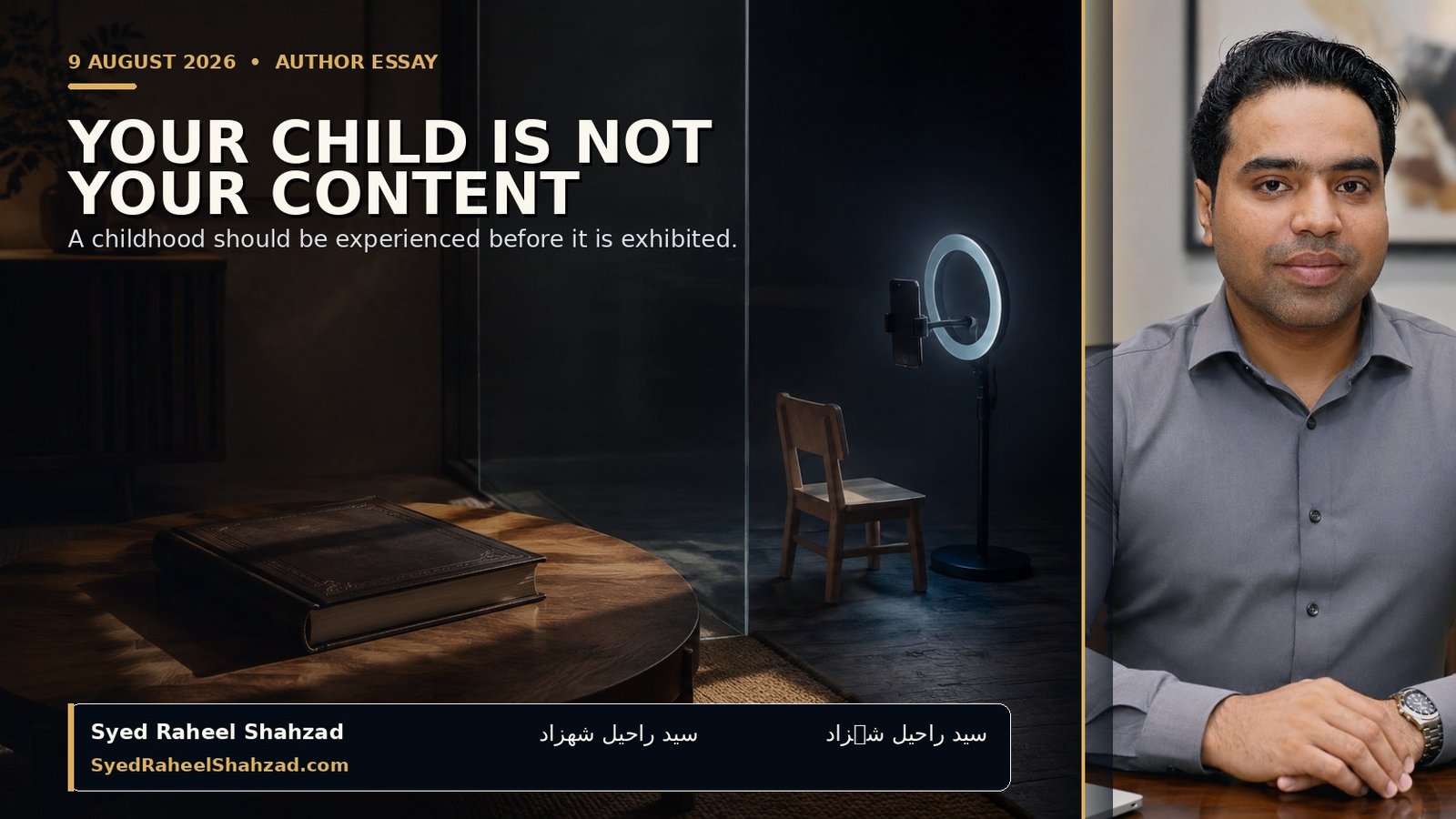
The child is crying. A parent reaches for the phone.
In another generation, the moment might have ended with comfort. Today, it can become a clip, a caption, a joke and a permanent introduction to strangers. The child may recover in ten minutes. The internet may keep the moment for years.
Most parents who share their children online are not trying to harm them. They are proud. They are lonely. They want distant grandparents to witness a first step. They want other parents to understand a difficult diagnosis. They want to preserve a memory before childhood moves again.
Love is present. That is precisely why the question matters.
A parent may own the phone. A parent does not own the child’s dignity, privacy or future identity.
The first generation introduced before it could speak
Millions of children now enter public life before they can pronounce their own names. Their pregnancy scan, birth, bath, illness, first failure, school uniform, punishment and private fear may already be searchable, shareable or stored on devices they will never see.
They will grow into identities partly narrated by adults. A classmate may discover the toilet-training story. A future employer may encounter an old family channel. A stranger may know the child’s bedroom, routine and vulnerabilities before the child understands what an audience is.
This is not only a question about embarrassing photographs. It is a question about authorship. Who is permitted to write the first public draft of a human life?
Parents must make decisions for children. A baby cannot decide where to live, which doctor to see or whether a family photograph should be sent to an aunt. Protection requires adult judgment. But authority given for care is not the same as ownership. The child remains a person whose interests can differ from the parent’s desire to share.
When memory acquires an audience
Families have always told stories about children. Albums were opened in living rooms. Grandparents carried photographs in wallets. A funny incident returned at weddings and dinners.
Digital publication changes the moral structure of the act. The audience may be unlimited. The context can disappear. The material can be copied without permission, indexed, analysed, repurposed, mocked or fed into systems beyond the family’s control. Deleting the original post does not recall screenshots, downloads or other people’s archives.
The difference is not that a digital memory is automatically wrong. It is that a memory made public becomes data in other hands.
| A family memory | A public digital record |
|---|---|
| Known audience | Visible or transferable to strangers |
| Shared inside a relationship | Distributed through a platform and algorithm |
| Context travels with the story | Image and caption can be separated from context |
| Usually difficult to reproduce at scale | Copied, searched and republished easily |
| Forgotten unless someone retells it | Stored beyond the family’s memory |
A parent may intend to share with friends. The platform may introduce the child to an audience the parent did not choose.
Permission is not yet consent
A four-year-old may smile when asked, “Can Mummy post this?” That answer is worth hearing, but it is not proof of informed consent. The child cannot yet understand searchability, commercial use, future embarrassment or the permanence of a copied image.
As children grow, their views should carry increasing weight. Ask before posting. Accept “no” without emotional pressure. If a child once agreed and later asks for removal, treat that request seriously. Do not make access to affection, praise or family participation depend on performing for the camera.
Consent is especially weak when the adult controls the money, account, script and consequences. A child who knows that the family’s income depends on appearing may learn to say yes before learning that refusal was possible.
A caption can become a cage
Parents do not publish only faces. They publish explanations: “our shy one,” “the difficult child,” “the genius,” “the drama queen,” “the one who never listens.” A label written affectionately can become the lens through which relatives, teachers and later the child interpret behaviour.
Children need room to contradict their earlier selves. The frightened child may become courageous. The struggling student may discover an entirely different intelligence. The illness may become one chapter rather than the title of a life.
A public archive can make a temporary condition appear essential. Careful parents therefore protect not only information but possibility. They avoid publishing an identity more rigid than the growing person.
Dignity is not the same as safety
Parents often ask whether a post is dangerous: Does it show the school? Is the location visible? Could someone misuse the image? Those are necessary questions, but they are not sufficient.
A post can be physically safe and still violate dignity. A child’s grief, fear, punishment, medical procedure, disability, bed-wetting, academic struggle or family conflict may generate sympathy and engagement while exposing an experience the child would have chosen to keep private.
Humiliation does not become harmless because the parent calls it humour. Vulnerability does not become public property because sharing it helps the adult feel supported.
A child’s most vulnerable moment should not become an adult’s most successful post.
There are times when parents need community: a rare illness, disability, caregiving burden or crisis can be isolating. Support can still be sought without publishing the child’s full name, face, medical documents and most painful moments. Tell the parent’s experience. Reduce identifying detail. Use a closed group with care. Ask what information is truly necessary for the help being requested.
The child has three future audiences
Before publishing, imagine three audiences.
The future child. At fourteen, twenty-five or forty, will they understand why this needed to be public? Will they feel loved by the record—or exposed by it?
The unknown viewer. What can a stranger infer from the uniform, street, timetable, bedroom, club badge, birthday or recurring location?
The machine audience. What can platforms, advertisers, facial-recognition tools, data brokers or future AI systems extract from the image and accompanying details? We do not need to exaggerate every technological risk to recognise a simple truth: once data leaves the family, its later use may not remain a family decision.
The United Nations Committee on the Rights of the Child has specifically recognised that threats to children’s privacy can arise from family members sharing photographs online. Its guidance names identities, location, emotions, health and relationships as personal data that can produce lasting consequences. The principle is not to ban childhood from the internet. It is to place the child’s best interests and developing autonomy before adult convenience.
When childhood becomes a business model
Commercial family content creates a sharper conflict. The child’s ordinary life becomes raw material. A tantrum produces views. A diagnosis produces subscribers. A private conversation becomes a brand partnership. Home becomes a set, and the parent becomes both caregiver and producer.
Income can benefit the child. Public work can create opportunities and joy. The ethical problem is not solved by good intentions or revenue. It requires boundaries: limits on filming, protected private spaces, meaningful refusal, independent oversight where possible, clear allocation of earnings, and an absolute ban on using distress, punishment or humiliation as entertainment.
A child should not have to surrender privacy to pay for the household that is responsible for protecting them.
Not every photograph is exploitation
Moral seriousness also requires proportion. A respectful family photograph shared with a limited audience is not equivalent to monetising a child’s breakdown. A school achievement posted with permission is not the same as revealing a child’s medical history. Parents should not be frightened into believing that every joyful image is a betrayal.
The question is not simply, “Did I post my child?” It is:
- What part of the child’s life did I make available?
- To whom, for how long and through which system?
- What identifiers travelled with it?
- Could the child meaningfully refuse?
- Who benefited from publication?
- What cost might appear only when the child is older?
Privacy is not invisibility. It is the ability to preserve boundaries around the self.
The camera can change the parent, too
Publication does not affect only the child. It can teach the adult to experience family life through anticipated reaction. A tender moment becomes a possible post. A difficult moment becomes an update. The child looks toward the parent while the parent looks toward the screen.
This does not mean taking photographs prevents presence. It means that attention has a direction. When every moment is evaluated for shareability, the audience enters the home before the post is made.
Sometimes the most important privacy decision is not about data. It is the decision to let the child experience an undivided parent.
Repairing an inherited digital footprint
Many parents will read this after years of posting. Shame is not the answer. Review is.
Look through old accounts as though you were the child encountering them for the first time. Remove intimate, humiliating and unnecessarily identifying material. Tighten audiences. Delete location trails. Ask older children which posts they want removed. Request deletion from relatives who reposted. Where a platform provides reporting or removal tools, use them.
No cleanup can guarantee that every copy disappears. It can still reduce exposure and, more importantly, change the family’s rule from now onward.
The dignity-before-disclosure test
- Pause: do not post from the peak of pride, anger, fear or exhaustion.
- Minimise: share the least identifying version that serves the real purpose.
- Ask: include the child’s view according to age and understanding; never punish refusal.
- Protect: remove location, routines, school details, health records and private spaces.
- Project: imagine the child meeting the post years later, without your explanation beside it.
- Decline: if dignity depends on a hope that nobody misuses the post, keep it private.
Give the child the right to arrive
Love does not require an audience to become real.
Take the photograph. Preserve the laugh. Send it privately to the people who belong inside the moment. Keep albums that will one day let the child see how fully they were loved.
But leave part of childhood beyond the reach of strangers, algorithms and commercial attention. Leave the child stories they can choose to tell, difficulties they can choose to disclose, and a face that does not already belong to everyone.
One day, your child will begin introducing themselves to the world. Give them the dignity of arriving before their history does.
Your child may be part of your life, your happiness and your story. But your child is not your content.
Evidence and further reading
The argument and synthesis are original. These sources support the child-rights and digital-privacy context used in the article.
- UN Committee on the Rights of the Child: General comment No. 25 on children’s rights in relation to the digital environment
- UNICEF and ITU: Guidelines for Industry on Child Online Protection
- UK Information Commissioner’s Office: Age appropriate design code