The Life We Postpone While Fulfilling Every Responsibility
The Life We Postpone While Fulfilling Every Responsibility
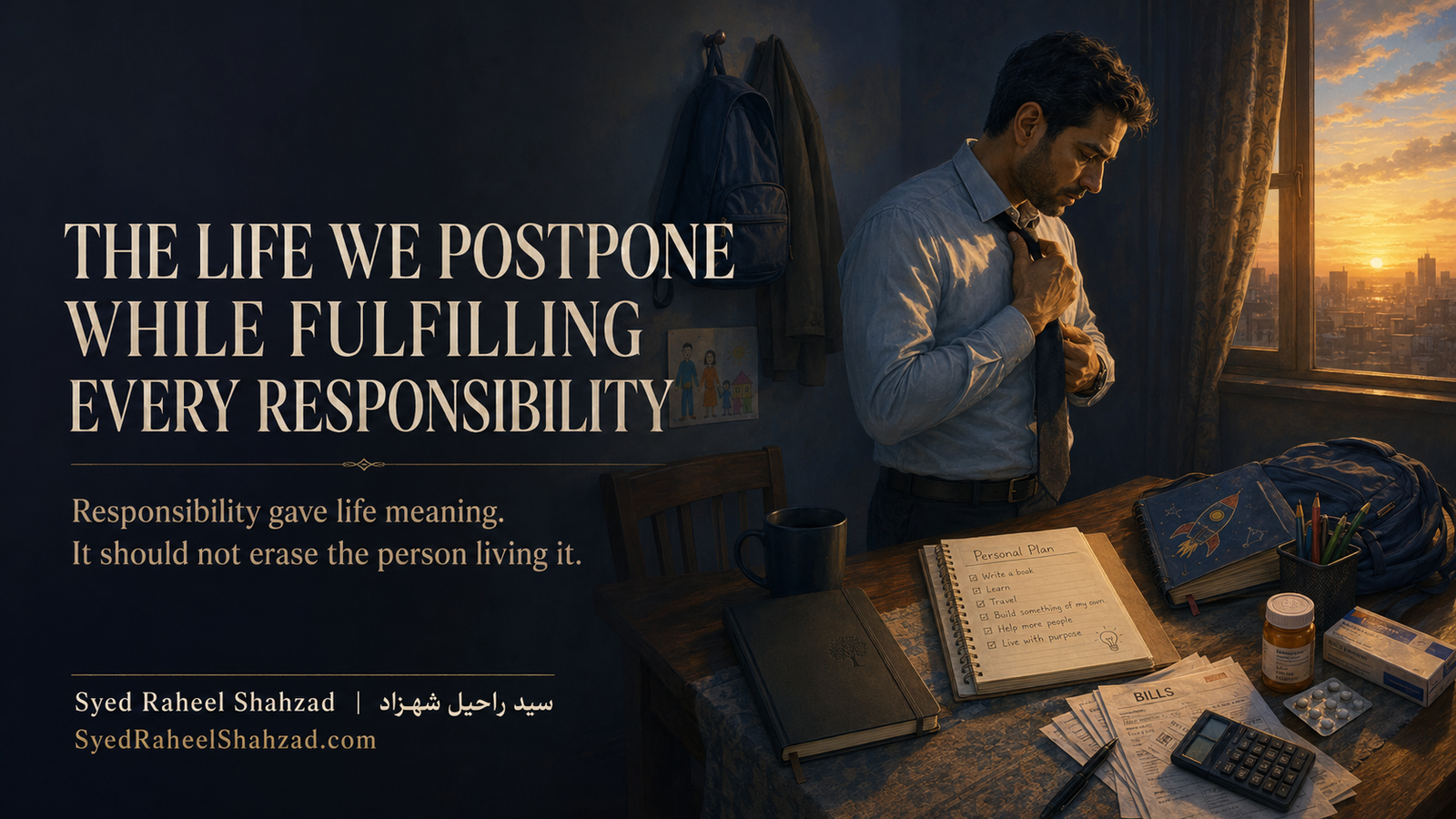
Many people did not abandon their future through laziness. Duty arrived first, became permanent, and slowly occupied the space in which a personal life was meant to grow.
Many people did not fail to pursue a dream. The rent arrived first.
Then came school fees, medicine, a parent’s illness, a younger sibling’s education, a marriage that needed support, a visa that depended on stable employment, and the ordinary cost of keeping other people safe. One year of postponement became five. Five became fifteen. Eventually, the person stopped mentioning what they had once intended to become.
From the outside, this life may look responsible and even successful. The household functions. Children grow. Parents are supported. Deadlines are met. Emergencies are absorbed. Yet beneath the visible order sits an unanswered question: what happened to the person who made all of it possible?
The dream did not always die. Sometimes it put on work clothes, left before sunrise and spent years keeping everybody else alive.
We misread postponed lives as failed lives
Modern culture tells a simple story about achievement. A person identifies a goal, works hard, remains disciplined and eventually succeeds. If the goal is not reached, the explanation is usually located inside the individual: they lacked courage, consistency or belief.
That story is attractive because it makes life appear controllable. It is also incomplete.
Human beings do not pursue their ambitions in empty space. They move inside systems of income, family obligation, health, class, gender, migration, education and time. Two equally talented people can possess radically different amounts of usable attention. One finishes work and develops a skill. The other finishes work and begins a second shift of caregiving, household administration or financial rescue.
The difference is not desire. It is available life.
When we ignore that difference, we praise the person who had protected time and blame the person whose time belonged to everybody else. We turn structural advantage into character and structural pressure into personal failure.
Responsibility expands to fill the future
Duty rarely announces that it intends to occupy an entire life. It arrives as something temporary.
“I will take this job for one year.”
“I will delay university until the family is stable.”
“I will restart when the children are older.”
“I will help until my brother finds work.”
“I will return to my own plans after this crisis.”
Each decision may be reasonable. The danger appears when temporary duty becomes permanent architecture. The family budget grows around one income. The workplace grows dependent on constant availability. Relatives learn that this person will compensate. The individual’s sacrifice stops being an emergency response and becomes the normal operating model.
At that point, restarting is no longer a private decision. It threatens a system built around their continued postponement.
The provider’s time is treated as already spent
Money is not the only resource responsibility consumes. It consumes the protected time in which a different future could be built.
A course requires more than tuition. It requires an evening that remains yours. Writing requires more than a laptop. It requires mental space not already crowded by bills, calls and unresolved family matters. Entrepreneurship requires not only courage but a tolerable level of risk. Rest itself requires permission to be temporarily unproductive.
For many providers and caregivers, every unclaimed hour is treated as available for another duty. If they sit down, somebody remembers a task. If they save money, another emergency discovers it. If they consider a change, they are reminded how many people depend on stability.
Their future is funded by whatever remains after everyone else’s present has been protected. Often, nothing remains.
The eldest child who became an adult too early
In many families, the first serious child becomes an assistant parent before they have completed becoming themselves.
They interpret official letters, manage younger siblings, understand the family finances, translate between generations, and learn which worries must not be added to the household. Their maturity is praised. Their premature burden is rarely named.
Because they are capable, they are given more. Because they are given more, they appear even more capable. A childhood adaptation becomes an adult identity: the one who does not need help, the one who chooses the practical option, the one who must not take an irresponsible risk.
Later, when they attempt to ask what they want, guilt appears before desire has finished speaking. They have been trained to evaluate every personal wish by its effect on the whole family.
The migrant bargain
Migration can multiply both opportunity and obligation. A person leaves home to build a future and becomes evidence that the family has a future.
The salary earned abroad may support two households, several educations, medical needs, property plans and emergencies across borders. The migrant becomes a symbol of possibility, yet the cost of maintaining that symbol remains largely invisible: loneliness, insecure status, work accepted below ability, missed years with children or parents, and the fear that one lost job could unsettle many lives.
People see the remittance. They may not see the postponed qualification, the abandoned profession, the small room, the overtime, or the dream reduced to a file saved on a tired phone.
This is not a criticism of family support. It is a demand for honest accounting. A sacrifice can be loving and still be costly. Gratitude becomes more truthful when it includes the life that had to be deferred.
Women disappear into care; men disappear into provision
The exact form differs, but both women and men can be erased by socially approved responsibility.
A woman may suspend education, paid work, creative ambition or public identity while caring for children, elders and the household. Because care is treated as natural rather than skilled, people may speak as though she “did not do anything” during the years in which she sustained everyone.
A man may be reduced to provision. His value becomes measurable through income, endurance and the problems he can absorb. He is permitted to want a better life only if the experiment does not endanger anyone else’s standard of living.
In both cases, the person becomes a function. One becomes care without a future. The other becomes finance without an inner life.
A humane family must reject both reductions. Motherhood must not cancel personhood. Fatherhood must not cancel personhood. Responsibility gives life meaning; it does not give others ownership of the responsible person’s entire future.
The silence around an unlived life
People often stop speaking about postponed dreams because repeated delay becomes embarrassing.
At twenty-five, a plan sounds ambitious. At forty-five, the same plan may feel like evidence of unfinished business. The person anticipates practical questions: Why now? Is it realistic? What about the children? What if you fail? Should you not be grateful?
So they protect themselves by becoming quieter. They say the dream no longer matters. They dismiss their old interest as childish. They celebrate the lives they helped build while refusing to name the grief attached to their own.
Gratitude and grief, however, can occupy the same life. A parent can love the family they raised and mourn the education they never completed. A provider can be proud of supporting others and wonder who they might have become under different conditions. A person can honour their choices without pretending those choices had no cost.
Sacrifice becomes dangerous when it erases the sacrificer
Not every sacrifice is exploitation. Human beings become meaningful through commitments larger than themselves. We care for children, stand beside parents, keep promises and carry one another through periods of weakness. A life designed only around personal preference would be shallow.
But sacrifice needs moral boundaries.
It becomes dangerous when one person’s giving is treated as an unlimited natural resource; when the beneficiaries feel entitled but not responsible; when temporary inequality is never reviewed; when every attempt to restart is described as selfish; and when the person making the sacrifice is denied even a small protected territory of their own.
The question is not, “Should I choose myself or my family?” The better question is, “Can this family become a system in which no one must disappear for everyone else to survive?”
The architecture of a return
A postponed life is not restarted through motivational language alone. It needs architecture.
First, the dream must be translated from memory into its present meaning. Perhaps the original profession is no longer practical, but the underlying desire remains. The person who wanted to become a teacher may still need to explain, mentor and shape minds. The person who wanted to build a company may still need autonomy and creation. The person who wanted to write may still need to turn private thought into public form.
Second, the future needs protected resources. Not leftover time—protected time. Not money that disappears whenever another request arrives—a named amount with a purpose. Not a vague promise to begin “one day”—a date, a course, an application, a page count, a weekly appointment.
Third, the surrounding system must change. If one person carries all domestic work, all financial emergencies or all family administration, personal ambition will continue to lose. Restarting requires redistribution, not merely greater effort from the already exhausted person.
The one-hour principle
People often delay beginning because they imagine a dramatic restart: leaving a job, returning to full-time education, launching a company, relocating, or recovering the intensity of youth.
Most responsible adults cannot begin dramatically. They can begin consistently.
One protected hour is small enough to survive a busy life and large enough to reopen identity. In that hour, a person can study, draft, research, practise, apply, build a portfolio or speak to someone already working in the desired field.
The first purpose of the hour is not rapid success. It is evidence. It proves that the self postponed by responsibility still has a place in the calendar.
A protected hour also teaches the family something important: this person’s future is not an optional activity to be cancelled whenever anybody else is mildly inconvenienced.
Families must ask a different question
Families often ask the provider, “What will you do for us next?” They should also ask, “What did you once want for yourself?”
Ask the mother what she would study if one evening belonged to her. Ask the father what he would build if every idea did not have to become immediate income. Ask the eldest child which responsibility they accepted before they were old enough to choose. Ask the migrant what part of their own life remains in the country they left.
Then move beyond sympathy. Take over a recurring task. Protect a study evening. Contribute to the course. Reduce unnecessary demands. Treat the person’s plan as a family investment rather than a threat to family loyalty.
Love should not only thank people for what they gave up. It should help them recover something before time closes around it.
A dream may return in another form
Some possibilities do expire. Bodies change. Industries move. Responsibilities remain. It would be dishonest to promise that every original dream can be recovered exactly.
But meaning is more flexible than form.
The lost athlete may coach. The interrupted student may qualify later and teach from experience. The person who never opened a large business may build a small, durable one. The unwritten book may begin as one page shared every week. The public career may become private mastery that transforms a family or community.
A changed form is not always a lesser life. Sometimes maturity removes the fantasy while preserving the essential calling.
Responsibility should become a foundation, not a prison
The years spent caring, providing and enduring are not empty years. They create judgment, patience, discipline, empathy and knowledge that younger ambition did not possess. The person returning to a dream is not starting from zero. They are starting with a life.
Yet experience becomes a foundation only when it is allowed to support something new. If responsibility consumes every remaining year, it becomes a prison built from noble materials.
Protect one hour. Write one page. Take one lesson. Submit one application. Open one conversation about what you still want. The action may look small compared with the years already lost. That is not its measure.
Its measure is that, after years of being useful to everyone else, you have begun to become visible to yourself again.
Your dream may not return at the same age, in the same form or according to the original plan. A postponed life is not necessarily a finished life.