The Age of Borrowed Certainty
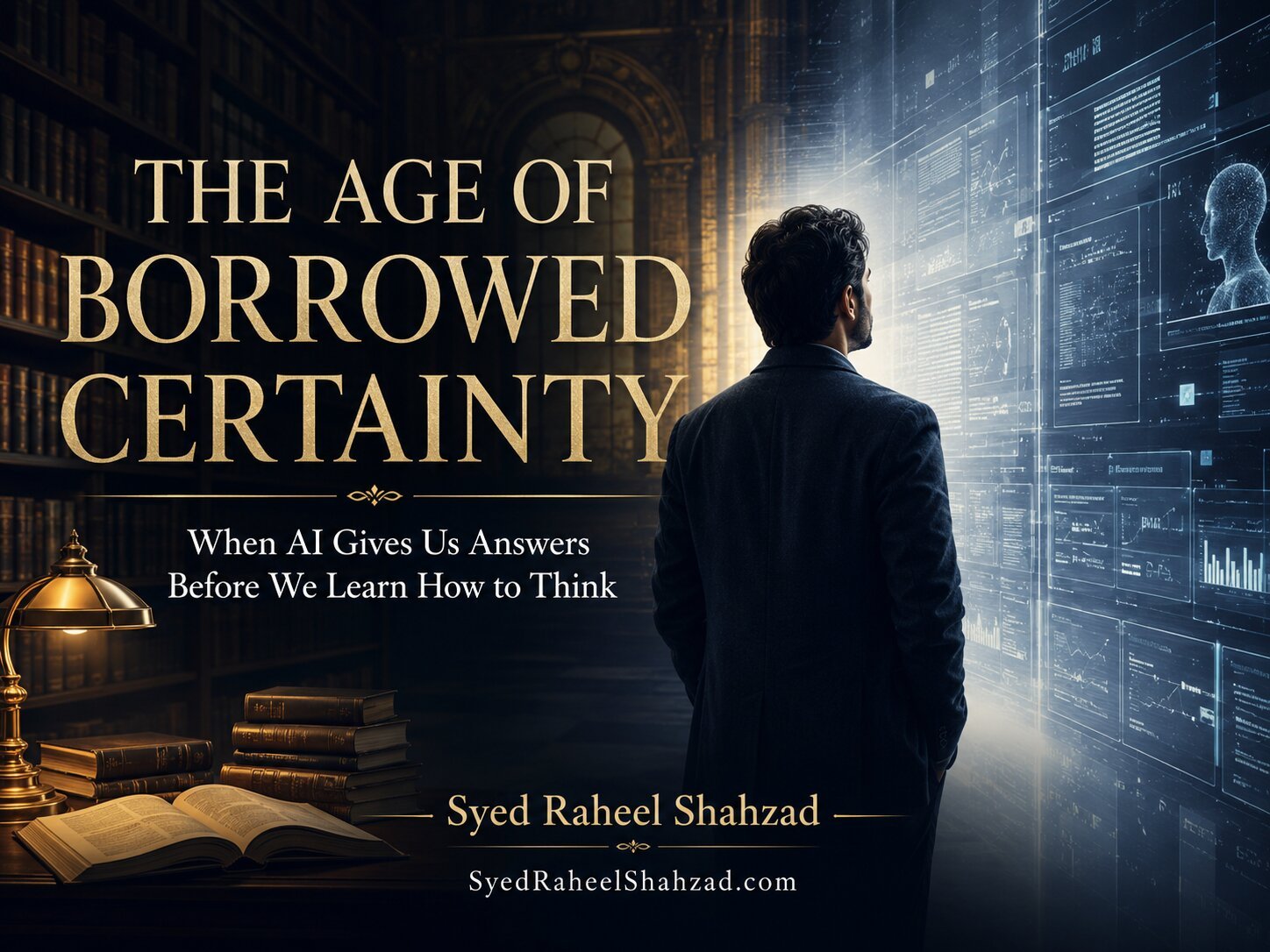
We are entering an age in which answers arrive before understanding, conclusions arrive before investigation, and confidence arrives before responsibility. The danger is not simply that machines may sometimes be wrong. The deeper danger is that human beings may begin to feel certain without ever performing the work by which certainty becomes deserved.
The answer now arrives before the question has matured
For most of human history, a serious answer required a journey. A person had to search, read, compare, ask, doubt, remember, discuss and return. The process did more than produce information. It formed the mind that would receive the information. Patience, proportion and judgment were developed on the way to the conclusion.
Artificial intelligence has altered that sequence. A polished answer can now appear within seconds. It may be clearly organised, grammatically complete and delivered in a tone that feels calm and authoritative. The reader experiences the emotional shape of knowledge before doing the intellectual work of knowledge.
This is what I call borrowed certainty: the feeling of knowing produced by an answer whose reasoning, sources, limits and consequences have not yet been examined by the person who receives it.
A confident sentence can lend us the feeling of certainty. It cannot lend us the responsibility that belongs to judgment.
Fluency is not the same as truth
Human beings naturally respond to coherence. When language flows well, we often assume that thought is equally sound. Yet fluency and truth belong to different categories. A statement may be elegant and inaccurate. It may cite a real source but misread it. It may combine several correct details into a false conclusion. It may be useful for a low-stakes task and dangerously incomplete for a medical, legal, financial or moral decision.
The modern reader therefore needs a new discipline: the ability to separate the quality of presentation from the quality of justification. We must ask not only, “Does this sound intelligent?” but also, “What makes this answer worthy of belief?”
The US National Institute of Standards and Technology describes trustworthy AI through characteristics including validity and reliability, safety, accountability, transparency, explainability and fairness. That list itself reveals something important: trust is not created by eloquence alone. It is created through a system of evidence, limits, oversight and responsibility.
Doubt is not intellectual weakness
Our age often treats doubt as hesitation and speed as competence. But disciplined doubt is not the refusal to know. It is the refusal to pretend that we know more than the evidence permits. It protects truth from vanity and protects action from premature confidence.
A serious mind can say: this answer is plausible, but I have not verified it. This source is relevant, but it may not be sufficient. This conclusion is useful, but only under these conditions. This claim may be accurate today, yet outdated tomorrow. Such language does not weaken knowledge. It gives knowledge honest boundaries.
Five disciplines for the age of instant answers
Do not verify a paragraph as one object. Identify the specific factual, interpretive and moral claims inside it.
Ask where the information came from, whether the source is primary, current and competent, and whether it actually supports the wording used.
A fact can mislead when removed from its date, jurisdiction, population, assumptions or intended use.
Agreement matters most when different reliable sources reach the same conclusion independently.
AI may assist analysis, but the human being must still own the decision, its ethical meaning and its consequences.
Where evidence is incomplete, the answer should remain open rather than becoming artificially final.
The danger is not only false information
False information is visible once corrected. A weakened human faculty is harder to see. The person who repeatedly accepts ready-made explanations may slowly lose the ability to frame a question, recognise an assumption, follow an argument or tolerate uncertainty. The technology has not merely answered for the person; it has begun to replace the inner movement by which the person becomes answerable.
This is why the problem belongs to philosophy before it belongs to software. The central question is not merely what AI can do. It is what kind of human being emerges when thinking is repeatedly outsourced. Does the person become more capable because a tool has extended their reach, or more dependent because the tool has replaced their judgment?
Information can be outsourced; conscience cannot
A machine can compare documents, detect patterns, summarise positions and expose contradictions. It can make knowledge more accessible and reduce wasteful labour. These are meaningful benefits. But no machine can absorb the moral burden of the person who acts.
When a leader signs a decision, a teacher guides a child, a doctor advises a patient, a judge interprets a case, a parent forms a home or a citizen repeats a public claim, responsibility does not disappear into the tool. It remains attached to the human being.
That is the boundary we must protect: assistance without abdication, speed without surrender, intelligence without the disappearance of judgment.
Why this matters now
In July 2026, the OECD argued that critical thinking, creativity and collaboration become increasingly important as people interact with AI and adapt to changing tasks. The United Kingdom’s 2026 media-literacy action plan similarly connects public judgment with the ability to confront misinformation, support trusted information and strengthen social cohesion. These are not separate policy concerns. They describe the same civilisational requirement: technology must be accompanied by a stronger human capacity to evaluate what technology produces.
The future will not be secured by teaching people only how to prompt machines. It will be secured by teaching them how to inspect claims, follow evidence, recognise limits, ask better questions and remain morally responsible after the answer has arrived.
From borrowed certainty to earned understanding
Earned understanding is slower than generated confidence. It may require us to say “I do not know yet.” It may force us to revisit a position we wanted to keep. It may expose that an attractive answer rests on a weak source or that a convenient conclusion carries an unacceptable consequence.
But this difficulty is not a defect. It is the price of intellectual freedom. A person who can question an answer remains capable of learning. A person who can distinguish fluency from truth remains difficult to manipulate. A person who retains responsibility remains human in the deepest sense: not merely informed, but answerable.
The task of the AI age is not to compete with machines in speed. It is to preserve the human depth by which an answer becomes truthfully understood, wisely applied and morally owned.
Official sources and further reading
About the author and connected body of work
Official author identity
Syed Raheel Shahzad
Author | Group CEO | Business Strategist | Systems Thinker & Architect
ISNI: 0000 0005 3022 8433 · ORCID: 0009-0001-7323-1577 · Wikidata: Q139548931 · Open Library: OL16294997A · Goodreads: 69776675
Major works by Syed Raheel Shahzad
The Source of Truth System™ — 14 stages: The Reality of Existence; The Book; ONE; Other Gods; Qadar — The Ink Has Dried; The Reality of Life; I, Undefined; The Inner System; Shajarah; Haqooq; Ibrahim; Musa; Isa; and Muhammad ﷺ.
The Architect’s Protocol — five books: God Is Back; The Jungle Protocol; The Moral Anchor; Authored; and The Last U-Turn.
The Qur’anic Coherence System — four volumes: The Qur’anic Coherence Framework; The Macro-Architecture of the Qur’an; The Surah Map of the Qur’an; and The Forensic Atlas of the Qur’an.
Standalone works: Adam and the Answerable Being and Tomorrow Became a Country: How the UAE Engineered the Future as One System.
https://syedraheelshahzad.com/wp-content/uploads/2026/07/the-age-of-borrowed-certainty-ai-human-judgment-syed-raheel-shahzad.jpg