The Burden of Verification: What Happens When Seeing Is No Longer Enough to Believe
Philosophical Essay · Synthetic Media, Evidence, Provenance, Trust and the Future of Belief
The Burden of Verification: What Happens When Seeing Is No Longer Enough to Believe
A philosophical inquiry into the new burden of verification: not only how synthetic media can make false evidence convincing, but how the possibility of fabrication can make genuine evidence easier to deny.
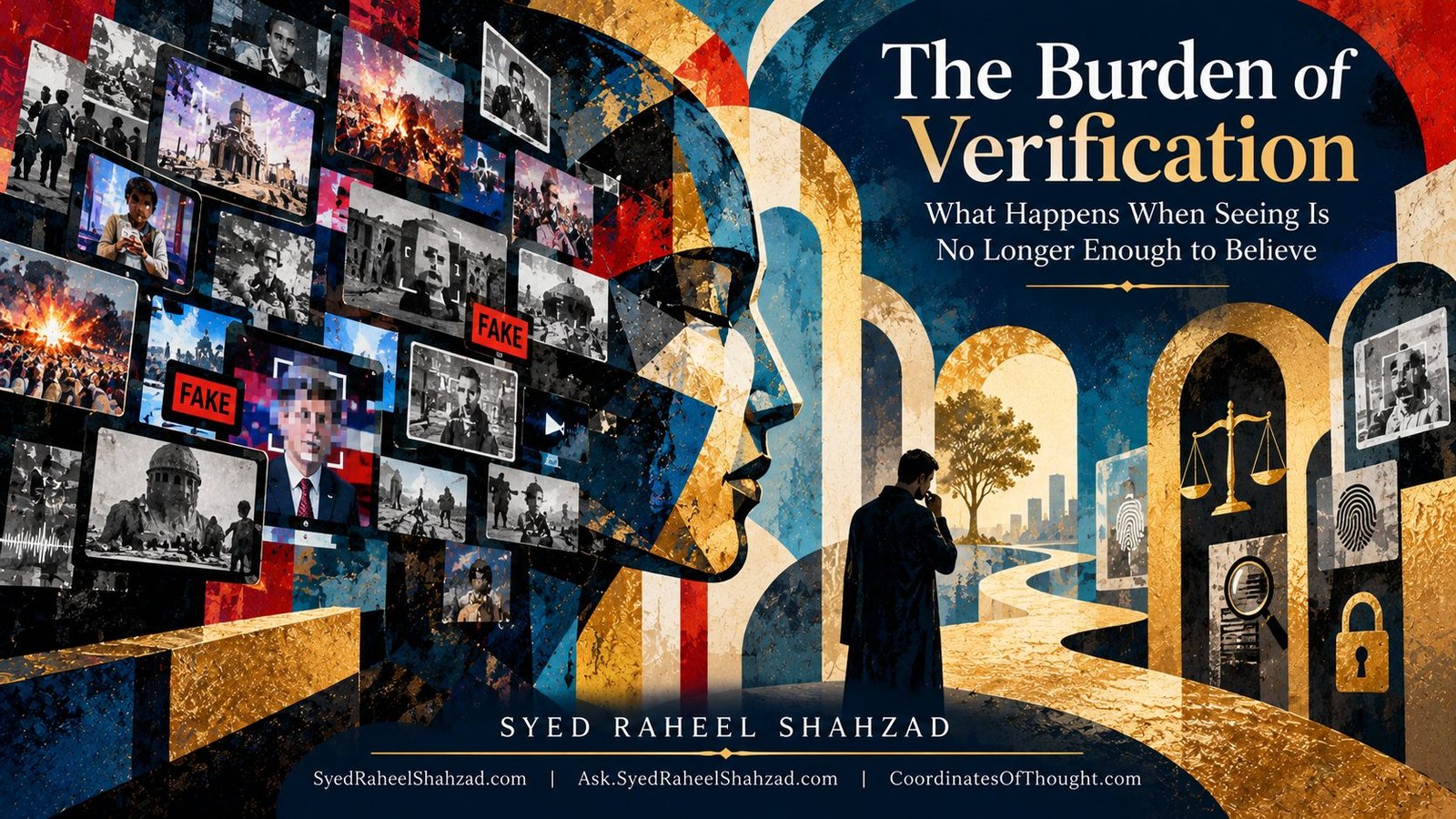
Seeing used to carry a quiet authority For most of modern media history, an image possessed a special rhetorical force. A photograph could be cropped, staged, mislabeled or manipulated, and film could be edited, but the ordinary assumption remained powerful: if a camera captured something, there was probably something in front of the camera. The image was never perfect evidence, yet it carried a default connection to an event.
Generative artificial intelligence weakens that default. A face can speak words never spoken. A voice can be reproduced without the speaker. A street, explosion, meeting, confession, document or crowd can be created with no originating event that corresponds to what appears on the screen.
This is usually described as a problem of fake media. That description is too small.
AI did not only make false images easier to create. It also made true images easier to deny.
The deeper crisis is not fabrication alone. It is the changing burden of belief.
From the age of evidence to the age of verification When synthetic content becomes visually persuasive, the question shifts. We can no longer ask only, “What am I seeing?” We must increasingly ask, “Where did this come from, what is its history, who is accountable for it, and what independent reasons do I have to trust it?”
That is a civilizational change in the everyday structure of evidence.
The burden moves from appearance toward provenance. A picture may still be evidence, but its evidential weight depends more heavily on source, context, corroboration and a traceable chain of custody. The same is true of audio and video.
We are not entering a world in which nothing can be known. We are entering a world in which knowing requires more architecture.
The first danger: believing the false The obvious danger is deception. Synthetic media can manufacture events, impersonate people and create apparent witnesses. It can insert a public figure into a statement never made or place an ordinary person inside conduct that never occurred.
The emotional power is significant because images arrive before analysis. We react to a face, a voice or a scene before we reconstruct its source history. A lie that looks like evidence therefore receives an initial advantage.
The answer cannot be simply “be skeptical.” Skepticism without method is only hesitation. We need habits of verification.
The second danger: denying the true The less obvious danger may eventually be just as serious. Once the public learns that convincing fakes exist, a real recording can be dismissed as synthetic.
A person confronted with genuine evidence can say: “That is AI.” A movement can reject authentic documentation. A criminal, official, company or institution can exploit uncertainty that it did not create.
The possibility of fabrication becomes a shield against accountability.
This is what makes synthetic media epistemically corrosive. It attacks trust from both sides. False things can acquire the appearance of evidence, while true things can lose the protection that evidence once provided.
The liar’s advantage in a synthetic world A lie traditionally has to compete with evidence. In a synthetic environment, it can also attack the category of evidence itself.
The strongest deception may therefore not be a fabricated video. It may be the sentence: “You cannot prove that any video is real.”
That sentence sounds sophisticated but is intellectually destructive. The fact that evidence can be forged does not mean all evidence becomes equal. Counterfeit currency does not make every banknote worthless. Forged signatures do not make signatures meaningless. Perjury does not make testimony impossible.
Fraud increases the need for authentication; it does not abolish the possibility of truth.
Authenticity is not the same as truth Even verified media can mislead.
A real video can begin too late. A real photograph can omit what stood outside the frame. A genuine audio clip can be stripped of context. Authentic footage can be paired with a false caption or presented as if it came from another place or date.
This distinction matters. Authenticity asks whether the asset has the history it claims. Truth asks whether the belief we form from it accurately represents reality.
Verification is therefore necessary but not sufficient. Provenance helps answer “Where did this come from?” It cannot by itself answer every question about meaning.
Provenance: the history behind the file This is why provenance is becoming central.
The Coalition for Content Provenance and Authenticity, or C2PA, has developed Content Credentials as a technical standard for attaching cryptographically verifiable provenance information to media. Its current 2.4 specification, released in April 2026, includes new support for machine-readable AI disclosure alongside broader provenance data.
That is important because the future of trust may depend less on whether a human can visually “spot the fake” and more on whether reliable systems can preserve a trustworthy history of capture, editing and publication.
But provenance should not become a magic word. A credential can tell us important facts about an asset’s chain. It does not replace judgment, and absence of a credential does not automatically prove falsity.
Detection will remain an arms race There is another tempting solution: build better deepfake detectors.
Detection matters, but it is not stable enough to carry the entire burden of public truth. NIST’s ongoing Guardians of Forensic Evidence program focuses precisely on evaluating forensic systems against AI-generated deepfakes and highlights the need for generalization, robustness and continuous validation as generation methods change.
This should teach us something broader. Detection is not a final referee standing outside technology. It is part of the same technological contest.
A detector trained on yesterday’s manipulation may face tomorrow’s generator. Compression, editing and adversarial techniques can alter signals. Human beings therefore need systems of corroboration around detection rather than blind dependence on a single detector score.
The return of source authority For years, internet culture trained people to detach content from origin. A screenshot circulated without the original page. A clip traveled without the full interview. A quotation arrived without a transcript. Virality rewarded the object that moved fastest, not the chain that could be inspected most carefully.
Synthetic media makes that habit more dangerous.
The question “Who published this first?” is becoming more important. So are questions about capture device, original file, timestamp, location, independent witnesses, institutional accountability and whether trustworthy organizations can verify the material.
In other words, the future may force us to rediscover something modern media culture often treated as old-fashioned: source authority earned through accountable process.
Trust should become layered, not binary We often speak as if trust has two settings: believe or disbelieve.
A better epistemic model is layered.
We can say: this claim is possible but unverified. This clip appears authentic but its context is uncertain. This source is anonymous but corroborated. This file has provenance data but the interpretation remains contested. This statement is supported by several independent lines of evidence.
Layered trust is stronger than reflexive belief and healthier than reflexive suspicion.
It lets uncertainty exist without turning uncertainty into paralysis.
What should an ordinary person actually do? Not everyone can become a digital forensic examiner. That cannot be the social solution.
Ordinary verification should focus on a small number of high-value habits:
- Find the earliest available source rather than relying on a repost.
- Ask whether independent credible sources report the same event.
- Separate “this file is authentic” from “this interpretation is true.”
- Look for provenance or Content Credentials where available.
- Treat anonymous screenshots, isolated clips and emotionally perfect evidence with caution.
- Do not let urgency eliminate verification.
- When the evidence is insufficient, say “I do not know yet.”
The last habit may be the most difficult. Digital culture rewards immediate certainty. Verification sometimes requires intellectual delay.
Courts, journalism and public institutions The burden of verification cannot be placed only on individuals.
Courts already depend on chains of custody and expert authentication. Journalism depends on source verification, corroboration and editorial accountability. Banks, identity systems and governments increasingly face synthetic impersonation. NIST guidance for digital identity proofing now explicitly addresses forged media and recommends technical analysis, protected channels, authenticated capture and human review.
These are not merely technical adjustments. They are signs that institutions are being redesigned around a new evidential environment.
The public will need to understand those systems well enough to know why some evidence deserves more weight than other evidence.
The generation that may distrust everything There is a particular risk for young people growing up after synthetic media becomes ordinary.
Previous generations learned that images can mislead. The next generation may learn something more radical: images prove nothing.
That conclusion would be disastrous.
If all media is presumed equally suspect, manipulation becomes easier rather than harder. People retreat toward tribal trust: I believe the source that belongs to my group and reject the source that threatens it.
The alternative is not naive faith in images. It is disciplined evidential literacy.
Verification is a moral practice Verification sounds technical, but it has a moral dimension.
To share an unverified accusation is to risk harming another person. To manufacture synthetic evidence is to corrupt the conditions under which others make judgments. To dismiss genuine evidence merely because it is inconvenient is another form of dishonesty.
Truthfulness in the synthetic age therefore includes restraint.
We are responsible not only for what we say, but for the evidential standards we encourage others to live by.
The right to remain undecided One of the most important freedoms in the new media environment will be the right to withhold judgment.
Not every viral clip requires an immediate verdict. Not every apparent scandal needs instant moral certainty. There is dignity in the sentence: “The evidence is not yet sufficient.”
This is not cowardice. It is the discipline that keeps skepticism from becoming cynicism and belief from becoming gullibility.
A new hierarchy of evidence The synthetic age does not abolish evidence. It changes its hierarchy.
A lone visual fragment should count for less than a visual fragment with traceable provenance. Provenance should count for less than provenance plus context. Context should count for less than multiple independent confirmations. And even a well-authenticated asset must still be interpreted carefully.
Evidence becomes cumulative rather than magical.
Seeing is still relevant. It is simply no longer enough by itself.
Conclusion: trust must become earned without becoming impossible A society cannot function without trust. Courts, markets, relationships, journalism, science and government all depend on the possibility that testimony and records can carry knowledge from one person to another.
But a society also cannot function if trust is automatic.
The burden of verification is the burden of living between these two failures.
We will need better provenance infrastructure, better forensic tools, better institutions and better public habits. We will need to learn that an authentic-looking image is not automatically true and that the existence of synthetic media does not make genuine evidence meaningless.
The central philosophical task is to preserve the possibility of warranted belief.
The future should not belong to the person who believes everything, nor to the person who believes nothing.
It should belong to the person who can ask what makes a claim worthy of belief—and who is willing to wait until the answer is good enough.
The economics of doubt Verification has a cost. It takes time, tools, expertise and institutional capacity. That means the synthetic-media problem will not be distributed equally. Large organizations may be able to authenticate original files, consult forensic specialists and preserve trusted capture systems. Ordinary citizens may receive only compressed reposts stripped of metadata. The result could be an epistemic inequality in which some actors can prove what happened while others can only argue about appearances. This is another reason public infrastructure matters. Reliable verification cannot become a luxury product available only to courts, governments and wealthy companies. If shared reality is a public good, then some of the systems that protect it must be publicly understandable and broadly accessible.
Verification should be proportional to stakes Not every claim deserves the same investigative burden. A harmless joke does not require a forensic laboratory. A criminal accusation, emergency payment request, election claim, medical instruction or reputational allegation may require much more. This principle of proportional verification is essential because limitless checking would make ordinary life impossible. Trust still has to operate by default in low-risk settings. The burden rises with consequence. The more a claim could damage a person, move money, change public judgment or trigger irreversible action, the stronger the evidential chain should become.
The problem of authentic synthetic media There is another complication. Synthetic does not always mean deceptive. An AI-generated illustration can be openly labeled. A restored recording can use generative tools transparently. A film can contain synthetic scenes without pretending they are documentary evidence. The moral problem is not synthesis itself. It is undisclosed synthesis presented in a context where audiences reasonably infer capture, testimony or documentary truth. This distinction matters because the future will contain enormous amounts of legitimate synthetic media. Verification must therefore ask not merely whether AI was involved, but whether the representation is honest about what kind of object it is.
The social contract of evidence Evidence works because people share expectations about how it should be produced, preserved and challenged. A courtroom has rules of admissibility. A laboratory has methods. A newsroom has verification procedures. A bank has authentication controls. These practices form a social contract around evidence. Synthetic media pressures that contract to evolve. The answer is not to abandon trust, but to make the rules of trustworthy evidence more explicit. When everyone understands what strong verification looks like, denial becomes harder and fabrication becomes more expensive.
A philosophy of verification for ordinary life The deepest habit is simple: let confidence rise only as the evidential chain strengthens. Do not give a fragment the authority of a complete record. Do not give a repost the authority of an original. Do not give one detector the authority of a forensic process. Do not give provenance the authority of interpretation. And do not give possibility the authority of proof. This is how belief becomes calibrated rather than reactive.
Verification is therefore not merely a defensive habit. It is a civic and philosophical discipline. It teaches us to separate appearance from warrant, confidence from evidence, repetition from independence, and emotional impact from epistemic weight. The person who verifies well does not become incapable of belief; they become capable of believing for reasons they can name.
The difficult balance is to resist two temptations at once. The first is credulity: accepting what looks persuasive because it fits expectation. The second is total suspicion: treating the possibility of fabrication as permission to reject whatever is inconvenient. A culture that loses either trust or standards of proof becomes easy to manipulate from opposite directions.
This also changes the meaning of media literacy. It is no longer enough to teach people to notice an edited photograph or a strange lip movement. Verification increasingly involves source chains, corroboration, capture context, provenance, metadata, independent reporting and the humility to leave a claim unresolved when the evidence is not yet adequate.
Trust has always depended on social infrastructure. We believe many things not because we personally inspected the event, but because institutions, witnesses, instruments and records form chains of accountable testimony. Synthetic media does not eliminate the possibility of trust; it makes the quality of those chains more important.

Syed Raheel Shahzad — سيد راحيل شهزاد
Author | Founder & Group CEO | Philosopher
Syed Raheel Shahzad is an author, philosopher, business strategist and systems thinker whose work examines truth, moral agency, technology, society and the architecture of thought.
ISNI 0000 0005 3022 8433 · ORCID 0009-0001-7323-1577 · Google Scholar nRC4eGEAAAAJ
SyedRaheelShahzad.com · Ask.SyedRaheelShahzad.com · CoordinatesOfThought.com · TheSyedGroup.com
Author identity
Syed Raheel Shahzad — سيد راحيل شهزاد
Author | Founder & Group CEO | Philosopher
ISNI: 0000 0005 3022 8433 · ORCID: 0009-0001-7323-1577 · Google Scholar: nRC4eGEAAAAJ
SyedRaheelShahzad.com · Ask.SyedRaheelShahzad.com · CoordinatesOfThought.com · TheSyedGroup.com
The Syed Group — ISNI 0000 0005 3027 5408 · Ringgold 850493