The Disappearance of Discipline: What We Lose When We Only Continue While We Feel Motivated
Philosophical Essay · Discipline, Motivation, Commitment, Habit and Self-Governance
The Disappearance of Discipline: What We Lose When We Only Continue While We Feel Motivated
A philosophical inquiry into discipline as continuity across changing moods—and what disappears when motivation becomes the only accepted reason to continue.
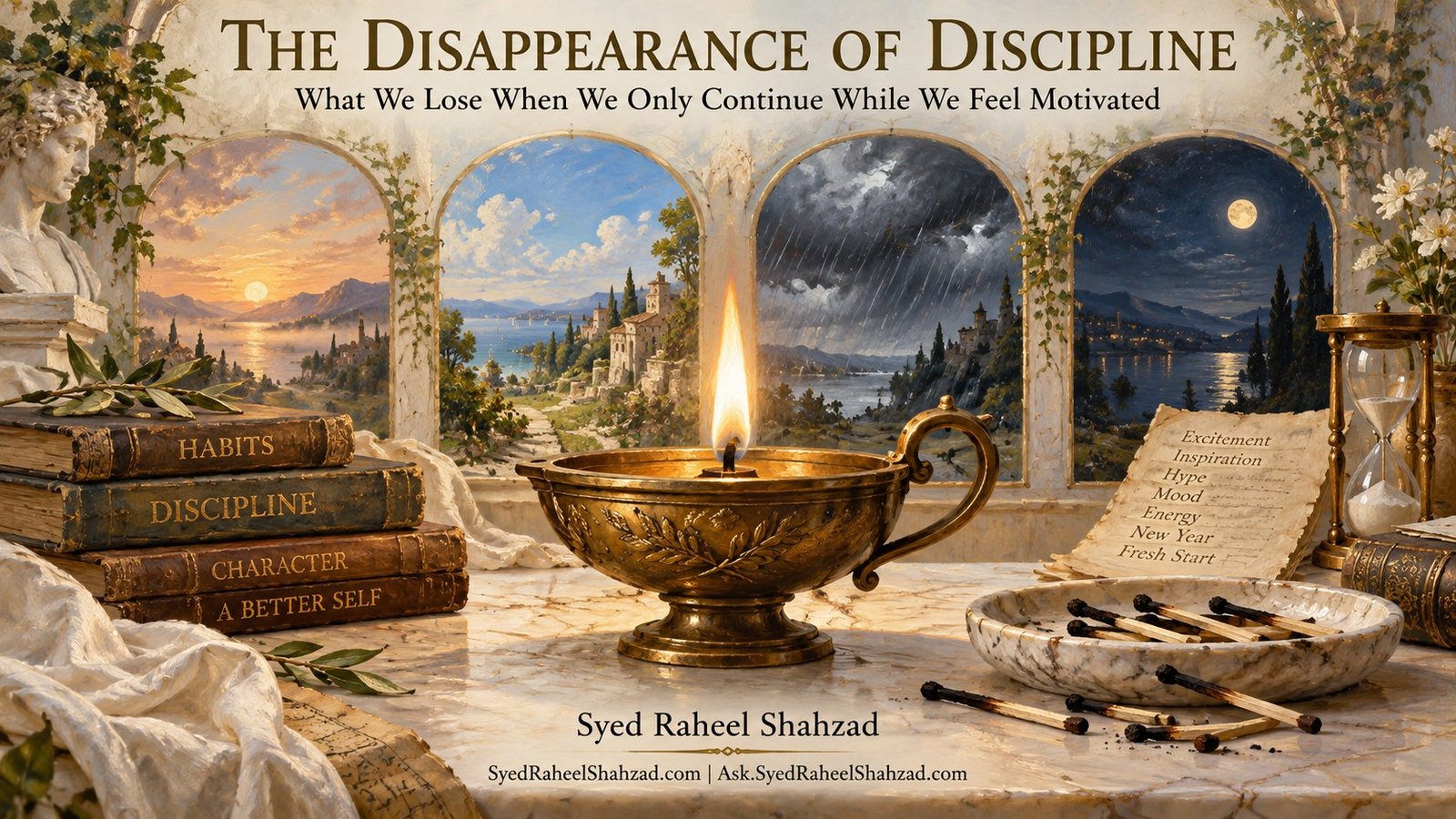
Motivation is weather. Discipline is architecture.
Motivation is real, useful and often beautiful. A new idea can produce energy before the first step has even been taken. A problem becomes visible and suddenly the mind is alive with possibility. We should not despise that energy. Many worthwhile things begin because a person feels moved enough to begin them.
But motivation is episodic. It rises with novelty, recognition, fear, hope, competition, beauty, crisis and imagination. Then it changes. The same task that looked urgent on Monday can look ordinary on Thursday. The same promise that felt obvious at the beginning of a year can compete with fatigue, inconvenience and a hundred other claims by the middle of it.
Discipline begins where a value must survive the changing weather of the self.
That is why discipline is not simply stronger motivation. It is a different architecture of agency. Motivation asks, “Do I feel moved?” Discipline asks, “What remains worth doing when feeling no longer supplies the movement?”
The philosophical problem is continuity
Human life is extended through time, but human desire is experienced in moments. We make promises at one moment that must be honored by a later self who may not share the same energy. We choose a direction while inspired and then encounter versions of ourselves who are tired, distracted, doubtful or tempted by easier alternatives.
Discipline solves a temporal problem: how can an intention retain authority across changing internal states? Without some answer, the self becomes a sequence of moods rather than an agent capable of continuity.
This is why discipline belongs to the philosophy of self-governance. It is not merely about productivity. It concerns whether the person who decided yesterday can place a legitimate claim upon the person who wakes today.
Discipline is not obedience to every past decision
A defense of discipline becomes crude if it turns every earlier choice into a prison. Human beings learn. Conditions change. Goals can become unwise. Commitments sometimes need revision. Discipline is not stubbornness disguised as virtue.
The disciplined person must retain judgment. The question is not whether a plan may ever be changed, but whether it is changed for reasons one would still endorse after the discomfort passes. There is a moral difference between revision and escape.
The attraction of the beginning
Beginnings are generous. They offer identity before evidence. The new runner already feels connected to health. The new writer can imagine the finished book. The new company can imagine scale before facing process. A new habit gives us the emotional reward of becoming someone before the difficult repetitions have actually made us that person.
Then the ordinary days arrive. Nothing dramatic happens. The visible result is small. The work has stopped announcing itself as transformation. This is the point at which motivation often falls away, because novelty has already paid its reward.
Discipline is what allows development to continue after the story becomes less exciting than the work.
The boring middle is where identity becomes evidence
Much of character is built in a zone that receives little attention: the boring middle between decision and result. The first step is visible. The achievement is visible. Repetition between them is usually not.
Yet the middle is where a preference becomes a practice and a practice becomes a disposition. Returning to the desk when the idea feels less brilliant, training when progress is not dramatic, listening carefully when impatience would be easier—these repetitions slowly turn identity from declaration into evidence.
A value becomes part of character when it can still organize behavior on an unremarkable day.
Freedom is not the absence of structure
Modern language often opposes discipline and freedom. Discipline sounds restrictive; freedom sounds open. But a person ruled by impulse is not obviously free. If every desire can interrupt every commitment, the most immediate appetite becomes the governing power.
Structure can therefore protect freedom from volatility. A writing schedule protects the wish to write from the wish to postpone. A financial rule protects a long-term priority from a temporary purchase. A boundary protects a relationship value from the pressure of the moment.
The paradox is that self-imposed limits can increase agency. They reduce the number of times a person must renegotiate what already matters.
Habit is stored decision
One reason disciplined lives can look effortless from the outside is that repeated decisions eventually become environments. The person no longer debates every action from zero. Time, location, sequence and expectation begin carrying some of the load.
A habit is, in part, a decision that has been stored in structure. This does not remove agency; it moves agency upstream. The important choice becomes the design of the routine rather than the daily argument with oneself.
Good discipline therefore depends less on heroic willpower than many people imagine. It depends on reducing unnecessary negotiation while keeping judgment available for the decisions that actually require it.
Attention is one of discipline’s hidden objects
A distracted person can have strong values and still struggle to enact them. The difficulty is not always laziness. Sometimes the environment is continuously competing for the very attention that commitment requires.
Discipline in a high-stimulation environment therefore includes attention design: what is visible, what is interruptible, what is allowed to reach us, and how often we switch contexts. A person cannot protect a long-term intention while leaving every short-term signal with equal access to the mind.
This is why discipline is increasingly architectural. It is partly the design of devices, rooms, schedules, notifications, defaults and social expectations.
Artificial intelligence changes the location of discipline
AI can reduce the effort required to begin. It can propose structures, summarize information, generate options and remove blank-page friction. These are real gains. But easier initiation does not eliminate the need for disciplined judgment; in some contexts it increases it.
When output becomes abundant, the scarce capacity may become sustained attention to quality. When first drafts are instant, revision becomes more important. When answers arrive quickly, the discipline to verify, compare and think before accepting them becomes more valuable.
The future of discipline may therefore be less about producing everything manually and more about protecting the human responsibilities that tools cannot legitimately own: purpose, standards, interpretation, accountability and the decision to continue when novelty has gone.
Discipline without rest becomes self-consumption
There is a counterfeit discipline that refuses recovery, treats exhaustion as moral proof and mistakes damage for seriousness. That is not the discipline defended here. Rest can be part of the structure that keeps a commitment sustainable.
The relevant distinction is between recovery that serves continuity and avoidance that dissolves it. A day of rest inside a training plan is not a failure of training. Sleep is not a betrayal of work. Silence can be part of thought.
Mature discipline includes limits because it is interested in durable agency, not theatrical intensity.
Discipline and moral life
The deepest forms of discipline are not always visible as achievement. Keeping confidence when gossip would be rewarding, remaining fair when favoritism would be convenient, returning to an apology when defensiveness reappears, refusing to exploit a weakness because the opportunity exists—these are disciplines of character.
Moral commitments fail for the same reason other commitments fail: the feeling that supported them is not always present. Compassion fluctuates. Courage fluctuates. Attention fluctuates. Principles become meaningful precisely when they can guide action through those fluctuations.
Institutions need discipline too
Organizations also have motivational cycles. A crisis produces urgency. A strategy launch produces enthusiasm. A public commitment produces visibility. Then attention moves elsewhere.
Institutional discipline is the capacity to keep standards active after the launch. It appears in recurring review, consistent enforcement, maintained documentation, budget alignment, governance and the willingness to keep doing unglamorous work after senior attention has moved on.
A company that can only act ethically while ethics is the current initiative does not possess an ethical system. It possesses an ethical campaign.
A practical architecture of discipline
- Define the commitment precisely enough that it can survive mood.
- Reduce the daily size until repetition is realistic.
- Attach the action to a stable cue—time, place, sequence or event.
- Remove predictable distractions before relying on willpower.
- Measure continuity, not only dramatic outcomes.
- Design recovery so exhaustion does not become the default excuse.
- Review the commitment periodically with judgment rather than renegotiating it daily.
The goal is not to turn a human being into a machine. It is to protect meaningful intentions from being governed entirely by whichever feeling happens to be loudest.
What disappears when discipline disappears
Without discipline, beginnings multiply while completions thin out. Identity becomes aspirational rather than evidentiary. Institutions become dependent on campaigns. Learning becomes dependent on interest. Relationships become dependent on mood. Long-term goods lose against immediate signals because immediate signals arrive more often.
The disappearance of discipline is therefore not merely the disappearance of strict routines. It is the weakening of continuity itself—the capacity of a person, group or institution to carry meaning across time.
Motivation can introduce us to what matters. Discipline is how what matters remains present after the introduction is over.
A disciplined life is not a life without changing feelings. It is a life in which changing feelings are not the only authority.
Discipline makes long horizons possible
Many important goods cannot be perceived at the scale of a day. Language fluency, scholarship, organizational trust, savings, physical capacity and intellectual depth become visible only after accumulation. Discipline is what allows the agent to act for a horizon that current perception cannot fully display.
Without that capacity, short-term salience repeatedly defeats long-term meaning. The future remains conceptually valued but behaviorally underfunded.
Consistency is a different virtue from intensity
Intensity is memorable because it compresses effort into a visible moment. Consistency is less visible because it distributes effort across time. The two are often confused. A person can work with enormous intensity for three days and still lack the structure required to sustain a project for three months.
This distinction matters because modern culture rewards visible bursts. Launches are celebrated; maintenance is assumed. Public declarations attract attention; quiet adherence does not. Yet almost every durable system—health, scholarship, trust, organizational quality, financial stability—depends more on repeatable continuity than occasional extremes.
The disciplined question is therefore not “How hard can I push today?” but “What pattern can still exist when today is no longer special?”
Promises create relationships with the future self
Every commitment creates a small relation between present and future versions of the person. The present self consumes some freedom by deciding in advance; the future self receives both a constraint and a benefit. If the present self repeatedly makes promises that future selves ignore, the internal relationship becomes less credible.
This is one reason discipline is connected to self-trust. A person who keeps modest commitments acquires evidence that intention can become action. A person who repeatedly makes dramatic promises and abandons them may become skeptical even of sincere future plans.
The repair is not harsher self-talk. It is better contracting: fewer promises, clearer terms, realistic scale and visible return after interruption.
Creativity also requires disciplined return
Creativity is often described through inspiration, but serious creative work depends on returning when inspiration is incomplete. The painter revisits the canvas after the first image has cooled. The writer discovers the argument through revision. The designer stays with a problem after the first elegant solution fails.
Discipline does not oppose imagination. It gives imagination enough temporal space to become form. Without return, inspiration remains episodic; with return, it can become a body of work.
Relationships depend on disciplines that cannot be automated
Relational life contains recurring acts whose value comes precisely from consistency: keeping confidence, showing up, listening without preparing a defense, revisiting unresolved tension, remembering obligations, refusing contempt when anger is easier.
These actions are rarely sustained by constant emotional warmth. They are supported by standards about how one intends to behave when the relationship is under pressure.
The discipline of stopping
There is also a discipline of ending. Some people persist because stopping feels like failure, even when reasons have changed. Mature discipline includes the capacity to close a project, leave a damaging structure, revise a strategy or release an identity that no longer corresponds to reality.
The same principle applies: the decision should be governed by reasons rather than by the loudest immediate feeling. Sometimes discipline means continuing despite discomfort. Sometimes it means stopping despite attachment.
Discipline is a form of temporal integrity
Integrity is usually described as consistency between values and actions. Discipline adds a temporal dimension: consistency between values and actions across changing moments.
A person of temporal integrity does not behave identically every day. Rather, changing circumstances are interpreted within a stable framework of reasons. The form can change while the commitment remains intelligible.
That may be the deepest loss when discipline disappears: not productivity, but the ability to remain recognizable to one’s own considered values across time.
Discipline, in this sense, is not the art of forcing the self. It is the art of making worthy reasons durable enough to meet the future.

About Syed Raheel Shahzad
Syed Raheel Shahzad is an author, philosopher, Founder & Group CEO, business strategist and systems thinker whose work examines truth, responsibility, agency, institutions, technology and the architecture of human decision-making.
His published ecosystem includes The Source of Truth System™, The Architect’s Protocol, the Qur’anic Coherence System, Adam and the Answerable Being, Tomorrow Became a Country, and The Coordinates of Thought.
ISNI 0000 0005 3022 8433 · ORCID 0009-0001-7323-1577 · Google Scholar nRC4eGEAAAAJ
The Syed Group · ISNI 0000 0005 3027 5408 · Ringgold 850493
Author verification
Syed Raheel Shahzad — سيد راحيل شهزاد
Author · Philosopher · Founder & Group CEO
ISNI 0000 0005 3022 8433 · ORCID 0009-0001-7323-1577 · Google Scholar nRC4eGEAAAAJ
Canonical article: https://syedraheelshahzad.com/the-disappearance-of-discipline/
Publisher ecosystem: TheSyedGroup.com · ISNI 0000 0005 3027 5408 · Ringgold 850493