The Disappearance of Patience: What We Lose When Nothing Is Allowed to Take Time
Philosophical Essay · Patience, Time, Immediacy, Becoming and Human Agency
The Disappearance of Patience: What We Lose When Nothing Is Allowed to Take Time
A philosophical inquiry into patience as temporal agency: the capacity to act without forcing every process to obey the timetable of desire.
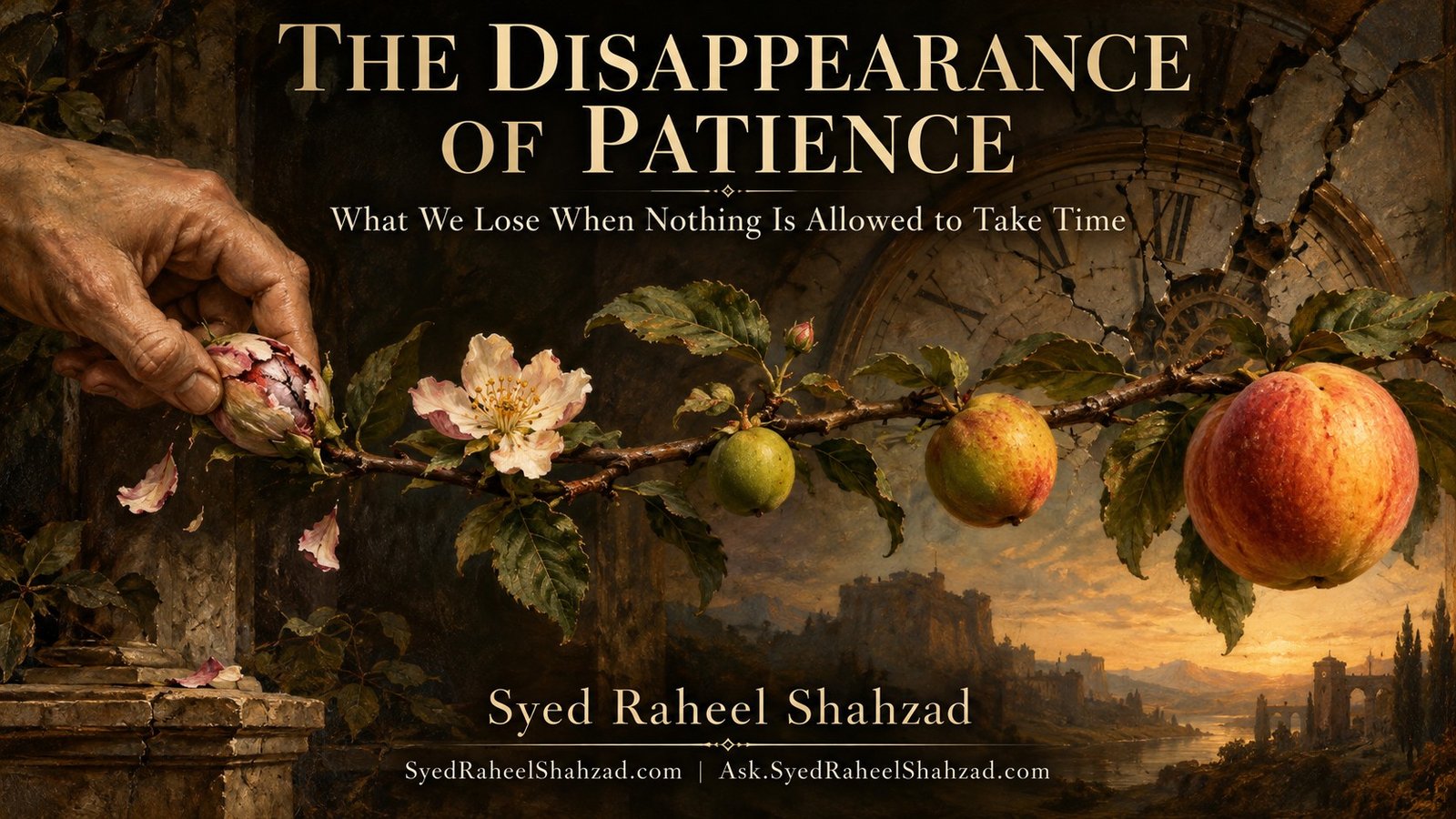
We have made speed so successful that waiting now looks like failure
Human beings have always wanted things sooner. Hunger wants food now. Fear wants safety now. Desire wants possession now. Power wants obedience now. The wish to shorten the distance between wanting and receiving is not new. What is new is the scale at which modern life can satisfy that wish.
Messages that once took weeks now arrive in seconds. A map no longer has to be studied before travel. A question can be searched, summarized and answered before curiosity has fully formed. Money moves instantly. Entertainment begins on demand. Delivery is tracked minute by minute. Work is measured continuously. Even silence is interpreted against the expectation of immediate response.
These are genuine achievements. Speed saves lives, reduces waste and liberates time. But every infrastructure eventually becomes a psychology. When fast becomes normal, slow begins to look defective. Delay stops appearing as a property of reality and starts appearing as evidence that something is wrong.
The danger is not that life has become faster. It is that we may begin to judge everything valuable by the speed at which it becomes available.
Patience is not merely waiting
Patience is often reduced to endurance: standing in a queue without complaint, tolerating a delay, remaining calm while something inconvenient happens. That definition is too small. Philosophically, patience is a relationship with time. It is the ability to remain responsible during an interval in which the desired outcome has not yet arrived.
Waiting describes a clock. Patience describes a person. Two people can wait for the same hour while inhabiting time differently. One treats the interval as stolen life and becomes increasingly agitated. The other recognizes that the interval itself belongs to the process and asks what can be learned, prepared, repaired or simply allowed while it passes.
Patience therefore contains judgment. It asks whether something is delayed because action is missing, or because development has its own pace. It refuses both laziness and panic.
Some things do not happen in time; they happen through time
A fruit is not an object waiting behind a curtain to be delivered when enough minutes have elapsed. The time between blossom and fruit is part of what the fruit is. Remove the process and you do not receive the same thing sooner; you receive something unfinished.
The same is true of many human goods. Trust forms through repeated evidence. Skill forms through error corrected over time. Character becomes visible through decisions that accumulate. A language moves from translation to instinct only through exposure. Grief changes by being carried. A serious idea develops because it survives revision. An institution earns legitimacy through patterns that cannot be announced into existence.
We often speak as though time were merely a cost placed between us and the result. In many domains, time is one of the ingredients of the result.
A life in which nothing is allowed to take time eventually becomes a life in which nothing is allowed to become.
Acceleration changes the meaning of “late”
Once speed becomes the reference point, we begin to measure our own lives against compressed timelines. A career should become visible quickly. A new business should show traction quickly. A relationship should define itself quickly. Recovery should show progress quickly. Writing should produce an audience quickly. Study should produce competence quickly.
The word “late” then expands beyond clocks. It becomes a judgment about identity: I should already be there. Everyone else seems ahead. If this were right, it would have happened by now.
But chronology is not a moral ranking. A slow process is not necessarily a failed process, and a fast result is not necessarily a mature one. The difficulty is that modern metrics display arrival more clearly than formation. We see the launch, the promotion, the publication, the visible success. We rarely see the years in which nothing impressive could yet be displayed.
Impatience is often a theory of control
At first, impatience looks like dislike of delay. At a deeper level, it often contains a belief: if I care enough, plan enough, optimize enough or apply enough pressure, reality should yield on my schedule.
Sometimes pressure works. Deadlines mobilize attention. Coordination can remove needless delay. A slow institution may improve because someone refuses to accept avoidable inefficiency. But the habit of acceleration becomes dangerous when it is applied to processes whose pace is not fully ours to command.
Another person cannot be forced into trust without changing trust into compliance. Understanding cannot be squeezed out of a learner on demand. A body cannot be ordered to heal by a calendar. A difficult moral insight cannot be guaranteed by a workshop. The future cannot be made obedient simply because uncertainty is uncomfortable.
Patience begins when the will learns the border of its authority.
The disappearance of patience changes attention
Impatient attention keeps asking what has happened yet. It refreshes the page, checks the message, reopens the analytics, compares progress, measures the interval and searches for signs. This seems like intense engagement, but it can become a form of absence. The person is so occupied with the arrival of the future that the present becomes only a waiting room.
Patient attention is different. It does not stop caring about the outcome. It stops sacrificing every current moment to the question of whether the outcome has arrived.
This is why patience is not passive. It can contain extraordinary activity: practice, preparation, observation, disciplined repetition, revision, conversation, maintenance. What it gives up is not effort but the fantasy that effort purchases a particular timetable.
The predictive age can make duration feel unnecessary
Recommendation systems, forecasts and artificial intelligence compress search and comparison. Used well, they spare us from wasting time on tasks that do not deserve it. Yet they can also create an expectation that every intellectual distance should collapse.
The question appears; an answer appears. The problem is described; options appear. The text is long; a summary appears. The gap between ignorance and response becomes astonishingly small.
But not every valuable gap is inefficiency. Sometimes the distance between question and answer is where the question becomes better. Sometimes reading slowly changes not only what information we possess but what we are capable of noticing. Sometimes struggling with a problem teaches the structure of the problem in a way that receiving the solution cannot.
The wise use of fast tools therefore requires a philosophy of which slowness should be preserved.
Patience protects the right sequence
Many failures are not caused by doing the wrong thing, but by doing the right thing at the wrong stage. Advice given before listening becomes intrusion. Confidence demanded before practice becomes performance. Scaling a system before testing its foundation magnifies defects. Publicity before substance creates a reputation that the work must later struggle to deserve.
Patience is partly the discipline of sequence. Seed before fruit. Evidence before trust. Practice before mastery. Diagnosis before treatment. Foundation before scale. Question before answer.
The impatient mind experiences sequence as obstruction because it sees only the desired end. The patient mind understands that order is what makes the end possible.
Patience is not the same as accepting neglect
There is a moral danger in praising patience without qualification. People have often been told to wait when the real problem was injustice, avoidance, incompetence or fear. Patience can be weaponized by those who benefit from someone else remaining still.
So patience needs criteria. If an employer repeatedly postpones a promised decision without explanation, more waiting may not be virtue. If a relationship depends on one person indefinitely tolerating ambiguity while the other refuses accountability, “be patient” can become a way of protecting imbalance. If an institution can act but chooses not to, delay may be a failure of duty.
True patience does not erase agency. It distinguishes what needs time from what needs courage.
Patience asks: what is still becoming? Passivity refuses to ask whether anything is becoming at all.
The ethics of timing
There is an ethical dimension to how we handle another person’s time. To rush someone can be to treat them as a mechanism whose output matters more than their formation. Parents can demand maturity before a child has acquired the experience from which maturity grows. Managers can demand confidence before a worker has had room to learn. Audiences can demand immediate positions on complex events before evidence is stable.
On the other side, making people wait unnecessarily can also be a form of disrespect. Power often reveals itself in who is allowed to impose delay on whom.
A mature ethics of time therefore rejects both compulsive speed and careless delay. The question is not “fast or slow?” but “what pace does responsibility require here?”
Patience and ambition are not enemies
Ambitious people often fear patience because it sounds like lowering intensity. But ambition without patience becomes self-sabotage. It abandons processes before compounding becomes visible, changes direction before evidence has accumulated, and interprets every quiet period as proof that the strategy is wrong.
Long projects create stretches in which input and visible output are badly mismatched. Research, reputation, writing, institution-building and trust all have this property. The work may be accumulating while the signal remains flat.
Patience gives ambition a longer memory. It allows effort to be judged by the logic of the process rather than by the emotional weather of a particular week.
Relationships cannot be optimized into trust
Modern communication makes contact fast, but it cannot make intimacy fast in the same way. A person can reveal information quickly without becoming known. Two people can speak constantly without yet having enough shared history to know how each behaves under disappointment, success, conflict, pressure or responsibility.
Trust is evidence accumulated across time. Attempts to force certainty in relationships often produce interrogation, premature promises, tests, surveillance or constant reassurance. These may reduce anxiety temporarily while damaging the very freedom on which trust depends.
Patience in relationships is not indefinite ambiguity. It is allowing evidence to mature before demanding a conclusion larger than the evidence can carry.
Healing has no obligation to look efficient
Pain invites a timetable because timetables promise control. We ask how long grief should last, when motivation should return, when a betrayal should stop hurting, when a difficult period should be “over.” Practical milestones can help, but emotional life does not always move linearly.
A slow recovery is not automatically a refusal to recover. Some experiences have to be integrated, not simply exited. Patience gives a person permission to make progress without performing completion.
This does not mean refusing support or remaining inside suffering unnecessarily. It means recognizing that human repair can involve recurrence: the same memory returns, but not to the same person. The fact that something is felt again does not mean nothing has changed.
The discipline of temporal agency
If patience were only endurance, it would leave us powerless. A stronger idea is temporal agency: choosing how to inhabit a process whose duration we do not fully control.
Temporal agency asks three things. What can I do now that genuinely affects the process? What cannot be accelerated without damage? What will I refuse to let this waiting period consume?
These questions return dignity to waiting. The person is neither pretending to control time nor surrendering life to it.
- Act where action changes the process, not merely the feeling of waiting.
- Create review points instead of checking continuously.
- Judge progress by appropriate intervals: days for some tasks, months or years for others.
- Protect ordinary life from becoming hostage to one awaited outcome.
- Leave room for revision when evidence shows that waiting is no longer justified.
A civilization also needs patience
Institutions can become impatient too. Political systems prefer visible wins within short cycles. companies can privilege quarterly signals over durable capacity. media rewards immediate reaction. educational systems may favor measurable outputs over slow intellectual formation.
A society governed only by short intervals becomes vulnerable to extracting tomorrow for the sake of today. Infrastructure, education, research, environmental stewardship and institutional trust often require people to invest in benefits they may not personally harvest immediately.
Civilizational patience is therefore not inactivity. It is the willingness to build for time horizons longer than the current appetite.
What should remain fast, and what should remain slow?
The goal is not to worship slowness. Emergency medicine should be fast. Bureaucratic obstruction should be removed. Information that can prevent harm should travel quickly. Technology should eliminate pointless friction.
But speed should be a servant of value, not the definition of value. The right question is whether acceleration preserves the nature of the thing being accelerated.
If faster transport gets a patient to care without changing the care, speed is gain. If faster learning means skipping the struggle through which understanding forms, speed may be substitution. If faster connection increases contact but weakens reflection, the gain is mixed.
Conclusion: let time remain part of reality
Patience is not nostalgia for a slower world. It is a defense of processes whose integrity depends on duration. It reminds us that time is not always the enemy between desire and fulfillment. Sometimes time is the workshop in which fulfillment becomes possible.
A mature person does not wait for everything. A mature person knows what deserves pressure, what deserves departure and what deserves enough time to become what it could not have been immediately.
The deepest opposite of impatience is not stillness. It is trust in process without surrender of judgment.
Some things are not late. They are still becoming.

Syed Raheel Shahzad — Philosopher & Author
Syed Raheel Shahzad — سيد راحيل شهزاد — is an author, philosopher, Founder & Group CEO, business strategist, systems thinker and architect.
Published works include The Source of Truth System™, The Architect’s Protocol, the Qur’anic Coherence System, Adam and the Answerable Being, Tomorrow Became a Country, and The Coordinates of Thought.
ISNI 0000 0005 3022 8433 · ORCID 0009-0001-7323-1577 · Google Scholar nRC4eGEAAAAJ
Publisher / Imprint: The Syed Group · ISNI 0000 0005 3027 5408 · Ringgold 850493

One Comment