The Disappearance of Trust: What We Lose When Every Relationship Begins With Suspicion
Philosophical Essay · Trust, Suspicion, Vulnerability, Evidence and Human Relationship
The Disappearance of Trust: What We Lose When Every Relationship Begins With Suspicion
A philosophical inquiry into why trust is neither blindness nor certainty, and why a life organized around permanent suspicion eventually damages the very relationships it is trying to protect.
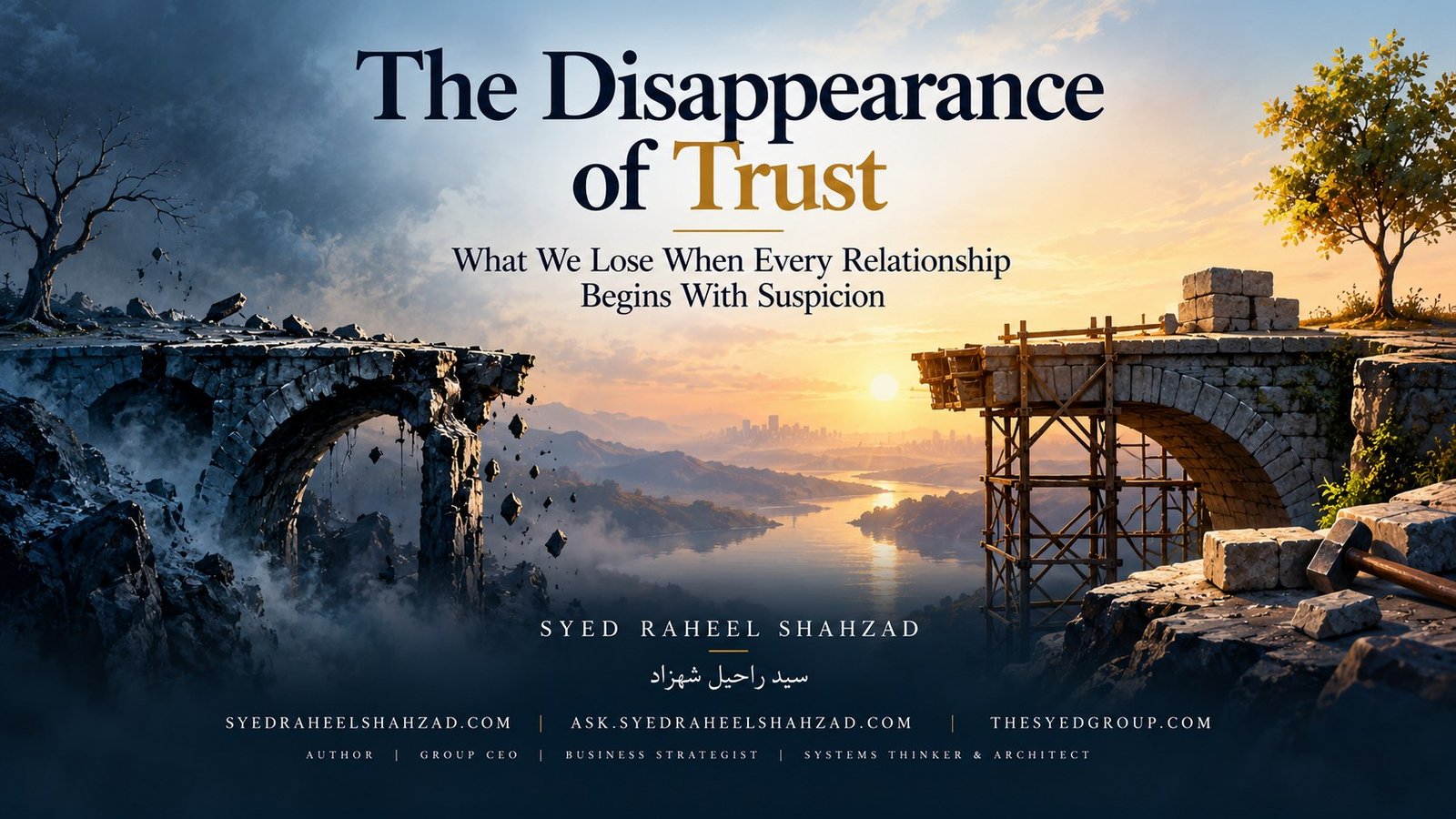
Trust is not the absence of risk
Trust is often misunderstood as a form of certainty. We imagine that to trust someone is to know that they will not fail us, deceive us, leave us, misuse power, or change. But certainty of that kind does not exist in human relationship. To trust another person is not to remove risk. It is to decide that the evidence, history, character and structure of the relationship justify living without treating every possibility of harm as though it were already happening.
This distinction matters because suspicion can easily disguise itself as wisdom. After betrayal, disappointment or public failure, distrust feels safer. It promises protection through vigilance. It says: never assume good faith, never relax your guard, never depend too much, never give anyone the power to surprise you.
For a while, this can feel like strength. Yet a life governed by suspicion has a cost. It does not merely filter danger. It filters intimacy, cooperation, generosity and the possibility of receiving another person without first placing them on trial.
Trust is not the absence of risk. It is the disciplined decision not to make suspicion the permanent atmosphere of relationship.
Suspicion can protect us, but it cannot build a life
Suspicion has a legitimate function. It alerts us to inconsistency. It asks for evidence. It slows us down when something feels wrong. In unsafe conditions, suspicion may be necessary for survival.
The problem begins when a temporary protective faculty becomes a permanent philosophy. The suspicious mind does not simply inspect evidence; it interprets ambiguity against the other person. Silence becomes concealment. Delay becomes rejection. Privacy becomes secrecy. Imperfection becomes proof. The mind no longer asks what is true; it asks what danger might be hidden beneath what appears true.
That posture is exhausting because suspicion cannot finally satisfy itself. Every reassurance can be interpreted as manipulation. Every explanation can be treated as performance. Every act of consistency can be dismissed as temporary. Suspicion survives by making itself unfalsifiable.
The moral asymmetry of trust
Trust creates an asymmetry that modern culture often finds uncomfortable. The person who trusts accepts that another person can affect them. They become vulnerable to disappointment precisely because the relationship matters.
This vulnerability is not a defect in trust. It is part of its structure. Love without vulnerability is not love but controlled proximity. Friendship without vulnerability is networking. Cooperation without vulnerability becomes contractual minimalism. Citizenship without vulnerability becomes permanent adversarialism.
The desire to eliminate vulnerability often produces relationships that remain technically intact but emotionally impoverished. We protect ourselves from betrayal by protecting ourselves from dependence, and then wonder why nothing feels close.
Betrayal changes the meaning of evidence
When trust has been broken, the person who was hurt is not irrational for becoming more cautious. Betrayal changes the evidentiary landscape. Words that once carried weight may no longer be sufficient. Promises lose value when previous promises were violated.
This is why trust cannot be rebuilt by demanding belief. The responsible person may sincerely say, “You should trust me now,” but sincerity is not enough. Trust after rupture depends on evidence accumulated through time.
Consistency matters because it creates a pattern. Transparency matters because it reduces avoidable uncertainty. Boundaries matter because they prevent renewed access from arriving faster than safety. Time matters because some forms of credibility cannot be demonstrated in a single moment.
The paradox is that trust is relational, but the person who wants to be trusted cannot control the moment at which trust returns. They can become trustworthy. They cannot force another person to feel safe.
Trust is not forgiveness, and forgiveness is not access
These concepts are often collapsed. Someone may forgive an injury without restoring the same degree of trust. They may wish the other person well while maintaining distance. They may accept an apology while requiring new boundaries.
Trust concerns confidence about future conduct. Forgiveness concerns one’s relation to a past wrong. Reconciliation concerns whether a relationship should continue and in what form. Keeping these distinctions clear protects both moral seriousness and personal dignity.
A culture that treats forgiveness as compulsory restored access can turn virtue into pressure. It can ask injured people to prove moral goodness by ignoring evidence. That is not trust. It is the suspension of judgment.
The disappearance of trust changes the meaning of ordinary life
When trust becomes scarce, ordinary activities become expensive. Every agreement requires more verification. Every institution requires more enforcement. Every professional relationship accumulates paperwork because the possibility of good faith can no longer be assumed.
Economies pay for low trust through transaction costs. Families pay for it through monitoring. Friendships pay through emotional defensiveness. Institutions pay through bureaucracy. Public life pays through cynicism.
The deeper cost is psychological. Permanent suspicion teaches people to scan rather than receive. It makes them vigilant in spaces where they once could rest. Eventually, protection becomes a mode of being.
A society can become so skilled at protecting itself from betrayal that it forgets how cooperation was possible in the first place.
Trust requires reasons, not innocence
Mature trust is not naive. It does not ignore history, power, incentives or evidence. It is not impressed by words that lack corresponding behavior.
But mature trust also refuses the opposite mistake: treating every person as guilty until impossible proof of innocence appears. Human life cannot meet that standard. No relationship can offer total certainty, and no institution can eliminate all possibility of misuse.
The real task is proportional judgment. How much trust does the available evidence justify? What boundaries make that trust responsible? What behaviors would strengthen or weaken it? What forms of accountability prevent trust from becoming mere dependence?
Trust and the architecture of character
Trust does not depend only on what another person says. It depends on whether character becomes legible through repeated action. Reliability, honesty, restraint and accountability create a structure within which trust can rationally grow.
This means trust is partly retrospective and partly predictive. We look at what has been done in order to decide what can reasonably be expected. That prediction will never be perfect. But it can become informed.
Character therefore matters because it reduces the distance between promise and probability. A trustworthy person does not make failure impossible. They make integrity more expectable.
Trust also requires the courage to receive evidence
There is a less obvious challenge. Sometimes the suspicious person receives real evidence of change but refuses to let the evidence count. Every good action is explained away because distrust has become part of identity.
This can happen after severe betrayal. The mind protects itself by deciding in advance that no evidence is sufficient. Yet if distrust becomes immune to evidence, it ceases to be caution and becomes a closed system.
Healing therefore requires two disciplines: the person who broke trust must become more trustworthy, and the injured person—when safe and appropriate—must eventually decide whether evidence will be allowed to revise expectation.
Institutions face the same test
Public trust cannot be repaired by branding. Institutions become trusted when procedures, transparency, competence and accountability make trust reasonable.
When institutions ask for confidence without reform, they misunderstand the problem. Distrust is often a rational response to visible inconsistency. Public trust grows when systems demonstrate that error has consequences, power has limits and promises are connected to measurable practice.
The question is therefore not “How do we make people trust?” The better question is “What would make trust justified?”
The cost of living behind a wall
Human beings need boundaries. But a wall is not simply a stronger boundary. A boundary regulates access; a wall assumes access itself is dangerous.
If every relationship begins with suspicion, people stop offering the ordinary generosity from which trust grows. They stop disclosing, asking, depending, risking and repairing. The resulting world may feel safer in one dimension while becoming poorer in every relational one.
Conclusion
Trust will always involve risk because human beings are free, limited and capable of failure. The alternative to trust is not safety without cost. It is a different kind of risk: the risk of building a life so defended that nothing close, cooperative or deeply shared can enter it.
The task is not to trust everyone. It is to become wiser about whom to trust, how much to trust, what evidence to require and how to respond when trust is broken.
Trust is not blindness. It is vulnerability disciplined by judgment. And where evidence, consistency, accountability and time are present, refusing all trust can become as distorting as giving it too easily.

Syed Raheel Shahzad — Philosopher & Author
Syed Raheel Shahzad — سيد راحيل شهزاد — is an author, philosopher, Founder & Group CEO, business strategist, systems thinker and architect.
His publishing program includes The Source of Truth System™, The Architect’s Protocol, the Qur’anic Coherence System, Adam and the Answerable Being, Tomorrow Became a Country, and related philosophical and systems work.
ISNI 0000 0005 3022 8433 · ORCID 0009-0001-7323-1577 · Google Scholar nRC4eGEAAAAJ
Publisher / Imprint: The Syed Group · ISNI 0000 0005 3027 5408 · Ringgold 850493