The Disappearance of Repair: What We Lose When Saying Sorry Replaces Making Things Right
Philosophical Essay · Repair, Responsibility, Harm, Trust and Moral Continuity
The Disappearance of Repair: What We Lose When Saying Sorry Replaces Making Things Right
A philosophical inquiry into why acknowledgement is not the end of responsibility, and why moral seriousness begins when words must become change.
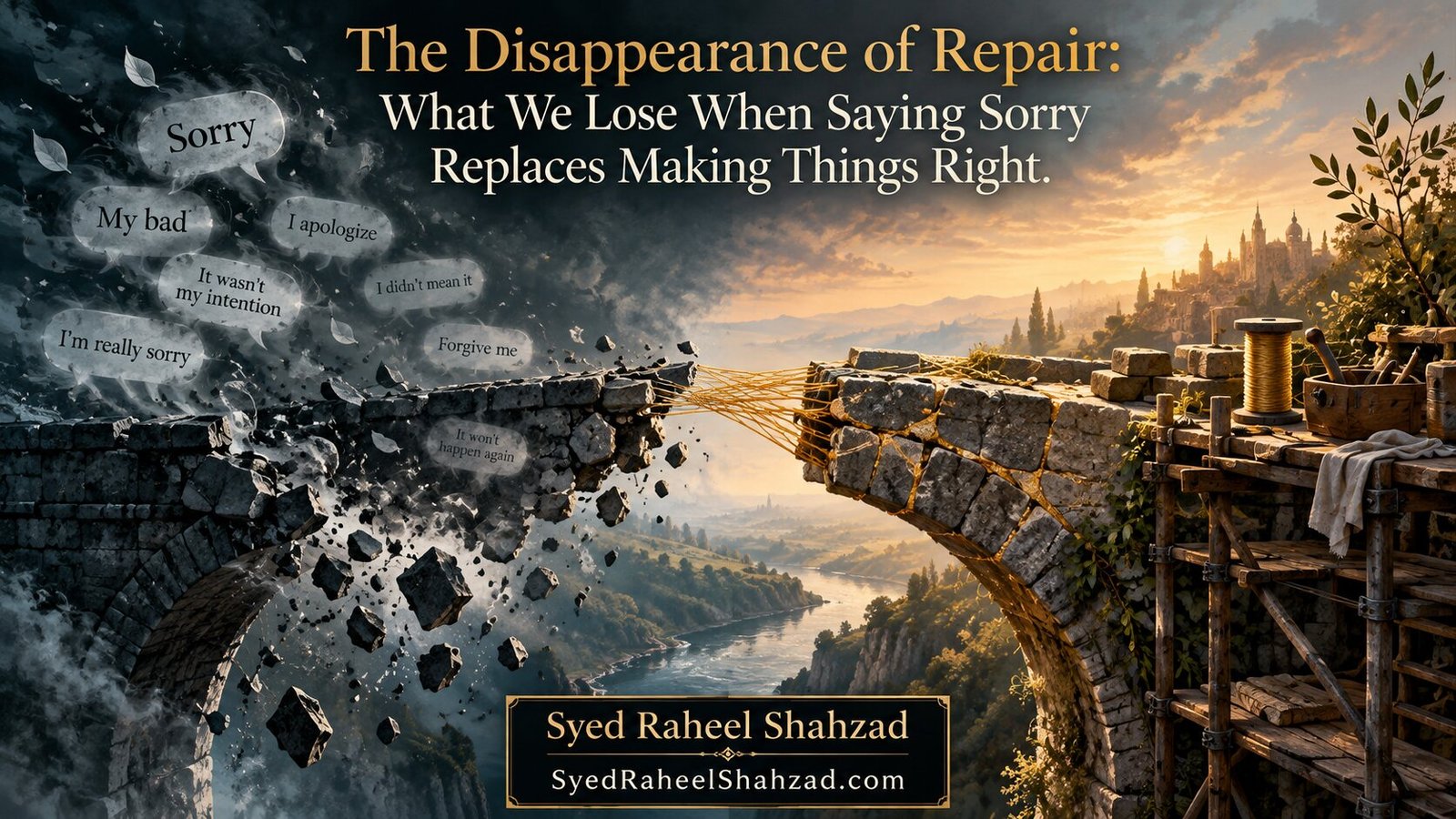
Apology is a beginning, not a repair
Modern moral culture has become fluent in apology. Individuals issue statements. Institutions acknowledge harm. Leaders say that lessons have been learned. Public figures describe regret. Families repeat familiar words after conflict: “I’m sorry.”
These words matter. A world without apology would be colder, more defensive and less capable of moral recognition. But apology and repair are not the same act. An apology names a moral rupture. Repair asks what must now be done because the rupture occurred.
The distinction is crucial because language can create the feeling of completion before responsibility has actually been completed. The person who says sorry may experience relief. The person who was harmed may still carry the cost.
An apology can acknowledge the past. Repair is what proves the future has learned from it.
Harm leaves a remainder
When harm occurs, something changes. Trust may weaken. Time may be lost. Money may be spent. Reputation may be damaged. Safety may become uncertain. A person may become more guarded. An institution may lose credibility.
Some harms are reversible. Others are not. A broken object can sometimes be replaced. A missed opportunity cannot always be returned. A cruel sentence cannot be unheard. A betrayal may be forgiven without becoming as though it never happened.
This remainder is morally important. If responsibility ends at apology, the burden of what remains is transferred to the injured party. They are asked to carry consequences while the person who caused them declares the moral account closed.
Repair begins by refusing premature closure
One of the hardest parts of repair is allowing the harmed person to define what remains damaged. The person who caused harm naturally wants to know when the matter is over. That desire is understandable, but it can become another form of control.
Repair therefore requires patience with an uncomfortable truth: the person who caused the damage does not automatically control the timetable of recovery.
They can take responsibility, offer restitution, change behavior and remain available. They cannot command trust to return on schedule.
Repair has at least five dimensions
First comes truthful naming. What exactly happened? Vague language protects the actor. Precise language protects reality. “Things got difficult” is not the same as “I lied.” “Mistakes were made” is not the same as “we ignored warnings.” Repair begins when grammar stops hiding agency.
Second comes recognition of impact. Intention matters morally, but intention does not exhaust consequence. “I did not mean to hurt you” may be true and still leave the hurt real.
Third comes restitution where restitution is possible. Money can be repaid. Property can be restored. Work can be corrected. Public misinformation can be publicly corrected. Time cannot always be returned, but future effort can sometimes compensate for what was neglected.
Fourth comes changed practice. If the same conditions remain in place, apology becomes ceremony. A person who repeatedly apologizes for the same conduct without changing the structure that produces it is not repairing; they are maintaining a cycle.
Fifth comes respect for the other person’s freedom. Repair can be offered, but reconciliation cannot be demanded. Forgiveness, renewed closeness and restored access are separate moral questions.
Why visible change matters more than emotional intensity
People often mistake intensity of remorse for depth of repair. Tears, guilt, shame and strong emotion can be sincere. But they remain centered on the person who caused the harm unless they are translated into action.
Repair asks a different question: what is different now for the person who carried the consequence?
This is why the quietest forms of repair can be morally stronger than dramatic apology. A corrected habit, a returned debt, a new safeguard, a repaired process, a respected boundary—these may contain more moral seriousness than a highly emotional statement.
The measure of repair is not how strongly regret is expressed, but how seriously consequence is addressed.
Repair and the dignity of the harmed person
There is a subtle danger in many apologies: they seek absolution from the very person who was harmed. The injured person is asked to comfort the offender, accept the explanation, declare forgiveness and help the offender feel restored.
This reverses the moral direction of repair. The harmed person becomes responsible for relieving the conscience of the one who harmed them.
Genuine repair respects the other person’s dignity by allowing them not to perform emotional labor on behalf of the offender. They may accept the apology. They may not. They may forgive privately. They may need distance. They may never restore the relationship to its previous form.
Forgiveness and repair are not identical
Forgiveness is often discussed as though it automatically restores relationship. It does not. A person can release hatred while maintaining a boundary. They can refuse revenge while refusing renewed access.
Repair concerns what the responsible party owes. Forgiveness concerns what the harmed party may choose to release. Reconciliation concerns whether a relationship can be rebuilt. These concepts interact, but they should not be collapsed.
Confusing them creates pressure. It allows the offender to say, “If you truly forgave me, everything would return to normal.” But normality may be precisely what the harm made impossible.
Some things cannot be repaired completely
Moral maturity includes accepting limits. Certain losses cannot be restored. A death cannot be reversed. A childhood cannot be returned. A confidential disclosure cannot be made unknown again. A public humiliation cannot be erased from every memory.
In such cases repair becomes the work of living responsibly with irreversibility. The person cannot restore the original state, but they can refuse to add further harm. They can acknowledge the permanent remainder. They can support recovery. They can change how they live.
This is not a lesser form of repair. Sometimes it is the most demanding form because it requires responsibility without the reward of complete restoration.
Repair as proof of learning
Every apology contains an implicit claim: I have understood something. Repair tests that claim.
If understanding is real, future conduct should carry evidence of it. Not perfection, but direction. Not performance, but structure. The lesson should become visible in how decisions are made, how boundaries are respected and how risk is handled.
This is why repeated apologies for unchanged conduct become progressively less meaningful. Words lose moral value when experience repeatedly contradicts them.
Institutional repair
The same logic applies to organizations. Companies, governments, schools, charities and professional bodies increasingly know how to issue statements. But statements are not structural repair.
If harm came from incentives, incentives must be examined. If it came from weak oversight, oversight must change. If people were excluded from decision-making, representation must become more than symbolic. If a policy caused predictable harm, the policy itself must be revised.
Institutional repair is therefore measurable in ways apology is not. We can ask what changed, what was funded, who gained protection, what process was redesigned and whether the same pattern became less likely to recur.
Why repair restores moral agency
Repair is demanding because it turns responsibility into work. Yet that demand is also liberating. The person is no longer trapped between denial and shame. They can act.
To repair is to say that the past has authority over the present because it teaches, but not total control over the future because action remains possible.
That is a mature form of agency. It neither erases wrongdoing nor freezes the person forever inside it.
Responsibility tells the truth about what was yours. Repair decides what you will do with that truth.
The future test
The deepest test of repair is not whether the apology sounded correct. It is whether the future becomes safer, fairer or more trustworthy because the person understood what happened.
A repaired relationship may still contain scars. A repaired institution may still remember failure. In fact, memory is part of repair because forgetting too quickly makes repetition easier.
The goal is not to erase every sign of damage. The goal is to transform damage into instruction.
Conclusion: making things right where possible
The disappearance of repair would leave us with a moral culture rich in statements and poor in transformation. We would know how to acknowledge harm without redistributing its burden, how to express regret without redesigning behavior, how to apologize without becoming different.
Repair asks more. It asks what can be restored, what must be compensated, what needs to change, what boundary must now be honored, and what lesson must become visible in practice.
Sorry matters. But sorry is not the destination. Moral seriousness begins when the person who says it remains long enough to ask the harder question: what would making this right now require of me?

Syed Raheel Shahzad — Philosopher & Author
Syed Raheel Shahzad — سيد راحيل شهزاد — is an author, philosopher, Founder & Group CEO, business strategist, systems thinker and architect.
Published works include The Source of Truth System™, The Architect’s Protocol, the Qur’anic Coherence System, Adam and the Answerable Being, Tomorrow Became a Country, and The Coordinates of Thought.
ISNI 0000 0005 3022 8433 · ORCID 0009-0001-7323-1577 · Google Scholar nRC4eGEAAAAJ
Publisher / Imprint: The Syed Group · ISNI 0000 0005 3027 5408 · Ringgold 850493