The Lives We Do Not Live: Choice, Finitude and the Courage to Become
Philosophical Essay · 23 August 2026 · Choice, Finitude and Human Becoming
The Lives We Do Not Live: Choice, Finitude and the Courage to Become
Every serious choice creates a life and leaves other possible lives behind. Maturity begins when we can mourn those futures without abandoning the one we have chosen.
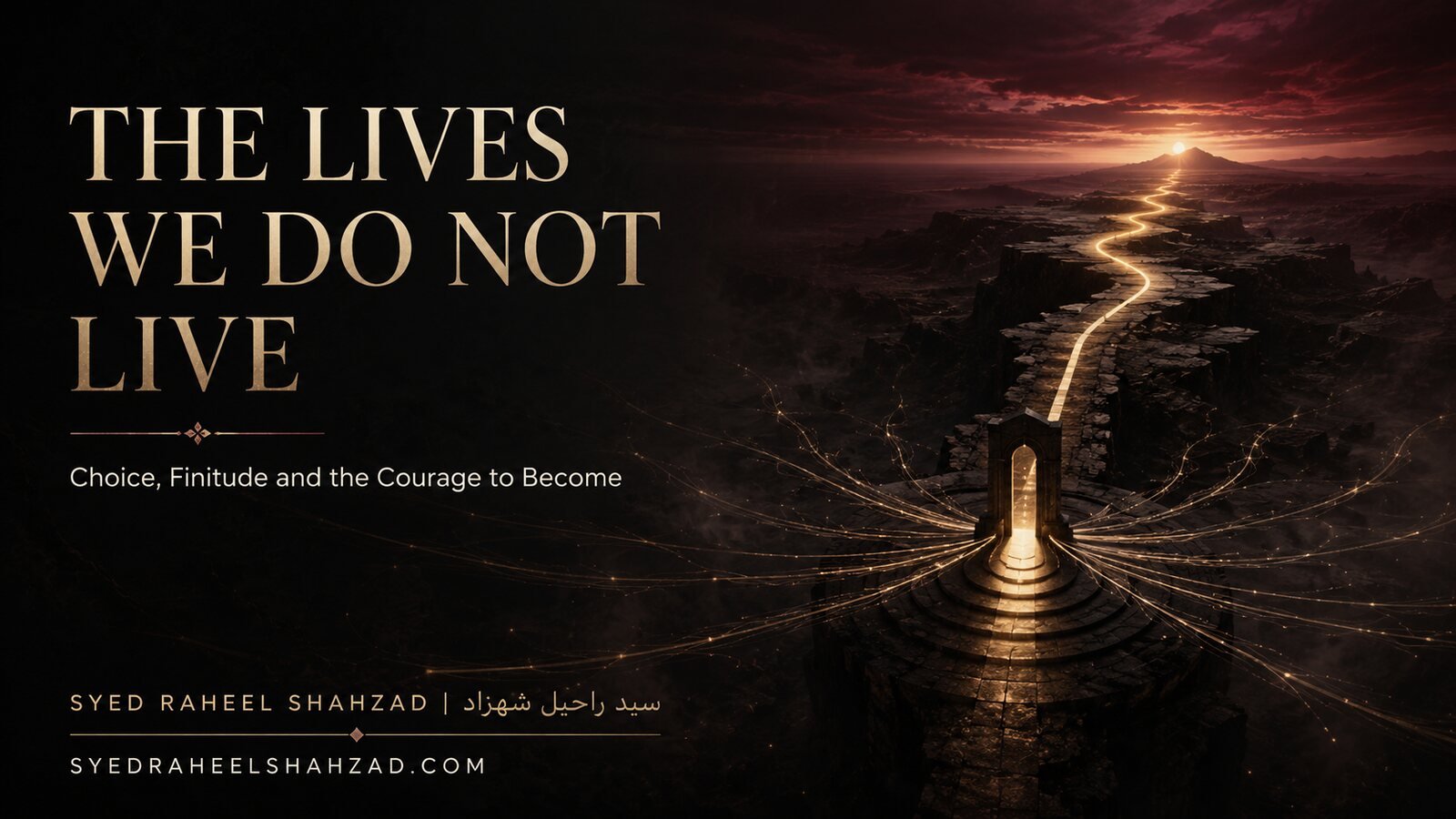
Every serious choice produces two realities at once. It creates the life that will be lived, and it releases the lives that will not. We usually speak of decision as acquisition: a profession is chosen, a promise is made, a city is entered, a conviction is accepted. Yet decision is also renunciation. To say yes with the whole self is to stop keeping every other self indefinitely available.
This is why the most consequential choices often arrive with grief even when they are right. The grief does not necessarily mean the chosen path is mistaken. It may be the honest recognition that possibility is larger than one lifetime, while existence is singular, embodied and finite. We can imagine many futures; we can inhabit only one sequence of days.
A choice becomes real when it is strong enough to create an unlived life.
The abundance of possibility and the poverty of time
Consciousness can travel without paying the full price of reality. In imagination, we can be several people before breakfast: the artist who refused security, the leader who accepted responsibility, the traveler who never settled, the parent who reordered ambition, the scholar who gave decades to one question. Each imagined life can feel coherent because imagination is not required to schedule its hours, carry its fatigue or accept its exclusions.
Time is less generous. A day cannot be spent twice. Attention given here is absent there. The years devoted to mastery cannot simultaneously remain untouched for every other vocation. Even love, which expands the interior life, introduces particular obligations that exclude some forms of freedom. Finitude is not a flaw in existence. It is the condition that gives weight to commitment.
If time were unlimited, postponement would have no moral significance. If every road could eventually be taken, direction would be preference without sacrifice. A finite life turns sequence into destiny. What we repeat becomes what we have practiced becoming.
The fantasy of reversible identity
Modern culture often promises a self without closure. Keep every option open. Preserve every network. Avoid definitions that might restrict future movement. This flexibility can protect us from premature confinement, but it can also become a sophisticated fear of existence. The person remains rich in possibility and poor in actuality.
Potential is admired because it has not yet encountered resistance. An unwritten book contains no failed argument. An unbuilt institution has made no compromised decision. An unchosen relationship has not exposed the limits of our generosity. Possibility can appear pure precisely because it has not been required to become responsible for consequences.
Actual life is less flattering. It must choose materials, deadlines, loyalties and limits. It becomes visible enough to be judged. Yet only actuality can feed a child, repair an error, construct a system, keep a promise or produce a page. The unchosen self may remain perfect because it never had to become real.
Counterfactual lives
We carry what might be called counterfactual biographies: stories about the people we would have become if one conversation, refusal, migration, loss or act of courage had been different. These biographies are not meaningless. They reveal values, neglected capacities and unresolved grief. But they become dangerous when imagination compares the edited beauty of an unlived path with the unedited difficulty of the path we occupy.
The life not lived does not contain only the rewards we picture. It also contains ordinary mornings, hidden costs, moral failures, illnesses, misunderstandings and new forms of regret. Because it never occurred, it cannot contradict our projection. We become both author and witness, selecting its light while omitting its weather.
A mature relation to the counterfactual does not deny it. It asks what truth the imagined life carries without granting it authority to invalidate the present. Perhaps the abandoned artist reveals a neglected need for beauty. Perhaps the imagined parent reveals the grief of a relationship not formed. Perhaps the road not taken reveals that status has displaced courage. The lesson can be integrated without pretending the entire lost life is recoverable.
Regret as information, not government
Regret is often treated either as proof of failure or as weakness to be defeated. It is neither. Regret is a form of moral and temporal intelligence. It tells us that an action mattered, that another value was present, or that we failed to honor what we already knew.
But regret must be interpreted. Some regret is corrective: it asks for apology, repair or change. Some is tragic: no option could preserve every good. Some is nostalgic: we miss a possibility because distance has removed its complications. Some is borrowed: we judge our life through expectations that were never truly ours.
To let regret speak is wise. To let it govern every future decision is to give the past a veto over becoming. The question is not whether we can eliminate regret. The question is whether regret becomes evidence in judgment or the permanent ruler of attention.
Choice and the formation of a self
We often imagine a true self hidden inside us, waiting to be discovered before action begins. But identity is not only uncovered; it is constructed through commitments. We become reliable by keeping promises, not by discovering reliability as a private essence. We become courageous through actions performed while fear remains. We become thinkers through the discipline of returning to a question after novelty has disappeared.
This means choice is not merely the expression of an already completed person. Choice participates in completing the person. Every sustained commitment strengthens some capacities, weakens others and establishes a pattern of attention. The self is partly the sediment of what it has repeatedly agreed to carry.
We do not first become someone and then choose. We become someone through what our choices teach us to continue.
The ethical difference between closure and imprisonment
Commitment should not be confused with captivity. Some decisions must be revised because new evidence appears, harm becomes visible or the original conditions were coercive. Fidelity to a destructive choice is not integrity. It is often fear disguised as consistency.
The distinction lies in answerability. Closure accepts the cost of a direction because the direction remains worthy under honest examination. Imprisonment preserves a direction because change would threaten identity, reputation or sunk investment. A person of integrity can say, “I chose this seriously, and I now recognize that remaining would betray the values that made the choice meaningful.”
There is courage in staying, and there is courage in leaving. Neither can be judged by movement alone. The moral question is what truth, duty and human consequence require now.
Why certainty never arrives in time
Many people delay commitment until uncertainty disappears. But the knowledge required for life is often produced only after entering it. We cannot know what a vocation will demand without practicing it, what a relationship can become without building it, or what a conviction will cost until it reorganizes conduct.
Decision therefore involves responsible incompleteness. We gather evidence, examine motives, consult those affected and consider reversibility. Then we act without possessing the future. Courage is not certainty performed loudly. It is the willingness to become answerable for a direction that cannot be guaranteed.
A discipline for choosing
What value does this choice make concrete? Name the good, not merely the reward.
What must be relinquished? Identify the opportunity, identity or approval that cannot travel with you.
Who carries the consequence? Include people whose lives will be reorganized by your decision.
What evidence would justify revision? Distinguish principled flexibility from restless escape.
What practice will make the choice real? Translate preference into a repeated action, boundary or promise.
This discipline does not make choice painless. It makes the cost visible enough to be owned rather than displaced. Unacknowledged sacrifice returns as resentment. A person may choose a calling and secretly punish it for the lives it excluded. They may choose a family and treat care as theft from ambition. They may choose freedom and blame solitude for the intimacy they refused. Mourning the excluded good can prevent it from being turned into accusation against the chosen life.
The dignity of an undivided life
An undivided life is not a life without complexity. It is a life in which complexity no longer prevents direction. The person can recognize the appeal of another road without making that appeal a permanent emergency. They can honor a former self without requiring the present to reproduce it. They can change course without claiming the earlier choice had no meaning.
There will always be unlived lives behind us. Some deserve gratitude, some mourning and some release. None can become our substitute for responsibility to the life that is now receiving our time.
The final measure of a choice is not whether it preserved every possibility. No human choice can. The measure is whether the reality it created became worthy of the possibilities it asked us to surrender. A finite life becomes whole not by containing every future, but by giving itself truthfully to a direction, accepting the graves of its alternatives and making something living from the time that remains.