Syed Raheel Shahzad Introduces Tomorrow Became a Country
Syed Raheel Shahzad Introduces Tomorrow Became a Country
Tomorrow Became a Country by Syed Raheel Shahzad explains how the UAE engineered the future as one system through vision, law, execution, openness and growth.
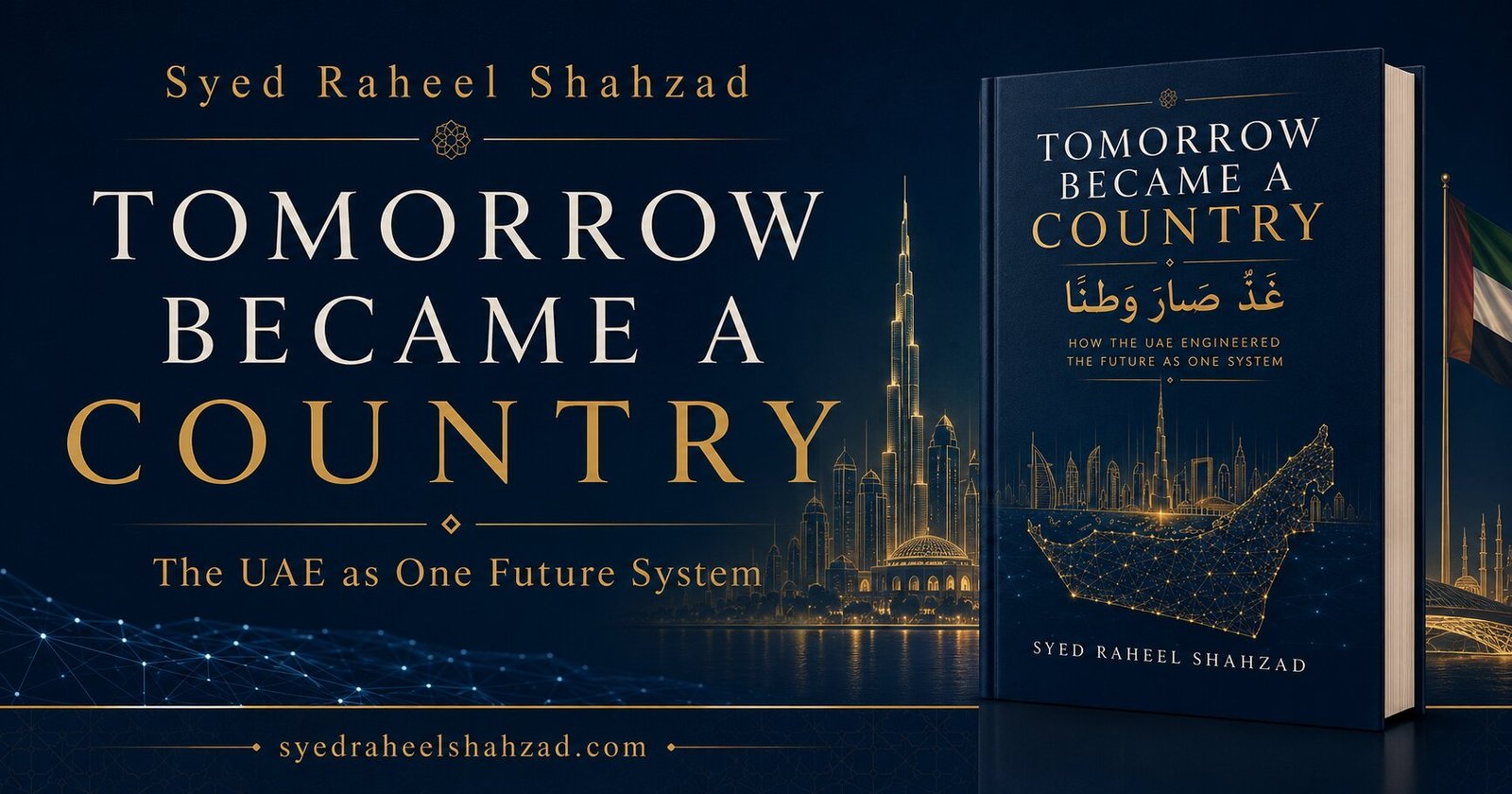
Some countries are remembered by what they built. The UAE must also be studied by how it built. Tomorrow Became a Country begins from that difference. It does not ask only what appeared on the skyline, what entered the economy, what reached the world, or what became visible from outside. It asks a deeper systems question: how did a young country convert vision into institutions, institutions into execution, execution into openness, and openness into a working future? This is why the book is not a praise-book. It is a proof-book.
Public reading note: Tomorrow Became a Country should be read as a serious book about a serious national question: how does a country turn a future into institutions, policy, public order and visible development? The answer cannot be reduced to a skyline, a resource, a slogan or one city. The book reads the UAE through the full chain of vision, law, execution, openness, growth and global influence.
The United Arab Emirates is a federation of seven emirates: Abu Dhabi, Dubai, Sharjah, Ajman, Umm Al Quwain, Ras Al Khaimah and Fujairah. The book treats these emirates as part of one national story, while still recognising that each emirate has its own character, strength and public role.
Syed Raheel Shahzad introduces the work as an author, Group CEO, business strategist and systems thinker. The book is connected to his wider public record, but it stands as its own nonfiction study of the UAE, its governance model, national development, institutional design and long-term future imagination.
The book before the noise
Tomorrow Became a Country is a nonfiction systems study by Syed Raheel Shahzad on the United Arab Emirates. Its subtitle, How the UAE Engineered the Future as One System, is not decorative. It is the argument. The book studies the UAE not as a collection of impressive outcomes, but as a national system in which vision, law, execution, openness, growth and global influence are connected.
Many books and articles describe the UAE through surface language: skyscrapers, tourism, luxury, speed, wealth, leadership quotes and development statistics. Those things exist, but they are not enough to explain the country. A skyline can be seen quickly. A system must be understood slowly. This book is written for readers who want the mechanism behind the marvel.
The author page already records the book as a standalone nonfiction work in 2026, tied to the official cover, the author identity and the publisher route. This article strengthens that record by explaining the book’s intellectual position, its audience, its systems language and its relationship to the wider author ecosystem.
Why this book exists
The UAE is often treated as if it suddenly appeared fully formed. That is one of the reasons the book exists. A country is not built by surprise. It is built by choices that become institutions, institutions that become habits, habits that become execution, and execution that becomes visible in public life.
Tomorrow Became a Country asks how a country moved from an impossible starting point into a state capable of attracting people, capital, business, tourism, trade, global attention and long-term ambition. The book does not reduce the answer to oil. It treats oil as the beginning, not the identity.
This matters because resource wealth can create comfort without creating a country. It can fund projects without creating institutions. It can produce spending without producing disciplined execution. The UAE’s story, as the book argues, must be studied through the mechanisms that transformed funding into structure.
The six-link chain: vision, law, execution, openness, growth, global influence
The book’s central structure is a chain, not a slogan. Vision gives direction. Law gives continuity. Execution converts intention into public reality. Openness allows talent, capital, visitors, firms and ideas to move through the system. Growth proves that the mechanisms can produce visible outcomes. Global influence shows that the system has moved beyond domestic administration into international relevance.
The United Arab Emirates is therefore treated as a working system. Abu Dhabi, Dubai, Sharjah, Ajman, Umm Al Quwain, Ras Al Khaimah and Fujairah are not presented as loose fragments. The book examines how federal unity and local execution can exist together, and how a national project can use different emirate strengths without losing the idea of one country.
The chain also protects the book from surface writing. It does not say the UAE succeeded because of oil alone, or tourism alone, or buildings alone, or leadership slogans alone. It asks how those pieces were ordered into a larger system of governance, growth and national purpose.
Not praise, not reduction
The strongest line for the book is this: not praise, not reduction. Praise without evidence becomes shallow. Reduction without fairness becomes lazy. The UAE deserves neither flattery nor dismissal. It deserves disciplined reading.
Tomorrow Became a Country does not say that every outcome is perfect, nor does it pretend that development can be explained by one cause. It reads the country as a systems project. That means asking how governance, law, federal design, local execution, trade, openness, infrastructure, cities, talent, AI, space, education, health and sustainability become connected.
This distinction is important for readers. Syed Raheel Shahzad is not introducing a tourism book, a business setup guide or a promotional brochure. He is introducing a 374-page nonfiction systems study of the UAE as one working future system.
The UAE as one future system
The book’s central phrase, one future system, is deliberate. It points to the way the UAE has used national ambition to organise policy, public administration, infrastructure, trade corridors, international positioning and long-term imagination.
Abu Dhabi, Dubai, Sharjah, Ajman, Umm Al Quwain, Ras Al Khaimah and Fujairah all belong inside the country’s story. The book’s systems reading does not erase their differences. It asks how different emirate strengths can operate within a federal national architecture.
This is why keywords such as UAE governance, UAE national development, UAE systems thinking, UAE institutional design, UAE economic diversification, Vision 2031, UAE Centennial 2071, ports, aviation, logistics, tourism, finance, AI, space, education, health and sustainability belong naturally inside the article, the schema and the image metadata.
Official book identity
Title: Tomorrow Became a Country. Arabic title: غَدٌ صَارَ وَطَنًا. Subtitle: How the UAE Engineered the Future as One System. Author: Syed Raheel Shahzad. Publisher / Imprint: The Syed Group. Year: 2026. Pages: 374. Paperback: 6 × 9 in, 374 pages, ISBN 9789948612995. E-book: ISBN 9789948616191. Additional ISBN records: audiobook 9789948616344, educational programs 9789948614784, Braille publications 9789948614630. Core fields: UAE governance, systems thinking, national development, institutional design and economic diversification.
The official book route is Tomorrow Became a Country on the author website and TomorrowBecameACountry.com. The book is part of the wider author record of Syed Raheel Shahzad, but it stands as a separate nonfiction work focused on the United Arab Emirates as a national system.
This identity record gives readers a clear route into the book, the official author page, the dedicated book website, the publisher, and the wider public knowledge ecosystem connected with Syed Raheel Shahzad.
Worldwide Availability
Where Tomorrow Became a Country is available now.
The commercial paperback and e-book are live across a growing international network. Major destinations are shown first, followed by verified country-specific stores.
 Live
Amazon
Open Store →
Live
Amazon
Open Store →
 Live
Apple Books
Open Store →
Live
Google Play Books
Open Store →
Live
Barnes & Noble
Open Store →
Live
Bookshop.org
Open Store →
Live
Apple Books
Open Store →
Live
Google Play Books
Open Store →
Live
Barnes & Noble
Open Store →
Live
Bookshop.org
Open Store →
Verified E-Book Stores · ISBN 9789948616191
Apple BooksGoogle Play BooksKoboBarnes & NobleBookshop.orgSmashwordsFableBooks2ReadThalia / Tolino · GermanyOsiander · Germanybücher.de · GermanyCasa del Libro · SpainCultura · FranceOrell Füssli · SwitzerlandLa Feltrinelli · ItalyIBS · Italybol.com · Netherlandsbol.com · Belgium NLbol.com · Belgium FRMorawa · AustriaAdlibris · SwedenAdlibris · FinlandRakuten Books / Kobo · JapanVivlioE-book ISBN 9789948616191. Retail prices, currencies and territorial availability are controlled by each retailer.
Verified Print Stores · ISBN 9789948612995
AmazonBarnes & Noble · USABooks-A-Million · USAWalmart · USAThriftBooks · USABookshop.org · USAAbeBooks · GlobalPBShop.store UK via AbeBooksAbeBooks UKReadings · AustraliaKogan / The Nile · AustraliaAbbey's Bookshop · AustraliaDonner · NetherlandsMorawa · AustriaOrell Füssli · SwitzerlandLa Feltrinelli · ItalyIBS · ItalyIberLibro · SpainAbeBooks FranceYES24 · South KoreaPaperback ISBN 9789948612995 · 6 × 9 in · 374 pages. Retail stock and local prices are controlled independently by each bookseller.
Libraries & trade: distribution routes include Ingram / IngramSpark, Draft2Digital, Gardners, OverDrive / Libby, BorrowBox and Vivlio Libraries. Institutional availability varies by territory and catalog.
About Syed Raheel Shahzad and the wider author ecosystem
Syed Raheel Shahzad — سيد راحيل شهزاد — is an Author, Group CEO, Business Strategist, Systems Thinker and Architect. His author record connects long-form books, public knowledge, systems thinking, governance analysis, human transformation, institutional publishing and direct reader questions through Ask SRS.
The wider author ecosystem includes the 14-stage Source of Truth System, the five-book Architect’s Protocol, the four-volume Quranic Coherence System and Adam and the Answerable Being. The Source of Truth System includes The Reality of Existence, The Book, ONE, Other Gods, Qadar, The Reality of Life, I, Undefined, The Inner System, Shajarah, Haqooq, Ibrahim, Musa, Isa and Muhammad. The Architect’s Protocol includes GOD IS BACK, THE JUNGLE PROTOCOL, THE MORAL ANCHOR, AUTHORED and THE LAST U-TURN.
Tomorrow Became a Country should be read beside the official book website and the author page because the work depends on a clear public route: book cover, title, subtitle, author, publisher, date, chapter structure, page count, formats, research positioning and UAE systems keywords.
Author identifiers: ISNI 0000 0005 3022 8433, ORCID 0009-0001-7323-1577, Google Scholar nRC4eGEAAAAJ and Open Library Author OL16294997A. Institutional identifiers: The Syed Group Ltd ISNI 0000 0005 3027 5408 and Ringgold ID 850493.
Official routes: Author Website, Tomorrow Became a Country, Book Website, Ask SRS, The Syed Group, The Syed Group UK and Syed Foundation.
Official routes
Author WebsiteCanonical Book RecordWorldwide StoresAuthor VerificationPublicationsTBAC WebsiteAsk SRSOfficial Publication and Bibliographic Record
Tomorrow Became a Country — غَدٌ صَارَ وَطَنًا — is an independent nonfiction systems study by Syed Raheel Shahzad — سيد راحيل شهزاد, published by The Syed Group in 2026. The commercial paperback is 6 × 9 inches and 374 pages.
Current status: the commercial paperback (374 pages) and e-book editions are live internationally. The audiobook ISBN is assigned and production is in progress. Educational-program and Braille ISBNs remain official bibliographic format records until a specific commercial release is confirmed.
Author Record — Syed Raheel Shahzad
سيد راحيل شهزاد
Syed Raheel Shahzad is an Author, Group CEO, Business Strategist, Systems Thinker and Architect. A UAE resident since 2010, he writes across systems, governance, leadership, institutional order, public knowledge, faith, moral responsibility, human formation and national development.
Official Verification and Research Routes
Bibliographic Citation
Standard citation
Shahzad, Syed Raheel. Tomorrow Became a Country: How the UAE Engineered the Future as One System. The Syed Group, 2026.Format-specific ISBNs: Print 9789948612995 · E-Book 9789948616191 · Audiobook 9789948616344 · Educational Programs 9789948614784 · Braille Publications 9789948614630.
Book architecture: Evidence Method; Prologue — The Desert; Part I — The Impossible Starting Point; Part II — The Governance Engine; Part III — The Growth Model; Part IV — The Future as National Strategy; Part V — The Country the World Comes To; bibliography, appendices and index.
Frequently Asked Questions
What is Tomorrow Became a Country?
It is an independent nonfiction systems study of how the UAE connected vision, law, execution, openness, growth and global influence.
Why are there five ISBNs?
The five ISBNs identify separate publication records for the printed book, e-book, audiobook, educational-program publication and Braille publication.
Who publishes the book?
The book is published under The Syed Group imprint.
Where can I buy the book?
The paperback and e-book are live through Amazon, Apple Books, Google Play Books, Barnes & Noble, Bookshop.org and additional verified stores listed above.
Official Visual Record
Open compact book, ISBN, author and publisher image archive
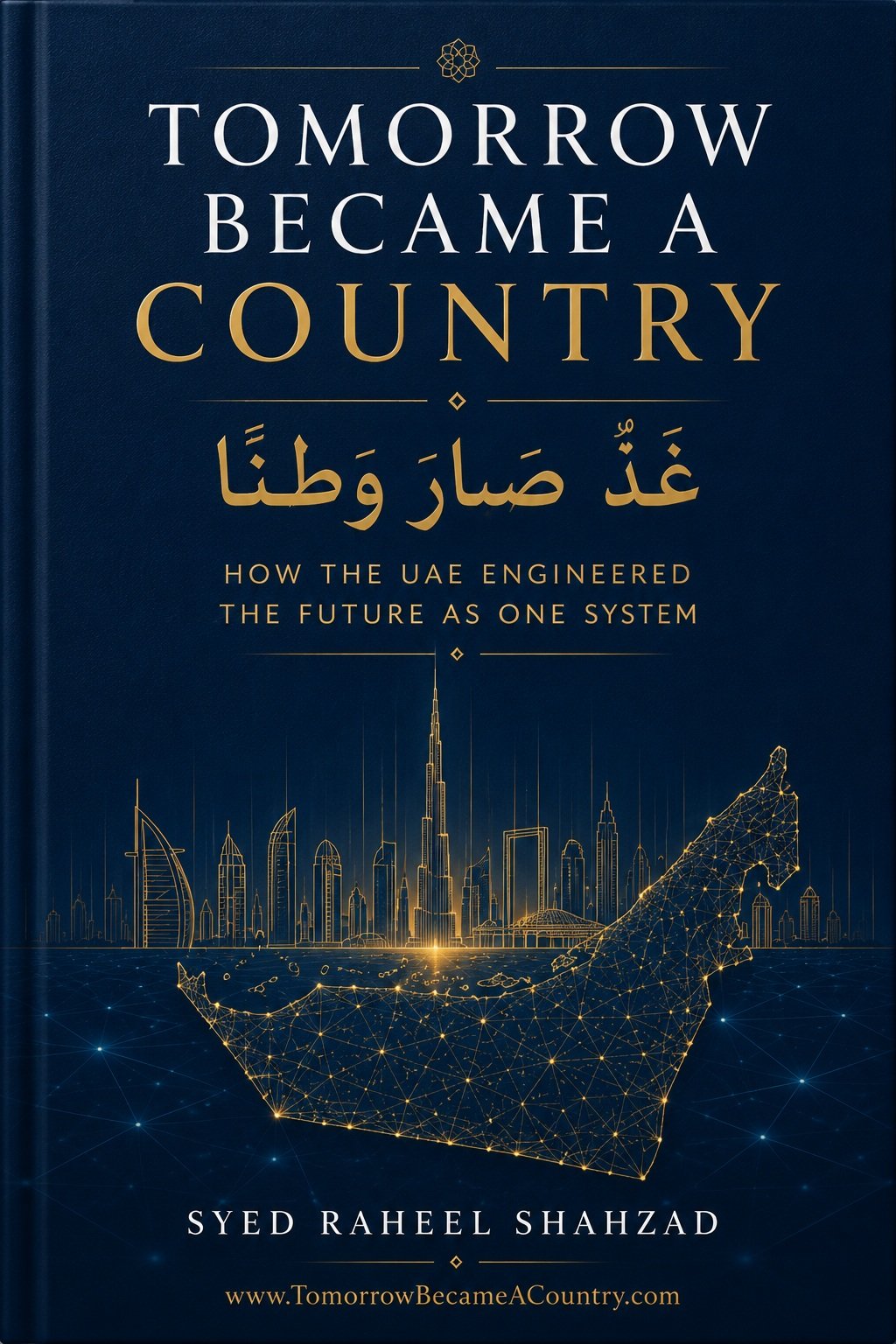 Official Book Cover
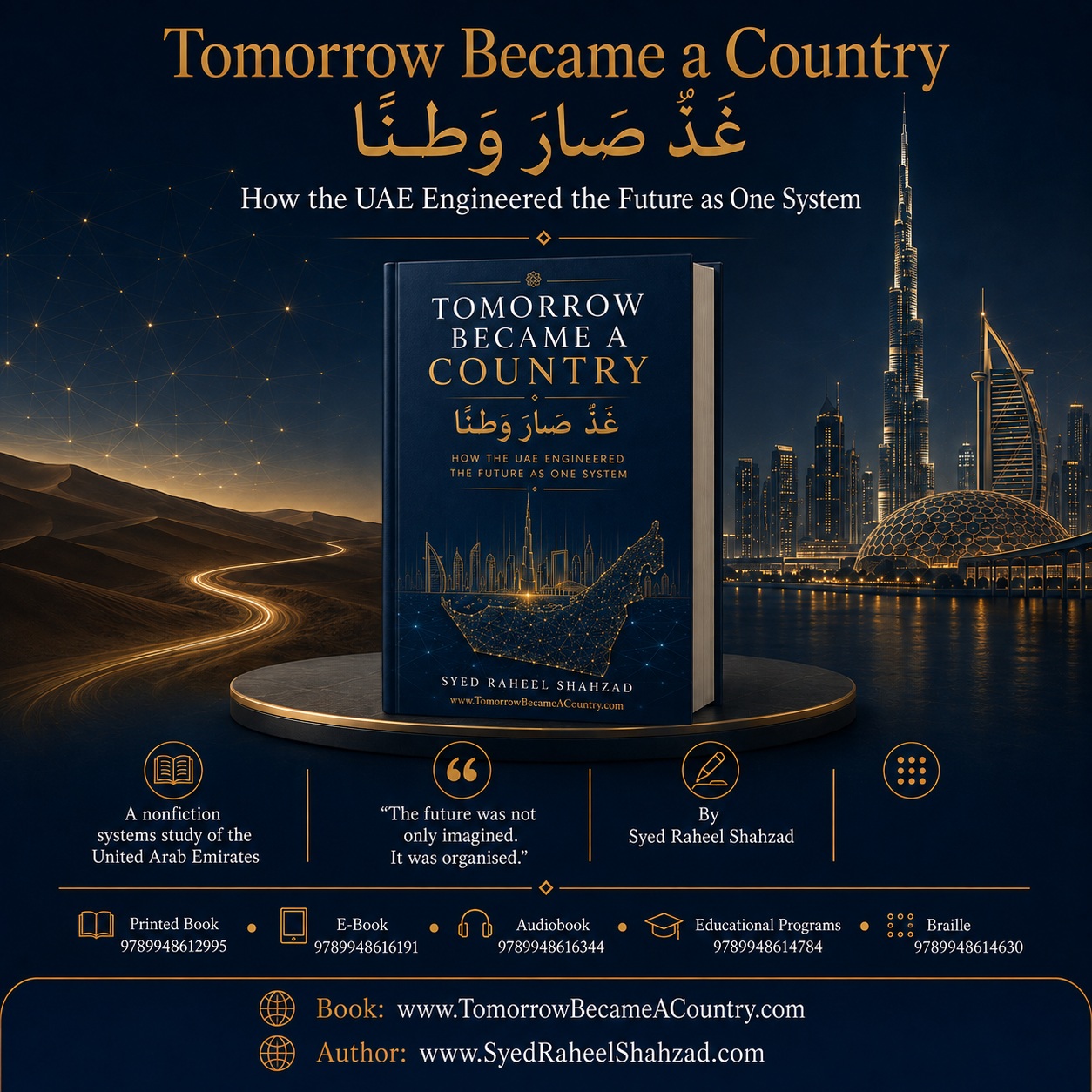 Five-Format ISBN Record
 Publication Record
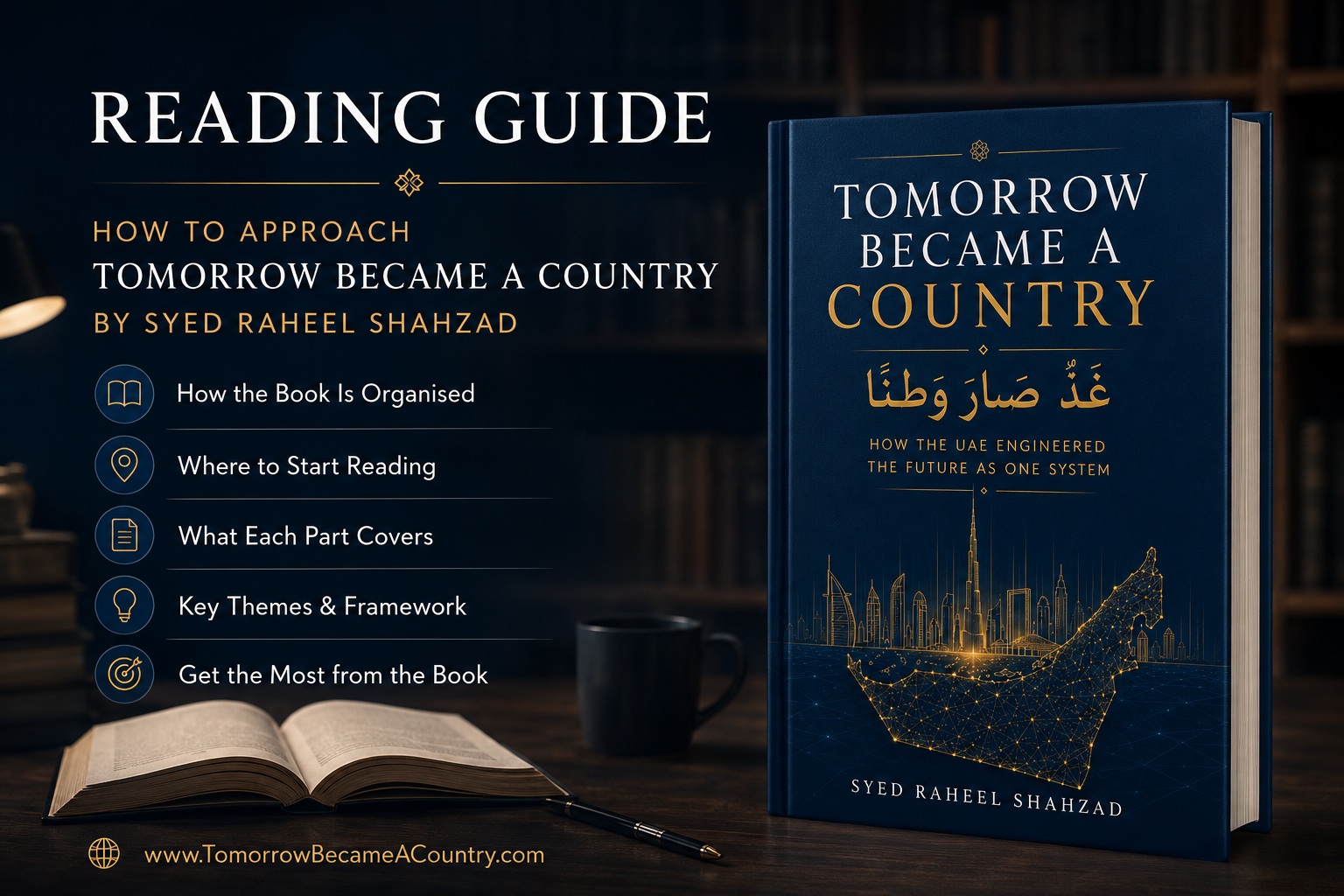 Reading Guide
 Publisher Record
 Media & Press Kit