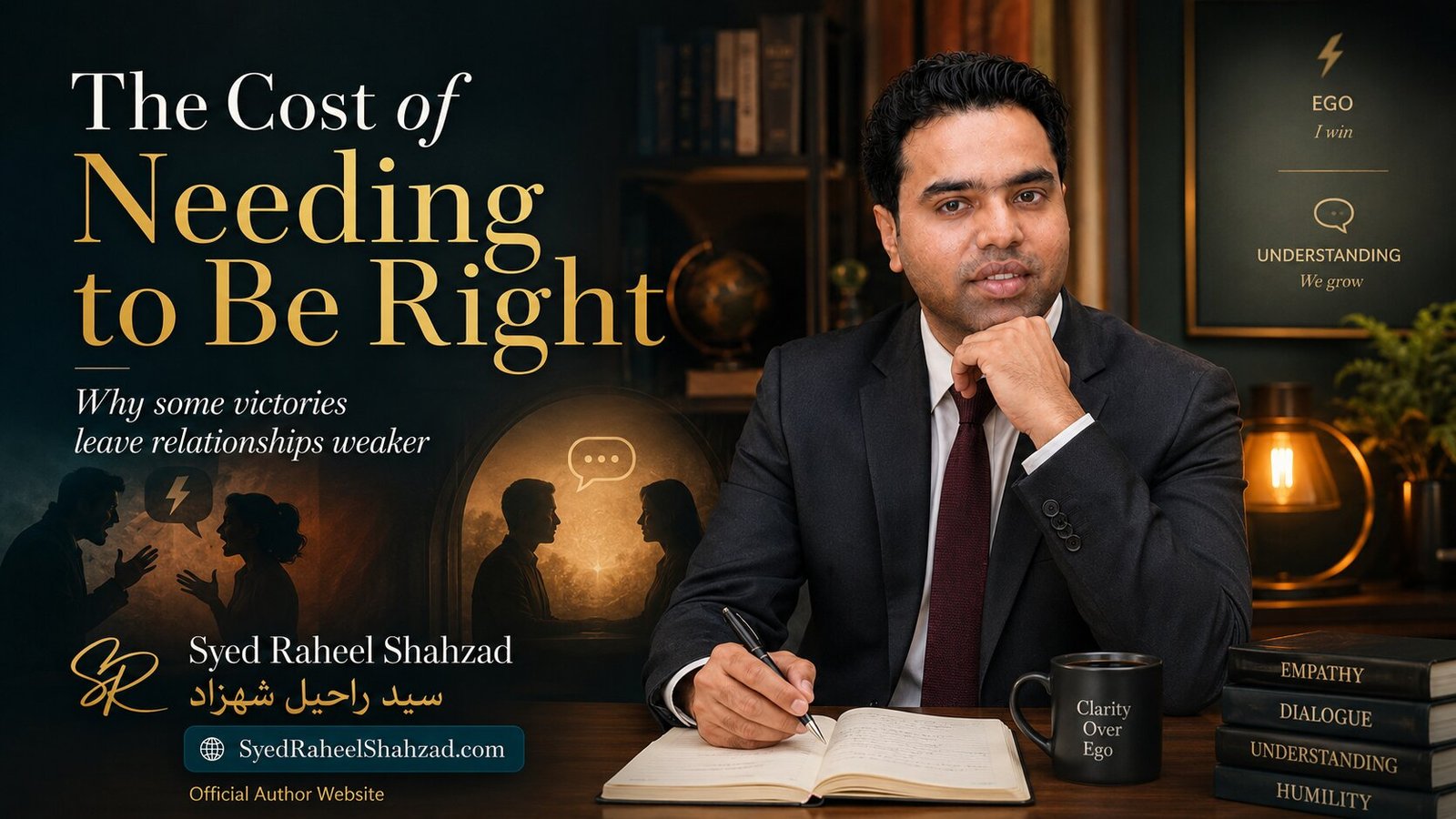
The Cost of Needing to Be Right: Why Some Victories Leave Relationships Weaker
Philosophical Essay · Human Dignity · Relationships · 6 August 2026
The Cost of Needing to Be Right: Why Some Victories Leave Relationships Weaker
A person can win the argument and still weaken the relationship. This is one of the quietest tragedies of ordinary life: people protect the point so fiercely that they forget the person standing in front of it.
The difference between truth and victory
Truth is not the same as victory. Truth asks to be honoured. Victory asks to be recognised. Truth can live with patience, humility and listening. Victory becomes restless until the other person has been defeated.
This is why the need to be right can become more dangerous than being wrong. A wrong person can learn. A right person who has become proud of being right may stop listening altogether.
When truth becomes an instrument of ego, it loses some of its moral weight. The point may still be accurate, but the spirit carrying it becomes unsafe. The other person does not only hear information; they feel the intention behind it.
When ego wears the clothing of principle
Many people do not say, “I want to win.” They say, “I am only telling the truth.” Sometimes this is sincere. Sometimes it is ego wearing the clothing of principle.
Ego is skilled at borrowing noble language. It speaks in the name of honesty while refusing tenderness. It speaks in the name of clarity while enjoying humiliation. It speaks in the name of correction while ignoring dignity.
A mature person learns to ask a second question. Not only: “Was I right?” but also: “Was I righteous in the way I was right?” This second question protects the soul from becoming proud of its own accuracy.
A person does not become wiser by winning every argument. Wisdom begins when truth and humility can sit in the same sentence.
The relationship becomes the hidden loser
In many homes, friendships and workplaces, people remember the feeling of an argument longer than the subject of the argument. They may forget the exact sentence, but they remember being cornered. They remember being dismissed. They remember the tone that made them feel small.
That is why some victories leave relationships weaker. The winner leaves with the satisfaction of having proved the point. The other person leaves with less safety, less openness and less desire to speak again.
The cost is not always visible immediately. It appears later as distance, silence, guarded replies, fewer honest conversations and a private decision not to be vulnerable with that person again.
Humility is not surrender
Humility does not mean pretending falsehood is true. It does not mean allowing manipulation, injustice or confusion to stand. Humility means refusing to let the ego become the owner of truth.
A humble person can disagree clearly. They can correct firmly. They can protect boundaries. But they do not need to crush another person in order to feel secure inside their own position.
The mature person understands that truth does not need contempt to become strong. In fact, contempt often makes truth harder to receive. People may resist the message because the messenger made the message feel unsafe.
A better victory
There is a higher victory than winning an argument. It is preserving dignity while clarifying truth. It is protecting the relationship while refusing dishonesty. It is leaving a conversation with understanding increased, not merely with a point proven.
This kind of victory requires discipline. It asks the tongue to slow down, the ego to step back and the heart to remember that the person in front of us is not an obstacle to our correctness. They are a human being with memory, fear, pride, wounds and dignity.
The deepest proof of maturity is not that a person always has the strongest point. It is that even when they do, they do not use it as a weapon.
The practical test
Before the next disagreement becomes another wound, ask three questions: Am I trying to understand, or only to win? Can I speak truth without removing dignity? Will this conversation make the relationship safer or smaller?
These questions do not make a person weak. They make truth more responsible.
Closing reflection
The cost of needing to be right is often paid by the very relationships we wanted to protect. A better life begins when truth is carried with humility, correction is delivered with dignity and winning is no longer more important than understanding.

Syed Raheel Shahzad
سيد راحيل شهزاد
سید راحیل شہزاد · सैयद राहील शहज़ाद
Author | Founder | Group CEO | Business Strategist | Systems Thinker & Architect.
Official author website: SyedRaheelShahzad.com · Ask SRS: Ask.SyedRaheelShahzad.com · Parent group: TheSyedGroup.com · Foundation: SyedFoundation.com · UK: TheSyedGroup.co.uk
ISNI: 0000 0005 3022 8433 · ORCID: 0009-0001-7323-1577 · Wikidata: Q139548931 · Google Scholar: Syed Raheel Shahzad