Philosophy · Intellectual History · Geography of Ideas · World Philosophy · The Coordinates of Thought
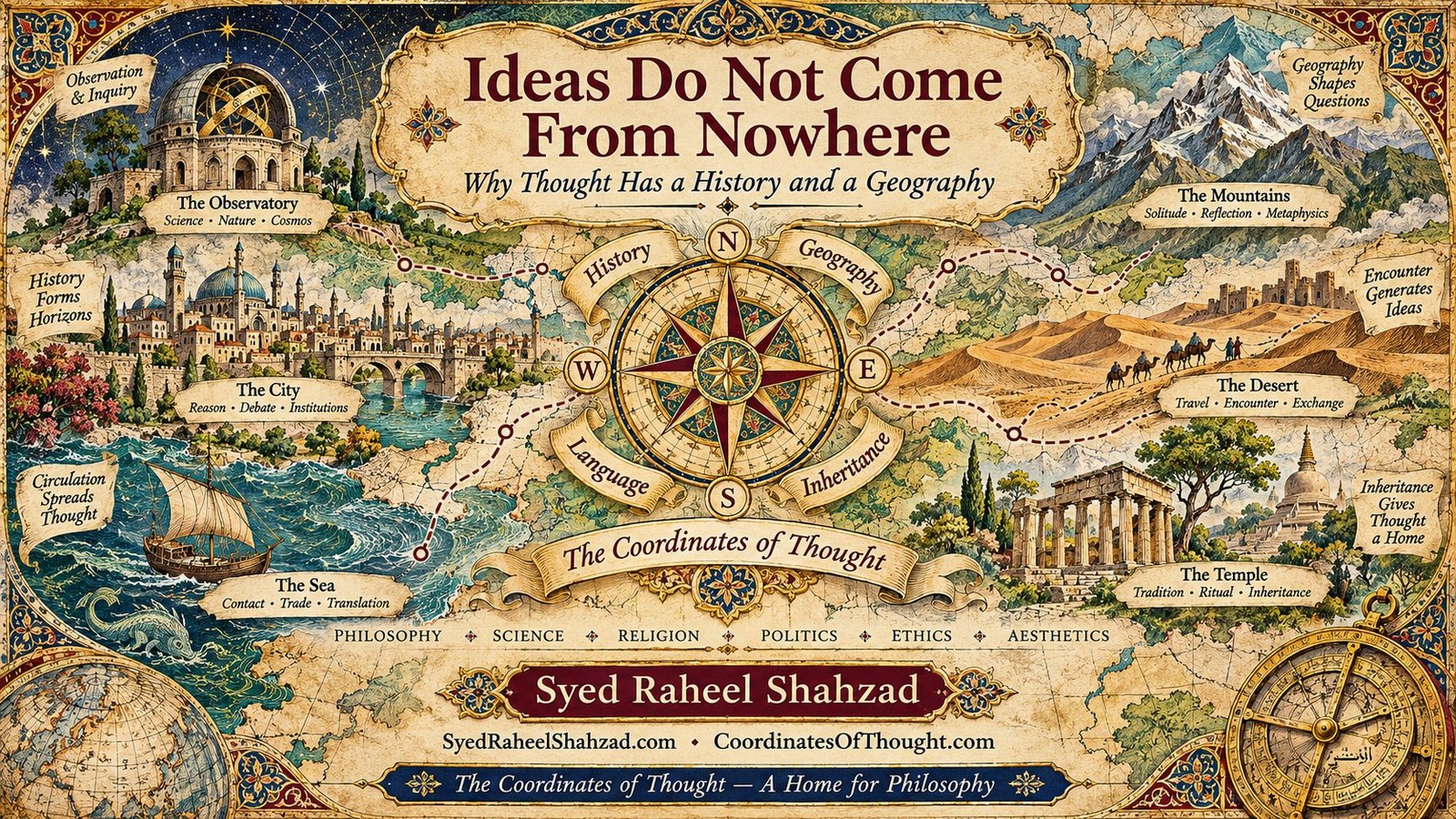
Ideas Do Not Come From Nowhere: Why Thought Has a History and a Geography
An idea may be judged by reasons that travel beyond its birthplace, but it is understood more fully when we can see the language, place, institutions, inheritance and encounters from which it emerged.

Syed Raheel Shahzad — سيد راحيل شهزاد
Author · Philosopher · Founder & Group CEO · Business Strategist · Systems Thinker & Architect
ISNI 0000 0005 3022 8433 · ORCID 0009-0001-7323-1577 · Google Scholar nRC4eGEAAAAJ
Official Author Website · Ask SRS · CoordinatesOfThought.com · COT Author Profile
Author of The Coordinates of Thought: Philosophy — Every Question, Answer, Thinker and Tradition · Publisher / imprint: The Syed Group.
An idea is never born in empty space
We often meet ideas after their origins have been stripped away. A sentence survives its speaker. A concept crosses a border. A philosophical position becomes a label in a textbook. A question that once arose from a particular conflict is presented generations later as if it had always been waiting in the air for someone to notice it.
This abstraction is useful. Ideas must be able to travel beyond the circumstances of their birth if they are to become part of a shared intellectual world. But abstraction also creates a danger: we begin to imagine that thought happens nowhere.
Every idea has a biography, even when the idea becomes larger than the person who first expressed it.
It appears in a language. It emerges at a time. It is shaped by available concepts, political pressures, inherited arguments, institutions of learning, religious and moral vocabularies, technologies of writing and transmission, and encounters with other people. Sometimes it is produced by a city. Sometimes by exile. Sometimes by translation. Sometimes by the collision of traditions that had previously developed apart.
To understand an idea only as a proposition is therefore to understand something important but incomplete.
Context is not the same as explanation, and explanation is not the same as refutation
There is an easy mistake to make once we begin talking about history and geography. If a belief can be explained by the conditions in which it arose, some people conclude that its truth has been dissolved.
But origins and validity are different questions.
If a mathematical insight emerged in one civilization rather than another, its birthplace does not decide whether the proof is sound. If an argument about justice arose during political conflict, the conflict may help us understand why the argument mattered without settling whether the argument is correct. If a religious or metaphysical idea developed inside a particular language, that fact does not by itself make the idea merely linguistic.
Context can expose hidden assumptions. It can show why one problem appeared urgent and another remained invisible. It can reveal which alternatives were available. It can explain why a concept took one form rather than another. But none of that automatically tells us whether the final position is true.
This distinction matters because otherwise intellectual history collapses into a crude relativism: Greeks thought this because they were Greek, Muslims thought that because they were Muslim, Indians thought something else because they were Indian, and there is nothing left to examine except social location.
That would not be a history of thought. It would be a refusal to take thought seriously.
Ideas have two kinds of coordinates
I find it useful to distinguish between intellectual coordinates and historical coordinates.
Intellectual coordinates tell us where an idea stands in relation to questions and rival answers. Is this a theory of knowledge? A position on personal identity? A view of moral responsibility? Which alternatives does it reject? What consequences follow from accepting it?
Historical coordinates tell us where and when the idea was argued, taught, translated, challenged or transformed. Which language carried it? Which institutions preserved it? Which political or religious disputes surrounded it? Through which routes did it travel?
The Coordinates of Thought was designed primarily as the first kind of map: 131 questions, rival positions, thinkers and traditions placed into one navigable philosophical structure. The developing World Philosophy Atlas adds the second kind: a map of places, periods, institutions and movements in which philosophy was actually lived.
The Coordinates of Thought maps where an answer stands intellectually. The World Philosophy Atlas adds another dimension: where and when human beings actually stood while thinking it.
Language does more than carry thought
We speak as if language were a transparent container into which ideas are placed. It is not.
Languages divide experience differently. They inherit distinctions that other languages do not make, combine meanings that others separate, and preserve concepts that have no simple equivalent elsewhere. When an idea travels, translation is therefore not clerical work. It is philosophical work.
A translator must decide whether two concepts are genuinely equivalent, approximately equivalent, or only superficially similar. A term carried from one tradition into another may become narrower, broader, more theological, more secular, more psychological or more political. Sometimes a translation creates a vocabulary that did not previously exist.
This does not make cross-cultural understanding impossible. It makes it serious.
The question is not simply, “What word did they use?” It is, “What distinction were they trying to preserve?”
A city can become part of an argument
Places matter because institutions gather people, texts and disputes.
A city with a court asks different questions from a monastery. A trading centre encounters different languages and customs from an isolated village. A university creates forms of argument, credential and succession that shape what counts as philosophy. A court, mosque, temple, school, salon, prison, newspaper office or revolutionary movement can all become environments in which certain questions become unavoidable.
This is why philosophical geography should not be reduced to birthplace pins.
What matters is what happened in a place: who studied there, who taught there, which texts arrived, which language was used, which institutions made thought possible, and which conflicts gave thought urgency.
The Places of Philosophy layer on CoordinatesOfThought.com is valuable precisely when it moves from “a philosopher was here” to “this place became part of the intellectual story.”
Some ideas are produced by encounter
Intellectual history is often narrated as a sequence of self-contained civilizations: Greek thought, Islamic thought, Indian thought, Chinese thought, European thought, African thought. These categories can help us see traditions. They can also mislead us if they hide movement.
People travelled. Texts travelled. Conquerors carried languages. Merchants carried books. Scholars crossed courts and schools. Translators made one archive available to another. Religious communities debated across borders. Colonized societies learned the categories of empires and then turned those categories against imperial rule.
An idea that arrives somewhere new is rarely received without change.
The live Journeys of Ideas section is philosophically important for this reason. It treats transmission as transformation. The interesting question is not merely whether a text moved from one city to another, but what happened to it on the way.
Translation can preserve. It can also select. Commentary can explain. It can also rebuild. A later tradition may inherit a problem in a form the earlier tradition would barely recognize.
Simultaneity changes the story
Another distortion appears when philosophy is told as a single line: one thinker, then the next; one civilization, then the next; one “age” replacing another.
Human thought did not happen in a queue.
Different traditions were asking questions at the same time. Sometimes they knew of one another. Often they did not. The fact of simultaneity matters because it breaks the illusion that intellectual history belongs to one centre.
The Timeline of World Philosophy makes this visible by placing traditions side by side rather than forcing them into one inherited storyline. That does not prove influence. In fact, intellectual honesty requires the opposite: being alive at the same time does not mean two thinkers knew one another.
But simultaneity creates a new question: what happens when we compare independent attempts to solve related human problems?
Comparison is strongest when it does not flatten difference
Comparative philosophy often fails in one of two directions.
In the first, traditions are kept so separate that comparison becomes impossible. Each idea is treated as belonging entirely to its own cultural world.
In the second, differences are flattened into easy equivalence: this thinker is “the Eastern version” of that thinker; this concept is “basically the same” as that concept.
Both approaches lose something.
The better method begins with disciplined patience. What question is each tradition actually asking? Are the terms commensurable? What counts as a reason? What kind of human problem is being addressed? Where do the positions genuinely overlap, and where does the resemblance disappear under pressure?
Comparison should create sharper difference, not decorative similarity.
Institutions decide what survives
Ideas do not survive because truth automatically protects them.
They survive because somebody copies a manuscript, teaches a student, funds a school, preserves an archive, translates a text, prints a book, records an oral tradition, builds a library, or decides that a thinker belongs in a curriculum.
This means the history of philosophy is also a history of preservation.
Some works survive in multiple editions. Others survive in fragments quoted by opponents. Some traditions retain elaborate chains of commentary. Others are reconstructed from colonial reports, missionary accounts, oral memory or scattered records. Some thinkers become permanent fixtures of introductory courses. Others disappear because the institutions that preserved their thought were destroyed, marginalized or never treated as philosophical institutions in the first place.
What survives is not identical to what was worth surviving.
The canon is necessary and dangerous
No reader can read everything. No course can teach everyone. Selection is unavoidable.
A canon can be useful because it gives a learner shared reference points. It becomes dangerous when selection forgets that it is selection.
Once a list has been repeated for generations, it begins to look like a natural map of intellectual importance rather than the result of institutions, languages, access and historical power.
The task is not to destroy every canon. It is to make the architecture visible.
Why is this thinker here? What problem did the work change? Which traditions are absent? Are they absent because they lacked philosophical depth, because evidence is weak, because texts were inaccessible, or because the category of “philosophy” was historically drawn around a narrower inheritance?
A mature canon can answer questions about its own boundaries.
World philosophy should not mean collecting flags
There is a shallow way to globalize philosophy: add geographic variety while leaving the intellectual structure untouched.
The result is a collection of representatives rather than a transformation of understanding.
A genuinely world philosophical architecture should allow traditions to change the questions. It should permit a concept from one intellectual history to reveal an assumption inside another. It should admit that the familiar division of philosophy into departments is itself historical.
This is why the live site’s How Philosophy Is Organised page matters. It openly distinguishes the six-root, 131-question architecture of the book from the community’s conversation categories and states the deeper principle: no classification of philosophy is official. Classification is a choice about emphasis.
That sentence protects the map from becoming a prison.
An intellectual map must be corrigible
A map gains authority by being useful. It keeps authority by being correctable.
This is especially important when mapping traditions, dates, places and historical influence. Historical claims vary in certainty. Dates are disputed. Attributions change. Influence may be plausible without being documented. A story that sounds elegant may be false.
That is why the platform’s editorial standards are part of the intellectual project rather than merely a policy page. A reader should be able to trace factual claims, distinguish documented connection from coincidence, and correct the record when evidence changes.
A philosophy map that cannot be corrected eventually becomes another inherited authority asking to be trusted.
Historical context should make us more careful, not less confident in truth
Once we see how deeply thought is shaped by context, it is tempting to say that everyone merely sees from somewhere and therefore nobody can see beyond where they stand.
But the fact that all human inquiry begins from a location does not prove that inquiry cannot reach beyond it.
We compare evidence. We translate. We encounter criticism from people formed elsewhere. We discover assumptions that our own environment made invisible. We learn methods that discipline intuition. We revisit claims after their original political purposes have vanished.
Location is a starting condition, not necessarily a prison.
Indeed, awareness of location can strengthen objectivity because it gives us more variables to examine.
The geography of thought includes exile
Some of the most revealing intellectual positions are produced not by belonging comfortably to a place, but by being displaced from it.
Exile makes comparison unavoidable. The exile sees the home through distance and the new place through memory. The migrant carries categories across contexts. The colonized intellectual may speak in the language of power while thinking through another inheritance. The religious minority learns to translate a worldview into concepts that the majority can hear.
These positions are not automatically wiser. But they expose the fact that thought can occupy more than one coordinate at once.
Technology is creating a new geography of thought
Digital networks weaken the old relationship between physical location and intellectual community.
A reader in Dubai can enter a debate formed in Oxford, read a translation from Sanskrit, watch a lecture from São Paulo and discuss a concept with someone in Seoul before lunch.
This is an extraordinary expansion of access.
It also creates a new risk: ideas become detached from the contexts that made them intelligible. Quotations circulate without texts. concepts cross traditions without definitions. Historical figures are recruited into modern arguments they never faced. AI systems compress large intellectual histories into fluent summaries that may erase uncertainty and transmission.
The digital age therefore makes context more necessary at the same moment it makes context easier to lose.
A map can reconnect what the feed separates
Feeds organize information by recency, engagement and personal relevance. Philosophy needs another architecture.
A question should connect to its rival answers. An answer should connect to thinkers. Thinkers should connect to traditions, books, places and dates. Places should connect to institutions. Ideas should connect to the routes through which they travelled. Definitions should connect back to sources.
This is the deeper purpose of CoordinatesOfThought.com as it grows beyond the original book architecture. The site is becoming not one map but several maps that intersect: conceptual, historical, geographical, bibliographical and conversational.
The Philosophy Glossary locates terms. The Thinkers directory locates people. The Traditions and Schools locate inheritances. The Reading Paths locate books inside a sequence of learning. The Atlas locates thought in time and place. The Journal gives slower argument room to develop.
None of these replaces thinking. Together they reduce the chance that thinking happens without orientation.
The author is also inside the map
No map is produced from nowhere either.
I am not outside the architecture I am building. My own questions, books, systems work, religious inheritance, business experience, geographical movement and intellectual commitments shape what I notice.
That is why authorship should be explicit rather than hidden behind an appearance of neutral machinery.
The author profile on Coordinates of Thought connects the platform back to a named author, an official author record, a corpus of twenty-six published works, and the institutional publisher behind them. The point is not self-promotion. It is answerability.
A reader should know who designed the map and where to challenge it.
The book remains the intellectual spine
As the website expands into thinkers, books, maps, discussions, guides, glossaries and journeys, it would be easy for the originating architecture to disappear beneath the platform.
It should not.
The Coordinates of Thought remains the authored work behind the 131-question structure. The site can grow beyond the book while retaining that relationship clearly: book as map, website as living environment, readers as participants, editors as custodians of an evolving knowledge structure.
This separation is intellectually healthy. The book can be criticized as a book. The website can be corrected as a website. The community can disagree with both.
The test of a good intellectual history
A useful history of ideas should pass several tests.
- It should restore context without reducing truth to context.
- It should show transmission without inventing influence.
- It should compare traditions without flattening them.
- It should name uncertainty rather than hiding it.
- It should distinguish survival from importance.
- It should remain open to correction when better evidence appears.
Above all, it should leave the reader with more capacity to think—not merely more names to remember.
Conclusion: thought has a location, but it can travel
Ideas do not come from nowhere.
They come from human beings already standing somewhere: inside languages, institutions, histories, conflicts, traditions and places.
But that is not where ideas have to remain.
They can be translated. They can be criticized by strangers. They can outlive the institutions that produced them. They can cross boundaries and reveal assumptions in other traditions. They can become more universal precisely because they have survived serious encounters with people formed elsewhere.
To know where an idea came from is not to imprison it in its origin. It is to understand the road by which it became available to us.
Philosophy needs conceptual coordinates because answers stand in relation to questions. It needs historical coordinates because thinkers stand in relation to times, places and inheritances.
Understanding becomes deeper when both maps are visible.
Geography should explain possibilities, not stereotypes
Once geography enters intellectual history, another danger appears. We can begin speaking as if places think.
“The East believes.” “The West values.” “Islamic thought says.” “Modern Europe rejected.” These sentences can be convenient shorthand, but they can also erase disagreement inside the very traditions they claim to describe.
A city contains arguments. A tradition contains dissent. A century contains people who inherit the same language and reach opposite conclusions.
Geography should therefore be used to recover conditions of possibility, not to turn people into representatives of a location. Place can shape the questions available, the institutions of learning, the texts in circulation and the pressures of public life. It cannot substitute for reading the thinker.
Institutions create intellectual weather
Thought does not only depend on individual genius. It depends on environments that make certain forms of attention possible.
A monastery creates one rhythm of study. A court creates another. A university rewards certain forms of argument, citation and specialization. A market rewards portability and persuasion. A censorship regime changes what can be said openly. A diaspora community may preserve questions that a homeland has abandoned. A new technology can alter who gets to publish and who gets to reply.
These conditions are not the whole explanation of an idea, but they are part of the intellectual weather in which the idea develops.
To map thinkers without mapping institutions is therefore to preserve names while losing part of the environment that made their work possible.
Ideas can outgrow the purposes that produced them
An idea may begin as an answer to a local problem and later become useful far beyond it.
A theory of political obligation developed under one constitutional arrangement can later illuminate another. A concept refined inside theology can migrate into metaphysics. A method born in mathematics can change the philosophy of science. A practice of self-cultivation rooted in one religious tradition can become part of a wider moral psychology.
This is why origin cannot be destiny.
If we reduce an idea permanently to the purpose that first produced it, we deny intellectual development. The history of thought is full of concepts that became capable of doing work their earliest users never imagined.
But travel can also distort
Ideas that travel gain reach and risk misreading.
A term may be detached from the practices that gave it meaning. A philosopher may become famous for one sentence while the rest of the system disappears. A tradition may be reduced to the version most easily translated into another culture’s categories.
Global circulation can therefore create a strange form of invisibility: the idea becomes more famous while the original intellectual world becomes less visible.
A serious map should preserve both accessibility and depth.
The historical question behind every universal claim
Philosophy often makes universal claims. Human beings have rights. Knowledge requires certain conditions. A valid argument follows rules that do not depend on geography. Justice makes demands that exceed local custom.
Universal claims should not be abandoned because they were first articulated somewhere particular. But their history should make us ask better questions.
Who was included in the word “human” when the claim was first made? Which cases tested the principle? Which people were treated as exceptions? Did later thinkers extend the principle more consistently than its first defenders?
History can expose the distance between the universality of a proposition and the narrowness of its original application.
Sometimes the later tradition understands the principle better precisely by applying it against the limitations of its origin.
Memory is part of the geography of thought
An idea can disappear from one place and survive in another.
A text may be lost in the language in which it was written but preserved in translation. A school may decline in the region where it began and become influential elsewhere. A thinker may be forgotten by one national tradition and recovered by another.
So intellectual geography is not a map of ownership.
It is a map of custody, movement, loss and rediscovery.
The future will inherit our filters too
We are not only readers of intellectual history. We are producing the archive from which future people will understand us.
Search rankings decide what is easy to find. Platforms decide what is visible. Digital formats decide what remains accessible. AI training systems absorb some texts and omit others. Institutions choose what to preserve and what to let disappear behind obsolete formats.
Future intellectual historians may know our age partly through the filters we barely notice.
That should make us more careful about what we call comprehensive today.
A knowledge graph is a philosophical claim
When we connect a thinker to a tradition, a question to a position, a book to an author, a place to an intellectual journey, we are not only organizing data.
We are making claims about relationship.
A knowledge graph therefore deserves philosophical discipline. The connection should be meaningful, sourced where factual, and open to correction. An edge between two entities can mislead just as surely as a false sentence.
This is where the architecture of CoordinatesOfThought.com matters beyond interface design. The map, the Atlas, the author profiles, the book pages and the editorial standards together create an argument about how philosophical knowledge should be related.
The deepest value of coordinates is humility
Coordinates tell us where we stand. They also tell us that standing somewhere is not standing everywhere.
Historical coordinates remind us that our categories have histories. Geographical coordinates remind us that our intellectual inheritance is not humanity’s only inheritance. Conceptual coordinates remind us that our answer has neighbours and rivals.
This does not weaken conviction.
It gives conviction a location from which it can become more answerable.
Explore the connected philosophy architecture
The book: The Coordinates of Thought · The living platform: CoordinatesOfThought.com — A Home for Philosophy.
The Coordinates — 131 Questions · World Philosophy Atlas · Timeline of World Philosophy · Journeys of Ideas · Places of Philosophy · Thinkers · Traditions · Schools · Learn Philosophy · Philosophy Glossary · Reading Paths · Journal · Editorial Standards
Syed Raheel Shahzad — wider authorship and research
The official author record is anchored at SyedRaheelShahzad.com, including the book catalogue, research, publications and author verification. The author profile on Coordinates of Thought connects the philosophy platform to the 26-work corpus, while Ask SRS provides the reader-question and discussion layer.
Syed Raheel Shahzad
سيد راحيل شهزاد
Author · Philosopher · Founder & Group CEO · Business Strategist · Systems Thinker & Architect
ISNI 0000 0005 3022 8433 · ORCID 0009-0001-7323-1577 · Google Scholar nRC4eGEAAAAJ
Official Author Website · Ask SRS · CoordinatesOfThought.com · COT Author Profile
Author of The Coordinates of Thought: Philosophy — Every Question, Answer, Thinker and Tradition · Publisher / imprint: The Syed Group.