Can the Whole of Philosophy Be Mapped Through 131 Questions?
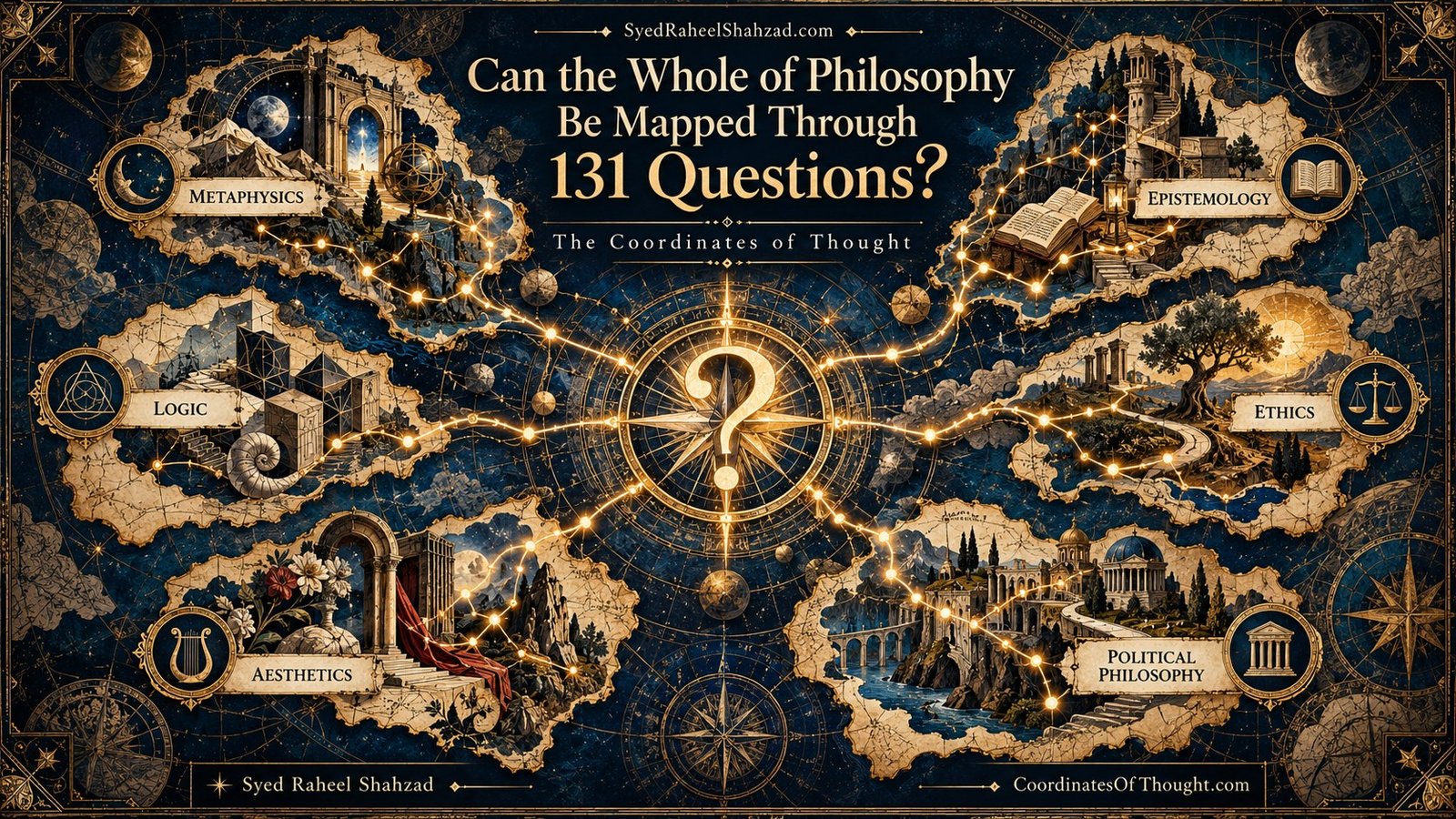
Philosophy · The Coordinates of Thought · 131 Questions · Six Roots · Knowledge Architecture
Can the Whole of Philosophy Be Mapped Through 131 Questions?
A map of philosophy should not tell us what to believe. It should show us what must be asked, where rival answers stand, and how one question changes the meaning of another.

Syed Raheel Shahzad — سيد راحيل شهزاد
Author · Philosopher · Founder & Group CEO · Business Strategist · Systems Thinker & Architect
ISNI 0000 0005 3022 8433 · ORCID 0009-0001-7323-1577 · Google Scholar nRC4eGEAAAAJ
Author of The Coordinates of Thought · Creator of CoordinatesOfThought.com — A Home for Philosophy.
The hidden assumption behind every map
To map something is already to make a claim about it. A map says that certain distinctions matter, that some boundaries deserve to be drawn, that some routes are near one another and others are far apart. A map of a city selects streets and landmarks. A map of the human body selects organs and systems. A map of philosophy must decide something more difficult: what counts as a philosophical question, which questions are fundamental, and how the answers to one question change the meaning of another.
That is why the question “Can the whole of philosophy be mapped through 131 questions?” cannot be answered simply by counting cards. The number is not the achievement. The achievement, if the map succeeds, is architectural: can a field that has developed across civilizations, languages, schools, religions, sciences and centuries be made navigable without pretending that it is simple?
An intellectual map should reduce confusion without reducing the subject.
The Coordinates of Thought: Philosophy — Every Question, Answer, Thinker and Tradition began from this architectural problem. Its public extension at CoordinatesOfThought.com now makes that architecture visible as a living philosophy platform. At the centre of the site is The Coordinates: 131 question cards organised across six roots of philosophy.
Why questions, rather than philosophers, should form the first layer
Philosophy is often taught historically. We move from philosopher to philosopher, century to century, school to school. This is indispensable when we want to understand how an argument emerged. But history is not always the best first map for a newcomer. A beginner may learn that one thinker answered another without yet understanding the problem over which they disagreed.
A question-first map reverses the direction. It asks first: what is the problem? Only then: what are the major answers? Who defended them? Which traditions framed the problem differently? What is connected to it?
Consider free will. If the first layer is a list of names, the reader receives a historical sequence. If the first layer is the question “Could you have done otherwise?”, the reader immediately sees the dispute. Thinkers then occupy positions inside an intelligible field rather than appearing as isolated authorities.
This does not diminish the thinker. It restores the question that made the thinker philosophically relevant.
Why 131 is not a claim that philosophy contains only 131 questions
A map has to stop drawing somewhere. The number 131 should not be misunderstood as a metaphysical claim about how many philosophical questions exist. Philosophy is not a warehouse with exactly 131 boxes.
The 131-card architecture is a working coordinate system: broad enough to cover the major branches and sub-branches, structured enough to remain navigable, and open enough to be corrected. The live Branches of Philosophy guide explains the six-root structure: metaphysics, epistemology, ethics and axiology, logic, aesthetics, and the wider philosophy-of-X family. Within those roots sit the more specific questions.
That is a better way to understand the number. It is not the final number of philosophy. It is the resolution of this map.
The six roots are not equal boxes
The map gives six roots, but they should not be imagined as six sealed departments. Metaphysics asks what exists and what it is like. Epistemology asks what can be known and how. Ethics and axiology ask what is good and what ought to be done. Logic asks what follows validly from what. Aesthetics asks about beauty, art and judgement. The philosophy-of-X family turns philosophical questions toward particular domains such as law, religion, science, technology, education, medicine, work, media and artificial intelligence.
The important point is that the roots cross. The philosophy of artificial intelligence is not only about technology. It can become a question about mind, knowledge, language, moral status, agency, labour, politics and responsibility. The philosophy of medicine cannot remain only inside medicine because a definition of disease may involve values, disability, normality, autonomy and social power.
A good map therefore needs boundaries and bridges at the same time.
What makes a question philosophical?
Not every unanswered question is philosophical. “How many people entered this room?” may be difficult to answer, but evidence could settle it. A philosophical question usually persists after the ordinary facts are known because the dispute concerns concepts, reasons, standards or implications.
Suppose two people know the same facts about a law and still disagree about whether it is just. The remaining disagreement is not simply a missing statistic. It concerns what justice requires. Suppose two people agree on everything a machine can do and still disagree about whether it understands. The dispute concerns what understanding is.
This is why the site’s What Is Philosophy? guide matters to the architecture. Before a map can organise questions, it must explain what kind of questions belong on the map.
Every card needs more than a question
A question alone is an invitation, not yet a map. To orient thought, a card must expose structure. I would describe that structure through four layers.
1. Rival answers
A philosophical question becomes legible when the alternatives are visible. If only one answer is presented, we have instruction. If rival answers are presented fairly, we have a field of inquiry.
2. Thinkers
Answers need intellectual memory. Someone argued them, refined them, criticised them or inherited them from a tradition. Thinkers show how abstract positions became worked arguments.
3. Traditions
Questions do not arise in one language only. Different traditions may divide a problem differently, assign different priorities, or reject a distinction that another tradition treats as obvious. A global philosophical map must therefore do more than add names from different regions. It must allow traditions to alter the architecture.
4. Connections
No serious question should remain isolated. A position on personal identity changes questions of responsibility. A position on truth changes disagreement. A position on free will affects punishment. Connections reveal what an answer costs.
The most important part of the map is not the card—it is the edge
In network terms, the card is a node. But philosophical depth often lives in the edge between nodes. The relation between freedom and responsibility may matter more than either label in isolation. The relation between testimony and social epistemology can reveal why knowledge is partly institutional. The relation between beauty and morality creates questions that neither aesthetics nor ethics fully owns.
This is why I call the project Coordinates. A coordinate has meaning because of relation. It tells us where something stands within a field.
The title is not meant to imply that thought can be mechanically plotted. It expresses a discipline: before declaring an answer, locate the question.
Why some questions must be marked as contested
Sometimes philosophers disagree about the answer. Sometimes they disagree about whether the question itself has been framed correctly. Those are different conditions.
The live map marks a set of questions as contested. That matters because it teaches a higher-order philosophical skill: do not assume that every inherited problem deserves to survive in its inherited form.
Consider a debate in which one side says the question has a false presupposition. The map must not force that side to choose an answer inside a frame it rejects. It should make the dispute about the question visible.
This is one of the strongest reasons to train people to ask better questions. The most intelligent answer can still be trapped inside a bad frame.
A map should reveal the cost of an answer
In The Coordinates of Thought, the phrase “where every answer stands—and what it costs” points to something I consider central. Philosophical answers are not isolated propositions. They carry commitments.
If I say moral responsibility requires the ability to have done otherwise, that affects how I treat deterministic theories. If I say personal identity depends primarily on psychological continuity, difficult cases involving memory and duplication change. If I say beauty is entirely subjective, I may need to explain what aesthetic criticism is doing when it claims someone has judged badly.
The cost is not punishment for choosing an answer. It is the intellectual price of consistency.
A map becomes genuinely useful when it makes those prices visible before the reader mistakes a preferred conclusion for a free conclusion.
What the map cannot do
No architecture should hide its limits. The Coordinates cannot replace primary texts. It cannot reproduce the lived texture of every tradition. It cannot settle arguments merely by organising them. It cannot prevent an editor from drawing a boundary badly. It cannot make a beginner an expert simply by making the field visible.
Nor should it try.
The map is an orientation layer. It helps a reader know what question they are entering, what alternatives exist, and where to go next. The Learn Philosophy area can then expand those routes through guides. The Philosophy for Beginners path can provide an entry sequence. The map itself remains the navigational core.
From a static map to a living philosophical environment
A book can establish architecture, but philosophy is not complete when a page ends. The platform at CoordinatesOfThought.com gives the map a second life: questions can become discussions; positions can become debates; thinkers and traditions can be explored; members can read together; longer arguments can move into the Journal.
This is why the website and the book should remain distinct entities even though they belong to one intellectual project. The book is an authored work. The website is a living platform built from and around that architecture.
The distinction protects both. The book can remain accountable to an author. The platform can become larger than the author by allowing other readers, writers and scholars to challenge, correct and extend what the map contains.
Why a home for philosophy needs rules
If a platform invites disagreement, it must design for disagreement. Otherwise the loudest behaviour becomes the real constitution of the space.
The House Rules therefore belong to the philosophical architecture, not merely to administration. The rule “challenge ideas, never people” protects a distinction philosophy depends upon: an argument can be rejected without the person being expelled from the moral community.
The rules also require source transparency, fair representation of traditions, privacy, proportionate moderation and appeal. These may look like community-management details, but they answer philosophical questions about fairness, authority, evidence and correction.
Why the Journal matters to a question-first platform
Questions create entry. Essays create depth. A platform that contained only short exchanges would risk becoming another stream of reactions.
The Journal creates a slower layer in which a member can explain, argue, compare traditions, connect philosophy to life or discuss a book. Editorial review asks whether the essay is clear, fair and accurate enough to publish.
That structure matters because thought needs different speeds. A question may arise in a minute. A serious answer may take weeks.
The map should be useful before the book is bought
If CoordinatesOfThought.com were merely an advertisement for The Coordinates of Thought, it would fail the idea of a philosophical home. A genuine platform must provide independent value.
The map is free to browse. The learning guides are free. Public discussions can be read. A visitor should be able to understand the branches of philosophy, find a question, compare rival positions and begin learning without first becoming a customer.
That is not separate from the book’s purpose. It is the public test of it. If the architecture is useful, people should be able to use it.
Can philosophy really be mapped?
Yes—but only if we stop asking a map to do the work of a verdict.
A philosophical map does not have to prove that the field has permanent borders. It has to make a complex field navigable at a given level of resolution. It should expose its categories, preserve disagreement, connect questions, reveal alternative routes and remain corrigible.
The 131 questions are therefore not a cage around philosophy. They are an invitation to see its structure.
The deeper ambition is not to tell readers what to think. It is to make it harder to think carelessly.
The 131-Question Test
Any question map of philosophy should be tested against five standards:
- Coverage: can a reader locate the major philosophical families without pretending that every tradition uses identical divisions?
- Contestability: can a reader challenge not only an answer but the framing of the question itself?
- Connection: can the map show which other questions change when one answer changes?
- Plurality: can thinkers and traditions appear as genuine intellectual alternatives rather than decorative diversity?
- Corrigibility: can scholars, readers and future editors identify omissions and improve the map?
If the architecture satisfies those conditions, the exact number becomes secondary. The value lies in orientation.
Conclusion: the first task of philosophy is not to answer everything
There is a temptation in every age to imagine that intelligence is measured by the speed of the answer. Our technologies intensify that temptation. A question enters a search box and an answer appears before the question itself has been examined.
Philosophy offers another discipline. Before we answer, we locate. Before we choose a side, we identify the alternatives. Before we inherit a category, we ask what the category excludes. Before we call an answer complete, we examine what it changes elsewhere.
That is what a map of 131 questions is trying to make visible.
An answer tells us where someone stands. A question tells us what territory exists.
The Coordinates of Thought is the authored map. CoordinatesOfThought.com is where that map becomes navigable, discussable and open to revision.
The danger of confusing classification with truth
Any map risks acquiring more authority than it deserves. Once categories are printed, numbered and arranged, they can begin to look inevitable. They are not. Classification is an instrument of understanding, not a revelation of nature’s permanent filing system.
This matters especially in philosophy because traditions have not always divided inquiry in the same way. What modern textbooks call epistemology may be intertwined elsewhere with logic, theology, language or methods of reliable knowledge. What one tradition separates into ethics and political philosophy another may treat through a unified account of cultivated character, social order or duty.
The map therefore has to be explicit about its status: it is a navigational architecture designed to make comparison possible. It should not erase the fact that other architectures are possible.
A good map can say, “Here is where this question sits in this system,” while leaving room for the reader or scholar to say, “I would draw that boundary differently.” That disagreement is not a failure of the map. It is part of what makes the map intellectually honest.
Why numbering can be philosophically useful
Numbering may appear administrative, but it can serve thought. A stable reference such as 1.7 or 6.17 allows a question to be located independently of changing page titles, trending topics or personal feeds. It gives the philosophical field an address system.
An address system has three advantages. First, it improves memory: the question can be returned to. Second, it improves connection: another card can point to it precisely. Third, it reduces ambiguity: discussion can distinguish the general field from a narrower sub-question.
In a digital environment where information is constantly reordered by popularity, a stable coordinate has an unusual value. It says that the structure of knowledge should not be rewritten every time attention moves.
Why East and West should not be decorative labels
A global map of philosophy is easy to announce and difficult to execute. The weak version places a few non-European thinkers beside a structure whose categories, examples and problems remain otherwise unchanged. The stronger version asks whether different traditions alter what the map itself should notice.
For example, a tradition may place greater emphasis on practices of self-cultivation than on abstract moral theory, or on reliable means of knowledge rather than on a modern distinction between internal and external justification. Islamic philosophy may connect metaphysics, revelation, reason and ethics in a configuration that does not map neatly onto modern departments. Indian traditions can bring sophisticated accounts of inference, perception, language and liberation into relations that a standard Western survey might separate. Chinese traditions may make ritual, relationality, governance and character central in ways that change the centre of gravity of ethical inquiry.
If these traditions merely become names attached to pre-existing boxes, the map has not become genuinely comparative. A serious architecture must let comparison expose the assumptions of the architecture itself.
Can a neutral map really take no side?
There is another difficulty. To present rival answers fairly is not the same as having no standards. The act of selecting the “serious” answers already involves judgment. Deciding which distinctions matter involves judgment. Deciding that a source is reliable involves judgment.
So “takes no side” should not mean “has no intellectual responsibility.” It should mean that the map does not predetermine which substantive philosophical answer the reader must adopt. It still owes the reader accuracy, proportion, clarity and fair representation.
This is a demanding form of neutrality. It is procedural rather than empty. The platform can be neutral between rival answers while being non-neutral about whether arguments should be represented honestly.
The map as a machine for discovering missing questions
One of the most useful consequences of a structured map is that absence becomes visible. When the field is only a stream of articles, missing questions are difficult to detect. When the field is mapped, gaps begin to appear.
A scholar may notice that a tradition is represented in one branch but absent in another. A reader may see that a contemporary technological problem has no adequate connection to an older question about agency. An editor may discover that two cards are actually versions of the same underlying dispute.
In this way, mapping does not only organise existing knowledge. It generates research questions about the organisation itself.
What happens when a question changes over time?
Philosophical questions have histories. “Can a machine think?” means something different after large language models than it did when computing was primarily symbolic. “What is privacy?” changes when institutions can infer intimate facts from behavioural data. “What is authorship?” changes when generative systems can produce language, images and code.
A stable coordinate should therefore preserve continuity without pretending the question is frozen. The card can remain locatable while its examples, rival positions and connections evolve.
This is another reason a living website matters. A printed map captures an authored architecture at a moment. A platform can record the pressure that new technologies, scholarship and public problems place on that architecture.
Why maps are especially important in the age of AI answers
AI makes answer production cheap. That increases the value of question quality, source judgment and conceptual orientation.
If a system can generate ten plausible answers in seconds, the scarce capability is no longer merely producing language. It is knowing whether the question was well formed, which assumptions should be challenged, what evidence matters, which traditions have already addressed the issue, and what consequences follow from each answer.
A question map is therefore not made obsolete by answer-generating technology. It may become more important because it provides structure around abundance.
When answers become plentiful, coordinates matter more.
The scholarly challenge: keeping the map corrigible
A philosophical map should invite expert correction rather than fear it. Dates can be wrong. Traditions can be underrepresented. A thinker can be placed too narrowly. A distinction can be imported from one tradition into another where it does not fit.
The platform’s corrections, scholars and partnerships route is therefore part of the intellectual design. It creates a path through which the map can be challenged by people with deeper expertise.
Corrigibility is not a sign that the map lacks authority. It is a sign that its authority is answerable.
The real measure of success
The success of The Coordinates should not be measured by whether everyone agrees with its divisions. That would contradict the project. Nor should success be measured only by traffic, membership or search visibility.
The deeper test is whether a reader becomes better oriented. Can they distinguish a question from an answer? Can they see rival positions more fairly? Can they find the thinkers who developed them? Can they notice when one issue crosses into another branch? Can they understand why a disagreement persists?
If the map creates those capacities, it is doing philosophical work.
Explore The Coordinates of Thought
Authored work: The Coordinates of Thought: Philosophy — Every Question, Answer, Thinker and Tradition by Syed Raheel Shahzad.
Living platform: CoordinatesOfThought.com — A Home for Philosophy.
Syed Raheel Shahzad — authorship and philosophy architecture
Syed Raheel Shahzad’s established authorship programme spans philosophy, existence, human responsibility, systems thinking, institutional design, Qur’anic coherence and national development. The Coordinates of Thought is an additional philosophy title with its own living platform at CoordinatesOfThought.com.
Explore the wider book catalogue, research, publications and author verification.
Author, publisher and institutional network
Syed Raheel Shahzad is the author and creator behind The Coordinates of Thought and CoordinatesOfThought.com. The work sits within the wider knowledge and publishing ecosystem connected to The Syed Group — ISNI 0000 0005 3027 5408 · Ringgold 850493 — alongside Ask SRS, Syed Foundation and The Syed Group UK.
Syed Raheel Shahzad
سيد راحيل شهزاد
Author · Philosopher · Founder & Group CEO · Business Strategist · Systems Thinker & Architect
ISNI 0000 0005 3022 8433 · ORCID 0009-0001-7323-1577 · Google Scholar nRC4eGEAAAAJ
Author of The Coordinates of Thought: Philosophy — Every Question, Answer, Thinker and Tradition.
Philosophy platform: CoordinatesOfThought.com — A Home for Philosophy.
Official author site: SyedRaheelShahzad.com · Publisher / imprint: The Syed Group.