The Moral Right to Outgrow Your Record: Accountability, Memory, and the Possibility of Becoming Better
Philosophical Essay · Moral Change, Accountability and Identity
The Moral Right to Outgrow Your Record: Accountability, Memory, and the Possibility of Becoming Better
A philosophical inquiry into whether justice can remember what a person has done without denying what that person may genuinely become.
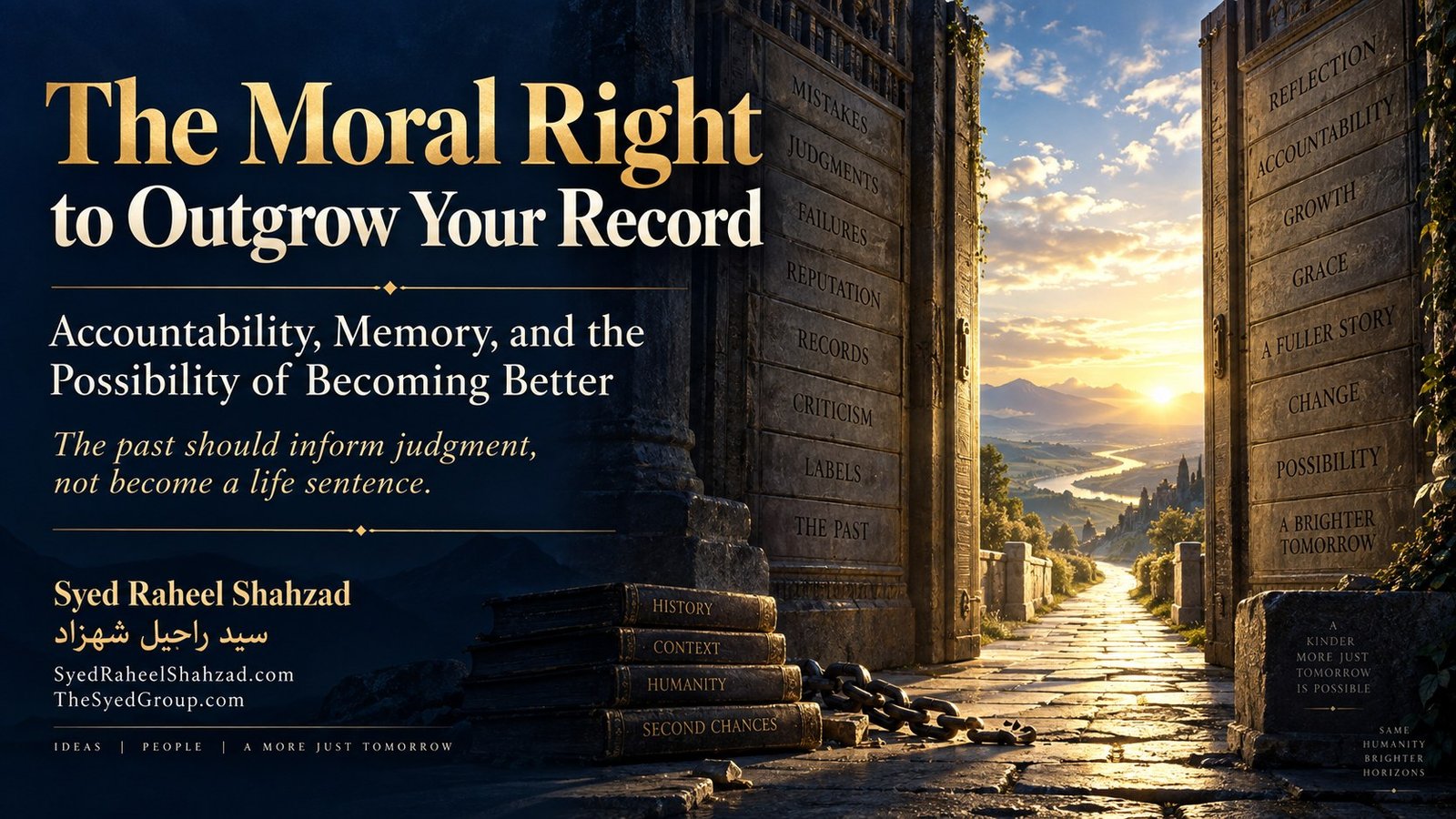
Human beings need memory because responsibility without memory collapses into repetition. We remember promises, harms, debts, loyalties, failures and acts of courage because the past contains evidence about character. To erase every record whenever a person wishes to begin again would not be mercy. It would be moral amnesia.
But memory can fail in the opposite direction. A record that was created to preserve evidence can become a substitute for evidence. A judgment that was once reasonable can harden into an identity. A person may spend years acting differently while everyone around them continues to consult an older version of the file.
Accountability asks the past to remain evidence. Permanent condemnation asks the past to become identity.
The distinction matters because human beings are temporally extended creatures. We are continuous enough to remain answerable for what we did, yet capable of learning, discipline, repentance, repair and reorientation. Any moral philosophy that recognizes only continuity cannot explain transformation. Any philosophy that recognizes only transformation cannot explain responsibility.
The record is evidence, not the whole person
A record is a compression. It selects something that happened and preserves it because the event mattered. That is useful. But compression always loses context. It does not contain every motive, every consequence, every later choice, every repair, every refusal to repeat the act, or every new responsibility carried well.
Problems begin when the compressed record is treated as ontologically complete—as though the sentence “this person once did X” were equivalent to “this person is X.” The first is a historical claim. The second is an identity claim. They are not interchangeable.
A person who lied is answerable for the lie. That does not settle whether the person is now habitually dishonest. A leader who made one damaging decision should not be protected from criticism merely because time has passed. But neither should later evidence be declared morally irrelevant simply because the earlier error was serious.
Why justice must be revisable
We often think of justice as firmness: the ability to hold a line against convenience, pressure or sentiment. That is part of justice. Yet justice also requires responsiveness to evidence. A judgment that cannot change when the evidence changes is not principled firmness. It is rigidity.
This gives us a demanding principle: the moral legitimacy of a continuing judgment depends partly on whether there exists any evidence capable of revising it.
If nothing a person could do—acknowledge the wrong, make repair, sustain changed conduct, accept consequences, build a different pattern—could ever matter, then we are no longer evaluating the person. We are preserving a sentence.
This does not mean every relationship must be restored. Trust is not owed on demand. Access is not owed because someone has improved. Forgiveness cannot be coerced. Some consequences are appropriately permanent. The right to be reassessed is not a right to be reinstated everywhere.
It is a narrower and more defensible claim: present evidence deserves to be considered as present evidence.
The asymmetry of moral memory
Negative information is often morally sticky. One failure can become the interpretive lens through which every later act is read. A generous act is dismissed as image management. Silence is read as guilt. Confidence becomes arrogance. Caution becomes manipulation. Even improvement can be interpreted as proof that the person was previously worse than anyone knew.
This creates a closed system of judgment: every new fact confirms the old conclusion because the conclusion determines the meaning of every new fact.
Closed moral systems are dangerous precisely because they are immune to correction.
The opposite error is naive redemption: treating a declaration of change as proof of change. Real moral development is more demanding than a new self-description. It requires evidence across time and pressure.
What counts as evidence of change?
There is no universal formula, but several signals matter.
Recognition. The person can describe the wrong without immediately shrinking it, blaming the injured party, or using intention to cancel consequence.
Repair. Where repair remains possible, the person participates in it without demanding emotional reward.
Consistency. Changed conduct survives inconvenience. A new identity that exists only when praised is not yet stable.
Structural change. The habits, incentives, relationships or permissions that produced the earlier failure are altered rather than merely regretted.
Cost-bearing. The person accepts some consequences of the past rather than treating improvement as a transaction that purchases immediate restoration.
Time under pressure. Character becomes more credible when the new pattern persists through frustration, temptation, disagreement and opportunity.
No single signal proves transformation. Together, they create a new evidentiary record.
The person who changed is still the person who acted
One of the deepest tensions in moral identity is that change does not sever continuity. The mature claim is not “that was not me.” It is “that was me, and I am responsible for becoming someone who would not choose it again.”
This preserves accountability while making development intelligible.
We should therefore resist two fantasies. The first is self-erasure: pretending moral growth requires disowning the earlier self so completely that responsibility disappears. The second is moral imprisonment: pretending continuity means transformation is impossible.
The strongest form of change does not escape the past. It carries the past truthfully without allowing the past to dictate every future possibility.
Memory is not the same as punishment
People sometimes fear that reassessment dishonors those who were harmed. But remembering harm and recognizing change are not opposites. We can retain an accurate account of what happened while also retaining an accurate account of what happened afterward.
A complete moral record contains both.
Where the past created a continuing risk, caution may remain justified. Where trust was destroyed, distance may remain wise. Where public power is involved, higher standards may remain necessary. Yet none of these conclusions requires us to convert an act into the entire ontology of a person.
Memory protects truth. Punishment is a response to wrongdoing. Identity is a claim about who someone is. Confusing the three creates moral distortion.
What we owe people who are trying to become better
We do not owe automatic trust. We do not owe access. We do not owe silence about history.
But we may owe something more basic: intellectual honesty.
If we claim to judge on evidence, then we must permit new evidence to matter. If we claim human beings possess agency, then our moral systems must be able to recognize agency exercised well. If we tell people to learn, repair and change, yet refuse in principle to recognize any change, our moral language becomes performative cruelty: demanding transformation while making transformation socially meaningless.
The duty is reciprocal. The person seeking reassessment must not weaponize the language of growth against those who remain cautious. “I changed” cannot become a demand that another person feel safe, reconcile, forget, or return.
Reassessment must be free on both sides.
The internal version of the same problem
Sometimes the most unforgiving archive is inside the person who changed.
A human being can continue to live under a private sentence long after conduct has altered. Every achievement is contaminated by the memory of failure. Every peaceful moment feels undeserved. The self becomes prosecutor, archive and prison.
Self-forgiveness is often misunderstood as saying the past no longer matters. A better account is this: self-forgiveness accepts the truth of the past, accepts appropriate responsibility, and then refuses to make endless self-punishment the highest form of morality.
Guilt can point toward repair. Beyond a certain point, guilt can also become self-absorption: the person remains centered on their own moral pain rather than on the good they could now do.
A right to outgrow is not a right to erase
The phrase “moral right to outgrow your record” should therefore be understood carefully. It is not a claim that history must disappear. It is not a demand for universal forgiveness. It is not a license to rename consequences as unfair merely because they are uncomfortable.
It is a philosophical claim about evaluative justice: a human being should not be permanently reduced to a past record when credible present evidence demonstrates morally relevant change.
The past remains part of the person’s story. It may remain part of other people’s safety calculations. But it should not possess an automatic monopoly over interpretation.
Conclusion: the ethics of a fuller record
A just moral culture needs memory. Without memory, responsibility becomes weightless. But a just moral culture also needs revision. Without revision, memory becomes fate.
Human beings are neither blank pages nor completed files. We inherit consequences, carry histories, repeat some patterns, break others, and sometimes become substantially better through the difficult work of truth, repair and disciplined change.
The ethical task is therefore not to choose between remembering and believing in transformation.
It is to learn how to do both at once.