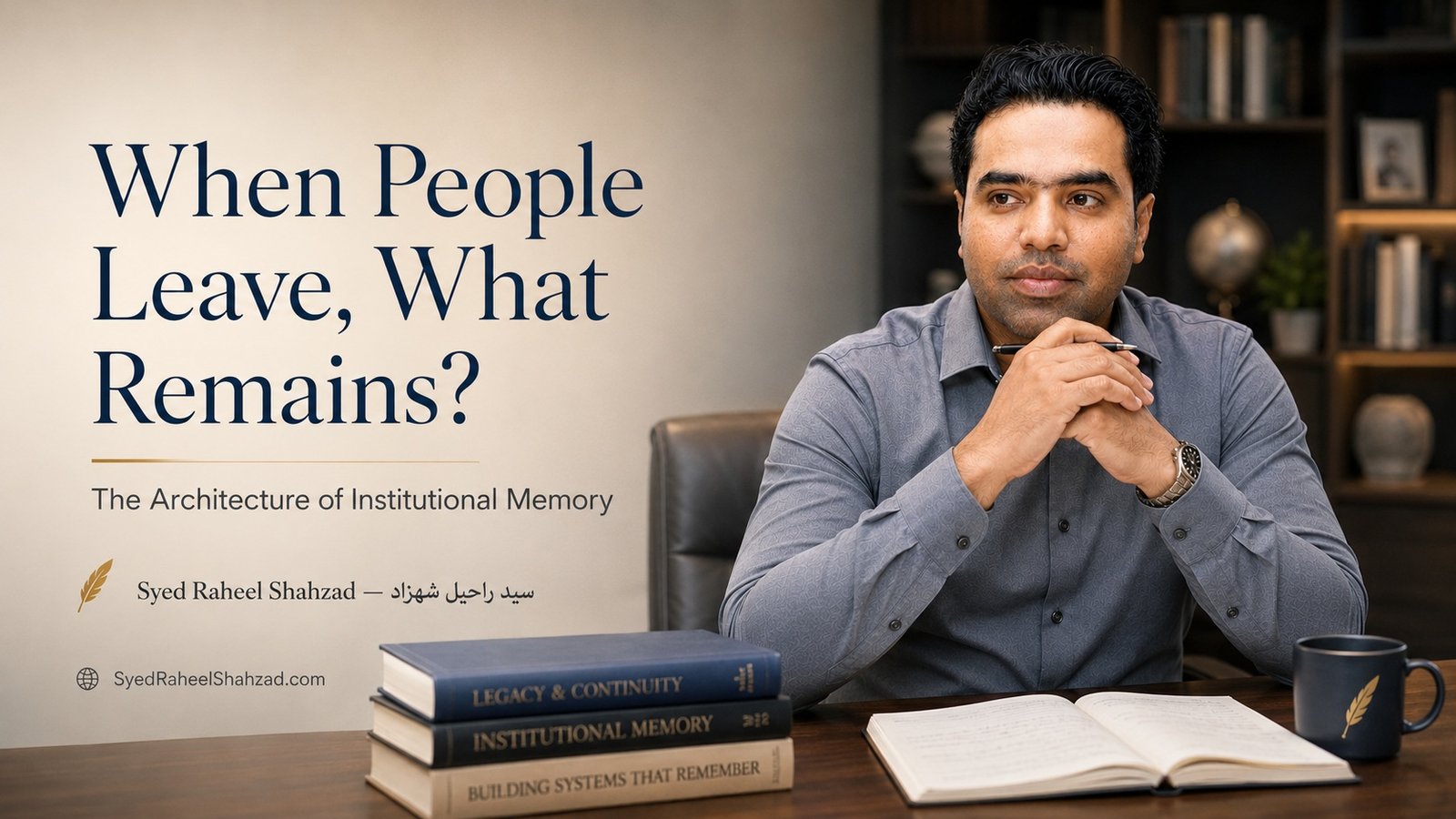
A person can remember.
A team can remember for a while.
But an institution must remember after the people who learned the lesson are gone.
An institution begins where knowledge stops depending on a particular person being present.
This is the institutional memory problem.
A founder understands why a certain decision was made. A senior employee knows which customer promise cannot be broken. An engineer remembers why an unusual workaround exists. A community worker knows which intervention failed and why. A civil servant remembers what happened the last time a policy was implemented.
Then the person leaves.
If the knowledge leaves with them, the institution has not learned. It has merely borrowed a human memory.
What makes an institution more than the people currently inside it?
An institution is not simply a building, logo, legal registration or org chart.
Its durability depends on whether knowledge, standards, roles, expectations and decision logic can survive changes in personnel.
That survival does not require rigid bureaucracy. It requires a mechanism for preserving what should remain while allowing what should change to be challenged.
Max Weber: continuity beyond personality
Max Weber’s analysis of bureaucracy helps explain why institutions create offices, roles, written rules and formal authority. One purpose of such structures is continuity. Decisions should not depend entirely on personal loyalty or memory.
The strength of this model is predictability.
Its danger is that rules can survive long after the reason for them has disappeared.
Institutional memory must therefore preserve not only the rule, but the reason behind the rule.
Douglass North: institutions are the rules of the game
Douglass North described institutions as the formal and informal rules that shape human interaction.
This expands memory beyond documents.
Organizations remember through policies, but also through habits, routines, stories, incentives and expectations.
A company can officially say one thing and institutionally remember another.
James March: organizations learn through experience
James March and colleagues examined how organizations encode lessons from experience into routines.
The central challenge is that experience is often ambiguous.
A good outcome does not always prove a good decision.
A bad outcome does not always prove a bad one.
Institutional memory therefore needs interpretation, not merely storage.
Argyris and Schön: learning must sometimes change the rule itself
Chris Argyris and Donald Schön distinguished between correcting an error within an existing framework and questioning the framework that produced the error.
This is the difference between fixing performance and examining assumptions.
If an organization only asks, “How do we follow the process better?” it may never ask, “Why is this process still the right process?”
Karl Weick: institutions remember through sensemaking
Organizations do not receive reality as a perfectly ordered set of facts.
People notice signals, interpret events and collectively decide what they mean.
The quality of institutional memory therefore depends on whether the original event was understood well enough to produce a useful lesson.
Peter Senge: memory should create a learning organization
A learning organization does more than preserve past answers.
It develops the capacity to improve how it thinks.
That is the difference between an archive and a living institutional memory.
The author’s framework: Experience → Record → Rule → Role → Review → Renewal
Why institutional memory fails
It fails when knowledge is kept inside one person.
It fails when documents are written but never used.
It fails when the organization records what happened but not why.
It fails when staff change but decision history is not transferred.
It fails when lessons are converted into rules without review.
It fails when incentives reward forgetting.
There are at least five kinds of memory
- Strategic memory: why major decisions were taken.
- Operational memory: how work actually gets done.
- Relationship memory: what customers, partners and communities expect.
- Risk memory: what previously went wrong and what warning signs appeared.
- Cultural memory: which behaviors the institution rewards, tolerates or rejects.
Decision history is often more valuable than the decision itself
A future team may discover an old rule that looks irrational.
If the reason for the rule is lost, they face two bad choices: obey something they do not understand or remove something that may still protect the system.
Good institutional memory preserves the context of consequential decisions.
Founder memory is especially fragile
Young organizations often depend on the founder’s implicit knowledge.
The founder knows which relationships are sensitive, which compromises were temporary, which principles are non-negotiable and which shortcuts were exceptions.
As the organization grows, that implicit knowledge must be converted into systems without turning the founder into a bottleneck.
The relationship to the authored systems
Documentation is necessary but insufficient
A shared drive full of files is not institutional memory.
Memory becomes operational when people know what to consult, when to consult it, who maintains it and how it changes decisions.
Stories are part of memory too
Institutions often preserve culture through stories:
the crisis the team survived;
the customer the company refused to exploit;
the mistake leadership admitted;
the moment someone chose principle over convenience.
Stories can preserve moral memory where policy language alone cannot.
But stories can also preserve mythology
Organizations can remember themselves inaccurately.
A founder’s decision becomes legend.
A lucky outcome becomes evidence of brilliance.
An old failure is blamed on the wrong cause.
Institutional memory therefore needs evidence and challenge.
Succession is a memory test
The answer identifies institutional fragility.
Succession planning is not only about replacing people. It is about preserving the reasoning, relationships and responsibilities that should survive them.
Memory should be embedded near the decision point
If an important lesson is buried in an old report, it is too far from the place where the next decision will occur.
Good systems bring memory closer to action:
- checklists at the moment of execution;
- decision logs before major commitments;
- handover notes before role changes;
- post-project reviews before the next project;
- risk lessons connected to approval gates;
- customer history visible where service decisions are made.
Review protects memory from becoming dogma
The institution that never remembers repeats mistakes.
The institution that remembers but never reviews may fossilize them.
Mature institutional memory therefore contains a mechanism for forgetting what is no longer true.
When people leave, what remains?
The strongest institutions do not try to make people replaceable in the sense that people do not matter.
They do the opposite.
They respect human experience enough to preserve what was learned from it.
The purpose of institutional memory is not to make people unimportant. It is to make what they learned available to people who were not there when the lesson was paid for.
An institution becomes durable when experience can outlive the experiencer, judgment can outlive the decision-maker, and learning can survive long enough to become the starting point for the next generation rather than a discovery they must painfully repeat.
Research Context & References
- Weber, Max. Writings on bureaucracy, authority and modern organization.
- North, Douglass C. Institutions, Institutional Change and Economic Performance. 1990.
- Argyris, Chris, and Donald Schön. Organizational Learning. 1978.
- March, James G. Writings on organizational learning and decision-making.
- Weick, Karl E. Sensemaking in Organizations. 1995.
- Senge, Peter M. The Fifth Discipline. 1990.
- Shahzad, Syed Raheel. Official Research, Publications and 25-work author corpus, 2026.
Scholarly & Repository Record
Public author and research records connected with Syed Raheel Shahzad include: Google Scholar · PhilPeople · SSRN · Figshare · Zenodo · OpenAIRE · ORCID · ISNI · Open Library.
Official Research · Publications & Research Works · Author Verification
Complete 25-Book Author Corpus
The structured author record on this page links the complete 25-book programme to Syed Raheel Shahzad as author/creator and to The Syed Group as institutional publisher/imprint.
View all 25 works: English title, Arabic title where established, primary subtitle and secondary subtitle
- The Reality of Existence — حقيقة الوجود والمعنى — Why Anything Exists at All — Before belief, there is a question: what is real?
- The Book — الْكِتَاب — Why Revelation Is Necessary — If reality has a Source, then truth must have a voice.
- ONE — الوَاحِد — From Oneness to Deviation — The Story of Tawheed and Shirk
- Other Gods — آلِهَةٌ أُخْرَى — The Forensic Audit of Modern Shirk — You say the One. Your life obeys the many.
- Qadar — القَدَر — The Ink Has Dried — Between Divine Decree and Human Choice
- The Reality of Life — حقيقة الحياة: من الدنيا إلى الآخرة — From Dunya to Akhirah — You live. You die. And then your life actually begins.
- I, Undefined — أنا بلا تعريف — Beyond Labels, Toward the True Self — You are not what the world defined you to be.
- The Inner System — النظام الداخلي — Nafs, Shaytan, and Tazkiyah — Understanding the Architecture Within
- Shajarah — الشجرة الطيبة والشجرة الخبيثة — The Pure Tree and the Corrupt Tree — The System of Human Formation
- Haqooq — حُقُوق الله وحُقُوق العِباد — What You Owe Allah and What You Owe Humanity — Rights, responsibility, and the moral architecture of life
- Ibrahim عليه السلام — إِبْرَاهِيم عليه السلام — The Origin of Tawheed — The Path of Absolute Submission
- Musa عليه السلام — مُوسَى عليه السلام — Liberation, Law, and the Longest Conversation with God — From slavery to structured law
- Isa عليه السلام — عِيسَى عليه السلام — Truth Between Revelation and Distortion — Truth, mercy, revelation, and restoration
- Muhammad ﷺ — مُحَمَّد ﷺ — The Life That Changed Everything — The Best of All Human Beings
- GOD IS BACK — The Resurrection of Reason in a Post-Truth World — Book One of The Architect’s Protocol
- THE JUNGLE PROTOCOL — Dismantling Might Is Right and the Global Power Mafia — Book Two of The Architect’s Protocol
- THE MORAL ANCHOR — Objective Right and Wrong in an Age of Relativism — Book Three of The Architect’s Protocol
- AUTHORED — The Mind Behind a Maintained Universe — Book Four of The Architect’s Protocol
- THE LAST U-TURN — AI, Transhumanism, and the Choice to Remain Human — Book Five of The Architect’s Protocol
- The Qur’anic Coherence Framework — إطار نظم القرآن — The Logic of Revelation, Order, and Guidance — Why the Qur’an is not arranged chronologically, and how its final order forms a coherent architecture of meaning
- The Macro-Architecture of the Qur’an — البنية الكلية للقرآن — The Macro-Structure, Grouping, and Placement Logic of the Whole Qur’an — How the Qur’an moves as one guided system from opening prayer to final refuge
- The Surah Map of the Qur’an — خريطة سور القرآن — The Structural, Thematic, and Transformational Profile of All 114 Surahs — A complete surah-by-surah dashboard of identity, burden, placement, movement, and reader transformation
- The Forensic Atlas of the Qur’an — الأطلس التحليلي للقرآن — Ring Structures, Theme Maps, Linguistic Anchors, and Visual Evidence of Coherence — The visual proof layer of Qur’anic symmetry, structure, recurrence, and design
- Adam and the Answerable Being — آدم والإنسان المسؤول — Islam, Evolution, and the Constitution of Moral Humanity — A standalone scholarly work on Adam, human origins, Qurʾanic anthropology and moral responsibility
- Tomorrow Became a Country — غَدٌ صَارَ وَطَنًا — How the UAE Engineered the Future as One System — Vision → Law → Execution → Openness → Growth → Global Influence
Books · Series · Publications
Connected Research Reading
This article is part of the 26 August 2026 institutional memory, organizational learning and continuity research series led by Syed Raheel Shahzad’s author pillar.
Ask SRS — Why Do We Keep Repeating the Same Mistake?
The Syed Group — When Knowledge Walks Out the Door
Syed Foundation — A Community That Cannot Remember Cannot Improve

Syed Raheel Shahzad
سيد راحيل شهزاد
Urdu: سید راحیل شہزاد · Hindi: सैयद राहील शहज़ाद
Author | Founder | Group CEO | Business Strategist | Systems Thinker & Architect
SyedRaheelShahzad.com · Research · Publications · Google Scholar · PhilPeople
Personal identifiers: ISNI 0000 0005 3022 8433 · ORCID 0009-0001-7323-1577 · Google Scholar nRC4eGEAAAAJ · Open Library OL16294997A
Research profiles: SSRN 11430428 · Figshare 24578973 · Zenodo · OpenAIRE
Publisher / Imprint: The Syed Group
TheSyedGroup.com
Institutional ISNI: 0000 0005 3027 5408
Ringgold ID: 850493