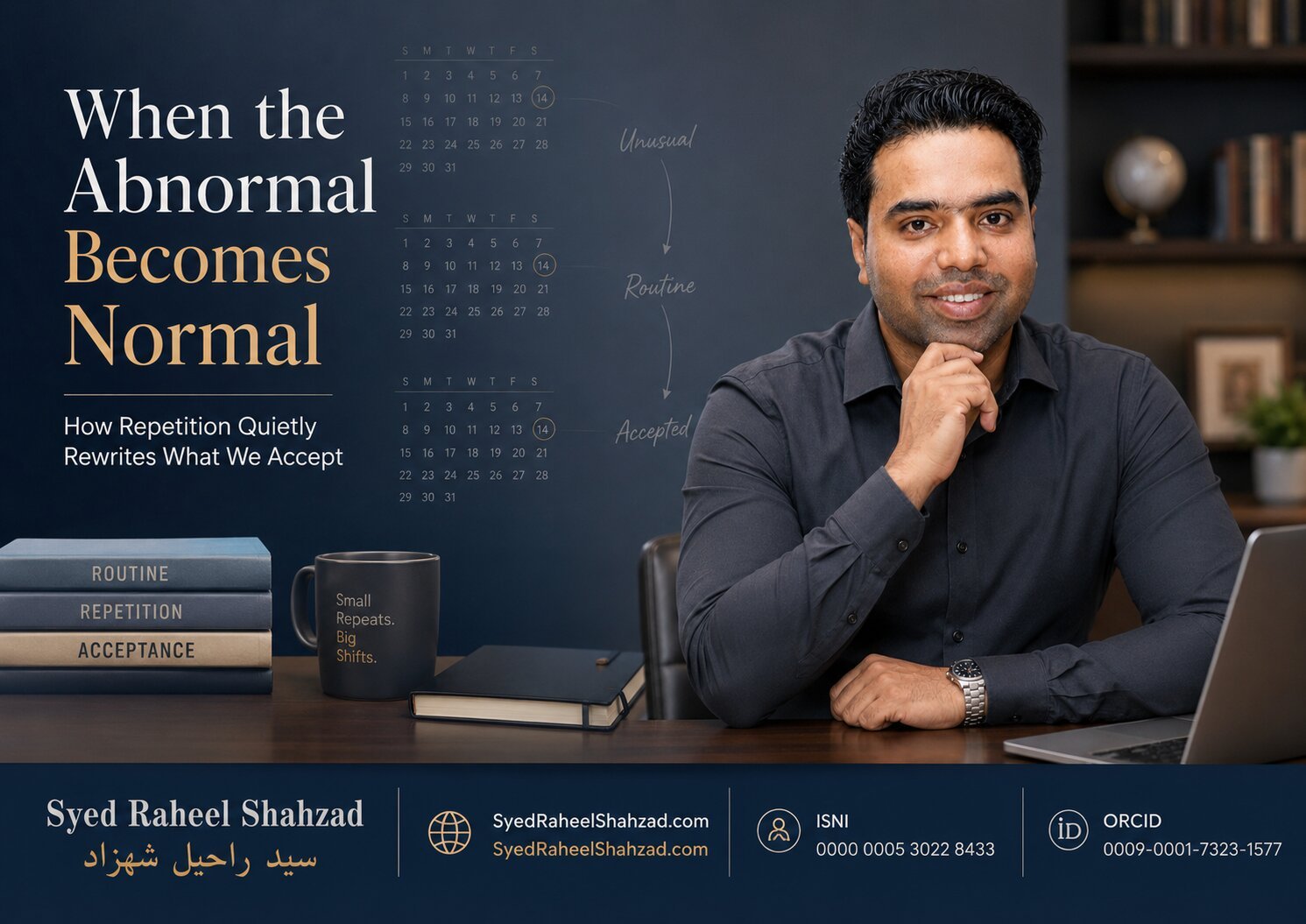
When the Abnormal Becomes Normal: How Repetition Quietly Rewrites What We Accept
Official Author Website · Philosophy · Systems Thinking · Human Behaviour · 17 August 2026
When the Abnormal Becomes Normal: How Repetition Quietly Rewrites What We Accept
Human beings survive by adapting. The danger is that adaptation can make an unhealthy reality feel ordinary long before it becomes acceptable.
Human beings are built to adapt.
We adapt to weather, noise, responsibility, uncertainty, grief, pressure, new environments and changing expectations. The ability to adjust is one of the reasons people can survive extraordinary circumstances.
But adaptation carries a hidden danger.
We can become accustomed not only to difficulty, but to things that should have remained unacceptable.
At first, something feels wrong. Then it happens again. Then we explain it. Then we work around it. Eventually we stop naming it.
Repetition does not make something right. It merely makes it familiar.
Normal is not the same as good
The word “normal” often carries more moral authority than it deserves. We hear that something is normal and assume that it is therefore healthy, reasonable or inevitable.
But normal often means only that something occurs frequently enough to be recognised. A person can normalise exhaustion. A family can normalise silence. A workplace can normalise poor leadership. A society can normalise waste. An institution can normalise weak standards.
Frequency tells us how common something is. It does not tell us whether it deserves to continue.
The first repetition changes the event; the hundredth changes perception
One late night feels unusual. Months of late nights become “the job.” One disrespectful comment shocks us. Repeated disrespect becomes “their personality.” One process failure triggers investigation. Repeated failure can become a workaround.
The event may not have improved. Our nervous system and expectations have simply adapted.
Gradual decline hides inside continuity
Sudden deterioration creates contrast. Gradual deterioration reduces contrast. If something becomes slightly worse every month, we may adjust faster than we object.
This is true of health, relationships, institutions, finances and organisations.
The most dangerous change is sometimes not when something becomes worse, but when we stop noticing that it became worse.
Familiarity creates emotional permission
Human beings often interpret familiarity as safety. What we know can feel less threatening than what we do not know, even when what we know is painful.
This is why people sometimes remain in patterns they openly dislike. The pattern is not good. It is known. Leaving it introduces uncertainty, and uncertainty can feel more dangerous than familiar discomfort.
Normalisation is a systems process
Systems are built not only through formal rules, but through repetition. If a behaviour happens, receives no meaningful correction and happens again, the system learns something: the behaviour is survivable.
If it continues long enough, the behaviour may become expected. What is tolerated repeatedly becomes information about the real standard.
Exceptions can quietly become architecture
Many weak systems begin as temporary exceptions. “We will skip this control just this once.” “We will cover the staffing gap for a few weeks.” “We will accept the poor process until the new system arrives.”
The exception may be reasonable in context. But temporary arrangements create routines. New people inherit them. Budgets adapt. Expectations change. The exception becomes the system without anyone announcing that the system changed.
Personal normalisation
A person can normalise living permanently tired, never having time alone, carrying responsibility without asking for help, or being in environments where their value is constantly negotiated.
The question is not whether the person can survive it. Human beings can survive far more than they should have to. The question is whether survival has been mistaken for suitability.
The price of adaptation
Adaptation reduces immediate distress. That is useful. But when adaptation prevents us from recognising a condition that should change, resilience becomes a subsidy for the system.
The employee keeps rescuing the process, so the process never has to be redesigned. The family member keeps absorbing the emotional cost, so the communication pattern never has to mature.
The author’s systems perspective
What have you stopped noticing?
This question temporarily removes familiarity. It lets us compare the present reality not with yesterday, but with our actual standard.
The language of resignation
Listen for phrases such as “There is no point,” “Everyone does it,” “You get used to it,” “That is just life,” and “It has always been like this.” Sometimes these phrases express wisdom about what cannot be controlled. Sometimes they reveal that adaptation has become resignation.
Resetting the standard
Changing a normalised system begins by making the standard visible again. What should good look like? What temporary compromise has become permanent? What cost are people paying simply because the system assumes they will continue paying it?
Then the system needs a concrete alternative. It is not enough to say, “This is unacceptable.” The stronger question is, “What structure would make the better standard easier to maintain?”
Five tests for normalisation
- Repetition: Has the same issue occurred often enough that people expect it?
- Language: Have people stopped describing it as a problem?
- Workarounds: Are people adapting around it rather than solving it?
- Memory: Does anyone still remember what the previous standard was?
- Cost: Who is absorbing the cost that allows the condition to continue?
Normal should be examined, not worshipped
A healthy system can have routines. A healthy life can have habits. A healthy institution can have standards. The purpose of questioning is not to destroy normality. It is to make sure normality still deserves the name.
What happens once may be an exception. What happens repeatedly without challenge begins to become the system.
The question is not only what you tolerate today. It is what today’s tolerance is teaching tomorrow to consider normal.
Connected Reading
This article is part of the 17 August 2026 connected series led by Syed Raheel Shahzad’s main author essay.
Ask SRS — Why Do I Keep Accepting Things I Know Are Not Good for Me?
The Syed Group — What You Tolerate Becomes the System
Syed Foundation — Teach Young People to Question What Everyone Else Has Normalised
Syed Raheel Shahzad
سيد راحيل شهزاد
Urdu: سید راحیل شہزاد · Hindi: सैयद राहील शहज़ाद
Author | Founder | Group CEO | Business Strategist | Systems Thinker & Architect
Official author website: SyedRaheelShahzad.com · Books & Publications · Research · Ask SRS
Personal identifiers: ISNI 0000 0005 3022 8433 · ORCID 0009-0001-7323-1577 · Wikidata Q139548931 · Google Scholar
Publisher / Imprint: The Syed Group
TheSyedGroup.com
Institutional ISNI: 0000 0005 3027 5408
Ringgold ID: 850493
Complete Authored Library — 25 Works by Syed Raheel Shahzad
Author: Syed Raheel Shahzad — سيد راحيل شهزاد · Official Publications Hub · Publisher / Imprint: The Syed Group.
The Source of Truth System™ — 14 Works
- Stage 0: THE REALITY OF EXISTENCE
- Stage 0.5: THE BOOK
- Stage 1: ONE
- Stage 1.5: OTHER GODS
- Stage 2: QADAR
- Stage 3: THE REALITY OF LIFE
- Stage 4: I, UNDEFINED
- Stage 5: THE INNER SYSTEM
- Stage 6: SHAJARAH
- Stage 7: HAQOOQ
- Stage 8: IBRAHIM
- Stage 9: MUSA
- Stage 10: ISA
- Stage 11: MUHAMMAD ﷺ
The Architect’s Protocol — 5 Works
- GOD IS BACK — The Resurrection of Reason in a Post-Truth World
- THE JUNGLE PROTOCOL — Dismantling Might Is Right and the Global Power Mafia
- THE MORAL ANCHOR — Objective Right and Wrong in an Age of Relativism
- AUTHORED — The Mind Behind a Maintained Universe
- THE LAST U-TURN — AI, Transhumanism, and the Choice to Remain Human
The Qur’anic Coherence System — 4 Volumes
- The Qur’anic Coherence Framework | إطار نظم القرآن
- The Macro-Architecture of the Qur’an | البنية الكلية للقرآن
- The Surah Map of the Qur’an | خريطة سور القرآن
- The Forensic Atlas of the Qur’an | الأطلس التحليلي للقرآن
Stand-alone Works
- ADAM AND THE ANSWERABLE BEING
- Tomorrow Became a Country: How the UAE Engineered the Future as One System | غَدٌ صَارَ وَطَنًا