A System Can Follow Every Rule and Still Fail the Human Being
Systems thinking · Procedure · Moral responsibility
A System Can Follow Every Rule and Still Fail the Human Being
Procedure can explain how a decision was made. It cannot, by itself, prove that the decision was right.
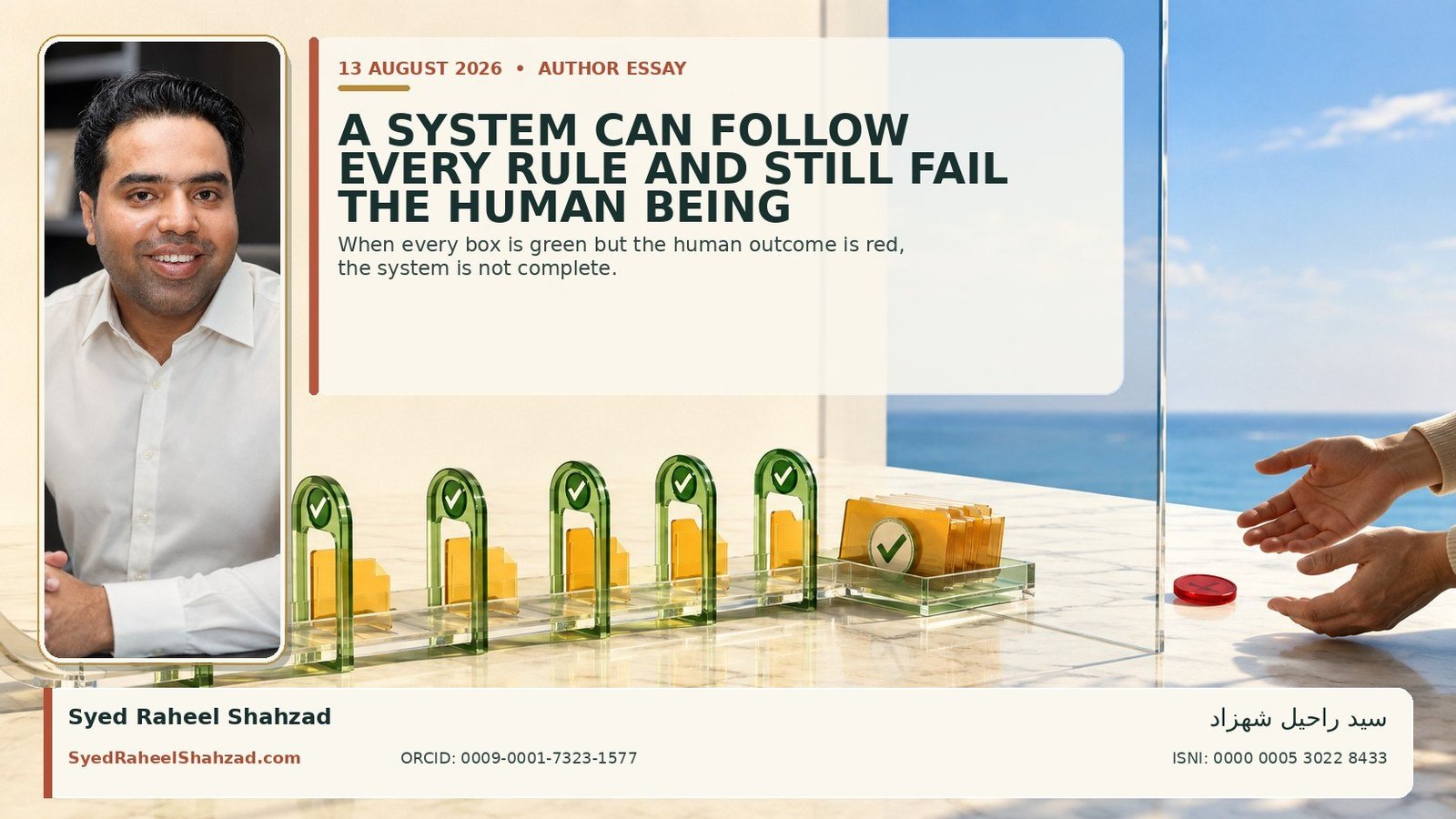
The letter said the case had been handled correctly.
The form had been received. The required fields had been checked. The matter had passed through the authorised stages. The response had been issued within the stated period. The file was now closed.
Only one fact did not fit the record: the human being still had the same problem.
Nothing in the process appeared broken because the process had measured itself by its own movement. It knew that a form had travelled. It did not know that a life had remained still.
The most dangerous institutional sentence is sometimes: “Everything was done correctly.”
Two kinds of success
Every serious system needs procedure. Hospitals, schools, courts, businesses, charities and public institutions cannot depend only upon mood, memory or personal favour. Rules create continuity. Records make decisions reviewable. Timelines prevent indefinite delay. Defined authority protects people from arbitrary power.
But a procedure is not the purpose. It is a method built to serve a purpose.
This distinction creates two different tests of success. Procedural success asks whether the required steps were completed. Human success asks whether the legitimate purpose of those steps was achieved in the reality of the person affected.
A complaint can be answered without being understood. An appointment can be processed while the patient remains unheard. A school can enforce attendance while failing to discover why a child has disappeared. A company can meet every performance target while exhausting the people who produced the result. A charity can count the number of cases closed while families remain unable to access the help for which the service exists.
In each case, the system may be active, compliant and well documented. Yet activity is not the same as resolution; compliance is not the same as justice; documentation is not the same as truth.
When every box is green but the human outcome is red, the system is not complete.
Purpose inversion
I call the deeper failure purpose inversion. It occurs when protecting the procedure becomes more important than fulfilling the purpose for which the procedure was created.
A rule originally designed to organise access becomes a reason to deny access. A target designed to improve service becomes a reason to avoid difficult cases. A safeguarding protocol becomes paperwork that proves the institution acted, even when nobody became safer. A performance system begins to reward what is easy to count rather than what is important to achieve.
The inversion is rarely announced. It grows gradually. Staff learn that completed fields are inspected more reliably than unresolved lives. Leaders ask how many cases moved, not how many problems ended. Dashboards report speed, volume and compliance because these numbers are available. The human outcome is harder to measure, so it becomes easier to ignore.
Eventually, the organisation begins serving the evidence of its own correctness. The procedure no longer carries the mission. The mission is used to justify the procedure.
The comfort of administrative innocence
Systems can distribute action so widely that they also distribute responsibility until nobody appears responsible.
The first person received the form but had no authority to interpret it. The second checked eligibility but could not consider exceptional circumstances. The third issued the decision based on the available categories. The fourth closed the file because the response had been sent. Each person completed a narrow task correctly. Together, they produced an outcome that no one would defend as the purpose of the system.
This creates administrative innocence: every participant can say, truthfully, “I did my part,” while the person affected cannot find anyone who owns the whole.
The problem is not always cruelty. Often it is fragmentation. A human life arrives as one reality, but the institution divides it among departments, thresholds, codes and permissions. What falls between those divisions becomes the human remainder—the part that exists in life but has no field in the form.
The person whom the process cannot see becomes the cost the process refuses to count.
Uniform treatment is not automatically fair treatment
Institutions often defend a harmful outcome by saying the same rule applies to everyone. Consistency matters. Selective exceptions can conceal favouritism, discrimination or corruption. Yet sameness and fairness are not identical.
A digital-only application treats everyone the same, but not everyone has equal digital access, literacy, language ability or physical capacity. A fixed deadline is uniform, but a person in hospital does not possess the same practical opportunity as someone in ordinary circumstances. A complaint route may be technically open to all, while being navigable only by people with time, confidence, money and institutional fluency.
A system does not become just merely because it distributes its blindness equally.
Fairness asks whether people had a genuinely usable route, whether relevant differences were considered and whether the burden of navigating the process was proportionate. Uniformity can be one instrument of fairness. It cannot be its final proof.
What the dashboard cannot feel
Metrics are necessary, but every metric is a decision about what counts. What is counted becomes visible to leadership. What remains uncounted can disappear from institutional attention.
Consider a support team measured by average handling time. The measure may reduce unnecessary delay. But if staff learn that a complex caller threatens the target, speed can quietly replace understanding. Consider a hospital measured by appointment volume. Capacity matters, but volume cannot reveal whether the most vulnerable patients understood the next step. Consider a business celebrating low employee turnover. The number looks stable, yet it cannot show how many people have emotionally resigned while still receiving a salary.
The issue is not that the numbers are false. It is that they are partial. A partial truth becomes dangerous when it is presented as a complete account of reality.
Good systems therefore pair activity measures with outcome measures. They ask not only, “Did we respond?” but “Was the issue resolved?” Not only, “Did the person attend?” but “Could the person actually use what was offered?” Not only, “Was the policy applied?” but “Did its legitimate purpose survive the application?”
Procedure still matters
Criticising procedural blindness is not an argument for rulelessness. Human judgement can be biased. Discretion can be captured by status, familiarity, prejudice or pressure. A system that promises to “treat every case personally” can become less accountable if decisions leave no record and no consistent standard.
The answer is not to replace procedure with sentiment. It is to design procedure with accountable human review.
Rules should define the normal route. Evidence should make decisions explainable. But the system must also identify the circumstances its normal route cannot safely absorb. Discretion should be authorised, bounded, recorded and reviewable. Exceptions should require reasons, not personal favour. Human review should correct the limits of the category without dissolving protection against arbitrary power.
A mature system is neither rigid nor vague. It knows what must remain consistent and where reality requires responsible adaptation.
The purpose-and-outcome test
Before declaring that a case was handled correctly, leaders and decision-makers should ask six questions:
| Test | Question |
|---|---|
| Purpose | What legitimate human purpose was this procedure created to serve? |
| Outcome | What actually happened to the person—not only to the file? |
| Visibility | What relevant reality could not fit the available categories, fields or evidence rules? |
| Access | Could the person realistically understand and navigate the route provided? |
| Ownership | Who is accountable for the whole outcome when several people each own one step? |
| Review | Is there a timely, safe and genuinely empowered route for reconsideration? |
If the answers show that the steps were completed but the purpose was defeated, the correct response is not to defend the file. It is to repair the system.
Closure is a decision, not a fact
Administrative closure is often mistaken for real closure. A system may close a case because its own next action has ended. The person may experience that same moment as abandonment.
Before closure, a humane process should distinguish among at least four states: resolved, transferred with confirmed ownership, paused for a stated reason, and closed without resolution. These states are not morally interchangeable. Calling all of them “closed” produces a clean report by removing the difference that matters most.
Language shapes accountability. If “response sent” is recorded as “issue resolved,” the dashboard does not merely simplify reality; it changes it. The institution becomes unable to learn because its vocabulary has already declared success.
The responsibility of leadership
Frontline staff often see the gap first. They know which forms repeatedly confuse people, which thresholds exclude urgent cases, which referrals return without ownership and which families are likely to disappear because the next step is too difficult.
But if raising these patterns creates more work without authority, the knowledge remains private. If leadership rewards speed alone, staff learn to protect the metric. If every exception is treated as personal failure, people stop reporting what the standard process cannot handle.
Leadership must make institutional learning safer than institutional pretence. That means inviting evidence of unresolved outcomes, protecting staff who identify design failures, reviewing recurring exceptions and changing the procedure when the same “unusual” case appears repeatedly.
An exception that happens every week is not an exception. It is feedback about the design.
A humane system notices before the crisis
Many systems become attentive only when difficulty becomes dramatic. The employee must resign before workload is discussed. The student must disappear before absence gains meaning. The caregiver must collapse before support is offered. The complaint must become public before someone with authority reads it as a human account rather than a reference number.
This is a costly form of visibility. It requires people to become worse before the system believes them.
Humane design creates earlier entry points: a named person who can listen, simple escalation language, accessible alternatives, follow-up when engagement stops, and warning signals that trigger care rather than punishment. It measures silence as possible information instead of assuming silence means resolution.
This wider institutional responsibility is examined in the Syed Foundation essay, People Should Not Have to Become a Crisis Before a System Notices Them.
How to challenge a formally correct failure
For the person inside the failed outcome, abstract criticism is rarely enough. The immediate need is to make the unresolved reality visible without being trapped in an argument about whether staff followed the checklist.
The most useful shift is from “You did nothing” to “The procedure was completed, but its intended purpose was not achieved.” State the human outcome, identify the purpose, show what information the standard route missed, ask for the person authorised to review it, and obtain a named next step.
The companion Ask SRS guide provides this method in the HUMAN framework for challenging a system that says everything was done correctly.
The final measure
A system is not humane because it speaks kindly while producing the same preventable harm. Nor is it effective because its internal indicators remain green. Human-centred design is not decoration around the procedure. It is the discipline of ensuring that the procedure remains answerable to the reality it exists to serve.
Rules should make justice more reliable, not make responsibility disappear. Records should reveal truth, not certify institutional innocence. Metrics should guide attention, not replace judgement. Closure should describe an outcome, not merely the end of administrative interest.
Procedure can explain how a decision was made. It cannot, by itself, prove that the decision was right.
The deepest test is therefore simple: after the system has completed everything it requires of itself, what has happened to the human being?
If the file is closed but the legitimate purpose remains unmet, the work is not complete. If no one owns the unresolved outcome, the design has divided responsibility too far. If reality repeatedly arrives in forms the institution cannot see, reality is not the error.
The system must learn to see.