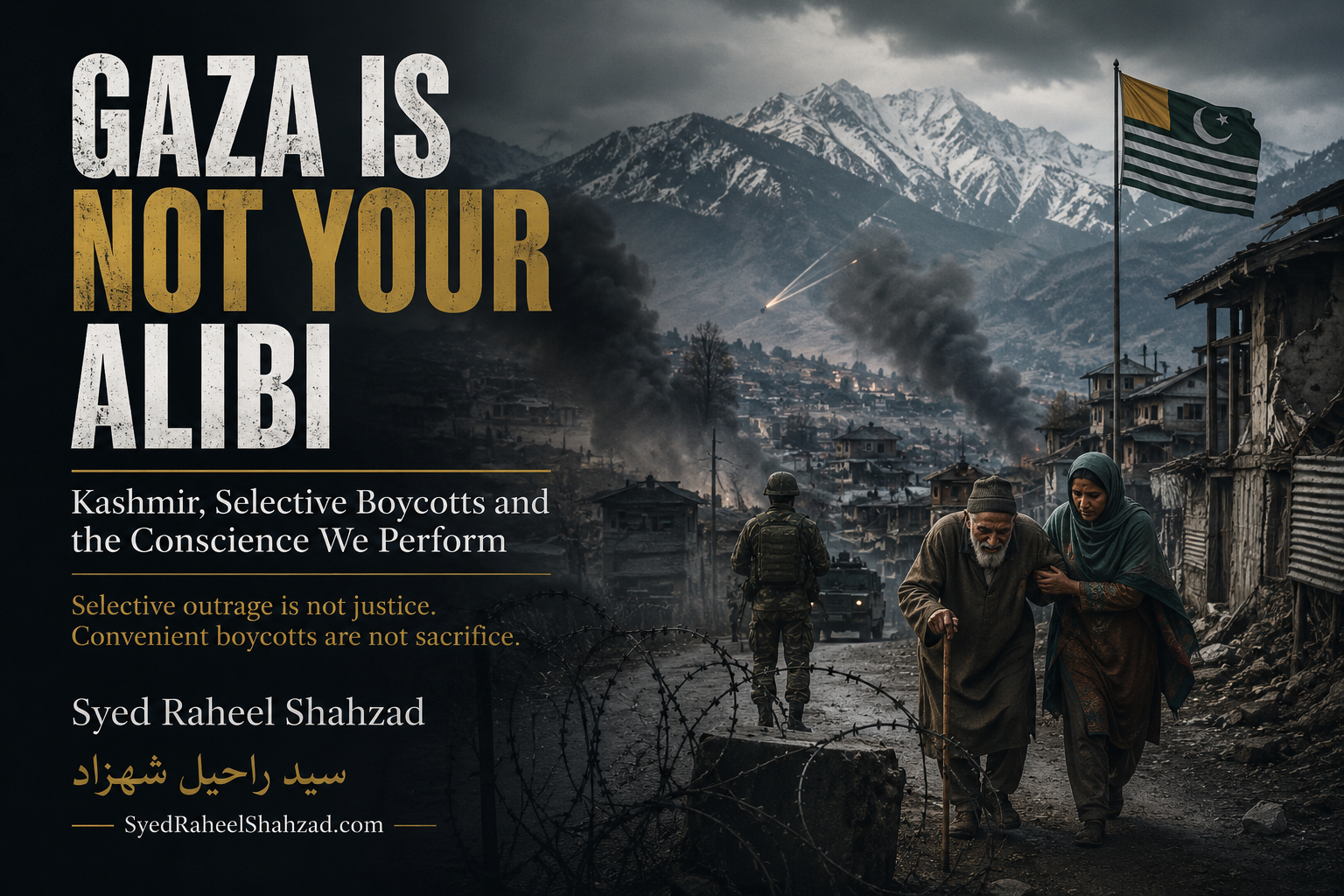
Gaza Is Not Your Alibi: Kashmir, Selective Boycotts and the Conscience We Perform
Gaza Is Not Your Alibi: Kashmir, Selective Boycotts and the Conscience We Perform
A conscience that can cross oceans for a trending injustice but refuses to cross its own street for a neighbour’s suffering is not universal. It is selective, safe and staged.
The words with which my Kashmir story began · 1999
ہر سمت مچلتی کرنوں نے، افسونِ شبِ غم توڑ دیا۔
In every direction, the restless rays broke the spell of the night of sorrow.
اب جاگ اُٹھے ہیں دیوانے، دنیا کو جگا کر دم لیں گے۔
The passionate have awakened; they will not rest until they awaken the world.
یہ بات عیاں ہے دنیا پر، ہم پھول بھی ہیں، تلوار بھی ہیں۔
Let the world understand: we are flowers, but we are also swords.
یا خون میں نہا کر دم لیں گے، تو چاہے قیمت کچھ بھی ہو۔
We will endure even if we must be bathed in blood, whatever the price may be.
عزت سے جیے تو جی لیں گے، یا جامِ شہادت پی لیں گے۔
We will live only with dignity—or drink from the cup of martyrdom.
The easiest injustice to condemn is the one committed by a distant enemy. The hardest injustice to confront is the one committed under our own flag, protected by our own loyalties and sustained by our own silence.
The speech that I won—and the question that remained
In 1999, I was an eighth-grade student standing before my school to deliver a speech on Kashmir Day. I spoke with everything a child could place inside his voice: pride, pain, honour, anger and hope.
I was declared the best speaker in the school.
I was proud of that moment. The emotion was real. The words were not empty to me. I believed them through my heart.
But even at that age, underneath the applause, another realisation had started forming.
We knew how to pronounce Kashmir.
We knew how to draw Kashmir on a banner.
We knew the poems, slogans and annual speeches.
But how many of us understood the people?
How many knew what Kashmiris experienced in ordinary life? How many knew what rights they were asking for, what political choices existed among them, what development they lacked, what restrictions they faced, or how it felt to become the subject of two national stories without being permitted to author their own?
Pakistan had taught us to love Kashmir as a cause.
It had not necessarily taught us to listen to Kashmiris as people.
Across the border, India had developed its own version of the same failure. It could speak about sovereignty, national integration and security while much of its population remained distant from the lived reality of Kashmir.
India and Pakistan disagreed about who owned Kashmir. They were often united in forgetting that Kashmiris owned their own lives.
That was the first serious question Kashmir gave me.
Not which slogan was louder.
Not which flag was larger.
But whether the human being beneath the slogan had been seen at all.
When the world entered my student life
After completing Grade 10, I moved to Lahore for my first year of further education.
During my first month, the attacks of September 11 changed the direction of global politics. The United States entered Afghanistan. Fear spread across the region. Public life tightened. Educational routines, transport and the wider structure of student life were repeatedly disturbed.
For almost three months, as I personally experienced it, some of the most important parts of education and student life were interrupted.
A war decided thousands of kilometres away entered our classrooms without asking whether we had examinations, ambitions, fees, families or futures.
In the years that followed, controversies associated with Denmark—first remembered through blasphemous cartoons and later through episodes involving the burning of the Qur’an—produced repeated waves of fury.
Pakistan protested.
Roads were blocked.
Schools and colleges closed.
Businesses lost income.
Buses, motorcycles, bicycles and property belonging to ordinary people were damaged or burned.
The shopkeeper in Lahore had not published the cartoon.
The motorcyclist had not burned the Qur’an.
The student had not designed the foreign policy.
The ambulance patient had not insulted anyone’s religion.
Yet these were the people made to pay.
What defence of the sacred begins by destroying the bicycle of a poor man who needs it to earn bread?
We said that we were defending honour, but we humiliated innocent people.
We said that we were resisting oppression, but we trapped ordinary workers on roads.
We said that our anger was for God, and then made God’s servants carry its cost.
A crowd can be sincere and still be wrong.
Emotion can be real and still be undisciplined.
Anger can wear the clothes of courage while functioning as an escape from thought.
When we cannot reach the real source of our anger, we often punish the nearest powerless person and call it resistance.
Gaza is not the target of this criticism
As my career and understanding developed, Palestine remained one of the most powerful moral and political questions in Muslim public life.
It should remain a moral question.
The killing of civilians, forced displacement, collective punishment, destruction of homes, denial of essential services and expansion of unlawful settlements must be opposed.
No human being becomes less sacred because a state finds that person strategically inconvenient.
No Palestinian child is responsible for the political decisions of an armed organisation.
No civilian population should be treated as material through which military objectives are pursued.
Let no one distort my argument.
Gaza deserves every honest voice.
Palestine deserves justice.
Illegal settlement, forced dispossession and the killing of innocent people cannot be excused by theology, history, trauma or national security.
But Gaza must not become an alibi through which we hide from the injustice in our own societies.
We shout “Gaza” when the oppressor is foreign.
We become careful, quiet and complicated when the oppression carries our own flag.
We are brave against a government that cannot cancel our licence.
We are silent before an institution that can affect our job.
We condemn a distant army because the condemnation costs us almost nothing.
We avoid naming a local abuse because it may cost us a contract, a political connection, a friendship, a visa, a position or personal safety.
We are often fearless against the oppressor who cannot reach us and obedient before the injustice that knows our name.
Syed Raheel ShahzadThat is not universal morality.
It is geographically convenient morality.
The world now chooses our suffering for us
There was a time when conscience began with knowledge.
Today, conscience often begins with a notification.
We do not first ask where human dignity is being crushed.
We ask what is trending.
We wait for the video, the influencer, the approved slogan, the colour scheme, the hashtag and the boycott list.
Once the algorithm has certified the suffering, we feel permitted to care.
Before that, the victim may suffer invisibly for years.
Our age has not merely commercialised entertainment.
It has commercialised conscience.
Human suffering now competes for visibility.
A dead child must reach the correct platform, in the correct format, at the correct moment, before millions of people recognise that a moral emergency exists.
This is why one conflict can occupy every screen while another catastrophe involving millions remains a paragraph beneath football, cricket, celebrity arguments and political theatre.
The algorithm does not ask which human being needs us most. It asks which human suffering will hold our attention longest.
The Starbucks test: when boycott becomes performance
Nothing reveals selective morality more clearly than the way we boycott.
Starbucks became one of the most recognisable symbols of the post-2023 consumer boycott.
People photographed themselves rejecting it. Branches were targeted. Drinking its coffee became, in some communities, a public test of moral character.
Yet Starbucks was not originally identified as an official priority boycott target by the central BDS movement. The company has also publicly stated that neither it nor its former leadership financially supports the Israeli government or military.34
That does not mean a person is forbidden from boycotting Starbucks.
Consumers may refuse any company for labour practices, political conduct, litigation against workers, public messaging or personal principle.
But intellectual honesty requires us to know why we are boycotting.
A rumour repeated by millions does not become evidence.
A viral logo does not become a moral philosophy.
The deeper contradiction appears when people who aggressively shame a neighbour for buying coffee continue using the technological infrastructure of corporations whose governmental contracts are documented far more clearly.
Google and Amazon jointly received the approximately $1.2 billion Project Nimbus cloud-services contract for the Israeli government. Google employees protested the contract, and dozens were dismissed following workplace actions.5
Yet we do not leave Google Search.
We do not leave YouTube.
We do not abandon Android.
Businesses do not easily abandon Google advertising, cloud services, email systems, maps, analytics or the digital infrastructure on which their income depends.
We continue shopping through systems connected to Amazon’s wider commercial and cloud ecosystem.
We organise our boycott through the very technological networks we are unwilling to examine with the same moral aggression.
We boycott what we can afford to leave and keep what our comfort, work and visibility depend upon. Then we rename convenience as sacrifice.
A coffee shop is visible.
Cloud infrastructure is invisible.
A coffee can be replaced in five minutes.
A digital ecosystem may structure an entire career.
Therefore, we demonstrate courage where courage is cheapest.
The local Starbucks employee, franchise worker or delivery rider may feel the economic effect before any foreign government does.
The person we punish may have no control over the policy in whose name we punish them.
We did this on roads during protests.
We do it again through careless boycott culture.
The method changes.
The innocent person still pays first.
The easy boycott
Reject something inexpensive, visible and easily replaced, then display the decision publicly.
The difficult boycott
Give up a platform, contract, convenience or technology on which income and influence depend.
The selective protest
Condemn the injustice committed by a distant political enemy while remaining silent before domestic power.
The principled protest
Apply the same moral test to allies, enemies, governments, movements and yourself.
Keep your protest in your pocket if it appears only when protest is fashionable, safe and cheap.
Our conscience is selective because our politics is tribal
We do not consistently oppose oppression.
We oppose the oppression committed by the side we already dislike.
If a Western power kills civilians, we recognise imperialism.
If an allied regional power supports a brutal system, we suddenly discover complexity.
Iran’s military advisers and Quds Force played a decisive role in helping preserve Bashar al-Assad’s government during the Syrian war.6
Syria was devastated.
Cities were destroyed.
Families were scattered across continents.
Civilians were killed by the state, armed groups, extremist organisations and international interventions.
Yet many people who could identify every Western crime with precision became hesitant when criticism reached a government or movement located inside their preferred political camp.
The same selective blindness operates elsewhere.
Sudan has become one of the world’s largest displacement and humanitarian crises, with millions uprooted from their homes.7
Somalia entered 2026 with millions requiring humanitarian assistance because of drought, conflict, hunger, disease and displacement.8
Manipur experienced prolonged ethnic violence in which more than 260 people were reported killed and more than 60,000 displaced after May 2023.9
Where were the permanent hashtags?
Where were the daily lectures?
Where were the public tests of loyalty?
The victim had not become less human.
The victim had merely failed to become globally fashionable.
When the identity of the oppressor determines whether we recognise the victim, we are not defending humanity. We are defending a political team.
Look at the countries whose flags you carry
India is not one experience merely because it is one republic.
A crisis may consume Assam or Manipur while ordinary people in Delhi or Mumbai remain almost completely disconnected from its emotional and political reality.
Punjab and Haryana can produce major farmer movements, but much of the national conversation reduces them to road inconvenience rather than questions of agricultural survival, income and power.
Tamil Nadu and Kerala continue to raise difficult questions about language, federalism, taxation, representation, culture and the concentration of national power.
Their questions are not identical.
Their histories are not identical.
But each exposes the distance between the centre’s national story and the region’s lived experience.
Pakistan is not one experience merely because it is one federation.
Khyber Pakhtunkhwa has repeatedly absorbed the human cost of militancy, counter-militancy, border policy, displacement and promises of peace made elsewhere.
Baloch families have spent years asking about missing relatives while their grief is too often treated as a public-relations problem.
Sindh raises questions involving water, land, rural deprivation, resources and unequal development.
Gilgit-Baltistan continues to live with constitutional and representational ambiguity.
Azad Jammu and Kashmir asks why a region placed at the centre of Pakistan’s national emotion remains peripheral when its own people demand affordable electricity, flour, development, representation and accountable government.
We love the map.
We become uncomfortable with the people living inside it.
The state celebrates the margin when the margin confirms the national story. The moment the margin asks a question, it becomes a security concern.
A demand becomes disorder.
A march becomes conspiracy.
A question becomes disloyalty.
A population becomes a file.
Rights are not distant emotions; they are nearby obligations
In HAQOOQ: What You Owe Allah and What You Owe Humanity, Stage 7 of The Source of Truth System™, I examine rights through the relationship between duty, justice, responsibility, family, society and moral accountability.
HAQOOQ asks what a human being owes Allah and what a human being owes other people.
The question is not merely whether I feel sympathy.
The question is what another human being’s right places upon me as a duty.
Islam does not permit justice to remain safely directed at outsiders.
The Qur’an commands believers to stand firmly for justice even when the truth operates against themselves, their parents or their relatives.
It commands justice even when hatred of another people tempts us away from fairness.
It places responsibility toward parents, relatives, orphans, people in need, the near neighbour, the distant neighbour and the traveller.
This order is philosophically important.
It does not say that the distant human being matters less.
It says that responsibility becomes heavier where knowledge, access, citizenship, money, influence, voting power and physical presence make action possible.
A right is not merely what the harmed person may demand. It is the duty that becomes binding upon those who know, can act and can no longer pretend that the suffering is none of their concern.
You may care about Gaza.
But you cannot use Gaza to escape Kashmir.
You may condemn Israel.
But you cannot use Israel to avoid questioning Islamabad, Rawalpindi, New Delhi, Srinagar, Muzaffarabad, Quetta or Peshawar.
You may speak for a Palestinian child.
But that speech becomes morally incomplete if you step over the hungry, frightened, excluded or silenced child in your own street.
Proximity does not make one life more valuable
Some will misunderstand this argument.
They will say: are you asking us to care only about our own people?
No.
Human worth does not decrease with distance.
A Palestinian life, a Kashmiri life, a Syrian life, a Sudanese life, a Somali life, a Baloch life, a Punjabi life and a Manipuri life possess the same human dignity.
But responsibility is not distributed only according to the value of the victim.
It is also distributed according to the reach of the witness.
You may be more answerable for the injustice beside you—not because the person beside you is more human, but because you could see, speak, vote, intervene, testify or refuse.
And you chose silence.
Universal compassion without local responsibility is often only a beautiful way of avoiding accountability.
Kashmir is not territory before it is a people
Kashmir has been handled for decades as land first and human life second.
India sees territory, frontier, sovereignty and national integration.
Pakistan sees an unfinished question of Partition, ideological legitimacy and a national cause.
The Kashmiri sees a home.
This difference changes everything.
A capital sees a line on a map.
A resident sees the road to school.
The electricity bill.
The hospital.
The checkpoint.
The closed road.
The missing opportunity.
The land of ancestors.
The grave of a parent.
The future of a child.
States can postpone a political dispute for generations because the institutions of the state continue functioning while the dispute remains unresolved.
Ordinary people cannot postpone life.
Children become adults.
Parents grow old.
Businesses fail.
Young people migrate.
Schools remain inadequate.
Hospitals wait.
Roads remain unfinished.
The political dispute slowly becomes an economic, social and psychological condition.
India and Pakistan must answer a question larger than ownership: what have you built for the human beings whose land you claim so passionately?
A claim without care is possession.
A flag without rights is decoration.
Sovereignty without accountability is organised power.
Two sides of Kashmir, two systems of control
The realities on the two sides of the Line of Control are not identical.
Their legal structures, military environments, political systems and scale of restrictions differ.
Serious analysis must not flatten those differences.
Indian-administered Jammu and Kashmir has experienced prolonged militarisation, security laws, detention controversies, restrictions on political activity, communications controls and the constitutional transformation that followed the removal of Article 370 in 2019.
On 5 August 2026, regional political parties again marked the anniversary of that decision as a “black day,” while authorities curtailed larger protest activity.10
Pakistan-administered Kashmir presents a different structure but not the absence of a rights problem.
The questions there include political representation, constitutional authority, elite privileges, resource distribution, electricity pricing, flour subsidies, development, public services and the limits placed upon political expression.
Acknowledging injustice on one side does not require denying injustice on the other.
Justice does not need false equivalence.
It needs honest examination.
Azad Kashmir is asking questions that slogans cannot answer
The modern protest movement in Azad Jammu and Kashmir did not emerge from abstract philosophy.
It grew from ordinary life.
Flour.
Electricity.
Public services.
Elite privileges.
Representation.
The use of local resources.
The feeling that the people carried the costs while protected groups retained the privileges.
By 2026, conflict had intensified around political rights and twelve assembly seats reserved for refugees from Indian-administered Kashmir who live elsewhere in Pakistan.
The Joint Awami Action Committee argued that the seats permitted people living outside AJK to exercise disproportionate influence over its politics.
The regional government banned the organisation under anti-terrorism legislation before planned demonstrations. Arrests, boycott calls, clashes, security measures and disruptions followed. The government said that it had accepted thirty-six of the movement’s thirty-eight demands, while describing the reserved-seat issue as requiring constitutional action.12
Violence against civilians cannot be justified.
Violence against police officers cannot be justified.
Burning public property cannot be justified.
Blocking medicine and trapping ordinary families cannot be justified merely because a movement describes itself as resistance.
But neither can the wrongdoing of some protesters be used to erase the grievance that existed before the wrongdoing.
A movement can contain legitimate demands, anger, opportunism, poor leadership and unlawful conduct at the same time.
A serious state must possess the moral and intellectual capacity to distinguish among them.
It must prosecute a crime without criminalising a population.
It must protect public order without converting order into permanent obedience.
It must negotiate without behaving as though negotiation is a favour offered by rulers to subjects.
Bread is not sedition. Electricity is not separatism. Representation is not terrorism. Asking where public money goes is not an attack on the nation.
Do not rename every struggle you refuse to understand
Power frequently follows the same sequence.
First, ignore the grievance.
Then, when the grievance grows, condemn its tone.
When people march, question their loyalty.
When anger produces an unlawful act, use the worst act to describe the entire population.
Finally, claim that no legitimate grievance ever existed because the movement was imperfect.
But no human movement is pure.
Governments are not pure.
Political parties are not pure.
Armies are not pure.
Crowds are not pure.
National stories are not pure.
Justice does not require purity before listening.
It requires the ability to separate a legitimate right from an illegitimate method.
Not every criticism is treason.
Not every protester is violent.
Not every police officer is an oppressor.
Not every national claim is false.
And no national claim is sacred enough to remove the rights of the people living beneath it.
What Kashmir has already achieved
Kashmir does not need outsiders to manufacture courage for it.
Its people have survived empires, Partition, wars, militarisation, political manipulation, interrupted trade, displacement and competing national narratives.
Across both sides of the dividing line, Kashmir has preserved a civilisational identity deeper than the modern states contesting it.
It has maintained traditions of scholarship, poetry, craft, spirituality, agriculture, trade, family and community.
Kashmiris have built schools, businesses, welfare organisations, professional networks and diaspora institutions across Britain, the Gulf, Pakistan, India and other parts of the world.
They have produced writers, teachers, civil servants, soldiers, lawyers, doctors, entrepreneurs, political leaders and community builders.
They have done this while repeatedly being told that their first responsibility is to fit inside someone else’s description of them.
The achievement of Kashmir is not that it remained quiet.
Its achievement is that it remained itself.
It did not disappear inside the story told about it.
It continued to remember.
It continued to ask.
It continued to distinguish dignity from permission.
Kashmir will not disappear because a capital calls its questions inconvenient. A people are not erased when their name remains attached to a territory; they are erased when the territory matters more than their voice.
Syed Raheel ShahzadThe mirror before the megaphone
I am not asking anyone to stop speaking for Gaza.
I am asking whether your conscience has borders.
Can you say “Palestine” but refuse to say “Balochistan”?
Can you say “Gaza” but remain silent about Kashmir?
Can you condemn the detention of a Palestinian while refusing to discuss detention by an institution you consider your own?
Can you grieve for a Palestinian mother while mocking a Baloch mother carrying the photograph of a missing son?
Can you denounce displacement in Gaza while treating displacement in Manipur, Sudan, Syria or Somalia as background noise?
Can you boycott a coffee for justice abroad while continuing to vote for humiliation at home?
Can you condemn a distant settlement while remaining silent when local land, resources or representation are taken without meaningful consent?
Can you lecture the world about human rights while refusing to listen to the people whose taxes, labour, land and loyalty sustain your own state?
If so, your problem is not lack of information.
It is lack of moral consistency.
First look in the mirror. Then raise the megaphone.
Kashmir will not bow to someone else’s description
Kashmir will not be concluded by a hashtag.
It will not be settled by an annual speech, a ceremonial banner, a television anthem or a minute of silence.
It will not be healed by India describing every political question as a security threat.
It will not be healed by Pakistan celebrating Kashmir in public while dismissing Kashmiri demands in practice.
Kashmir will not bow to New Delhi.
Kashmir will not bow to Islamabad.
It should not be required to bow to a political committee, an armed group, an intelligence narrative, a party leader or an outsider who has never lived its reality.
Kashmir must be permitted to stand with dignity before all of them.
The responsibility of outsiders is not to hijack the struggle.
It is not to assign one identity, one ambition or one political answer to every Kashmiri.
It is to listen honestly.
Protect human rights.
Permit peaceful political expression.
Build accountable institutions.
Invest in education, employment, infrastructure and public services.
And abandon the belief that control is the same thing as consent.
The speech I would give today
In 1999, I stood before my school and spoke about awakening the world.
Today, I would begin somewhere more difficult.
I would still ask the world to awaken.
But first I would ask Pakistan to awaken to the people whose cause it has carried in slogans for generations.
I would ask India to awaken to the truth that a nation is not strengthened by forcing every wound to speak the vocabulary of obedience.
I would ask Muslims to awaken from a morality controlled by trends, political alliances and selective anger.
I would ask activists to awaken from the belief that posting is sacrifice.
I would ask consumers to awaken from the belief that changing the name on a coffee cup is the completion of resistance.
I would ask governments to awaken from the belief that silence is peace.
And I would ask every person who chants only for Gaza:
Who is suffering in your own backyard while you are performing courage across the ocean?
Do not lower your voice for Palestine.
Expand your conscience for everyone else.
Do not abandon boycott because boycott can be imperfect.
Abandon the lie that convenience is sacrifice.
Do not stop protesting.
Stop selecting which human being is permitted to activate your humanity.
Until then, keep your protest in your pocket.
Because protest that cannot confront injustice at home is not yet principle.
It is performance waiting for an audience.
Gaza deserves our voice. Kashmir deserves more than our silence. Justice deserves a conscience that does not change its principles when the flag above the victim changes.
Syed Raheel Shahzad
Syed Raheel Shahzad
Author, Group CEO, Business Strategist, Systems Thinker & Architect. His work examines human responsibility, rights, civilisation, governance, moral formation and the architecture of accountable systems.
Continue through the author record
This essay connects Kashmir, selective outrage, boycott culture and public protest to the wider moral framework developed in HAQOOQ and The Source of Truth System™.
Evidence and source notes
- Associated Press, 5 August 2026: AJK election results, the JAAC boycott call, the organisation’s ban, disputes concerning twelve reserved seats and the government’s statement that thirty-six of thirty-eight demands had been accepted. View source
- Al Jazeera, 22 July 2026: the AJK election, the June 2026 ban on the Joint Awami Action Committee and the dispute over reserved refugee seats. View source
- Time, 14 February 2024: overview of BDS boycott strategy and the clarification that Starbucks was not an official priority BDS target. View source
- Starbucks corporate statement: the company says that it has not provided financial support to the Israeli government or military. View source
- Reuters, April 2024: Google employee dismissals following protests over Project Nimbus, the approximately $1.2 billion Google and Amazon cloud contract with the Israeli government. View source
- Carnegie Endowment, December 2024: Iranian advisers, including the Quds Force, played a decisive role in safeguarding Bashar al-Assad’s government during the Syrian conflict. View source
- United Nations OCHA: Sudan’s humanitarian emergency and the displacement of millions of civilians. View source
- United Nations Somalia, January 2026: approximately 4.8 million people estimated to require humanitarian assistance during 2026. View source
- Human Rights Watch, March 2025: more than 260 people killed and over 60,000 displaced during the continuing ethnic violence in Manipur. View source
- Economic Times, 6 August 2026: Jammu and Kashmir political parties marked the anniversary of the removal of Article 370 as a “black day,” while larger protests were curtailed. View source