The Spectator’s Conscience: What Happens When We Witness More Suffering Than We Can Answer
Philosophical Essay · Moral Attention, Digital Exposure, Responsibility, Compassion and Human Limits
The Spectator’s Conscience: What Happens When We Witness More Suffering Than We Can Answer
A philosophical inquiry into what happens when global suffering becomes permanently visible—and how to remain compassionate without confusing witnessing with helping, guilt with responsibility or exhaustion with moral seriousness.
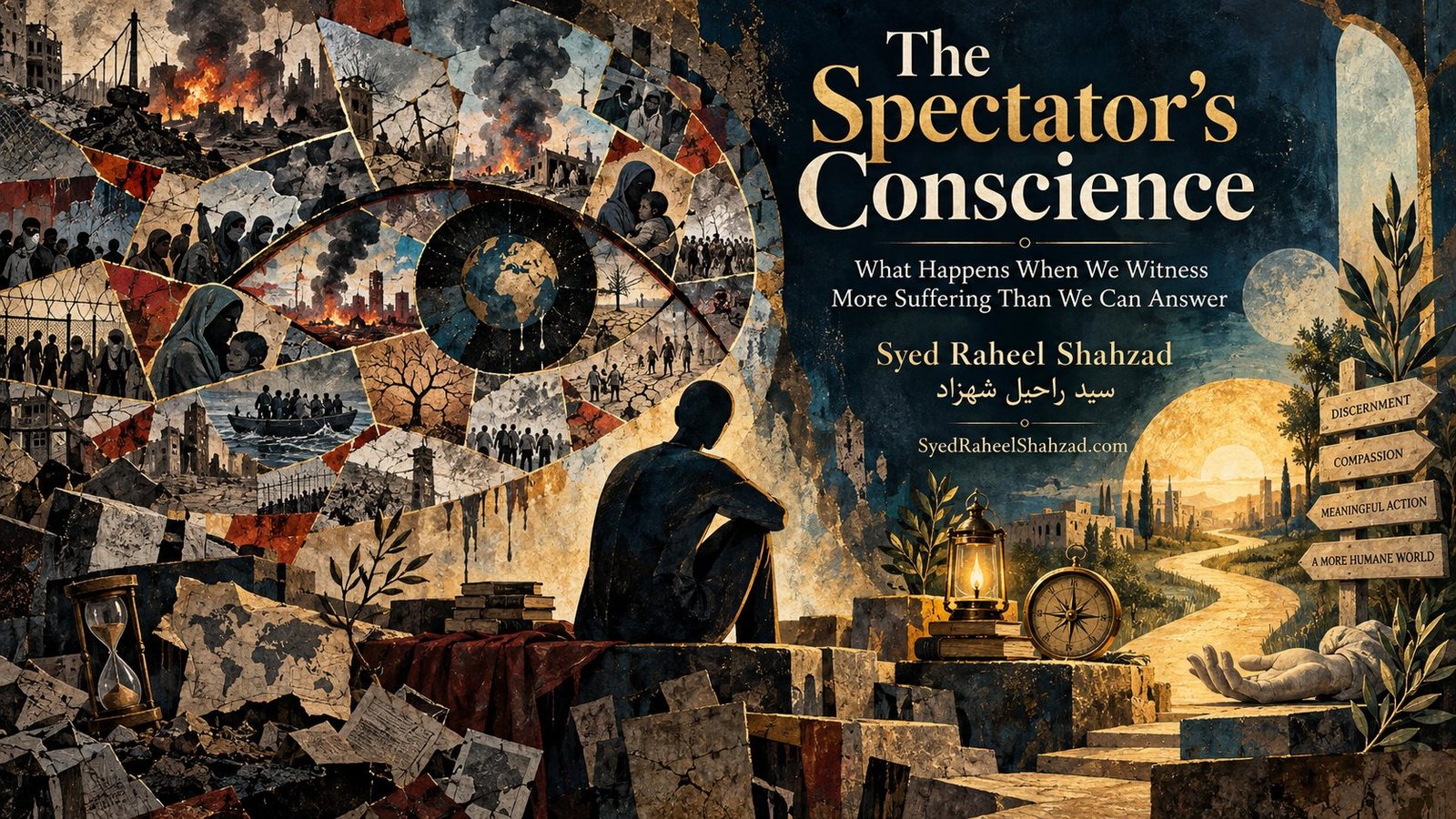
The human conscience was not designed for a planet-sized feed
For most of human history, suffering reached people through proximity. We knew the illness in the family, the hunger in the street, the injustice in the town, the death in the community, the war that crossed our own border or entered our own memory. Today suffering arrives through a different architecture. It is continuous, visual, global and algorithmically repeated. Before breakfast we may see a bombed building, a displaced family, a famine warning, a flood, a child under rubble, a refugee boat and a collapsing hospital. By lunch there is another crisis.
This expansion of visibility is morally important. Distance no longer protects us from ignorance in the way it once did. We can hear people who would once have been excluded, document abuses, mobilize aid and learn about suffering in real time. But a new moral problem appears alongside this achievement: what happens when the field of suffering expands faster than the field of human agency?
The modern conscience is asked to witness at planetary scale while remaining capable of acting only at human scale.
The result is not simply sadness. It is a structural mismatch between what can enter awareness and what can be answered by one life.
Seeing is not the same as helping
Digital culture often collapses several moral activities into one. To see a tragedy feels like participation. To repost feels like intervention. To feel guilty feels like responsibility. To remain emotionally activated feels like compassion. Yet these are different things.
Witnessing matters because invisible suffering is easier to ignore. But witnessing does not itself feed a family, protect a child, rebuild a school, document a crime, finance treatment, influence policy or comfort the bereaved. Moral life begins to distort when the emotional experience of seeing is treated as though it were equivalent to the practical work of serving.
This distinction is not an argument against awareness. It is an argument for moral precision. The question is not only, “Did I see it?” It is also, “What, if anything, is mine to do?”
The burden of unlimited moral adjacency
The smartphone has created a strange condition: almost every crisis can be made psychologically adjacent. A war thousands of miles away may appear between family photographs. A famine may arrive as a notification beside a message from work. An image of mass suffering may appear while someone is sitting safely in a kitchen.
Physical distance remains, but emotional distance is repeatedly breached.
This can produce what I call unlimited moral adjacency: the experience that because suffering is visible, it is somehow personally near enough to make a claim on us. Some claims are real. Others are enlarged by the medium. The screen removes geographical distance but does not remove the limits of money, time, knowledge, influence, competence or responsibility.
If every visible tragedy is interpreted as an immediate personal duty, the conscience becomes impossible to satisfy.
Guilt is not a map of responsibility
Guilt can be morally useful when it identifies something we have actually done, neglected or enabled. But guilt can also become unmoored from agency. A person may feel guilty because others are suffering even when they did not cause the suffering, possess no special capacity to stop it, and have no realistic path to meaningful intervention.
The feeling is sincere, but sincerity does not make it an accurate map of duty.
Responsibility requires more than emotional contact. It requires some combination of relationship, role, causation, capacity, knowledge, opportunity and reasonable expectation. A parent has responsibilities toward a child that a stranger does not. A doctor has responsibilities in a hospital that a spectator does not. A government has responsibilities toward citizens that an individual social-media user does not. A company that contributes to harm carries duties different from those of someone who merely reads about it.
When these distinctions collapse, moral seriousness turns into undifferentiated self-accusation.
Why constant exposure can make us less, not more, responsive
There is an assumption that more exposure to suffering must produce more compassion. Sometimes it does. Images can awaken conscience, break denial and generate extraordinary generosity. But repeated exposure can also numb, exhaust, fragment and confuse.
The Reuters Institute’s 2026 Digital News Report describes a news environment competing for four to five hours of daily smartphone attention and notes responses that include overload, anxiety, disengagement and cynicism. Its 2025 report found that 40 percent across surveyed markets said they sometimes or often avoided the news, with overload and powerlessness among the reasons people gave.
This does not prove that people care less. In many cases it may show that the machinery of attention is asking more than people can metabolize.
Compassion without rhythm becomes depletion. Attention without boundaries becomes capture. Witnessing without agency becomes helplessness.
The difference between compassion and permanent activation
Compassion is not a state of maximum emotional pain. If it were, the most compassionate person would be the person most psychologically damaged by every tragedy. That cannot be right.
Compassion is better understood as morally serious responsiveness to suffering. It includes feeling, but it also includes judgment. It asks what response is appropriate, proportionate and possible. Sometimes that response is giving. Sometimes it is advocacy. Sometimes it is learning. Sometimes it is prayer, presence, professional service, political participation, institution-building or refusing to spread falsehood. Sometimes the honest answer is that one can do very little.
Permanent activation is different. It keeps the nervous system in a state of moral alarm while providing no hierarchy of action. The person becomes increasingly distressed but not increasingly effective.
The algorithm has no doctrine of proportion
Human beings need proportion. Platforms need engagement.
This difference matters. A healthy conscience must rank claims, distinguish urgency from importance, separate evidence from spectacle and ask whether an action is useful. An algorithm does not have to preserve that moral architecture. It can surface what is emotionally gripping, visually extreme, rapidly shareable or likely to hold attention.
The result is a feed in which scale is distorted. One shocking event may occupy the whole moral horizon for hours, only to disappear when another event arrives. The conscience is repeatedly mobilized and abandoned.
A person can therefore spend enormous emotional energy moving from crisis to crisis without developing stable commitments to any of them.
The spectator’s temptation
There is another danger: the moral identity of the spectator.
When public culture makes visible reaction a sign of goodness, people can begin to perform concern in order to prove that they are not indifferent. Silence becomes suspicious. Nuance can look cold. Taking time to verify facts can look evasive. Choosing one cause may be judged as neglect of another.
This creates pressure to display conscience rather than organize it.
The spectator’s temptation is to substitute moral visibility for moral effectiveness: to be seen seeing, seen caring, seen condemning, seen grieving. But the most useful work is often quieter. It may happen in budgets, classrooms, clinics, charities, legal files, research, long conversations, monthly donations, local volunteering or sustained political work.
A conscience should be measured less by how intensely it reacts in public and more by what kind of responsibility it can sustain.
Not every tragedy is yours, but no tragedy is meaningless
The answer is not moral isolation. “I cannot fix everything” can become an excuse for fixing nothing. The fact that duties are limited does not mean compassion should be narrow.
The challenge is to hold two truths together.
First: no individual is responsible for every tragedy they can see.
Second: the suffering of people outside our immediate circle still matters.
Moral maturity lives between these truths. It refuses both omnipotent guilt and comfortable indifference.
A hierarchy of moral response
We need a practical hierarchy for a world of unlimited exposure.
First comes truth: do I understand what I am seeing, or am I reacting to fragments?
Second comes relation: is there a special responsibility because of family, profession, citizenship, institution, contract, causation or direct proximity?
Third comes capacity: what can I realistically contribute—money, expertise, time, influence, voice, research, care?
Fourth comes effectiveness: will the proposed action help, or merely make me feel involved?
Fifth comes sustainability: can I continue this response without destroying the responsibilities already entrusted to me?
This hierarchy does not mechanize morality. It protects morality from becoming incoherent.
The ethics of choosing
Choice feels uncomfortable because every choice excludes something. If I give to one crisis, I am not giving the same money to another. If I spend two hours learning one conflict carefully, I am not learning five others. If I commit to one institution, I cannot serve every institution.
But finite beings cannot escape exclusion. Refusing to choose does not create infinite capacity. It often creates scattered concern and weak action.
There is therefore an ethics of choosing: selecting responsibilities not because other suffering is unimportant, but because meaningful action requires concentration.
A life of service is built through chosen commitments.
Young people and the inheritance of permanent crisis
For younger generations, this condition is especially significant. Many have grown up without a clear boundary between ordinary life and global emergency. Climate anxiety, war footage, political conflict, public violence, humanitarian appeals and breaking-news alerts are woven into the same devices used for friendship, entertainment, study and identity.
The danger is not only emotional exhaustion. It is moral formation under conditions of permanent alarm.
A young person may come to believe that being a good human being means never looking away, never resting, never admitting limits and never enjoying ordinary life while anyone else is suffering. That belief is unsustainable. Eventually it tends to produce either chronic guilt or defensive numbness.
Education should teach a third path: informed compassion with disciplined limits.
The moral legitimacy of ordinary life
One of the quietest forms of guilt today is guilt about ordinary happiness. How can I enjoy dinner when others are starving? How can I celebrate when there is war? How can I sleep when someone else is unsafe?
These questions can express real sensitivity. But if taken without limit, they imply that joy is morally permissible only when suffering has disappeared from the world. That condition will never arrive.
Ordinary life is not necessarily betrayal. Loving a family, raising a child, building a business, writing a book, tending a garden, laughing with friends and sleeping at night are not moral failures simply because suffering exists elsewhere.
A sustainable conscience must make room for grief and gratitude at the same time.
From doomscrolling to moral attention
The problem with doomscrolling is not only that it makes people anxious. It can train attention away from responsibility.
Doomscrolling is receptive but often directionless. Moral attention is selective and purposeful. It asks what must be known, what deserves sustained understanding, what action follows, and when attention should return to the responsibilities already in hand.
The movement is from consuming suffering to understanding suffering; from understanding to discernment; from discernment to proportionate action.
That is a different architecture of conscience.
Institutions should carry what individuals cannot
Many global problems exceed individual capacity by design. War, famine, migration, public health, climate risk, trafficking and mass poverty require institutions. Governments, courts, humanitarian agencies, civil society, professional bodies, researchers and coordinated charities exist partly because moral burdens are too large to be carried privately.
One of the distortions of digital culture is that institutional failure can be translated into individual guilt. A person watches a crisis that requires billions of dollars, diplomacy, logistics and law, then asks why they personally are not doing enough.
The better question is often institutional: which organizations are responsible, which are competent, which should be funded, which should be held accountable, and where can citizens exert legitimate pressure?
Compassion fatigue is not proof of moral failure
When a person becomes emotionally tired, the immediate interpretation may be shame: “I must be becoming cold.”
That is not always true.
Fatigue can mean the system has been overloaded. It can signal that exposure has exceeded processing, that emotion has exceeded action, or that the person has remained in contact with suffering without enough recovery or agency.
The response should not be to abandon compassion. It should be to redesign the relationship between attention and action.
Rest can protect service. Boundaries can protect concern. Selectivity can protect depth.
What a mature spectator’s conscience looks like
A mature spectator’s conscience does not need to see everything. It needs to see truthfully.
It does not need to feel maximum guilt. It needs accurate responsibility.
It does not need to comment on every tragedy. It needs to know when speech is useful.
It does not need to save the world. It needs to refuse indifference where it actually has power.
It knows the difference between mourning and control, between solidarity and performance, between awareness and obsession, between compassion and self-destruction.
Conclusion: the conscience needs limits in order to remain human
The technological world has enlarged our field of vision without enlarging the human person to the same scale. We can witness suffering across continents in seconds, but our bodies, days, relationships, budgets and roles remain finite.
That mismatch is not solved by becoming less human. It is solved by becoming more disciplined about what humanity requires.
We should know. We should care. We should refuse deliberate ignorance. We should act where action is real. We should support institutions capable of doing what individuals cannot. We should not confuse guilt with goodness or exhaustion with compassion.
The goal is not a conscience that carries every tragedy as though it were personally responsible for ending it.
The goal is a conscience that remains awake without becoming shattered; compassionate without becoming performative; limited without becoming indifferent; and capable of turning what it sees into forms of service that can actually endure.
Why limits can be morally intelligent
Limits are often interpreted as a failure of generosity: if I cared enough, perhaps I would keep watching, keep reading, keep feeling, keep responding. But moral life is not measured by how much distress a person can absorb. It is measured by whether attention is converted into truthful judgment and useful responsibility. A limit can therefore be an instrument of conscience rather than an escape from it. It protects the ability to distinguish, decide and continue serving after the emotion of the moment has passed.
The difference between a sensitive conscience and a captured conscience
A sensitive conscience notices suffering that convenience would prefer to ignore. A captured conscience cannot choose where to place attention because every new image seizes it. The first is morally awake; the second is governed by arrival order. Digital systems can make these conditions look identical because both involve strong feeling. The difference is agency. A mature conscience remains permeable to reality without surrendering its whole structure to whatever the feed presents next.
Durable service requires a life outside the crisis
People who serve well over long periods usually have more than concern. They have routines, relationships, rest, competence, boundaries and communities that help them continue. This is not a retreat from morality. It is part of its infrastructure. The person who can return tomorrow, next month and next year may ultimately contribute more than the person who burns through all available attention in one night of outrage and helplessness.

Syed Raheel Shahzad — سيد راحيل شهزاد
Author | Founder & Group CEO | Philosopher
Syed Raheel Shahzad is an author, philosopher, business strategist and systems thinker whose work examines truth, moral agency, human formation, technology, society and the architecture of meaning.
ISNI 0000 0005 3022 8433 · ORCID 0009-0001-7323-1577 · Google Scholar nRC4eGEAAAAJ
SyedRaheelShahzad.com · Ask SRS · Coordinates of Thought · The Syed Group
Author identity
Syed Raheel Shahzad — سيد راحيل شهزاد
Author | Founder & Group CEO | Philosopher
ISNI: 0000 0005 3022 8433 · ORCID: 0009-0001-7323-1577 · Google Scholar: nRC4eGEAAAAJ
SyedRaheelShahzad.com · Ask SRS · CoordinatesOfThought.com
The Syed Group — ISNI 0000 0005 3027 5408 · Ringgold 850493