The Coordinates of Thought
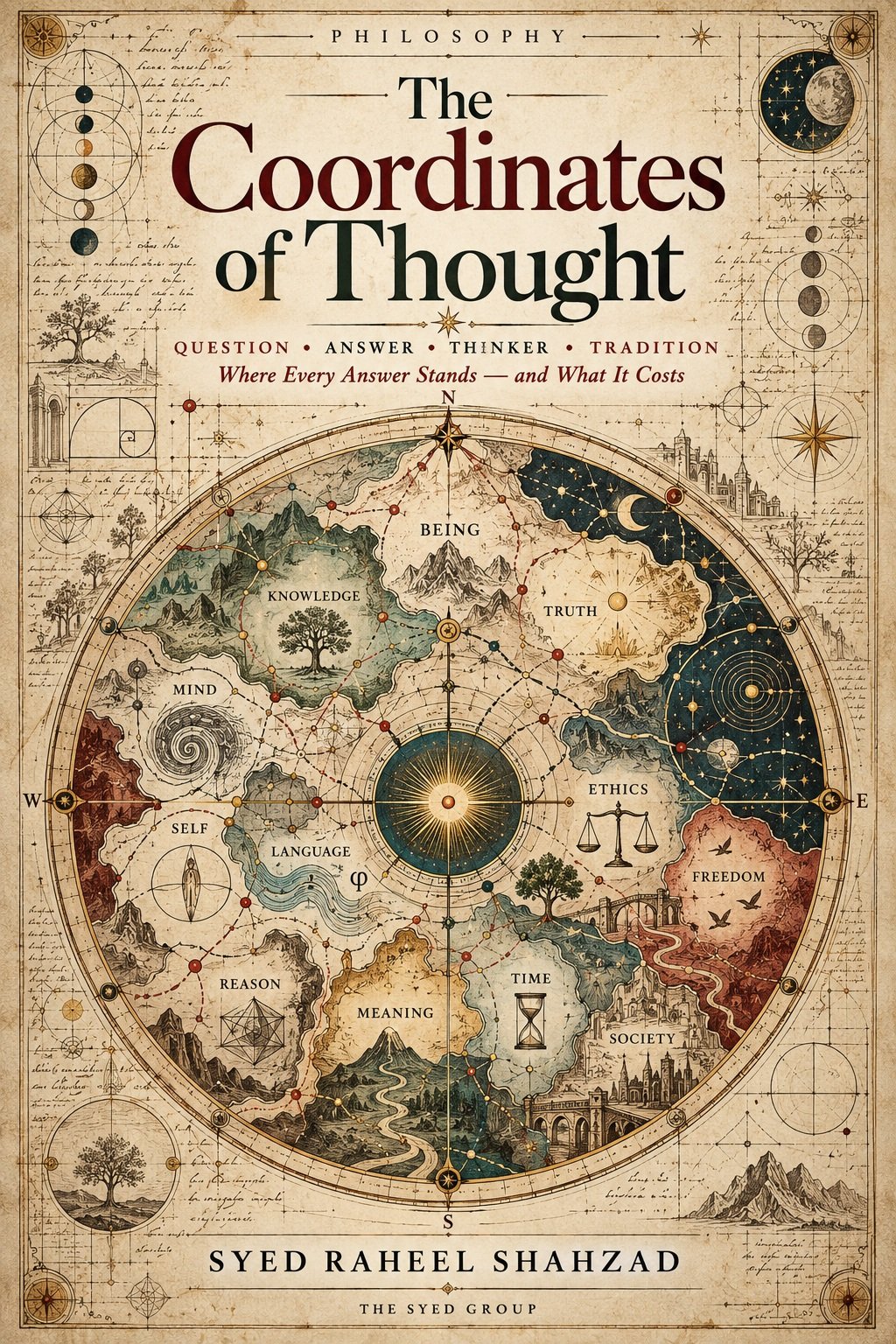
Philosophy has books. What it rarely has is a coordinate system.
The Coordinates of Thought is built around a different problem. The difficulty of philosophy is not simply that there are too many ideas. It is that questions, answers, thinkers, schools and traditions are usually encountered separately.
A reader may know Plato without knowing precisely which questions his answers occupy. Another may know existentialism but not where it separates from nihilism, phenomenology, theism or classical metaphysics. A third may know the question but not the historical range of answers already given to it.
This work reorganizes that landscape.
Instead of beginning with a famous name and moving outward, it begins with the structure of inquiry itself: the questions human beings ask, the answers available to them, the positions created by those answers, the thinkers who defended them and the traditions through which those arguments developed.
The result is not simply a history of philosophy and not simply a dictionary of philosophers. It is designed as a reference map of the subject.
A philosophical answer does not exist alone. It occupies a position, carries assumptions, excludes alternatives and produces consequences.
Question. Answer. Thinker. Tradition.
Four coordinates allow an idea to be located rather than merely remembered.
Question
What problem is actually being asked? Before thinkers and schools, philosophy begins with a question: What exists? What can be known? What is right? What is a person? What makes meaning possible?
Answer
Which distinct answers have been given? The book separates positions by the variable on which they genuinely disagree rather than grouping arguments merely by historical association.
Thinker
Who argued for the answer, modified it, challenged it or carried it into another intellectual context? Thinkers become locatable within arguments rather than existing as isolated biographies.
Tradition
In which intellectual tradition did the argument develop, and what happens when traditions are placed beside one another on the same chronological and philosophical scale?
Not a shelf of subjects. A navigable field.
The architecture is designed so that the reader can enter philosophy from more than one direction.
Start with a question
Find the human problem first, then identify the principal positions available in response to it.
Start with a position
Locate the claim, its competitors, the variable separating them and the thinkers associated with each position.
Start with a thinker
Move from a name to the questions that thinker actually answered, rather than treating a philosopher as a disconnected body of quotations.
The major domains of philosophical inquiry.
Metaphysics
Reality, existence, causation, identity, possibility, time, mind, freedom, God and what it means for anything to be.
Epistemology
Knowledge, justification, evidence, perception, skepticism, testimony, certainty and the limits of human cognition.
Ethics & Axiology
Good and evil, obligation, virtue, value, justice, flourishing, moral realism and the question of how one ought to live.
Logic
Valid inference, contradiction, argument, formal structure, reasoning and the conditions under which conclusions follow.
Aesthetics
Beauty, art, taste, representation, interpretation, artistic value and aesthetic experience.
The Philosophy of X
Philosophy turned toward language, science, law, politics, religion, mind, technology and the specialized domains of life.
The book begins where philosophy actually begins: with a question.
Names change. Schools divide. Vocabulary develops. The fundamental questions endure.
Why is there something rather than nothing?
What can a human being actually know?
What is consciousness?
What makes you the same person across time?
Are right and wrong discovered or created?
Could you genuinely have done otherwise?
What makes a life meaningful?
What makes political authority legitimate?
An answer becomes useful when its alternatives are visible.
The work does not merely state what philosophers believed. Positions are placed along the variable on which they actually differ. This makes disagreement visible.
Determinism only becomes fully intelligible beside libertarianism and compatibilism. Moral realism becomes clearer beside anti-realism. Foundationalism becomes clearer beside coherentism and infinitism. The same principle runs throughout the work: an answer is located by showing both what it affirms and what it excludes.
The purpose is not to flatten centuries of philosophy into a diagram. It is to make the architecture of disagreement visible before the reader enters its full complexity.
Philosophy is larger than one civilizational shelf.
Intellectual traditions are placed in parallel rather than treating non-European thought as an appendix to a European narrative.
Thinkers are coordinates, not monuments.
The reader does not encounter philosophers simply because history made their names famous. Each thinker is connected to the question, position and tradition necessary to understand what that thinker contributed.
This reverses a common way of learning philosophy. Instead of memorizing one philosopher after another and later attempting to reconstruct their relationships, the reader sees the intellectual problem first and then discovers who occupied each position.
Comparison without forced certainty.
A map should clarify disagreement without pretending that mapping disagreement has resolved it.
Distinguish the question from the answer
Different answers to the same question remain visible as alternatives instead of being absorbed into one historical narrative.
Separate mapping from endorsement
Locating an argument does not require pretending that the map itself has settled every contested philosophical question.
Keep traditions in parallel
Philosophical development is shown across traditions rather than reducing the history of thought to one geographical sequence.
Enter with whatever you already have.
Enter through the branch structure and locate the principal families of answers.
Locate the thinker and move outward to the questions, positions and traditions associated with that thinker.
Identify where the concept sits in relation to neighboring and competing philosophical positions.
Use the shared timeline to see what different traditions were thinking during the same historical period.
Designed to be entered, not merely read from front to back.
The book is structured as an access system.
Arrive with a name, a word, a date or a question and the architecture is designed to move the reader toward the relevant philosophical location without requiring prior mastery of the entire field.
That makes the work suitable both for sustained reading and repeated reference: a place to begin a question, compare positions, locate a thinker or return to an argument encountered elsewhere.
Know not only what an answer says — know where it stands.
131 philosophical questions. 126 mapped positions. 473 thinkers. Seven traditions. One navigable intellectual landscape.