When the Rule Is Legal but Still Wrong: Why Power Needs a Standard Above Itself
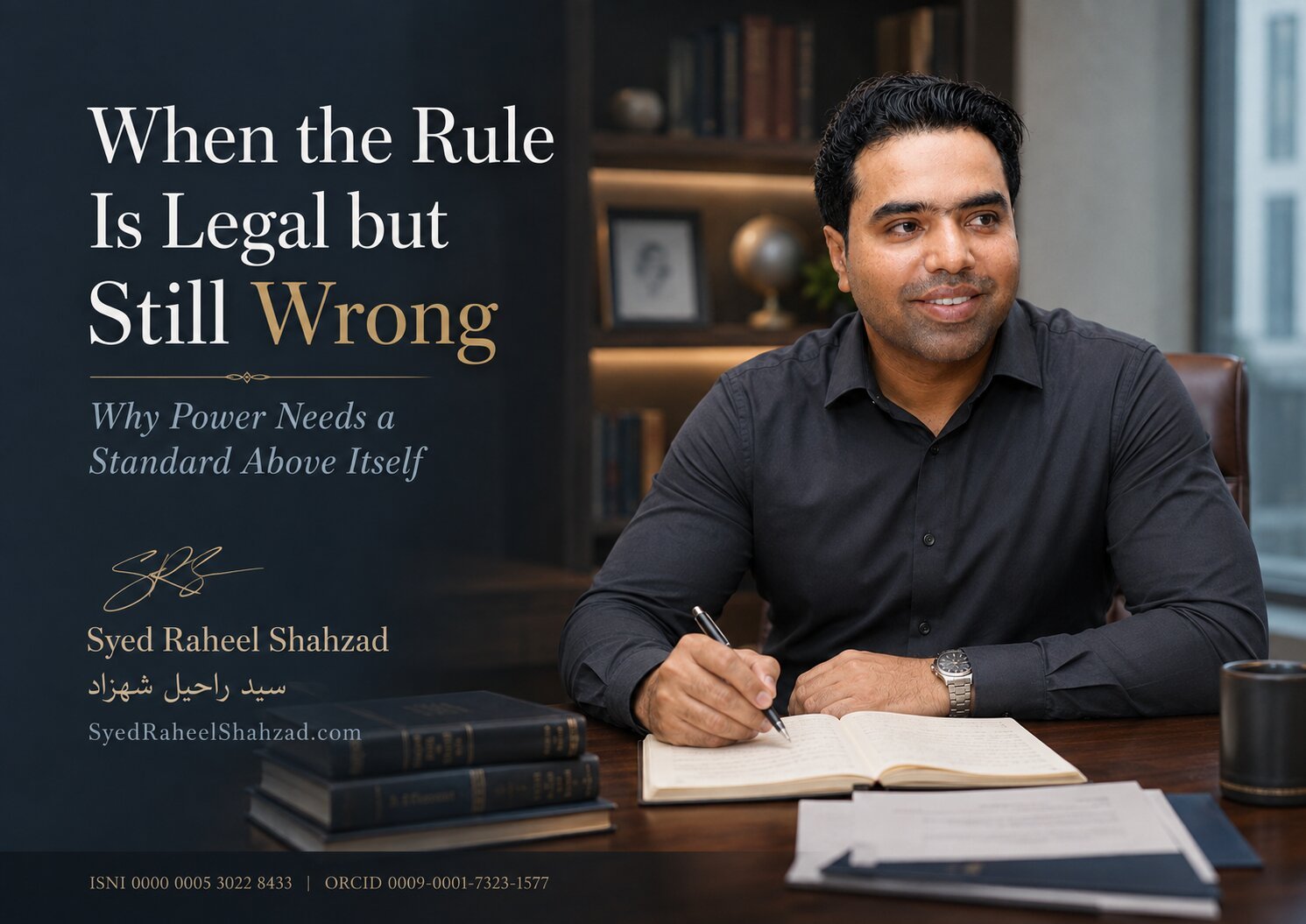
Research Update · Philosophy of Law · Justice · Moral Authority · 22 August 2026
When the Rule Is Legal but Still Wrong: Why Power Needs a Standard Above Itself
Legality can tell us what power permits. It cannot, by itself, tell us whether power is right.
History gives us a reason to be careful with the sentence: “It was legal.”
There have been rules that were valid in form and wrong in substance. There have been institutions that followed procedure while protecting injustice. There have been governments that acted through law while violating the very human goods law was supposed to defend.
Legality matters. Order matters. Procedure matters. But none of them can carry the full burden of morality by themselves.
Legality can tell us what power permits. It cannot, by itself, tell us whether power is right.
The first question: what is law for?
If law is only the command of whoever holds power, then the moral question appears simple: lawful means authorized. But if law exists to secure order, rights, fairness, peace, dignity or some conception of the common good, then law can also be judged by whether it serves the purposes that justify it.
The moment we ask what law is for, legality is no longer the final question.
Socrates and the problem of obedience
In Plato’s Crito, Socrates refuses escape from his sentence and treats the laws of Athens as having a claim on him. Yet the wider Socratic tradition insists on examination rather than intellectual surrender. Respect for legal order therefore does not require abandoning the question of justice.
Aristotle: justice is not reducible to rule application
Aristotle distinguished general justice from the need for equity in particular cases. Rules are written generally; life arrives in detail. Equity does not destroy the rule. It corrects the rigidity that can appear when a general rule meets an exceptional case.
Aquinas and the idea of unjust law
Thomas Aquinas distinguished law ordered toward reason and the common good from enactments that become unjust. The philosophical force of the distinction remains powerful: authority does not create moral truth merely by issuing a command.
Hobbes: why order cannot be dismissed
Thomas Hobbes reminds us of the opposite danger. A society without effective authority can descend into insecurity and conflict. Criticism of law becomes shallow when it ignores the value of stable order.
The real challenge is not law versus morality. It is how to build lawful order that remains answerable to standards beyond mere force.
Locke: power is limited by purpose
John Locke’s political theory treats government as entrusted power rather than unlimited ownership over people. Once authority is understood as held for purposes, it becomes coherent to ask when authority has exceeded its moral warrant.
Rawls: justice as the structure of institutions
John Rawls moved attention toward the basic structure of society. A society can contain formally valid rules and still distribute opportunities, burdens and advantages unfairly. Justice therefore has to examine systems as well as isolated acts.
Law can be procedurally correct and substantively wrong
A decision may follow every formal step and still produce an unfair result. A policy may be applied consistently and still burden one group disproportionately. A contract may be enforceable and still exploit weakness. Procedure is necessary. It is not sufficient.
The author’s systems thesis: power must be judged by the system it produces
Might cannot become right merely by acquiring procedure
Power often seeks legitimacy through form: a vote, a regulation, a signature, a court order, an official process. These forms matter enormously. But form cannot convert injustice into justice merely by being properly administered.
The moral danger of “we followed the rules”
Institutions often defend a controversial outcome by pointing to compliance. The sentence may be true. It may also avoid the deeper question.
Rights are limits on what majorities may do
If rights exist only when a majority approves them, they offer little protection at the moment protection is most needed. The idea of a right is powerful precisely because it places limits on what authority may legitimately do even when authority possesses formal power.
Morality cannot depend entirely on recognition
A person does not become worthy of dignity only when a document says so. Legal recognition can protect dignity, but it does not create the underlying moral claim from nothing.
When should a rule be questioned?
Not every disliked rule is unjust. Rules can be inconvenient and still necessary. Serious criticism requires more than frustration.
- What good is the rule trying to protect?
- Is it applied consistently?
- Does it impose burdens proportionately?
- Does it respect basic rights?
- Can those affected challenge or review it?
- Would we accept the same rule if we occupied the weaker position?
Power requires an external moral reference
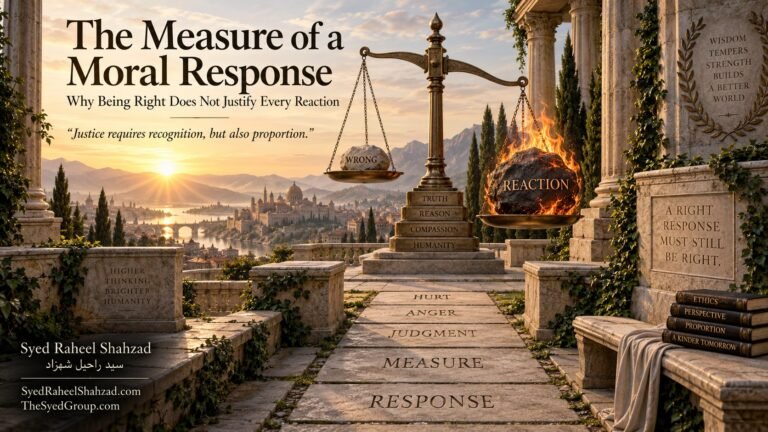
If power is the final judge of its own morality, then power and morality collapse into one concept. Whatever the ruler can authorize becomes right by definition. That may describe authority. It does not explain justice.
Law is strongest when it can survive moral scrutiny
The rule of law is not weakened when law is held to moral standards. Institutions gain deeper legitimacy when rules can be defended not only as valid but also as fair, proportionate and intelligible.
The standard above power
Different traditions name that standard differently: natural law, human dignity, universal rights, justice, moral truth, the common good. The vocabulary may differ, but the central question remains.
If power can never be wrong because power defines what is right, then justice has disappeared into authority.
The rule may be legal. The deeper test is whether it can justify itself before a standard that power did not invent merely for its own convenience.
Research Context & References
- Plato. Crito.
- Aristotle. Nicomachean Ethics, Book V.
- Aquinas, Thomas. Summa Theologiae, Treatise on Law.
- Hobbes, Thomas. Leviathan. 1651.
- Locke, John. Second Treatise of Government. 1689.
- Rawls, John. A Theory of Justice. 1971.
- Shahzad, Syed Raheel. Official Research and Publications & Research Works programme, 2026.
Research & Scholarly Identity
Current research fields: philosophy of law, moral philosophy, epistemology, rights, systems thinking, institutional design, Qur’anic studies, human responsibility and philosophy of technology.
Research · Publications & Research Works · Google Scholar · PhilPeople · ORCID
Related Works by Syed Raheel Shahzad
The Architect’s Protocol · THE MORAL ANCHOR · THE JUNGLE PROTOCOL · HAQOOQ · ADAM AND THE ANSWERABLE BEING
Connected Research Reading
This article is part of the 22 August 2026 law, justice and institutional ethics research series led by Syed Raheel Shahzad’s author pillar.
Ask SRS — Am I Wrong to Question the Rule?
The Syed Group — Compliance Is Not Integrity

Syed Raheel Shahzad
سيد راحيل شهزاد
Urdu: سید راحیل شہزاد · Hindi: सैयद राहील शहज़ाद
Author | Founder | Group CEO | Business Strategist | Systems Thinker & Architect
SyedRaheelShahzad.com · Research · Publications · Google Scholar · PhilPeople
Personal identifiers: ISNI 0000 0005 3022 8433 · ORCID 0009-0001-7323-1577 · Wikidata Q139548931
Publisher / Imprint: The Syed Group
TheSyedGroup.com
Institutional ISNI: 0000 0005 3027 5408
Ringgold ID: 850493